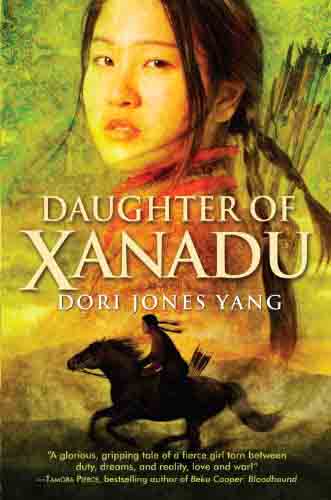
Daughter of Xanadu – Part 3/4

April 19, 2011


A review (guest post) by Tom Carter of Daughter of Xanadu by
Dori Jones Yang

Authoress Dori Jones Yang is a Caucasian American, yet she is no stranger to writing from the perspective of conflicted adolescent Chinese girls, as evinced in her previous, award-winning novel, The Secret Voice of Gina Zhang.

In Daughter of Xanadu, she hones in even deeper into the physiological confusion and emotional conflictions that make youth such a joy, turning Emmajin into such a hormonal wreck that this male reviewer often found himself gritting his teeth in frustration at such contradictive revelations as, “if he had pursued me, I would have rebuffed him. By holding himself aloof, he challenged me to win back his esteem.”
Daughter of Xanadu is not all-teenage angst.  As our protagonist matures, so does the content of the story.

Emmajin eventually persuades Khubilai Khan to allow her to train for war against the Burmese at the Battle of Vochan (present-day Yunnan province), where the embarrassment of getting her period in front of the all-male troops is a bloody omen for what’s to come.

Upon seeing her cousin slain, innocent Emmajin is transformed into a “mindless killer.”

  Bloodlust unleashed, the young princess swings her sword indiscriminately (“the hatred pounded in my ears…killing him felt good”), resulting in hundreds of men dead by her hand alone.

One can only imagine all the Mulan vs. Emmajin fan fiction that this novel will inspire!

Continued on April 20, 2011 in Daughter of Xanadu – Part 4 or return to Daughter of Xanadu – Part 2

View as Single Page

______________

Travel photographer Tom Carter is the author of China: Portrait of a People (San Francisco Chronicle Book Review), a 600-page China photography book, which may be found at Amazon.com.

Discover more “Guest Posts” from Tom Carter with Is Hong Kong Any Place for a Poor American?

If you want to subscribe to iLook China, there is a “Subscribe” button at the top of the screen in the menu bar.


Daughter of Xanadu – Part 2/4

April 18, 2011

A review (guest post) by Tom Carter of Daughter of Xanadu by Dori Jones Yang

The merchants’ young son turns out to be one Marco Polo, the now-legendary Venetian journeyer credited for introducing Asian culture to the west.

To Emmajin, however, he is just another “colored-eye man,” a court curiosity from Christendom whose gallantry and romantic gestures are as ridiculous to the manly Mongolians as his facial hair (“his beard was so thick I could imagine food sticking in it”).

Try as she might, however, Emmajin, caught in the peak of puberty, is unable to resist Marco’s western charm, and quickly finds herself enamored by his worldly vision (“I had learned to see the world through Marco’s eyes”) as well as his pelt.

“What would the hair on his arm feel like?” she often fantasized about at night.

But she was a Mongolian first, and reluctantly sacrifices her blossoming relationship with the foreigner to complete her spy mission (“He was not a friend but a source of information.”).

Continued on April 19, 2011 in Daughter of Xanadu – Part 3 or return to Part 1

View as Single Page

______________

Travel photographer Tom Carter is the author of China: Portrait of a People (San Francisco Chronicle Book Review), a 600-page China photography book, which may be found at Amazon.com.

Discover more “Guest Posts” from Tom Carter with Is Hong Kong Any Place for a Poor American?

If you want to subscribe to iLook China, there is a “Subscribe” button at the top of the screen in the menu bar.


The Qing Dynasty’s Banner Armies

February 14, 2011

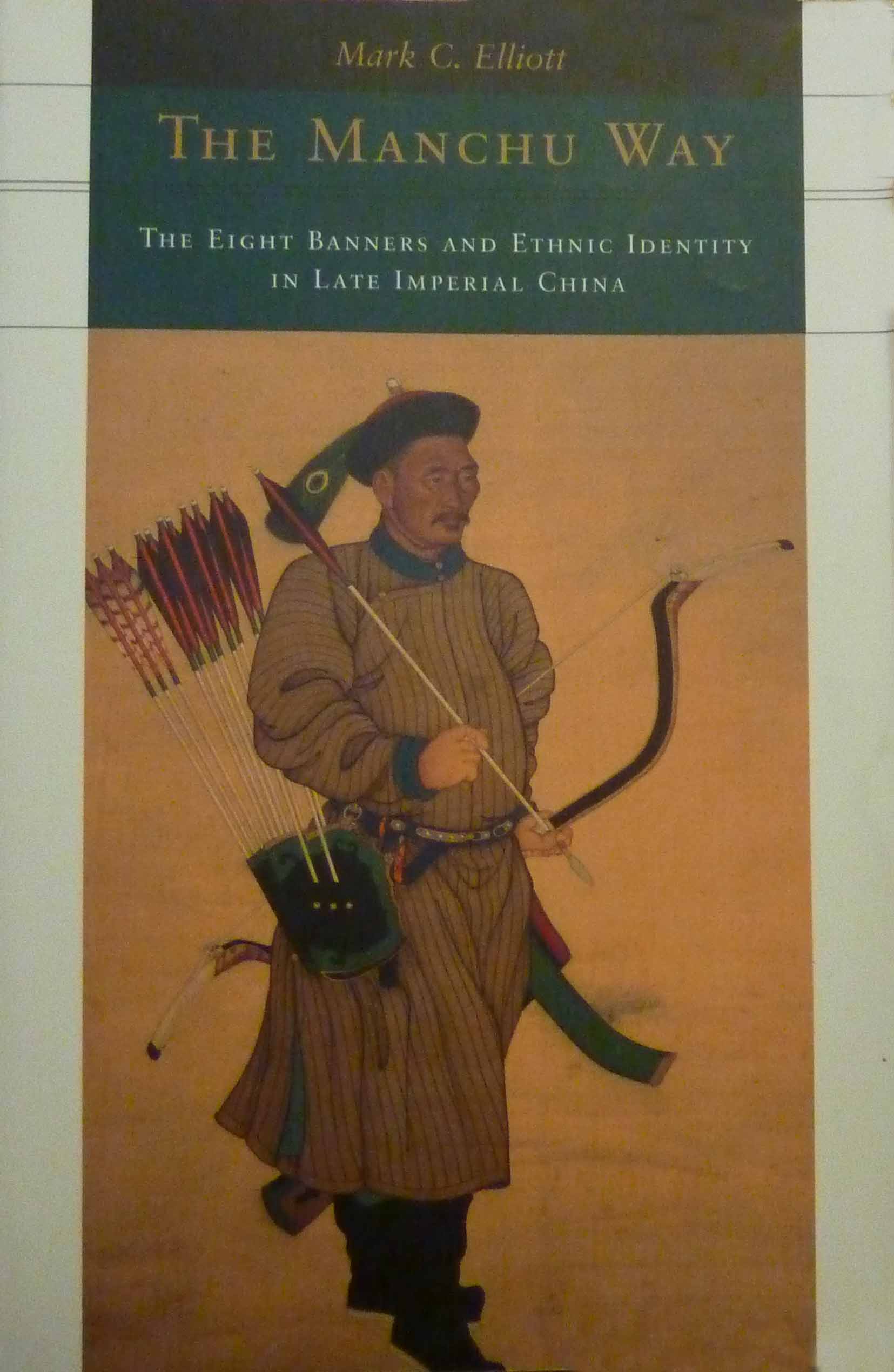
I have a book on the elite troops of China’s Qing Dynasty, and used The Manchu Way for research (along with lots of other work) while writing My Splendid Concubine and Our Hart. I spent from 1999 to late 2007 researching, writing, revising, editing and rewriting the manuscript.

I wanted 19th century China to come alive and be another character in Hart’s Concubine Saga.

Mark C. Elliott wrote The Manchu Way. I was attending a NCIBA Trade Show in Oakland, California several years ago and met Elliott.  When I expressed interest in the book due to my project, he gave me a copy.

History Today said of Elliott’s book, “This is a wide-ranging and innovative book. Furthermore, it is written in a lively, accessible style… Overall, it is undoubtedly a scholarly achievement of the highest order.”

I was fortunate to have this resource while writing of Robert Hart’s early years in China. In fact, Hart was the only foreigner the emperor trusted and Hart worked for Qing Dynasty for most of his life.

The Qianlong emperor (pronounced “chien-lung”) was the fourth monarch of the Qing dynasty (1644-1911) who reigned from 1736 to 1795.

The four-minute video starts by saying that during the reign of the Qianlong Emperor there were several rebellions in Sichuan province.

The Qing banner armies fought wars against the Uyghurs, Kazakhs, Kyrgyzs, Evenks and Mongols. Unsuccessful costly wars were also fought with Vietnam and Myanmar.

Although millions of square miles or kilometers were brought into the empire, the strain on China’s treasury and military due to casualties and deaths resulted in a military decline.

This decline contributed to China’s weakness a few decades later when the British Empire and France invaded China to force the Qing Dynasty to allow opium to be sold to the Chinese people and give missionaries total freedom to convert the population to Christianity, which caused more wars and tens of millions of deaths during the 19th century.

The Qing army was divided into eight banners. Each banner had its own color scheme, which was reflected in their clothing, armor and flags. There were eight Manchu banners, eight Mongolian banners and eventually eight Han Chinese banner armies for twenty-four armies. In 1648, there were between 1.3 and 2.44 million people in the Chinese, Manchu and Mongol Banner armies.  By 1720, the numbers were estimated at between 2.6 and 4.9 million.

China has a history of maintaining large armies for more than two thousand years mostly for defense.

Discover China’s Greatest Emperors

______________

Lloyd Lofthouse is the award-winning author of the concubine saga, My Splendid Concubine & Our Hart. When you love a Chinese woman, you marry her family and culture too.

If you want to subscribe to iLook China, there is a “Subscribe” button at the top of the screen in the menu bar.


Ma Yan’s Story – Part 2/2

February 11, 2011

A few days after Ma Yan hears that her family cannot afford to continue her education past fifth grade, Pierre Haski, the French journalist, visited her village.  After seeing the diaries, Haski promised that he would help her continue school then go to a university or even further than that.

Needless to say, after the publication of her diaries, Mao Yan continued on to middle school along with lots of attention from the media.

Ma Yan says that most of the media asked her about her experience at school and she wanted to tell them what it was like so the world would hear of the other poor children that wanted to go to school longer.

Because of that media attention, the students at her elementary and middle schools received offers of help.

That outpouring of interest led to the founding of Children of Ningxia, which will soon celebrate its tenth anniversary. The Children of Ningxia reports that the nonprofit has reached out to more than 2,500 students, scholarships to more than 150 and fourteen have finished their university studies since 2009.

China’s government also abolished school fees through ninth grade but many remote, rural families still struggle to pay for boarding fees.

One student, who is still in school, said she would have been doing farm work if it hadn’t been for Children of Ningxia.

As the Al Jazeera segment of Ma Yan’s Story ends, I thought of the billion people living in poverty around the world.  Less than 10% of those people live in China and this story is only of a few of those people.

Return to Ma Yan’s Story – Part 1

______________

Lloyd Lofthouse is the award-winning author of the concubine saga, My Splendid Concubine & Our Hart. When you love a Chinese woman, you marry her family and culture too.

If you want to subscribe to iLook China, there is a “Subscribe” button at the top of the screen in the menu bar.


Ma Yan’s Story – Part 1/2

February 10, 2011

In January 2010, Al Jazeera Witness reported the story of Ma Yan, a young Chinese girl that lived in rural China in the same poverty that rural Chinese have lived with for centuries and how The Diary of Ma Yan was published in many countries including China (where it was a best seller) and the US.

The village where Ma Yan lived is described in Edgar Snow’s Red Star Over China, but since that time, few outsiders have visited it. The United Nations says this is a region unfit for human habitation. Source: China.org.cn

Contrary to popular opinion, the poor in China did not get this way because of the Communists. The hardship and poverty of Ma Yan’s people and many others in China has been that way for centuries.

It didn’t help when the Communists won China’s civil war and the defeated Nationalists took the nation’s treasury and most of the ancient Imperial treasures to Taiwan leaving China nothing but people and the land.

In this segment of Witness, we travel with Mao Yan as she breaks the cycle of poverty.

By chance in 2001, a French journalist was visiting remote Ningxia province in northwest China when a Muslim woman wearing the white headscarf of the Hui people thrust her daughter’s diaries into his hands.

Ma Yan writes that the economy where she lives has not been developed. However, Mao Yan is not alone wanting to escape the hardship of poverty.  She wrote that her life was like a death sentence.

Then the French journalist read the diary Mao Yan’s mother had given him and was so impressed, he arranged for excerpts to be published in one of the French daily newspapers.

By 2007, Ma Yan passed a university exam and was one of the first girls from her village to be eligible for a university education. Her next move was to Paris where she lives with a French family and attends a university there.

Discover Mao Zedong and Edgar Snow, who wrote Red Star Over China.

______________

Lloyd Lofthouse is the award-winning author of the concubine saga, My Splendid Concubine & Our Hart. When you love a Chinese woman, you marry her family and culture too.

If you want to subscribe to iLook China, there is a “Subscribe” button at the top of the screen in the menu bar.