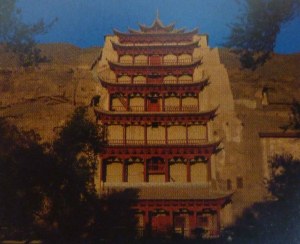
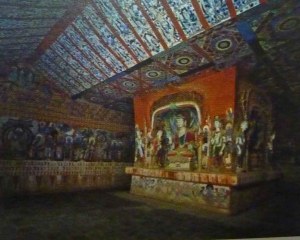
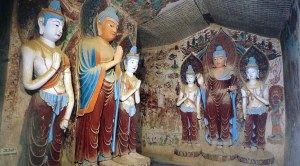
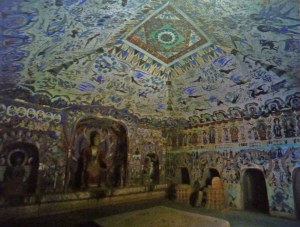
The June 2010 issue of National Geographic had a piece about the history of the Mogao caves near Dunhuang, a Silk Road oasis in northwestern China.
The Buddhist art found in almost 800 hand carved caves are considered among the world’s finest. There is nearly a half-million square feet of wall space decorated with these murals and more than 2,000 sculptures.
Between the fourth and 14th centuries AD—over a thousand years of history was documented on scrolls, sculptures and wall paintings revealing a multicultural world more vibrant than anyone imagined.
Contrary to popular belief and the Dalai Lama’s soft-spoken words of peace, Buddhism, like all large religious movements, has had a bloody and violent history depicted in the picture on page 145 of the National Geographic that shows an eighth-century heavenly armored guard with bulging eyes trampling a foreign demon.
_______________
Lloyd Lofthouse is the award-winning author of My Splendid Concubine [3rd edition]. When you love a Chinese woman, you marry her family and culture too. This is the love story Sir Robert Hart did not want the world to discover.
Subscribe to “iLook China”!
Sign up for an E-mail Subscription at the top of this page, or click on the “Following” tab in the WordPress toolbar at the top of the screen.
Many outside China only think of Mao Zedong (1893 – 1976) as a brutal dictator. Yet, he was fifty-six when he became the ruler of China and seventy-two at the beginning of The Cultural Revolution.
In fact, while commanding the Red Army during The Long March (1934-1935), we see a man who respected China’s peasants proving he was more of a nationalist than a Communist.
Then there was the move away from Communist Russia after Nixon’s visit to China in 1972, when Mao said, “Our common old friend, Generalissimo Chiang Kai-shek, doesn’t approve of this.”
In 1935, Mao’s poem, “The Long March”, reveals an awareness of the sacrifice and the willingness to suffer to accomplish great things.
The Red Army fears not the trials of the March,
Holding light ten thousand crags and torrents.
The Five Ridges wind like gentle ripples
And the majestic Wumeng roll by, globules of clay.
Warm the steep cliffs lapped by the waters of Golden Sand,
Cold the iron chains spanning the Tatu River.
Minshan’s thousand li of snow joyously crossed,
The three Armies march on, each face glowing.
Mao was a complex man, and it wasn’t until after the failure of the The Great Leap Forward (1958 – 1961) that the fatal attraction and power of leadership corrupted him leading to the horrors of The Cultural Revolution (1966 – 1976), which Mao’s critics in the West use to define him.
Anyone who follows Mao’s life instead of relying on his last decade would understand that he cared deeply about the common people while punishing the landowners and wealthy, who abused them. On the other hand, his foe, Chiang Kai-shek, supported the landowners and wealthy while crushing the peasants and workers.
There is a post on About China.info that says, “Mao’s poetry exhibits a spirit of boldness and power, weaving together history, reality and commitment… Bold transformation of myth and literary quotations are a distinct feature of Mao’s poetry.”
At Mao Zedong Poems, Two Birds” A Dialogue (1965), reveals what Mao may have been thinking about as President Johnson increased America’s involvement in Vietnam. Was Mao also warning us of what he was about to do in 1966, when he launched The Cultural Revolution?
Two Birds: A Dialogue (1965)
The roc wings fanwise,
Soaring ninety thousand li
And rousing a raging cyclone.
The blue sky on his back, he looks down
To survey Man’s world with its towns and cities.
Gunfire licks the heavens,
Shells pit the earth.
A sparrow in his bush is scared stiff..
“This is one hell of a mess!
O I want to flit and fly away.”
“Where, may I ask?”
The sparrow replies,
“To a jewelled palace in elfland’s hills.
Don’t you know a triple pact was signed
Under the bright autumn moon two years ago?
There’ll be plenty to eat,
Potatoes piping hot,
Beef-filled goulash.”
“Stop your windy nonsense!
Look, the world is being turned upside down.”
Through Mao’s poetry, we learn more about the man—not the modern emperor.
Lloyd Lofthouse is the award-winning author of My Splendid Concubine [3rd edition]. When you love a Chinese woman, you marry her family and culture too. This is the love story Sir Robert Hart did not want the world to discover.
Subscribe to “iLook China”!
Sign up for an E-mail Subscription at the top of this page, or click on the “Following” tab in the WordPress toolbar at the top of the screen.
Mao (born 1893) grew up during a period of madness in China. To learn more, I suggest reading The Roots of Madness, which shows that world.
Then the Chinese Civil War lasted from 1926 to 1949 with a few years out to fight the horrors of the Japanese invasion of China during World War II.
The Long Marchexperience by itself was enough to cause PTSD in all 6,000 of its survivors from the more than 80,000 troops that started the year-long journey of retreat, battle, and severe suffering that was surrounded by death on a daily basis.
After Mao was China’s leader, there was an assassination attempt by one of his most trusted generals, Lin Biao, a man Mao had named as his successor after he died. In addition, during China’s Civil War, Chiang Kai-shek ordered more than one failed assassination attempt on Mao.
However, the threats and violence that shaped Mao’s life began before The Long March and before he was a leader in the Chinese Communist Party.
As a child, he grew up among farmers and peasants with an average expected life span in China of 35 years. In the 1920s, as an idealist and a sensitive poet, he believed in helping the worker and led several labor movements that were brutally subdued by the Nationalist government led by Chiang Kai-shek.
Once, he barely escaped with his life.
In 1930, Yang Kaihu, his wife at the time—Mao was married four times—was arrested and executed. In addition, Mao had two younger brothers and an adopted sister executed by Chiang Kai-shek’s troops. If you had several close calls with death; lost a wife, two younger brothers and an adopted sister in this way, how would that affect you?
To judge Mao by today’s Politically Correct Western values is wrong, because he grew up in a world ruled by a completely different set of values that shaped him to be tough enough to survive and win.
Anyone that survived and went on to rule China at that time would have been judged as brutal by today’s Politically Correct Western values. In fact, Chiang Kai-shek was a brutal dictator who ruled Taiwan—after he fled mainland China in 1949—under military marshal law until his death in 1976. But Chiang didn’t have as many people to rule over so the death count was smaller but no less significant.
The History of Humanitarianism shows us that this concept was born and nurtured in the West and developed slowly over centuries with the result that the individual was made more important than an entire population.
However, in China, the whole is still more important than one person is as it was during Mao’s time. If you were to click on the link to the History of Humanitarianism and read it, you would discover that China was not part of this movement while Mao lived. (Discover more about China’s Collective Culture)
PTSD as a war wound and a trauma was not recognized or treated until well after America’s Vietnam War. Prior to its discovery, it was known as shell shock. The diagnosis of PTSD first appeared in the 1980s, and Mao died in 1976.
In fact, if Mao were alive today he would not be alone. In the United States, it is estimated that 7.8% of all Americans suffer from PTSD, and among that segment of the population, more than 300,000 Iraq and Afghanistan military veterans have PTSD in addition to 1.7 million Vietnam veterans.
Lloyd Lofthouse is the award-winning author of My Splendid Concubine [3rd edition]. When you love a Chinese woman, you marry her family and culture too. This is the love story Sir Robert Hart did not want the world to discover.
Subscribe to “iLook China”!
Sign up for an E-mail Subscription at the top of this page, or click on the “Following” tab in the WordPress toolbar at the top of the screen.
Who was Mao? Was he the demon the Western media often makes him out to be, or was he just a product of his environment?
Mao has been judged by a Western value system that did not exist in China or the United States during his lifetime. In addition, it is now known that who we grow up to become as adults is partially due to genetics but mostly from environmental and lifestyle influences.
Mao grew up in a world nothing like most in the West have ever experienced, but he has been judged by Western humanitarian beliefs—also known today as political correctness—that did not exist when he was born into China’s collective culture where the reverse was true and the individual was not more important than the whole.
There is a strong possibility that Mao also suffered from Post Traumatic Stress Disorder (PTSD), and this may have influenced his behavior and decisions during the years he ruled China [1949 – 1976].
Helping Psychology says, “PTSD victims tend to be in a continuous state of heightened alertness. The trauma that precipitates the disorder essentially conditions them to be ever-ready for a life threatening situation to arise at any moment … But the continuous releases of brain chemicals that accompany this reaction time – and their inability to control when this heightened reactivity will occur – take psychological and biological tolls on PTSD victims over time.”
And Medicine Net.com says, “Complex posttraumatic stress disorder(C-PTSD) usually results from prolonged exposure to a traumatic event or series thereof and is characterized by long-lasting problems with many aspects of emotional and social functioning.”
American combat veterans are not the only people on this planet to suffer from PTSD. Every person is susceptible to the ravages of a violent trauma and if we examine Mao’s life, it could be argued that PTSD may have played a strong role in the decisions he made as he aged.
We will examine Mao’s long history as a victim of violence in Part 2.
Lloyd Lofthouse is the award-winning author of My Splendid Concubine [3rd edition]. When you love a Chinese woman, you marry her family and culture too. This is the love story Sir Robert Hart did not want the world to discover.
Subscribe to “iLook China”!
Sign up for an E-mail Subscription at the top of this page, or click on the “Following” tab in the WordPress toolbar at the top of the screen.
Imagine how Americans would have felt if China had deployed several of its army divisions in the United States to protect the Chinese living in America after the racist and discriminatory Chinese Exclusion Act was signed into law by U.S. President Chester A. Arthur on May 6, 1886—this law would not be repealed until 1943.
Then there was Mao surviving Chiang Kai-shek‘s crack down on the labor movement led by the Communist Party. During World War II, Mao’s army not only fought Chiang Kai-shek’s troops but also the Japanese, who killed between 10 to 20 million Chinese in their attempt to conquer China.
The peasants trusted Mao’s troops but did not trust Chiang Kai-shek’s army. Do you know why?
Then there was the West’s wars in Korea (1950 – 1953: with an estimated 2.5 million killed/wounded) and Vietnam (1955 – 1975: with an estimated 3.8 million killed/wounded) in addition to America’s necklace of military basses surrounding China to this day. Source: Foreign Policy.com
Mao believed that socialism would create a better life for the Chinese. His failures were attempts to make China strong enough to defend his country against the foreign meddling and invasions that had plagued China since the 1850s.
Regardless of all the horrible facts the Western media keeps reminding the world about, there are a few facts that are not well known in the West about Mao and China—when Mao became the leader of mainland China in 1949, the average lifespan in China was age 35. When Mao died in 1976, the average lifespan had increased by twenty years to age 55—today the average life expectancy is almost age 75. In addition, the population of China was 400 million in 1949. Twenty-seven years later at the time of Mao’s death, China’s population had increased to 700 million.
These two facts alone call into question many of the alleged and inflated claims of deaths and suffering caused by the mistakes of the Great Leap Forward famine and the national insanity of the Cultural Revolution that are often trumpeted by China’s critics—some are quite rabid and idealistic and are more than willing to inflate and exaggerate the facts that are known.
Mao was not perfect by any means but even the Chinese—after his death—credited his leadership as 70% good and only 30% bad. You may not agree with this assessment, but did you live in China during and before the Mao era? Have you any idea how horrible life was for most Chinese before 1949?
Lloyd Lofthouse is the award-winning author of My Splendid Concubine [3rd edition]. When you love a Chinese woman, you marry her family and culture too. This is the love story Sir Robert Hart did not want the world to discover.
Subscribe to “iLook China”!
Sign up for an E-mail Subscription at the top of this page, or click on the “Following” tab in the WordPress toolbar at the top of the screen.