Wolf Totem – the book vs the film

September 22, 2015

I walked to town recently to see the film of a book I read several years ago. The theater I saw it in was huge and there were only three of us there. Wolf Totem was in Mandarin with English subtitles. Fortunately for the audience, there isn’t much dialogue so there isn’t that much to read if you don’t speak the language but the story—through the panoramic visuals—had a powerful message about mankind meddling with nature. In China, this film has earned more than $110 million U.S. I couldn’t find out how much it has earned in the U.S. where I saw it.

Consider the fact that pollution is not exclusive to China, and the United States, for instance, has more than 1,300 superfund sites—Superfund sites are polluted locations requiring a long-term response to clean up hazardous material contaminations. – epa.gov

In addition, the book and the film also offer another way to learn about China, it’s people and their humanity.

Jiang Rong is the pen name for Lu Jiamin, the author, a Chinese citizen. Set during the Cultural Revolution, Wolf Totem describes the education of an intellectual living with nomadic herders in the grasslands of Inner Mongolia.

The publisher of Wolf Totem said the novel was an epic Chinese tale and that’s true. Wolf Totem taught me a lot about this almost extinct culture. I learned about the fascinating connection between wolves and Mongolians and why this connection may have been the reason why Genghis Khan was so successful in his conquests.

I recommend the film more than the novel to anyone who wants to learn about the life of the Mongols and another perspective of Mao’s Cultural Revolution. If you can’t see the film, then the book is worth reading too.

However, the theme that runs through the novel of maintaining a balance with nature is a bit overdone—I didn’t get this impression from the film. In the novel, I got the message the first time the characters talked about it but then the topic comes up repeatedly—a bit too much but an insignificant criticism of a book worth reading and a film that I think is even more powerful.

I won’t give away the ending, but don’t expect it to be happy. Most Chinese novels don’t end with happy endings. The ending for the film was different than the novel, and I actually liked it better—a powerful and breathtakingly beautiful film.

______________________________

Lloyd Lofthouse is the award-winning author of My Splendid Concubine [3rd edition]. When you love a Chinese woman, you marry her family and culture too. This is the lusty love story Sir Robert Hart did not want the world to discover.

#1 - Joanna Daneman review posted June 19 2014

Where to Buy

Subscribe to “iLook China”!
Sign up for an E-mail Subscription at the top of this page, or click on the “Following” tab in the WordPress toolbar at the top of the screen.

About iLook China

China’s Holistic Historical Timeline


Long before Romeo and Juliet there was China’s Butterfly Lovers

August 25, 2015

The legend of The Butterfly Lovers first appeared in 618 AD during the Tang Dynasty, and it’s a tragic Chinese love story similar to Romeo and Juliet.

The basic premise is of a young woman in China wanting to go to school. Since boys were the only ones allowed to attend school, this young woman, like Barbara Streisand in the movie Yentl (1983), disguised herself as a boy.

Yentl was based on Isaac Bashevis Singer’s (1902 – 1991) short story Yentl the Yeshiva Boy.

When I talked to my wife about this, she found her copy of a popular theme song from The Butterfly Lovers played as a violin solo by Yu Lina. As the house filled with the music, which may also be found on the next embedded YouTube video, my wife started to dance.

She said, “This is one of my favorites. I cannot resist dancing when I hear it.”

In fact, Yentl the Yeshiva Boy and Shakespeare’s (1564 – 1616) Romeo and Juliet must be combined to become The Butterfly Lovers. What starts as a charade becomes a love story ending in the suicide of the two young lovers.

The love story of Liang Shanbo and Zhu Yingtai is one of four Chinese folk legends and one of the most influential and best known in China.

China has traded with the West since the Han Dynasty (206 BC – 219 AD). There was an overland route in the north and a sea route in the south, which the Roman Empire used around the time of Christ.

Since China traded with the West for more than two thousand years, it is conceivable that The Butterfly Lovers reached the West and was adapted by Shakespeare and then Singer after being exposed to the plot.

______________________________

Lloyd Lofthouse is the award-winning author of My Splendid Concubine [3rd edition]. When you love a Chinese woman, you marry her family and culture too. This is the lusty love story Sir Robert Hart did not want the world to discover.

2015 Promotion Image for My Splendid Concubine

Subscribe to “iLook China”!
Sign up for an E-mail Subscription at the top of this page, or click on the “Following” tab in the WordPress toolbar at the top of the screen.

About iLook China

China’s Holistic Historical Timeline


Searching for Shakespeare’s Romeo and Juliet in China

August 4, 2015

Shakespeare’s drama Romeo and Juliet is often taught to ninth graders in US high schools. Other Shakespeare plays are studied at other grade levels and in college.

However, you may be surprised to discover Shakespeare is probably more popular in China since his work is taught in most Chinese universities, both in English and in Chinese, and Shakespearean texts are easily available in China in both languages.

When Mao ruled China (1949 to 1976), Shakespeare was banned as was Aristotle and other Western philosophers.  Mao died in 1976, and that ban was lifted in 1978.

In fact, according to Cheng Zhaoxiang, the author of Teaching Shakespeare in China, “It is no exaggeration to say that every educated Chinese knows something about Shakespeare.”

However, when produced in China on stage, the plot may not stay true to the original Shakespeare.

Writing for the The People’s Republic of Shakespeare, Adventures in Chinese Research, Meammi says, “My interest in this topic started when I noticed that many of the Romeo and Juliets performed in China are either parodies or rewrites where one of the lovers survives in the end.

“China has their own pair of star-crossed lovers (The Peony Pavilion – 1598 AD), who tragically die for love and their plight is described in a much more mournful tone than Shakespeare’s version.

“Some Chinese theater companies state in interviews that their audiences have too much sadness in their lives so Romeo just can’t die in the end of their performance.”

______________________________

Lloyd Lofthouse is the award-winning author of My Splendid Concubine [3rd edition]. When you love a Chinese woman, you marry her family and culture too. This is the lusty love story Sir Robert Hart did not want the world to discover.

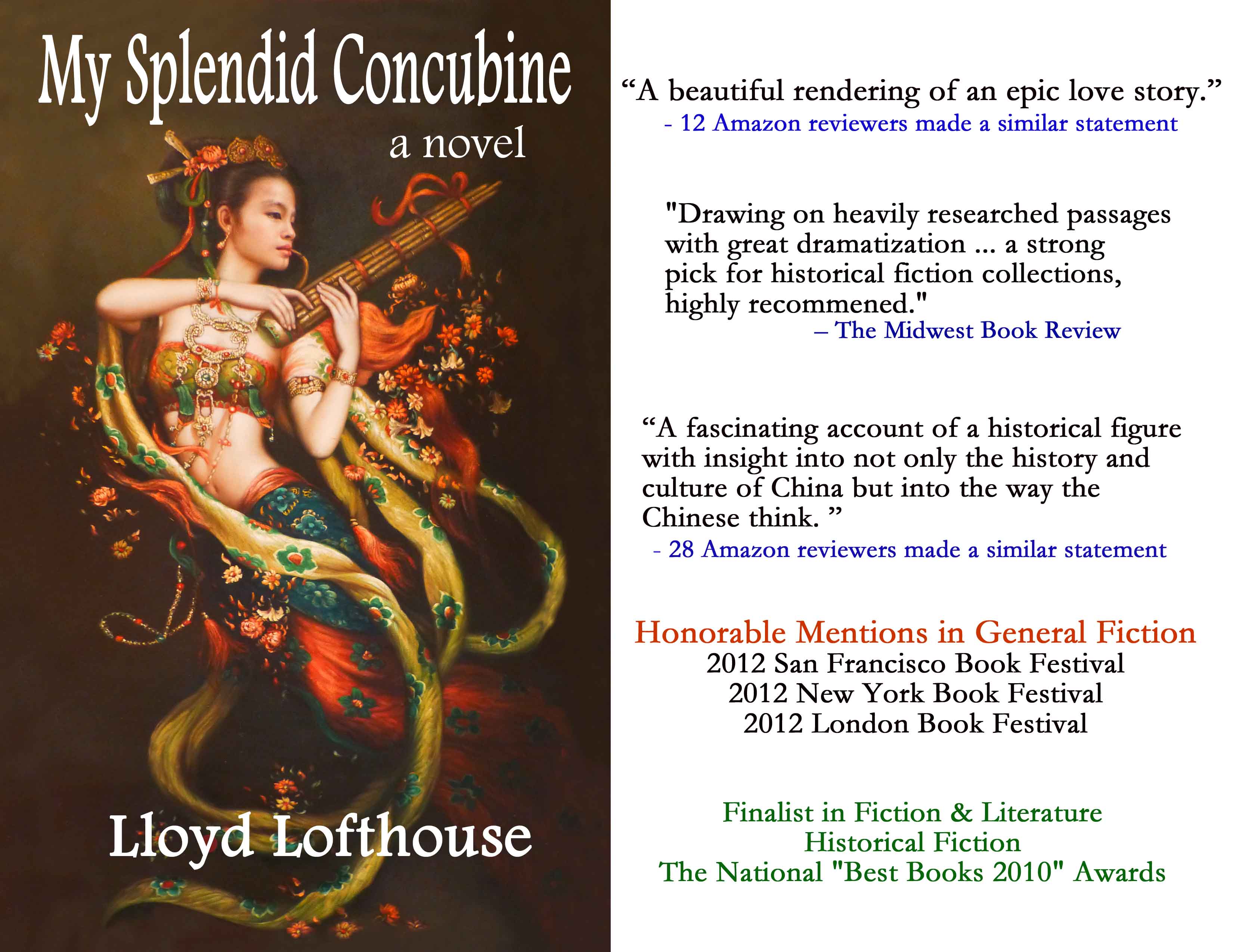
IMAGE with Blurbs and Awards to use on Twitter

Subscribe to “iLook China”!
Sign up for an E-mail Subscription at the top of this page, or click on the “Following” tab in the WordPress toolbar at the top of the screen.

About iLook China

China’s Holistic Historical Timeline


Harbin, China’s Northeastern Winter Wonderland

June 16, 2015

Casey Chan of Gizmodo posted A Winter Wonderland in China with two photos of The Harbin International Ice and Snow Festival located in Northeast China where the average winter temperature is a (minus) – 16.8 degrees Celsius (1.76 Fahrenheit). The Festival is held in January.

It is June, and you might wonder why I’m posting this now instead of December or January. The simple answer is for travelers who might want to visit China and think Harbin would be a good place to include in the trip—next winter.

Wikipedia says the annual Harbin International Ice and Snow Sculpture Festival was first held in 1963, but it was interrupted for a few years during the insanity of Mao’s Cultural Revolution. Mao died in 1976, and it took time for China’s economic engine to recover. The fact that the festival resumed in 1985 is a sign of the changes taking place in China.

In the comment section of Chan’s Gizmodo post, Adam wrote, “China is awesome when it comes to giant decorations and celebrations (just remember the Olympics!), but the people there still have an extremely low quality of life. Why, if they can do some things so well, do they fail at others?”

Sega8800 asked Adam, “How do you know their life is low quality?”

Adam’s answer was a Wikipedia link to a post of a 1994 book, China Wakes: The Struggle for the Soul of a Rising Power. The couple who wrote the book spent five years in China (1988 to 1993) as journalists for the New York Times—not the best unbiased source about China by a long shot.

I laughed.

The content for that book was based on material that was more than 22-years old, and time in China did not freeze. During those years, China transformed itself by rebuilding the old cities while building more than a hundred new ones in addition to the explosion of a middle class that equals or surpasses the entire population of the United States. China has also crisscrossed the country with new highways, railroads that include high speed rail that doesn’t even exist in the United States yet, and it has built more than 500 new airports while America’s airports are way overdue for an upgrade.

In fact, as the standard of living for China’s still growing middle class expands, the Chinese are now buying more new cars than Americans, traveling the world as tourists (about 100 million annually), and the most popular car that’s a status symbol in China is GM’s Buick (别克).

The embedded videos with this post are of Harbin and previous festivals.

map_china_showing_Harbin

______________________________

Lloyd Lofthouse is the award-winning author of My Splendid Concubine [3rd edition]. When you love a Chinese woman, you marry her family and culture too. This is the lusty love story Sir Robert Hart did not want the world to discover.

IMAGE with Blurbs and Awards to use on Twitter

Subscribe to “iLook China”!
Sign up for an E-mail Subscription at the top of this page, or click on the “Following” tab in the WordPress toolbar at the top of the screen.

About iLook China

China’s Holistic Historical Timeline


Chinese Cupping Therapy—Does it work?

June 3, 2015

I have been aware of cupping for some time, because I married into a Chinese family and one of my wife’s sisters used this method of Chinese medicine.

However, I didn’t pay much attention to cupping until I wrote a post about Gwyneth Paltrow being Popular in China.

Researching the Gwyneth Paltrow post, I discovered that she believes in Chinese medicine and has used cupping. She even told Oprah, “It feels amazing and it’s very relaxing, and it feels terrific. It’s just one of the alternative medicines that I do instead of taking antibiotics.”

The history of Chinese cupping dates from 281 AD. It was an ancient Taoist medical practice and was widely used in the courts of Imperial China at the time.  Its administration was first recorded by Ge Hong in an ancient tract called Handbook of Prescriptions for Emergencies.

In fact, medical education in China was elevated to a higher standard in 443 AD when Qin Cheng-zu petitioned Emperor Wen of the North and South Dynasty period to appoint physicians to teach medical students. Almost a thousand years later the first medical schools appeared in the West.

By 493 AD, the Imperial Academy had expanded to include lectureships and chairs for teaching Chinese medicine. – Shen-nong.com

Chinese medicine from the beginning focused on prevention to avoid illness where Western medicine has always focused on cures for illnesses after a life is threatened by diseases such as cancer, diabetes or heart disease.

______________________________

Lloyd Lofthouse is the award-winning author of My Splendid Concubine [3rd edition]. When you love a Chinese woman, you marry her family and culture too. This is the lusty love story Sir Robert Hart did not want the world to discover.

IMAGE with Blurbs and Awards to use on Twitter

Subscribe to “iLook China”!
Sign up for an E-mail Subscription at the top of this page, or click on the “Following” tab in the WordPress toolbar at the top of the screen.

About iLook China

China’s Holistic Historical Timeline