The Millennium Cult

April 23, 2010

Religions, as Christians, Jews and Muslims practice them, have never played a “major” role in Chinese Culture and Politics. Even today, more than 800 million Chinese say they do not belong to any religion and the largest religion in China is Buddhism (about 10% of the population of China).  Even during Imperial times, most members of government did not belong to organized religions. The same is true today with the Communist government.

China’s struggle with pagan cults (like the White Lotus Society) reaches back almost a thousand years. The White Lotus Society appealed to poor Han Chinese peasants and more so to women, who found peace in worshiping the Eternal Mother. It was believed that this Eternal Mother would gather all her children at the millennium into one family.
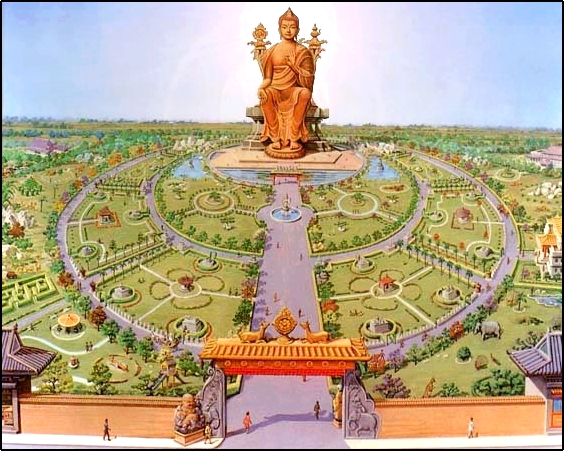
The Eternal Mother

White Lotus Societies started out seeking tranquilly through a combination of Buddhism with some elements of Daoism (Taoism) and other native Chinese religions. Even in the 12th century, the Yuan Dynasty was distrustful of the Yellow Lotus Society, which didn’t fit comfortably with Confucianism and the five Great Relationships.

See A Visit from the Falun Gong

_________________________

Lloyd Lofthouse is the award winning author of the concubine saga, My Splendid Concubine & Our Hart. When you love a Chinese woman, you marry her family and culture too. 

Sign up for an RSS Feed for iLook China


The First Emperor: The Man Who Made China – Part 9/9

April 23, 2010

In the seventh month of 2010 BC, the first emperor’s search for immortality has ended. At the age of fifty, Qin Shi Huangdi is dead.

While China’s first emperor is being buried according to his wishes, a power struggle rages outside the tomb. By tradition, the oldest son should have become the emperor but several ministers want a younger son on the throne. The others are assassinated and there is a slaughter.

The emperor is also not going alone into the afterlife. While his chosen successors are being assassinated, hundreds of his favorite concubines will stay with their master and die with him. The tomb’s designers and builders will be sealed in the tomb too. Everyone who knows the way dies.

Qin Shi Huangdi left a legacy–a unified nation with a single written language and a system of administration that is still used today.

You may return to Part 8, or start with The Man Who Made China, Part 1

View as Single Page

_________________________

Lloyd Lofthouse is the award-winning author of the concubine saga, My Splendid Concubine & Our Hart. When you love a Chinese woman, you marry her family and culture too. 

To subscribe to “iLook China”, look for the “Subscribe” button at the top of the screen in the menu bar, click on it then follow directions.


The First Emperor: The Man Who Made China – Part 8/9

April 22, 2010

Chinese alchemists knew liquid mercury as the only substance that could dissolve gold. To the ancient mind, that meant mercury had power that might prolong life. However, the human body cannot absorb pure mercury so the Chinese alchemists made a compound the emperor could digest.

As the mercury is absorbed, it slowly destroyed his nervous system and brain. Emperor Qin Shi Huangdi becomes aggressive, argumentative and paranoid. He goes into hiding. Anyone revealing his location is killed. His kidneys’ are failing and he starts talking to the gods.

Thirty-five years after becoming the king of Qin at thirteen, he goes on another Imperial tour.  But this time, he does not see the nation that is bankrupt and near famine. All the emperor can think about is living forever.

He’s told that giant fish guards the island of the immortals. The emperor dreams that he is a sea god who will kill the giant fish. Near the end of 210 BC, he visits the ocean hunting the giant fish with a crossbow while wading in the surf.

His advisors plan what to do with China once the emperor dies. On the return to the capital, the emperor falls ill and the Imperial convoy stops.

Go to Part 9 for The Man Who Made China or return to Part 7

View as Single Page

______________

Lloyd Lofthouse is the award-winning author of the concubine saga, My Splendid Concubine & Our Hart. When you love a Chinese woman, you marry her family and culture too.

To subscribe to “iLook China”, look for the “Subscribe” button at the top of the screen in the menu bar, click on it then follow directions.


The First Emperor: The Man Who Made China – Part 7/9

April 22, 2010

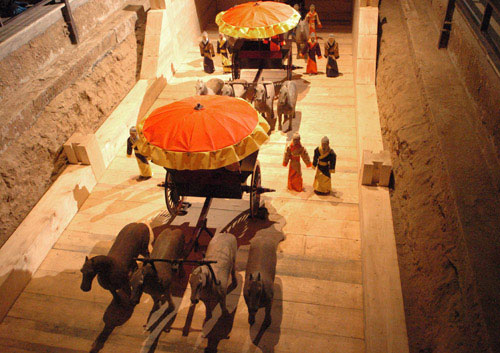
By 215 BC, Emperor Qin Shi Huangdi’s tomb is almost finished. The chamber where his body will rest is the size of a football field and will be hermitically sealed.  Then the tomb will be covered with a million tons of earth creating the hill we see today.

View of Qin Shi Huangdi's tomb

However, the Emperor doesn’t plan to die. Seeking advice from his doctor, he is given mercury capsules. At the time, it was believed that mercury would increase longevity.  Having lots of sex with multiple partners was also considered another way to increase life. The emperor follows the doctor’s advice and sends the doctor on an expedition to find an elixir for immortality.

The emperor isolates himself and delegates the power to rule the empire to those he trusts most. These men suppress free thought. Entire libraries are burned. Those who try to hide documents are branded on the face and sentenced to a life of force labor–mostly on The Great Wall. Anyone who resists is buried alive.

Professor Jeffrey Riegel, University of California, Berkeley, says that Chinese archeologists have no immediate plans to unearth the tomb, because there is no way to safeguard the contents from decay.

Go to Part 8 for The Man Who Made China or return to Part 6

View as Single Page

_________________________

Lloyd Lofthouse is the award-winning author of the concubine saga, My Splendid Concubine & Our Hart. When you love a Chinese woman, you marry her family and culture too. 

To subscribe to “iLook China”, look for the “Subscribe” button at the top of the screen in the menu bar, click on it then follow directions.


Blending the Law

April 21, 2010

The legal system in the United States comes primarily from English Common Law (influenced by Roman law and Greek teachings). English Common Law is a system based on the principle that the rulings made by the King’s courts were according to the common custom of the realm. Common law is grounded in precedent and local tradition stressing community and individualism.

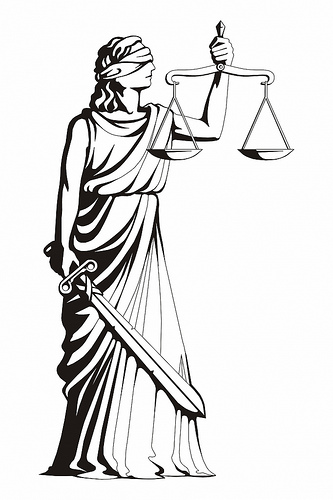
Is Justice Blind?

Legalism, the foundation of Chinese law, emphasizes the need for order above all other human concerns. The founder of the Legalistic school was Hsün Tzu (312–230 BC). He believed that humans are inherently evil and inclined toward criminal and selfish behavior. Since morality does not exist in nature and humans are part of nature, the only way to control behavior was through habit and harsh punishment. Without this, the result would be conflict and social disorder.

Even though both Confucianism and Legalism called for tradition and governmental control, the difference between the two is that Confucius (551–479 BC) advocated ruling benevolently by example. Both theories still play an important role in the cultural and legal development of China.

However, the legal system in the People’s Republic of China is currently undergoing gradual reform since international trade and globalization are influencing changes. What is evolving is a blending of English Common Law and Legalism.

Here is a good Blog to learn how to navigate through China’s legal system: http://www.chinalawblog.com/
See “China Law and Justice System” http://wp.me/pN4pY-hH

Sources used for this post: