I woke up this morning thinking that many in the West want nothing less than China to be something he or she understands, which means a capitalist, multi-party republic, Christian nation with a culture based on individualism rather than China’s more than two-thousand year old collective culture without religion.
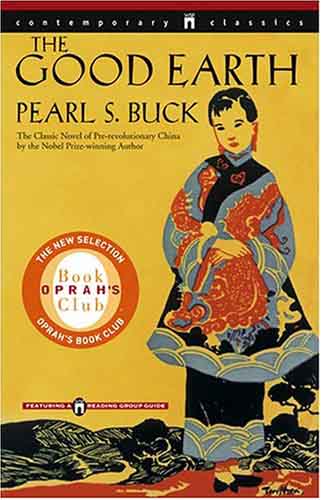
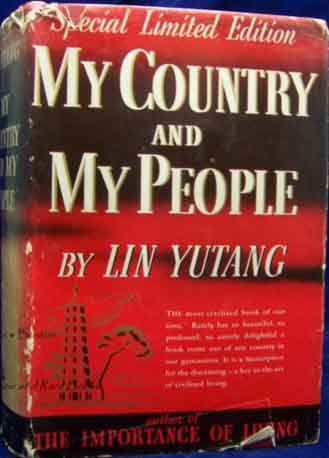
To help dispel this atmosphere of ignorance in the West, Pearl S. Buck urged Lin Yutang to write a book about China and its people. In the Preface for My Country and My People (1935), Lin Yutang wrote, “I write only for men of simple common sense…” Later, in the Prologue, he mentions how for every Sir Robert Hart, the Irish godfather of China’s modernization, there are ten thousand who do not understand the Chinese and do not care to learn.
Then in the Introduction for Lin’s book, Buck wrote, “It (My Country and My People) is truthful and not ashamed of the truth: it is written proudly and humorously and with beauty, seriously and with gaiety, appreciative and understanding of both old and new.”
It is unfortunate that most Sinophobes have no concept of China and its culture and do not want to learn, and men and women of simple common sense are as rare today as in Lin Yutan and Pearl S. Buck’s time.
Lloyd Lofthouse is the award-winning author of the concubine saga, My Splendid Concubine & Our Hart. When you love a Chinese woman, you marry her family and culture too.
Six hundred years after paper was invented, the Chinese invented printing and the first printed work wasBuddhist scripture during the Tang Dynasty (618 – 906). The most basic printing techniques are older. Engraving came later. The carving, printing technique originated during the Tang Dynasty
When we talk about paper and printing, it is to collect knowledge, preserve and share it.
Once there were paper books being printed to share Buddhist ideas, the religion spread through China into Korea and Japan. Over a thousand years printing techniques continued to improve until there were multi-colored printings.
Then during the Sung Dynasty, the printing board was invented, which used clay characters. One character was carved into a small block of clay. Then the clay was put in a kiln to heat into a solid block. This method was efficient for printing thousands of sheets. These blocks would be placed together to create sentences and paragraphs of Chinese characters.
Later, the characters were carved into wood. Over time, printing was developed into an art. In fact, Ancient Chinese culture was preserved due to the invention of paper and these printing methods, which wouldn’t reach Europe until after 1300 AD, almost 800 years later.
Without the Chinese invention of printing, Christianity, Islam and Buddhism may not have spread to the extent that they have.
Lloyd Lofthouse is the award-winning author of the concubine saga, My Splendid Concubine & Our Hart. When you love a Chinese woman, you marry her family and culture too.
To subscribe to “iLook China”, look for the “Subscribe” button at the top of the screen in the menu bar, click on it then follow directions.
Andrew Clark contributed a post to Politics Daily about China’s minorities and the autonomous regions they call home. As Andrew clearly pointed out, “Han Chinese make up 92 percent of the People’s Republic of China. The remaining 8 percent is made up of minority groups, mainly Tibetan, Zhuang, Uyghur, Mongolian, Miao, Manchu, and Hui (these are the major ethnic groups — China officially recognizes 55 minority populations).”
Clark concludes with, “It remains to be seen whether the Chinese government can successfully assimilate these groups, or if consistent suppression of uprisings can force social tranquility.”
The Chinese map has inflated and deflated for more than two-thousand years. Some of these minorities have been in China longer than others. The Mongolians Clark visited, like the Tibetans and the Uyghur, are three who haven’t been inside China as long since they were conquered by the Qing Dynasty (the Manchu minority), who ruled China from 1644 – 1911.
One other minority ruled China for a brief time and that was the Mongols as the Yuan Dynasty (1277 – 1367). Both the rulers of the Qing and the Yuan were assimilated into the Han culture while they ruled China. That’s was primarily because they were surrounded by Han Chinese in the capital.
Tibet broke from China in 1913 and stayed out until 1950 when Mao sent an army into Tibet, which has always been a difficult place for China to rule since sending armies there to enforce control was difficult. But today, a highway and a railroad make that journey easy. If those transportation routes are cut, there’s still air transportation. The travel distance between Tibet and Beijing is shorter than it was a century ago.
Currently, China is adding about 40 thousand more kilometers of rail throughout China and building another grid of high-speed rail. This improved transportation system is also bringing about change and causing a Han migration that would have been unthinkable more than a century ago when most of China didn’t have electricity or roads.
For centuries, China ruled over these minorities without moving Han Chinese into their territories, but times have changed and the Han Chinese, like the Americans Europeans moving West, have been migrating into the autonomous regions for years, which may have more of an impact keeping these territories part of China than armies ever have. And if that doesn’t work, China still has the largest standing army in the world.
Clark also claimed, “the United States has seemingly countless ethnic and cultural minorities that are proud to call themselves American…” While somewhat true, many of almost 2,500 American native tribes still hold to their old ways and live on reservations proud to be Navaho or Sioux, Black Foot or Apache, maybe more so than being American.
Lloyd Lofthouse is the award-winning author of the concubine saga, My Splendid Concubine & Our Hart. When you love a Chinese woman, you marry her family and culture too.
Imagine the rise of civilization to today’s level of technology without paper. Would men have walked on the moon?
Papermaking is one of the four significant inventions from ancient China. Almost 2,000 years ago, the discovery of paper was made in China.
in 105 AD, Cai Lon submitted his discovery to the Han emperor. He had invented a way to make paper. This method soon spread to the rest of China, and the emperor rewarded Cai Lon by making him a member of the nobility.
The basic principles of papermaking invented by Cai Lon are still in use today. To make paper was a six-step process, and paper manufactured properly lasts for centuries. Buddhism arrived in China about the time of the invention of paper and this helped spread Buddhist ideas, which contributed to the spread of civilization. By the 12th century, the paper making process reached Europe.
Lloyd Lofthouse is the award-winning author of the concubine saga, My Splendid Concubine & Our Hart. When you love a Chinese woman, you marry her family and culture too.
To subscribe to “iLook China”, look for the “Subscribe” button at the top of the screen in the menu bar, click on it then follow directions.
In the last post, I wrote about Zhang Heng, the man who invented the first seismograph centuries before anyone in the West would consider it. In this post, you will discover that the Chinese were the first to notice that the lodestone pointed one way, which led to the invention of the compass. The first compass was on a square slab, which had markings for the cardinal points and the constellations. The needle was a spoon-shaped device, with a handle that always pointed south.
Archeologists have not been able to discover the exact time the ancient Chinese discovered magnets. But it was first recorded in a book, Guanzi, written between 722 BC – 481 BC.
Later in the 8th century AD, magnetized needles would become common navigational device on ships. The first person given credit for using the compass in this way was Zheng He (1371 – 1435), who made the voyages made famous in book by Louise Levathes, When China Ruled the Seas.
Since the Chinese value education above all else, including business and the military, it makes sense that Chinese invented and used devises like the compass and the seismograph centuries before the West did.
Besides being used to avoid getting lost, the Compass was also considered a symbol of wisdom. About the 12th century, through trading, the technology spread to Arabia and last to Europe.
Lloyd Lofthouse is the award-winning author of the concubine saga, My Splendid Concubine & Our Hart. When you love a Chinese woman, you marry her family and culture too.
To subscribe to “iLook China”, look for the “Subscribe” button at the top of the screen in the menu bar, click on it then follow directions.


 Posted by Lloyd Lofthouse
  iLook China