Chiang Kai-shek

July 23, 2010

Chiang Kai-shek (also known as Jiang Jieshi) was born on October 31, 1887. His family was from the upper class and was wine merchants. At 18, he attended a military college in Japan. Chiang had four wives during his life. His first wife died in the Second Sino-Japanese War. His second wife contracted gonorrhea from Chiang (a known womanizer) soon after they married. His most famous wife lived to 106 and died in 2003. Before one marriage, he converted to Christianity as a condition to marry.

After training in Japan, he went to Russia to study the Soviet government and decided he did not care for the Communists. Returning to China, Sun Yat-sin appointed Chiang to command a military academy

Under Sun Yat-sen the Communists and the Nationalists worked together to rule China, and Soviet advisers provided the help needed to increase their power since most of China was ruled by warlords.

However, when Sun died in 1925, Chiang led the Kuomintang army north to defeat the warlords and destroy the Communists.

Meanwhile, in Shanghai, the Communist Party had organized labor unions to improve working conditions in the low paying sweat-shop factories. During Communist organized labor strikes, these factories were shut down.

When Chiang Kai-shek army reached Shanghai, he joined forces with gangsters then went on a killing spree known as the White Terror. Tens of thousands of workers, who belonged to the labor unions organized by the Communists, were hunted down and killed along with their Communist leaders. One of the few to escape was Mao Zedong.

For the next few years, Chiang would rule China unchallenged until 1931, when Japan invaded. During the early months of the war, Chiang ignored Japan and continued hunting for the Communist survivors, who had fled into the countryside.

In 1949, when Mao won the civil war, Chiang Kai-shek took the survivors of his nationalist army to Taiwan where, protected by the US military, he declared brutal martial law and ruled as a dictator until he died on April 5, 1975 at the age of eighty-seven.

______________________________

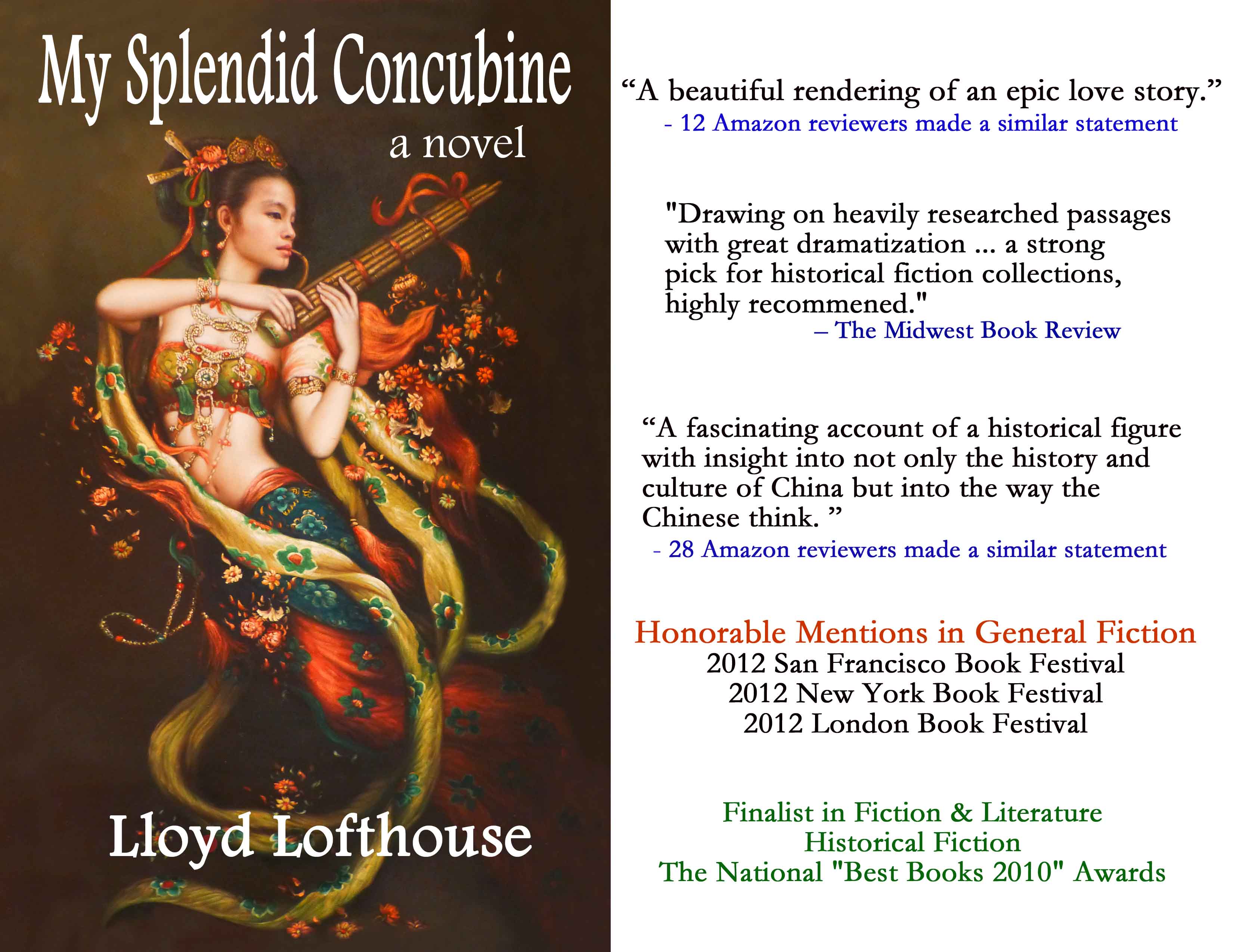
Lloyd Lofthouse is the award-winning author of My Splendid Concubine [3rd edition]. When you love a Chinese woman, you marry her family and culture too. This is the lusty love story Sir Robert Hart did not want the world to discover.

#1 - Joanna Daneman review posted June 19 2014

Where to Buy

Subscribe to “iLook China”!
Sign up for an E-mail Subscription at the top of this page, or click on the “Following” tab in the WordPress toolbar at the top of the screen.

About iLook China

China’s Holistic Historical Timeline


Dr. Sun Yat-Sen – China’s Democratic Revolutionary

July 23, 2010

“An individual should not have too much freedom. A nation should have absolute freedom.”
– Dr. Sun Yat-Sen (1866 – 1925)

He is referred to as the father of modern China.  If there were no Sun Yat-Sen and his revolution, there would be no modern China as it is becoming today.

While attending a Christian school in Hawaii, he converted to Christianity, which may have shaped his revolutionary future. It was obvious that his writing was influenced by American thought. With the support he received from the Hawaiian Chinese community, he networked with Chinese people all over the world.

He went on to publish revolutionary ideas seeking to overthrow the Manchu Dynasty and create a democratic China. In 1904, he wrote that he wanted to model China’s government after America but by combining Western thought with Chinese tradition.

Yet, he was considered an idealistic dreamer – that his ideas were impractical.

He said, “The whole world is one family.” (1910)

______________________________

Lloyd Lofthouse is the award-winning author of My Splendid Concubine [3rd edition]. When you love a Chinese woman, you marry her family and culture too. This is the lusty love story Sir Robert Hart did not want the world to discover.

2015 Promotion Image for My Splendid Concubine

Subscribe to “iLook China”!
Sign up for an E-mail Subscription at the top of this page, or click on the “Following” tab in the WordPress toolbar at the top of the screen.

About iLook China

China’s Holistic Historical Timeline


The Rape of Nanking with Iris Chang

July 22, 2010

One of the greatest atrocities in history was the rape of Nanking.  All humans are capable of great evil and this is an example. Thousand were murdered and tossed into the Yangtze River. There were so many bodies, the water turned red. Others were buried alive after digging their own graves.

For her book, Iris Chang went to China and interviewed the few hundred survivors still living to document the horrible crimes the Japanese committed.  She talked to one man who, as a child, watched his mother and little brothers being murdered.

Another witness tells Chang how she found her dead grandparents, mother and little sisters naked and raped.

There is a scene showing Chang transcribing taped interviews and it is mentioned that she had nightmares from this project. Chang said, someone had to listen, to record and validate the experience of the survivors and make it public.

The Rape of Nanking Movie Trailer

The Rape of Nanking was published November 1997 and became a bestseller while Japan tried to discredit the book. Iris Chang committed suicide on November 10, 2004. She was 36 and left behind a husband and two-year-old child.

See The Rape of Nanking

_________________________

Lloyd Lofthouse is the award-winning author of the concubine saga, My Splendid Concubine & Our Hart. When you love a Chinese woman, you marry her family and culture too. 

Sign up for an RSS Feed for iLook China


The Rape of Nanking

July 22, 2010

Warning, the video linked to this post may be disturbing. 

Although China and Nanking suffered from internal war and strife, China never invaded another nation in its four-thousand year history. China had always been self-sufficient and never needed anything from other countries. To wage war on its neighbors was not part of the Chinese character. 

Nanking was the capital of China from the third to the 6th century. In the 14th century, the first Ming Emperor made Nanking the capital again. To protect the capital, the largest city wall in the world was built. It was fifty -feet high, forty-feet wide and more than twenty-five miles long.

On July 1937, Japan attacked China. Chiang Kai-shek made himself the commander of China’s army and navy.  The battle for Shanghai came first. Tens of thousands of innocent Chinese were killed while 300 thousand Chinese troops died. After losing Shanghai, the Chinese army retreated to Nanking.

The Japanese soldiers were ordered to burn all, steal all, and kill all as they advanced through the countryside toward Nanking. It is estimated that 300 thousand innocent Chinese were murdered. 

For over one-hundred days, Japanese bombers bombed Nanking, while Chinese troops fought fiercely defending the city. Eventually, Chang Kai-shek fled with most of his generals and government officials, but ordered one general to stay behind with the army and fight.

As Nanking fell to the Japanese, mostly women, children and the elderly were killed by the tens of thousands. 

Part 2 continues the Rape of Nanking and it is so shocking and disturbing, you must go to YouTube and sign in showing that you are at least 18. If you do not wish to watch Part 2, the next post will continue to report about the Rape of Nanking, and it will not be as disturbing.

Go to Part 2, The Rape of Nanking

Also see The Roots of Madness

______________

Lloyd Lofthouse is the award-winning author of the concubine saga, My Splendid Concubine & Our Hart. When you love a Chinese woman, you marry her family and culture too.

If you want to subscribe to iLook China, there is a “Subscribe” button at the top of the screen in the menu bar.


China’s Warrior King

July 17, 2010

Qin Shi Huangdi (259 – 210 BC) unified China by using advanced weapons and brutal tactics. The Qin Dynasty arsenals made swords and other weapons with a precision unknown in Europe. Trigger mechanisms for crossbows and arrows were made in runs of tens of thousands.

The Qin military machine had one command—attack.

At this time, the Roman Empire had gathered 80,000 troops to defend Rome against Hannibal. In China, the king of Qin had an army of one-million.

Bravery was valued above all else. When a Qin soldier was killed in battle, it was up to his fellow troops to avenge his death. The penalty for cowardice was death.  More than two million will die before Qin Shi Huangdi conquerors all China.

Qin’s officers were advanced in rank by winning in battle. If you wanted to be advanced in rank, you brought back the head of an enemy solider. The honorable way to treat prisoners of war was to bury them alive.

Emperor Qin Shi Huangdi was the father of a unified China. He was also brutal and ruthless.

To discover more, see The First Emperor: The Man Who Made China (Part 1 of 9)

_________________________

Lloyd Lofthouse is the award-winning author of the concubine saga, My Splendid Concubine & Our Hart. When you love a Chinese woman, you marry her family and culture too. 

Sign up for an RSS Feed for iLook China