Food Safety in the People’s Republic of China

May 27, 2010

A friend sent me a piece about tainted supplements in the United States.  One paragraph grabbed my attention.

“In recent years, a vast majority of supplement suppliers have located overseas — principally in China. Nearly all of the vitamin C and many other supplements consumed in the United States are made from ingredients made in Chinese plants. Those plants are almost never inspected by the FDA because the agency is not required to do so, has little money to do so and does not view the plants as particularly risky.” Source: New York Times
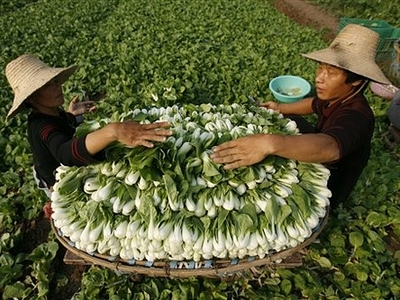
Chinese farmers harvesting bok choy

China has an agency that is similar to America’s FDA. It’s called The State Food and Drug Administration (SFDA) and was founded in 2003 as part of an effort to improve food safety. Today, there are about ten government departments and ministries under the State Council responsible for food safety in China. (Information about China’s SFDA)

Although China’s SFDA is relatively new compared to America’s FDA, China appears to be taking food safety seriously compared to weaknesses discovered in America’s FDA. 

Evidence that China is serious about food safety happened on July 10, 2007, when Zheng Xiaoyu, the former head of the SFDA was executed by lethal injection for taking bribes from various firms in exchange for state licenses related to product safety.

In fact, until the 1906 Food and Drug Act, America did not have an FDA (Source: FDA Early History), and recently the Union of Concerned Scientists revealed that hundreds of agency scientists had been pressured to approve a drug despite reservations about safety.   

Discover more about China’s Eating Culture

____________________________

Lloyd Lofthouse is the author of the award winning novels My Splendid Concubine and Our Hart. He also Blogs at The Soulful Veteran and Crazy Normal.

Sign up for an RSS Feed for iLook China


China’s Stick People

May 11, 2010

I’m always looking for information about China, and I hit gold with the May 8 The Economist. Click the link to read the entire piece or read this summary. I bought the magazine.

China has two classes—rural and urban.  The urban people have prospered for the last thirty years as China built a middle class.  Most rural Chinese have not been able to benefit from the booming economy and are getting restless.

Rural China

Rural land outside China’s cities belongs to collectives. When Mao won China, the Communists divided the land among villages—not individuals. Individuals do not hold title to farmland and cannot sell land that no one owns.

China saw what was happening in India when farmers sold their plots to developers.  Rural people in India flocked to the cities and built sprawling slums. To avoid that, the Chinese government created a system to keep rural people on their farms.  Another motivation was fear of another famine like the one that struck China from 1959 to 1961 killing millions from starvation. If farmers left the fields for a better lifestyle in cities, that nightmare might return.

Currently, an experiment is being tried in rural areas outside Chongqing to see if the land can be divided among individuals while increasing food production. Since the government still hasn’t figured out how to make the transition smoothly, don’t expect rural land reforms to happen quickly.

Discover China’s middle class expanding

_______________

Lloyd Lofthouse is the award-winning author of My Splendid Concubine [3rd edition]. When you love a Chinese woman, you marry her family and culture too. This is the love story Sir Robert Hart did not want the world to discover.

Subscribe to “iLook China”!
Sign up for an E-mail Subscription at the top of this page, or click on the “Following” tab in the WordPress toolbar at the top of the screen.

About iLook China


Food and China’s Eating Culture

May 10, 2010

China is an eating culture and always has been.  Although Today’s Chinese do not eat the quantities of meat the average American does, China accounts for half of global pig production because pork is the popular meat to eat.  Small farmer producers raise ninety-nine percent of pork in China. Source: China Translated

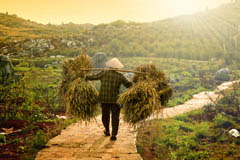
Chinese Farmer

Even when grain production falls in China that does not translate into a shortage since China has historically kept large food-grain stockpiles and those individual small farmer/producers help ensure food security. Source : China Through a Lens

As China’s economy continues to grow a spreading middle class with money to spend, food demand and eating habits are changing along with waistlines.  To meet this demand, Chinese have set up large pork and chicken operations in Australia to meet the growing demand for meat on the mainland. Source: Food Crisis

To insure a dependable supply of food to feed 1.3 billion people, Chinese companies have also bought or leased land in Africa sending Chinese laborers to produce crops for sale on the world market – and back home.  Source: Telegraph.co.uk

Discover Tofu

______________

Lloyd Lofthouse is the award-winning author of the concubine saga, My Splendid Concubine & Our Hart. When you love a Chinese woman, you marry her family and culture too. 

If you want to subscribe to iLook China, there is a “Subscribe” button at the top of the screen in the menu bar.


Hooters China

April 28, 2010

The score is America 455 and China 4. 

That score shows how fast China is changing as the Middle Kingdom evolves into an Asian Super Power beginning to look more like the US than the US.  As America’s political system drifts toward socialism, China is roaring toward capitalism with all the trappings of a consumer society.  Will the two meet at a “Hooters” balanced in the middle?


Hooters Girls In Shanghai, China

I’ve never been to a Hooters, but on my next trip to China, I may visit one since they are in Shanghai, Pudong, Beijing and Chingdu. I’ve already watched the YouTube videos.  See for yourself.  It’s fun.

As fast at McDonald’s, KFC, Pizza Hut, Starbucks, GM, and Ford are all growing in China (and making money), it’s easy to imagine that Hooters may have more stores in China than the US in a few years.

Discover Understanding How to do Business in China

______________

Lloyd Lofthouse is the award-winning author of the concubine saga, My Splendid Concubine & Our Hart. When you love a Chinese woman, you marry her family and culture too.

If you want to subscribe to iLook China, there is a “Subscribe” button at the top of the screen in the menu bar. 


I Miss the Smell of China

April 27, 2010
Bob Grant

Originally Published at Speak Without Interruption on April 16, 2010 by Bob Grant — publisher/editor for Speak Without Interruption. Posted on iLook China, April 27, 2010 at 12:00 PM

 For various reasons, my business in China declined a little over two years ago, and I have not had occasion to visit there during that time period. A lot has happened—both within the U.S. and China—since my business went south.

I do miss China – its people – its culture – its smell. This might seem like an irrational statement since China is suppose to be one of the most polluted countries in the world, but it is not the smell of pollution that sticks in my memory.

Our China office was located in Guangdong Province, which is in the southern part of China near Hong Kong. Traveling around that province, I always remember the fresh scents of flowers, rain, trees, grass, and meals being prepared for daily consumption.

I tended to visit factories that were in outlying areas—their conference rooms, factories, reception rooms, and gardens all had a smell that I grew to welcome during each of my visits. As I made trips and visits to other parts of China, I felt they each had their own unique smells and aromas that I have not found any other place in the world that I have traveled.

I have written other posts regarding my feelings about the Chinese people—those have not changed.  I am not certain that I will ever have occasion to visit China again but the smells and memories of that country and its people will remain with me forever.

Follow this link to see more by Bob Grant “Transporting Goods by Road in China” http://wp.me/pN4pY-jf