Americans doing Business in China – Part 9/16

February 29, 2012

Note from Blog host — another example of East meets West through business and trade: Higher education is a business, and the number of international students at U.S. colleges and universities reached 723,277 during the 2010-11 academic year.  China, the top country of origin for international students, sent 157,558 undergraduate and graduate students to America, up 23% from the previous year.

International students and their dependents contributed more than $20 billion to the U.S. economy that academic year. For Chinese students, that means about $4.4 billion came from China.

Ann Stock, assistant secretary of the US State Department says, “Young people who study abroad gain the global skills necessary to create solutions to 21st-century challenges. In turn, international students globalize our campuses and communities.” SOURCE: USA Today

_____________________

Guest Post by Bob Grant — publisher/editor for Speak Without Interruption, an international online magazine.

On October 1, 1949 the People’s Republic of China was formally established in a speech given by Mao Zedong from the Imperial Gate at Tiananmen Square. I stood at the very spot where Mao gave his speech and took a photo. From speaking with people – in China – who lived through his reign it was beyond believable. What he put his people through is an unforgivable act of power and brutality.

However, it is images from Mao’s era that some – outside of China – still have of the Chinese people. Nothing could be farther from the truth!
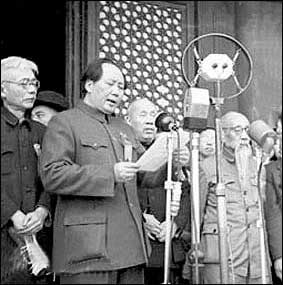
I never met a Chinese government official – did not even see one at least that I can recall. What I did meet were the people of China – the people with whom I had my business and personal interactions. I did not ask them questions about their government nor did they ask questions of mine.

The only political statement that I ever heard was a reference that China’s policy would probably change when the younger generation came into power, someday.

In meetings, over two years ago, I heard about the oil pipeline being built directly from Iran to China. None of the people in that meeting expressed an opinion one way or the other regarding this pipeline. It was a decision the Chinese government made.

Maybe my associates did not approve of dealing with Iran—maybe they did? The point being here is their government made this decision—not my associates.

Whether the officials in power in the US are republican or democrat, they have all made decisions of which I don’t agree. They did not consult me or ask my opinion—am I my government in these situations?

The point I am trying to make is that I found the Chinese people I met just like me in a lot of respects. I enjoyed doing business with them – learning their culture – and becoming their friend. No government – or its actions – is ever going to change that for me!

Note from Blog host – If you plan to do business in China, I recommend visiting the China Law Blog first.

Continued March 1, 2012 in  Americans doing Business in China – Part 10 (a guest post) or return to Part 8

______________

Lloyd Lofthouse is the award-winning author of The Concubine Saga. When you love a Chinese woman, you marry her family and culture too. This is the love story Sir Robert Hart did not want the world to discover.

Subscribe to “iLook China”
Sign up for an E-mail Subscription at the top of this page.

About iLook China

Note:  This guest post first appeared on March 9, 2010


Party Women

February 9, 2012

Starting with the I Ching, The Book of Changes, almost five thousand years ago, the central focus of Chinese philosophy was how to live an ideal life and how best to organize society.

When the Chinese Communist Party gained power in 1949, previous schools of Chinese philosophy, except Legalism, were denounced as backward and purged during the Great Leap Forward and the Cultural Revolution.

However, the influence of China’s five-thousand year old culture did not vanish as China’s Central Committee continues to plan and modernize while leading China into the future.

Most Chinese believe that true advancement and growth should only happen slowly, at a steady, measured pace, which means to grow but grow slow like a tree while following a well thought out plan to bring about changes.

Even the United States doesn’t change quickly.

In fact, it took almost ninety years to free the slaves, and women first sought the right to vote in 1848 at the Seneca Falls Woman’s Rights Convention.

Then seventy-two years later in 1920, American women finally earned the right to vote when the Nineteenth Amendment was adopted by Congress and was ratified by the states becoming a national law.

The last time women had relative freedom in China was in the seventh century during the Tang Dynasty when Emperor Wu Zetian, a woman, ruled the country.

Since 1982, when China ratified its Constitution, women in China have gained more freedom, power and rights than at any time in China’s history including the Tang Dynasty.

Critics in the West might point out that under the Communists, no woman has ruled China, but we could say the same of the United States and many other countries.

Today, Liu Yandong, a senior Party official, serves on China’s Politburo [a group of 24 people that oversees the CCP]. She is from Nantong in Jiangsu Province and graduated from Tsinghua University in 1970 with a degree in chemistry.

In fact, Chinese women today account for 40% of government officials. At least 21.3% of National People’s Congress delegates in 2008 were women (about 636 — the latest available data, according to the All China Women’s Federation).

Another example is Li Bin, acting governor of Anhui Province. In addition, 87.1% of China’s provincial regions have female vice governors. Women are also represented in the leadership of 89.4% of the country’s municipal governments. Source: Global Times

For comparison, in the United States, 79 women (of 435 representatives or 18%) serve in the House and 17 [of 100 or 17%] in the Senate. In addition, six women serve as governors [that’s 12% of the total].

Then, ipu.org’s “Women in national parliaments” ranks China 52 [tied with Italy] of 188 countries. The United States is ranked 71, Thailand 75, South Korea 81, Japan 96 and India 99.

“Chinese women leaders have much in common. They generally all have a good education background, being mainly science majors, and solid experience in government. They are of a caliber equal to that of their male counterparts,” an All-China Women’s Federation expert said.

Why do so many of China’s critics expect China to change faster than the US did?

______________

Lloyd Lofthouse is the award-winning author of The Concubine Saga. When you love a Chinese woman, you marry her family and culture too. This is the love story Sir Robert Hart did not want the world to discover.

Subscribe to “iLook China”
Sign up for an E-mail Subscription at the top of this page.

About iLook China

Note: This updated and revised post first appeared November 11, 2010


Women’s Rights in China

February 8, 2012

Dramatic changes in women’s rights have been achieved in a culture where for millennia women were stereotyped as inferior to men, had no rights and served as slaves, concubines and prostitutes. Marriages were arranged—sometimes at infancy.

In 1949, foot binding was abolished; the All-China Women’s Federation (ACWF) was formed and supported by China’s Communist Party (CCP). Change in China, as in the United States, has been a painful evolutionary process. However, the struggle for women to gain equality appears to have moved faster in China since the CCP came to power.

After the CCP was established in 1949, it took less than a year to liberate women and pass laws to speed this process along.

For a comparison, after the United States was established in 1776, it took one hundred and forty-four years until August 26, 1920 when the Congress voted in the 19th Amendment to the US Constitution giving women the right to vote.

At the 10th National Women’s Congress in the Great Hall of the People in Beijing, in 2008, Deputy-Chairwoman HuangQingyi said, “Sex discrimination in employment should be eradicated and the income gap between men and women should be further narrowed.”

It was also been reported that domestic violence is a severe threat to women. Chinese authorities reported 50,000 complaints annually, according to figures released by the ACWF. The domestic violence fact sheet shows this is also a problem in the United States.


Role of Women in China Then and Now

Sexual discrimination was supposed to have been abolished in China back in 1949, when Chairman Mao Zedong famously announced, “women hold up half the sky”, but it wasn’t. It has only been a few years since China outlawed sexual harassment. Laws may be written to bring about change but change comes slowly.

Today, statistics show China has about 27,000 women and children’s rights protection agencies. However, China’s critics and enemies will only point out what they believe is wrong without giving credit to what has changed for the good of women in China.

______________

Lloyd Lofthouse is the award-winning author of The Concubine Saga. When you love a Chinese woman, you marry her family and culture too. This is the love story Sir Robert Hart did not want the world to discover.

Subscribe to “iLook China”
Sign up for an E-mail Subscription at the top of this page.

Note: This revised and edited post first appeared on March 21, 2010


China’s Bound-Feet Women

February 7, 2012

According to historical accounts, foot binding appeared in China during the Sung Dynasty (960-1276 AD).

The process of foot binding usually started between the ages of four and seven. Feet were soaked in a blood and herb mixture. Toes were broken. Then the arch was broken. There was extreme pain since no pain relief was used. It is estimated that in a thousand years about two billion women went through the process.


What would you do for beauty?

The Manchu leaders of the Qing Dynasty (1644 to 1911) tried with little success to stop foot binding, and Manchu women did not bind their feet. Mostly Han (the majority in China) women continued the practice.

In 1928, the Nationalist government announced plans to do away with foot binding. This attempt to end foot binding met with mixed success. In rural areas, large feet were still considered unattractive and unacceptable and the practice continued.

While working in China for National Geographic on a three part Marco Polo series, Michael Yamashita, a veteran photographer, went in search of women who had bound feet. He found them living in remote urban villages.

Even in 19th century San Francisco, there were Chinese girls and women with bound feet. Source: Virtual Museum of the City of San Francisco

In most of China, social and sexual customs resist rapid change. For millions of women, the practice would continue until 1949 when the Communists came into power.

Then the popularity of foot binding to enhance a woman’s beauty ended.

______________

Lloyd Lofthouse is the award-winning author of The Concubine Saga. When you love a Chinese woman, you marry her family and culture too. This is the love story Sir Robert Hart did not want the world to discover.

Subscribe to “iLook China”
Sign up for an E-mail Subscription at the top of this page.

About iLook China

Note: This post first appeared November 7, 2010.


Ancient Feminism in China

February 6, 2012

Britannica Concise Encyclopedia says Feminism is a social movement that seeks equal rights for women.

The dates the Britannica throws out are the Enlightenment, a European intellectual movement of the 17th and 18th centuries and the 1848 Seneca Falls Convention, which called for full legal equality with men.

Merriam-Webster’s definition is “the theory of the political, economic, and social equality of the sexes” and “organized activity on behalf of women’s rights and interests.”

In fact, for centuries, Western women had been treated as chattel—the property of men.

After watching the video and reading the entry in Britannica and the definition in Merriam-Webster, it’s obvious that feminism was alive and well in China more than a thousand years ago during the Tang Dynasty.

In fact, Emperor Wu Zetian (625 to 705 AD) was a very early feminist that ruled the Tang Dynasty as an emperor and was China’s only woman emperor.

The Tang Dynasty was a time of relative freedom for women. Women did not bind their feet (for a few more centuries) or lead submissive lives. It was a time in which a number of exceptional women contributed in the areas of culture and politics. Source: Women in World History

Wu Zetian demanded the right of an emperor and kept male concubines. She also challenged Confucian beliefs against rule by women and started a campaign to elevate the position of women.

______________

Lloyd Lofthouse is the award-winning author of The Concubine Saga. When you love a Chinese woman, you marry her family and culture too. This is the love story Sir Robert Hart did not want the world to discover.

Subscribe to “iLook China”
Sign up for an E-mail Subscription at the top of this page.

Note: This post first appeared on November 08, 2010