What do Shanghai’s IKEA and Cupid have in common?

June 19, 2012

IKEA seems to have been adopted by the Chinese. Back in November 2010, I wrote IKEA Sleepover in Beijing about IKEA’s Chinese fans that loved the place so much, it became a favorite spot to take a nap.

Recently, I discovered that IKEA in Shanghai is where retired, singles seek love while drinking free coffee.

According to The Wall Street Journal, the dating hot-spot for senior citizens who are out either looking for love or new friends, is none other than the Swedish furniture manufacturer.

Then in November 2011, NPR.org reported, “Twice a week, hundreds of Shanghai residents who have formed an informal lonely hearts club of sorts gather at the cafeteria of the Swedish furniture megastore for free coffee and conversation.

“The pensioners begin arriving around 1 in the afternoon and fill nearly 20 tables in the store cafeteria. They sit for hours drinking coffee, gossiping and subtly checking each other out.” If you click on NPR’s link above, you may listen to the story.

Global Post.com says, “Unlike bars or dance clubs, the atmosphere at IKEA is casual and non-threatening. It makes it easy for the seniors, who show up in groups of 70 to 700 people, to chat over a cup of coffee. And because IKEA serves free coffee to anybody carrying an IKEA Family membership card, some of the seniors don’t even have to pay for their cup. Zhou Hong works at IKEA as a card swiper, and she told The Wall Street Journal that on average, she hands out around 500 cups of coffee each time the seniors meet.”

However, IKEA isn’t the only one playing the role of a cupid in China. China’s postal service also plays cupid. Yahoo.com says, “Who would have thought that Beijing’s publicly run postal service would try to play cupid and save marriages from the “seven-year itch” (the critical point when, some say, a spouse’s eyes begin to wander)?”

But what about IKEA?  Is IKEA losing money giving away free coffee to help fill lonely hearts with caffeinated love?

According to the numbers, no.

In fact, IKEA is doing great. Three of its five largest stores are in China, and IKEA reported that in 2011, its net profits rose 10.3% to $3.85 billion with its biggest gains in Russia, China and Poland.

Maybe handing out free coffee to lonely seniors was a good idea.

______________

Lloyd Lofthouse is the award-winning author of The Concubine Saga. When you love a Chinese woman, you marry her family and culture too. This is the love story Sir Robert Hart did not want the world to discover.

Subscribe to “iLook China”!
Sign up for an E-mail Subscription at the top of this page, or click on the “Following” tab in the WordPress toolbar at the top of the screen.

About iLook China


Recognizing Good Deeds in China

June 11, 2012

In October 2011, when a young child was run over by a van in the Chinese city of Foshan in southeastern Guangdong province, many China critics leaped on that one isolated example in a country about the size of the US in area with more than four times the population to stereotype all Chinese as insensitive monsters. I wrote about the incident in Litigation Nation Virus Spreading West to East.

Now, in 2012, we have an example of heroism from a Chinese man in Guangzhou, China where he risked his life to save a Chinese toddler.

The UK’s Daily Mail reported, “Chinese toddler dangling over 40 foot drop plucked by rescuer who scaled side of building to save him.” The Daily Mail ran four photos of the incident, which clearly show the danger to the hero and the child (click on link to see dramatic photos).

My question is, “Will the same China critics that used the Foshan incident to crucify China and the Chinese for apathy spend the same amount of time and effort to laud this hero as a positive role model?”

In fact, this hero risked his life and did not act alone. The Daily Mail said, “Within minutes of the terrified toddler being spotted, a crowd had assembled at street level with a large yellow blanket at the ready to catch him if he fell.”

I suspect that most China critics will claim this was a fluke instead of giving credit where credit is due. However, there is evidence that others also are willing to risk life and limb. For example, in July 2011, Wu Juping, 31, saved a two-year-old girl that fell out of a 10th floor window and Juping suffered a broken arm for her act of heroism. Source: China Daily

The truth is that the Chinese are just as diverse as most people in the world. For example, a recent study of human nature revealed that it is normal (for most of humanity) to lie and cheat—not just the Chinese as many China critics claim.

In The (Honest) Truth About Dishonesty: How We Lie to Everyone—Especially Ourselves, Dan Ariely, a behavioral economist at Duke University said, “Our behavior is driven by two opposing motivations. On the one hand, we want to view ourselves as honest, honorable people. On the other hand, we want to benefit from cheating and get as much money as possible. Human behavior is the balance between those two forces.”  Source: The Daily Ticker at Yahoo Finance

Moreover, if dishonesty is part of human nature, it stands to reason that people will be subconciously dishonest when they demonize something they fear or do not understanding, which means critics will filter the facts to fit personal beliefs—known as Cherry Picking and turn to the Ad Hominem Fallacy to slander an entire nation. Source: Discovering Intellectual Dishonesty

______________

Lloyd Lofthouse is the award-winning author of The Concubine Saga. When you love a Chinese woman, you marry her family and culture too. This is the love story Sir Robert Hart did not want the world to discover.

Subscribe to “iLook China”!
Sign up for an E-mail Subscription at the top of this page, or click on the “Following” tab in the WordPress toolbar at the top of the screen.

About iLook China


Change Comes to China’s “Granite Women”

June 5, 2012

Change taking place in China is not happening as fast as many Western critics want it to. To these critics, China should flip the feudal switch to democracy and the light should come on without effort.

However, in spite of Western pressure to speed things up, changes are taking place as planned by China’s government—one step at a time.

For example, foot binding was around centuries when the Qing Dynasty (1644 to 1911) first attempted to end the practice that would continue until 1949.

In 1976 when Mao died, twenty percent of the population was literate. Today more than 90% can read with a goal to reach 99%.

In 1985, school reform was implemented making nine years of education mandatory for all children. Academic achievement became the new priority over the political consciousness of the Mao era.

An example of how China’s education policies have brought about change may be seen among the “Granite Women”, who live near the coast in southeast China.

For centuries, these women carried blocks of granite from the quarries where their husbands, brothers and fathers worked cutting the stone.

However, today, China’s economic reforms along with education are changing the old ways.

Younger women, who have now had an education, know what they don’t want to do with their lives.

For centuries, others such the Qing Dynasty and the Nationalists failed to improve the quality of life in China for women. Where these others failed, the CCP appears to be succeeding.

______________

Lloyd Lofthouse is the award-winning author of The Concubine Saga. When you love a Chinese woman, you marry her family and culture too. This is the love story Sir Robert Hart did not want the world to discover.

Subscribe to “iLook China”
Sign up for an E-mail Subscription at the top of this page.

Note: This revised and edited post first appeared on November 7, 2010


“The Concubine Saga” Web Tour Schedule – June 2012

May 30, 2012

So Many Precious Books May 30 Review & Giveaway

Broken Teepee June 1 Review & Giveaway

My Little Pocketbooks June 30 Review

My Little Pocketbooks June 4 Interview & Giveaway

Bookish Dame June 6 Review

Bookish Dame G & GP June 6 Guest Post & Giveaway

J.A. Beard June 8 Interview

My Devotional Thoughts June 8 Review

My Devotional Thoughts June 9 Guest Post & Giveaway

Book Dilettante June 11 Review

Book Dilettante June 12 Guest Post

Joy Story June 12 Review

Books, Books, & More Books June 13 Review & Giveaway

Live to Read June 14 Review

Peeking Between the Pages June 14 Guest Post & Giveaway

Col Reads June 15 Review

Celtic Lady’s Reviews June 18 Review

Ink Spots & Roses June 18 Guest Post & Giveaway

The Readers Cafe June 19 Review

Knitting and Sundries June 20 Review & Giveaway

Sweeps 4 Bloggers June 21 Review & Giveaway

The Reading Life June 22 Review

The Reading Life June 21 Interview

Historical Fiction Connection June 22 Guest Post

Layered Pages June 25 Review

Layered Pages June 26 Interview
Historical Tapestry June 25 Guest Post

Peaceful Wishing June 26 Review

To Read or Not to Read June 27 Review

To Read or Not to Read June 28 Guest Post & Giveaway

M Denise C. June 28 Review

Succotash Reviews June 29 Review & Giveaway
Moonlight Gleam June 29 Guest Post & Giveaway

Jayne’s Books June 29 Review & Giveaway

___________________________________

PRESS RELEASE
FOR RELEASE before June 1, 2012
CONTACT:
Lloyd Lofthouse, author
lflwriter@gmail.com

IN THE 19th and EARLY 20th CENTURY, ROBERT HART WAS CRUCIAL TO THE SURVIVAL OF CHINA!

WALNUT CREEK, CA (3/2/12) — Robert Hart (1835 – 1911) was the ‘Godfather of China’s modernism’ and the only foreigner the emperor of China trusted. In fact, Hart played a crucial role in ending the bloodiest rebellion in history, and he owed this success largely to his live in dictionary and encyclopedia, his Chinese concubine Ayaou. In Dragon Lady, Sterling Seagrave wrote that Ayaou “was wise beyond her years”. In Entering China’s Service, Harvard scholars wrote, “Hart’s years of liaison with Ayaou gave him his fill of romance, including both its satisfaction and its limitations.”

With sales in the thousands, award-winning author Lloyd Lofthouse brings My Splendid Concubine (2007) and the sequel, Our Hart, Elegy for a Concubine (2010) together in The Concubine Saga (2012).

My Splendid Concubine was the love story Sir Robert Hart did not want the world to discover.

In the sequel, Our Hart, Elegy for a Concubine, he was the only foreigner the Emperor of China trusted.

Soon after arriving in China in 1854, Robert Hart falls in love with Ayaou, but his feelings for her sister go against the teachings of his Christian upbringing and almost break him emotionally. To survive he must learn how to live and think like the Chinese and soon finds himself thrust into the Opium Wars and the Taiping Rebellion, the bloodiest rebellion in human history, where he makes enemies of men such as the American soldier of fortune known as the Devil Soldier.

My Splendid Concubine earned honorable mentions in general fiction at the 2008 London Book Festival, and in 2009 at the Hollywood Book Festival and San Francisco Book Festival.

Our Hart, Elegy for a Concubine earned honorable mentions in general fiction at the Los Angeles Book Festival, Nashville Book Festival, London Book Festival, DIY Book Festival and was a Finalist of the National Best Books 2010 Awards.
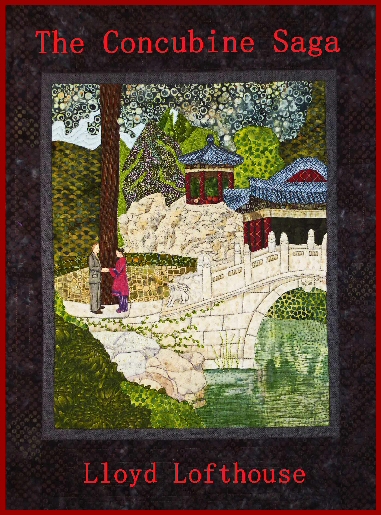
In addition, The Concubine Saga picked up an Honorable Mention in Fiction at the 2012 San Francisco Book Festival.

Lloyd Lofthouse served in the Vietnam War as a U.S. Marine and lives near San Francisco with his wife and family with a second home in Shanghai, China. As a former Marine, Lloyd earned a BA in Journalism and an MFA in writing. His Blog, iLook China.net, currently averages 600 views a day with more than 200,000 since its launch in January 2010. My Splendid Concubine.com, his Website, has had 72,000 visitors since December 2007. At Authors Den, his work has been viewed 336,000 times.

Virtual Author Book Tours.com arranged the June 2012 book tour of 27 book Blogs.

In addition, in 2008, following the launch of My Splendid Concubine, Lofthouse appeared as a China expert on more than 30 talk-radio shows from The Dr. Pat Show on KKNW 1150 AM in Seattle to The Smith and Riley Show on WFLF 540 AM in Orlando Florida.

The Concubine Saga
ISBN: 978-0-9819553-8-4

###


Country Driving in China with Peter Hessler – Part 2/2

May 29, 2012

In the first 122 pages of Country Driving, Peter Hessler sets out to drive the entire length of the Great Wall in a rented Chinese made Jeep Cherokee and he achieves his goal. In this section, I learned that the Wall was successful most of the time and not the failure historians claim it was. Yes, in several thousand years, the wall failed a few times but it served its purpose and did protect China’s heartland for centuries. Hessler says that there is no archaeologist in the world that has studied the history of the Great Wall but wrote there are amateur experts (we meet a few in this section along with a unique view of rural China) that have proven through historical research that the wall did work.

In Part II, Hessler takes us into a small village a few hours drive outside Beijing where he rents a house and becomes accepted by the insular-rural village community making friends and becoming involved personally with local families. The man that becomes his closest contact and friend in the village eventually joins the CCP (there are only about 80 million members in China) and then uses this to his advantage as he continues to improve the quality of his family’s lifestyle.

In Part III, Hessler travels to the city of Winzhou in Southern China where he spends time developing relationships with factory bosses and workers.  In this section, the Chinese people he meets are open and friendly. Hessler sees a side of China that few witness and it is obvious that the factory workers are not victims because of low pay and long hours of work but see this new life as an opportunity.


Peter Hessler discussing his novel “Oracle Bones”

When I finished Hessler’s memoir, I walked away feeling as if I had experienced an in-depth taste of the dramatic changes that have taken place in China since Mao’s death in 1976. Since China’s critics mostly focus on the negative, which is the corruption and/or authoritarian one-party system, and never admit the good that the CCP has accomplished, most people would not understand what I discovered.  To understand what I mean, one must compare China before 1949 with today by reading such books as those written by Hessler and his wife.

Before 1949, more than 90% of the people in China lived in severe poverty, more than 80% were illiterate, the average lifespan was 35, few people owned land, and the risk of death from famine had been an annual threat for more than two thousand years. In fact, most rural Chinese were treated as if they were beasts of burden and not human.

Today, about 13% live in severe poverty and those people mostly live in remote, rugged, difficult to reach areas of China.  The lifespan is now about 73 years and Helen H. Wang writing for Forbes.com (February 2011) reported that China’s middle class is already larger than the entire population of the United States and is expected to reach 800 million in fifteen years (2026). In addition, no one has died of famine since 1959-1961.

I highly recommend Country Living for anyone that wants to learn more about today’s dramatically changing China from an unbiased perspective.

Return to Country Driving in China with Peter Hessler – Part 1

______________

Lloyd Lofthouse is the award-winning author of The Concubine Saga. When you love a Chinese woman, you marry her family and culture too. This is the love story Sir Robert Hart did not want the world to discover.

Subscribe to “iLook China”!
Sign up for an E-mail Subscription at the top of this page, or click on the “Following” tab in the WordPress toolbar at the top of the screen.

About iLook China