The Complex Evolution of Sex in China

October 10, 2012

A Guest Post by Richard Burger of The Peking Duck

One of the questions I hear the most is whether the Chinese people’s attitude toward sex is conservative or open-minded. And the answer is that it’s complicated.

First, there is more than one China: there’s rich China and poor China, urban and rural China, young China and older China.

Generalizations are tricky, and there always have to be qualifiers. It’s safe to say that in the larger cities like Beijing and Shanghai people are far less hung up than they were about sex twenty years ago.

Even in most of the second-tier cities you’ll find gay bars, sex shops, young couples holding hands and a lot of young people finding one-night stands over the Internet.

Sexologist Li Yinhe estimates that more than 50 percent of young urban Chinese have premarital sex, something that was unheard of thirty-five years ago. In the countryside that number is probably far lower, but most young people are leaving their rural hometowns to find work in the larger cities.

At the same time, however, traditional Chinese beliefs still hold sway over many of these young people.

For example, sex is not something you talk about openly.

In addition, when it comes time to choose a spouse, nearly all young Chinese will include their parents in the process, striving to make it a family decision.

Many if not most husbands still place a high premium on virginity and expect to see blood on the sheets the night of their honeymoon. This attitude is so fixed that every year hundreds of thousands of Chinese women have an operation to restore their hymens, or buy inexpensive artificial hymens that seep artificial blood.

This is an anomaly: more Chinese young people are having premarital sex yet men still expect their wives to be virgins.

China is in a tug of war between its conservative past and the lure of Western-style sexual freedom.

Looking at the trends and how quickly China’s sexual revolution has progressed, I would have to predict that sexual openness and tolerance will increase, and eventually China will shake off the vestiges of the sexual puritanism that prevailed under Mao.

However, for now, sex remains a touchy subject, even in the cities. Sex education, for example, is mandatory but often biology teachers who are supposed to teach it are too squeamish and simply skip to the next chapter. When they do teach this subject, the focus is on biology and anatomy, with little or no reference to contraception or sexual morality, such as the woman’s right to say no.

Here, too, there are signs of improvement in the larger cities, but it is very slow going. Sex remains a taboo subject that most Chinese are not comfortable discussing outside of their bedroom.

Discover more of China’s Sexual Revolution

____________________________

Richard Burger is the author of Behind the Red Door: Sex in China, an exploration of China’s sexual revolution and its clash with traditional Chinese values.

Subscribe to “iLook China”!
Sign up for an E-mail Subscription at the top of this page, or click on the “Following” tab in the WordPress toolbar at the top of the screen.

About iLook China


The Orphan’s Life in China

October 9, 2012

More than ninety percent of babies in Chinese orphanages are girls. Prior to 1949, it was common for parents to murder girl infants. From the 1950s to the end of the 1970s, due to Mao’s leadership and a tough stance for women’s equality, the death rate went down. Then in the 1980s, with the population growing too fast, a desperate government implemented the one-child policy.

After that, many girl babies went missing or were abandoned to state-run orphanages. To end this tragedy, the government eventually allowed rural families to have two children per family—hoping for a boy.

The conditions in these rural, state-run orphanages are often not ideal. Girls, who are not adopted, usually end up being the caregivers for the younger children. Since these orphan caregivers were raised without the love of parents and siblings, they may not be loving themselves creating a cold environment to grow up in.


abandoned at birth

It isn’t as if China’s government has done nothing to stop a practice that has been around for thousands of years. During the 90s, tougher laws were passed but often ignored. Government inspectors were sent to rural areas to enforce these laws, but it isn’t easy controlling a population of 1.3 billion scattered over a mountainous country almost the size of the United States.

I will not criticize the Chinese government for these conditions. I’ve been to China and understand the challenges.

What would you do if you had inherited a medieval country in 1949 that was bankrupt due to the Kuomintang looting the banks and treasury as they fled to Taiwan under American protection?

Then there is a culture reaching back thousands of years where girls were considered worthless. That is a lot to overcome.

Learn of Gendercide in China and India, and also discover the heart-breaking story of one orphan’s journey in Saying Goodbye

______________

Lloyd Lofthouse is the award-winning author of The Concubine Saga. When you love a Chinese woman, you marry her family and culture too. This is the love story Sir Robert Hart did not want the world to discover.

Subscribe to “iLook China”!
Sign up for an E-mail Subscription at the top of this page, or click on the “Following” tab in the WordPress toolbar at the top of the screen.

About iLook China


China’s Huangmei Opera

October 8, 2012

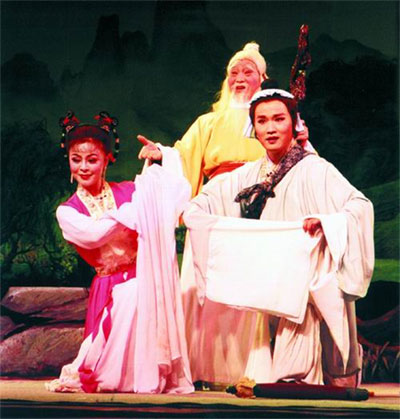
Anqing, in Anhui Province, is regarded as the hometown of Huangmei Opera and Hui Opera. Anqing was first built in 1217 and is almost eight-hundred years old, but Huangmei Opera first appeared about two centuries ago as a simple drama of song and dance.


Huangmei Opera Troupe

Huangmei opera did not involve the traditional opera gestures which often-used sleeves and step movements. The music is performed with a pitch that hits high and stays high and does not sound like the typical rhythmic Chinese opera.

The fairy tale of the Cowherd and the Weaving Girl is one of the four most famous folktales of ancient China. It is a classic love story between a fairy and a human being and has a widespread influence. The Qixi Festival is said to have something to do with the fairy tale, and the seventh day of every seventh month of the lunar calendar has become the Chinese Valentine’s Day.

Chinese opera together with Greek tragic-comedy and Indian Sanskrit Opera are the three oldest dramatic art forms in the world.

Discover Peking Opera

______________

Lloyd Lofthouse is the award-winning author of The Concubine Saga. When you love a Chinese woman, you marry her family and culture too. This is the love story Sir Robert Hart did not want the world to discover.

Subscribe to “iLook China”!
Sign up for an E-mail Subscription at the top of this page, or click on the “Following” tab in the WordPress toolbar at the top of the screen.

About iLook China


Chinese Police Officer in Action

October 2, 2012

One summer while we were in Beijing, a friend of my wife told us about an incident her neighbor was involved in.  The neighbor was a single man in his forties. His former girl friend was in her early twenties, who called the police from his apartment.

“He raped me. Arrest and punish him,” she said to the officer. The neighbors crowded the hall outside the open door to witness what was happening. The officer heard both sides. There was no rape. It turned out that the woman had discovered he had two other girlfriends.

“He asked me to strip,” she said. “He is corrupt.”

The officer studied her and then the man—the woman was taller and twenty pounds heavier. “You have legs. You could leave. But you stripped. Is that correct?”


Chinese Police in court with a Murder Suspect

There was the sound of laugher from the hallway audience. My wife’s friend was one of them.

The soon-to-be former girl friend nodded.

“No laws have been broken,” the police officer said. “He is a single man and can date anyone he likes. You could have said no. If you feel that you have been abused, there’s a woman’s organization that will help you. Do you want the phone number?”

“I already went to them. They won’t punish him either.”

The officer shook his head. “You will never come to this apartment again,” the officer said, as he wrote his verdict in a notebook.

China’s police do not have to read a suspected criminal his or her Miranda rights. In China, the police have more power. We often hear about China’s human rights violations. Read China’s response in China chides U.S. on rights record.

Maybe that difference helps explain why the United States has a prison population of 743 for each 100,000 of national population (total of 2,293,133) and China has 122 per 100,000 (1,650,000). The only country close to the United States is the Russian Federation with 568 in prison of each 100,000.

Discover more about China’s Legal system or learn about Tom Carter’s first-hand experience with Crime in China.

______________

Lloyd Lofthouse is the award-winning author of The Concubine Saga. When you love a Chinese woman, you marry her family and culture too. This is the love story Sir Robert Hart did not want the world to discover.

Subscribe to “iLook China”!
Sign up for an E-mail Subscription at the top of this page, or click on the “Following” tab in the WordPress toolbar at the top of the screen.

About iLook China


TABOO IS THE NEW NORMAL

October 1, 2012

A review of “Behind the Red Door” by Richard Burger
Review by Tom Carter

Among the many misimpressions westerners tend to have of China, sex as some kind of taboo topic here seems to be the most common, if not clichéd.  Forgetting for a moment that, owing to a population of 1.3 billion, somebody must be doing it, what most of us don’t seem to know is that, at several points throughout the millennia, China has been a society of extreme sexual openness.

And now, according to author Richard Burger’s new book Behind the Red Door, the Chinese are once again on the verge of a sexual revolution.

Best known for his knives-out commentary on The Peking Duck, one of China’s longest-running expat blogs, Burger takes a similar approach to surveying the subject of sex among the Sinae, leaving no explicit ivory carving unexamined, no raunchy ancient poetry unrecited, and, ahem, no miniskirt unturned.

Opening (metaphorically and literally) with an introduction about hymen restoration surgery, Burger delves dàndàn-deep into the olden days of Daoism, those prurient practitioners of free love who encouraged multiple sex partners as the ultimate co-joining of Yin and Yang.  Promiscuity, along with prostitution, flourished during the Tang Dynasty – recognized as China’s cultural zenith – which Burger’s research surmises is no mere coincidence.

Enter the Yuan Dynasty, and its conservative customs of Confucianism, whereby sex became regarded only “for the purpose of producing heirs.”  As much as we love to hate him, Mao Zedong is credited as single-handedly wiping out all those nasty neo-Confucius doctrines, including eliminating foot binding, forbidding spousal abuse, allowing divorce, banning prostitution (except, of course, for Party parties), and encouraging women to work.  But in typical fashion, laws were taken too far; within 20 years, China under Mao became a wholly androgynous state.

We then transition from China’s red past into the pink-lit present, whence prostitution is just a karaoke bar away, yet possession of pornography is punishable by imprisonment – despite the fact that millions of single Chinese men (called bare branches) will never have wives or even girlfriends due to gross gender imbalance.

Burger laudably also tackles the sex trade from a female’s perspective, including an interview with a housewife-turned-hair-salon hostess who, ironically, finds greater success with foreigners than with her own sex-starved albeit ageist countrymen.

Western dating practices among hip, urban Chinese are duly contrasted with traditional courtship conventions, though, when it comes down to settling down, Burger points out that the Chinese are still generally resistant to the idea that marriage can be based on love.  This topic naturally segues into the all-but-acceptable custom of kept women (little third), as well as homowives, those tens of millions of straight women trapped in passionless unions with closeted gay men out of filial piety.

Behind the Red Door concludes by stressing that while the Chinese remain a sexually open society at heart, contradictive policies (enforced by dubious statistics) designed to discard human desire are written into law yet seldom enforced, simply because “sexual contentment is seen as an important pacifier to keep society stable and harmonious.”

____________________________

Travel Photographer Tom Carter traveled for 2 years across the 33 provinces of China to show the diversity of Chinese people in  China: Portrait of a People, the most comprehensive photography book on modern China published by a single author.

Also by Tom Carter Eating Smoke — a question and answer with author, Chris Thrall in addition to Harlequin Romance Invades China

If you want to subscribe to iLook China, there is a “Subscribe” button at the top of the screen in the menu bar.

Note: This guest post by Tom Carter first appeared in China in City Weekend Magazine. Reblogged with permission of Tom Carter. Behind the Red Door was published by Earnshaw Books