Did you know that Christmas is celebrated in Communist China?

December 20, 2017

I don’t read or speak Mandarin and a few years ago in early December an e-mail arrived that was in Mandarin and there was a link to a video and other attachments.

Since I learned the hard way years earlier that you don’t open an attachment from an e-mail when you don’t know where it’s from, I waited until Anchee read it and said it was from one of our daughter’s grandfathers in China.

Inside the attached file were twelve virtual Christmas cards in English with flashing Christmas lights in winter settings. There was also a link to a video where people in China were being asked questions about celebrating Christmas.

Daughter’s grandpa lives in Shanghai, and the city’s shopping malls were decorated for Christmas. It seems that many Shanghai Chinese adopted the Christmas holiday and take it seriously even giving gifts.

One Chinese man in the linked video said, “Perhaps because Shanghai is quite an international city, we attach much importance to this festival and celebrate it in a grander manner compared to other cities in China.”

A young Chinese woman said, “If you live overseas for a long time, you will know that this is the time to reunite with your friends and exchange Christmas presents with those you know.”

The twelve virtual Christmas cards our daughter’s grandfather attached to his e-mail said:

  1. “Remember… Through the year, be thankful for what you have…”
  2. If you have food in the refrigerator, clothes on your back, a roof overhead and a place to sleep… You are richer than 75% of the world.”
  3. “If you have money in the bank, in your wallet, and spare change in a dish some place, you are among the top 8% of the world’s wealthy.”
  4. “If you woke up this morning with more health than illness… You are more blessed than the million who will not survive this week.”
  5. “If you have never experienced the danger of battle, the loneliness of imprisonment, the agony of torture, or the pangs of starvation… You are ahead of 500 million people in the world.”
  6. “If you can attend a church meeting without fear of harassment, arrest, torture, or death… You are more blessed than three billion people in the world.”
  7. “If your parents are still alive and still married… You are very rare, even in the United States.”
  8. “If you hold up your head with a smile on your face and are truly thankful… You are blessed, because the majority can, but most do not.”
  9. “If you can hold someone’s hand, hug them or even touch them on the shoulder… You are blessed because you can offer healing touch.”
  10. “If you can read this message, you just received a double blessing that someone was thinking of you, and furthermore … You are more blessed than over two billion people in the world that cannot read at all.”
  11. “Have a good day, count your blessings, and pass this along to remind everyone else how blessed we all are. You are wished a Merry Christmas.”
  12. “Remember … throughout the year, be thankful for what you have been blessed with …”

This e-mail came from a grandfather that fought on the winning side of China’s Civil War (1925 – 1949), and then he held an important position in China’s Communist Party until he retired at 67 (as the 1982 Chinese Constitution requires).

Country Digest says that Shanghai has a population of more than 24-million people, and only 2.6-percent (624k) are Protestants and Catholics.


There are Chinese and expatriates who celebrate Christmas in Beijing too.

中

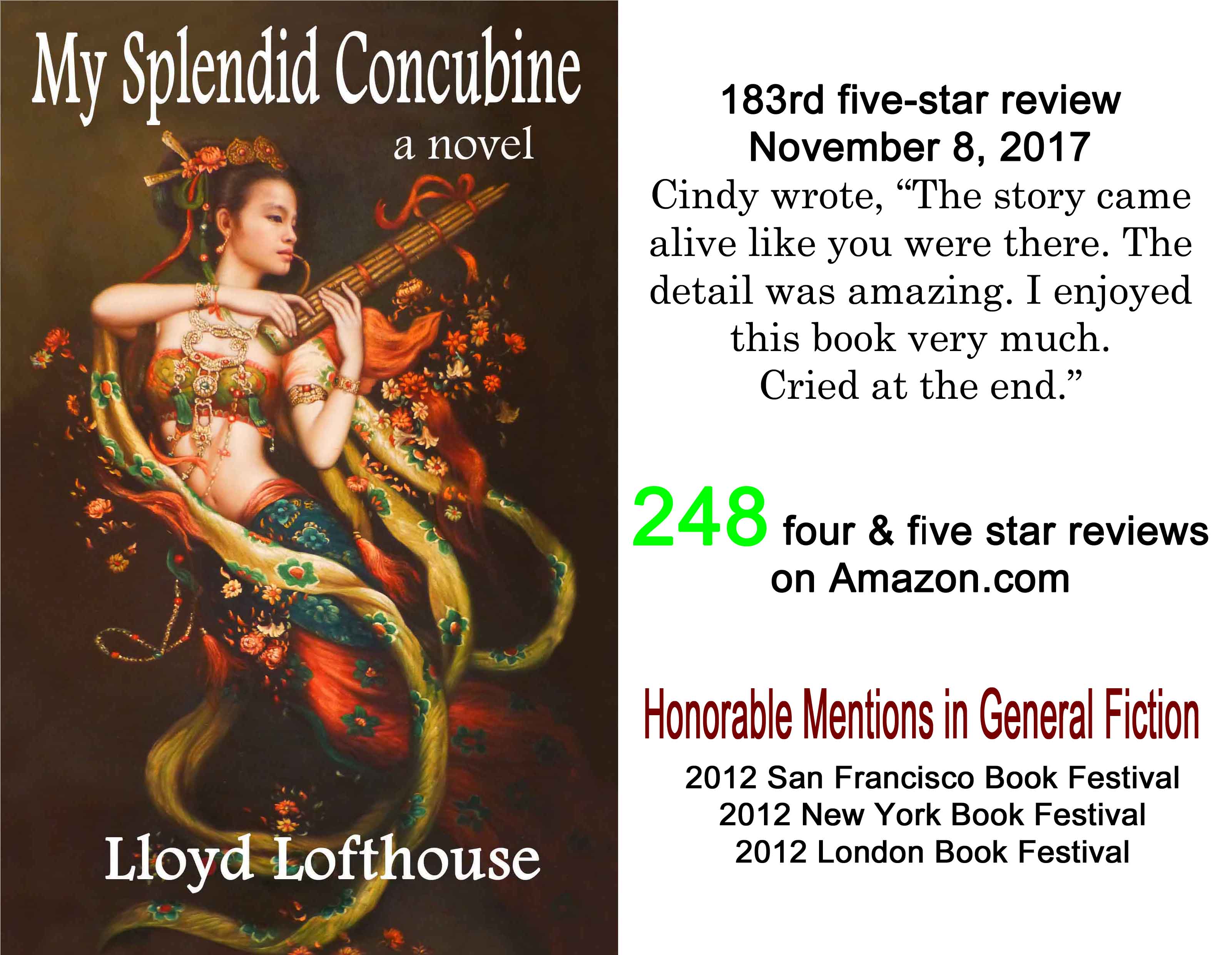
Lloyd Lofthouse is the award-winning author of My Splendid Concubine, Crazy is Normal, Running with the Enemy, and The Redemption of Don Juan Casanova.
Where to Buy

Subscribe to my newsletter to hear about new releases and get a free copy of my award-winning, historical fiction short story “A Night at the Well of Purity”.

About iLook China

China’s Holistic Historical Timeline


China after the Han Dynasty during the Three Kingdoms (220-265 AD)

December 19, 2017

I enjoy reading historical fiction. I also watch movies and TV series based on history. For instance, I recently watched the BBC’s Season 2 for The Last Kingdom (this one doesn’t take place in China).

Back in 2008, I bought the first version of the TV series for The Romance of the Three Kingdoms (1995), an epic about China’s history that has 84 episodes (45 minutes each for 63-hours). Based on the classical novel by Luo Guanzhong, this epic series covers the end of the Han Dynasty.


This episode with English subtitles is from a remake (2010) of the TV series.

Don’t let the title fool you. This story is not about romance as Westerners define that word. This historical fiction, based on fact, is about the romance of politics, war, and conquest. But don’t be disappointed, because there’s even a love story that comes with the ultimate sacrifice.

The novel was written in the 14th century and was more than a thousand pages long with 120 chapters. The translated English version is longer. After the Han Dynasty collapsed (206 BC to 219 AD), China shattered into three warring kingdoms.

This story is about how China was reunified as one nation again a few decades after the collapse of the Han Dynasty (205 B.C. – 220 A.D. I’ve seen the entire series once and plan to watch it again. When Jesus Christ was born, the Han Dynasty was more than 200 years old and had more than two hundred years left before it came to an end.

Discover China’s First Emperor Qin Shi Huangdi, the man that unified China more than 2,000 years ago.

中

Lloyd Lofthouse is the award-winning author of My Splendid Concubine, Crazy is Normal, Running with the Enemy, and The Redemption of Don Juan Casanova.

Where to Buy

Subscribe to my newsletter to hear about new releases and get a free copy of my award-winning, historical fiction short story “A Night at the Well of Purity”.

About iLook China

China’s Holistic Historical Timeline


China’s Film Industry Expanding around the World

December 12, 2017

Early this year, Time Magazine reported How China Is Remaking the Global Film Industry. “Chinese companies have snapped up Hollywood studios, theaters and production companies. Last year Dalian Wanda Group, the Chinese real estate and entertainment conglomerate, announced it was buying Legendary Entertainment studio — producer of blockbusters like Jurassic World — for $3.5 billion …”

For instance, The Great Wall, starring William Dafoe, Matt Damon and Pedro Pascal and produced by China’s Zhang Yimou cost $150 million to make, but only made about $45 million in the United States while raking in more than $289 million outside of the U.S.  The money for this film came from China.  I saw the film, and I enjoyed it. If you know about China’s Great Wall, imagine what it must have been like when it was still being used long before it became a tourist attraction. This film gives us an idea of what that must have been like even if the film was based on fiction.


There are more videos on YouTube with other segments from the film.

It also appears that the Chinese government has done some forgiving.  RealFilmCareer.com reports, “Zhang Zhao fled China for the U.S. soon after the crushing of the 1989 student democracy movement. But Mr. Zhang returned to China in 1998, and now he’s the man with the money: As head of Enlight Pictures, a unit of Enlight Media and one of the new film companies aspiring to tell Chinese stories to a rapidly expanding domestic audience, he has plans for an initial slate of 40 movies, and no problem with financing.”

Then there is Huayi Brothers Media, which the May issue of “The Hollywood Reporter” says raised $160 million in an IPO on the Zhenzhen stock exchange.  The Huayi brothers have already released over 50 films, most of them huge box office hits in China.

“Five years ago,” Wang Zhongjun said, “we hoped (the Hollywood studios) could bring us support and investments. Now we’re helping them,” reports The Hollywood Reporter. In 2016, China’s box office total was $6.58 billion.

Discover Anna May Wong, the American actress who died a thousand times.

中

Lloyd Lofthouse is the award-winning author of My Splendid Concubine, Crazy is Normal, Running with the Enemy, and The Redemption of Don Juan Casanova.

Where to Buy

Subscribe to my newsletter to hear about new releases and get a free copy of my award-winning, historical fiction short story “A Night at the Well of Purity”.

About iLook China

China’s Holistic Historical Timeline


Sipping Tea in China

December 6, 2017

The Chinese invented tea.  Then thousands of years later, the British stole the secrets of tea making, and you can read about that theft in For All the Tea in China: How England Stole the World’s Favorite Drink and Changed History.

However, whenever I’m in Shanghai, I enjoy visiting this shopping area. Go early; it gets crowded.

The Huxinting Teahouse has been around for a long time, and the last time this pavilion was restored was in 1784.  Then it was turned into the tea house in 1855.

The area in Shanghai around the Huxinting Teahouse is a good place to shop. Hint, do not pay asking prices. Be willing to bargain.  Start low and meet in the middle. Don’t be too cheap either, because the business you are buying from has to earn enough money to survive too.

And if you want to read my review of “For All the Tea in China”, click the link in this sentence.

To learn more about Shanghai, also click and read:
Shanghai
Shanghai’s History & Culture
Shanghai Huangpu River Tour
Eating Gourmet in Shanghai
Chinese Pavilion, Shanghai World Expo

Discover Wu Zetian, China’s only female emperor

中

Lloyd Lofthouse is the award-winning author of My Splendid Concubine, Crazy is Normal, Running with the Enemy, and The Redemption of Don Juan Casanova.

Where to Buy

Subscribe to my newsletter to hear about new releases and get a free copy of my award-winning, historical fiction short story “A Night at the Well of Purity”.

About iLook China

China’s Holistic Historical Timeline


Homosexuals and Transsexuals don’t have it easy in China

November 29, 2017

A Guest Post by Richard Burger of The Peking Duck

Like homosexuals, transsexuals, too, have a difficult time in China. The first male-to-female transsexual surgery was performed in 1983 at the Third Hospital of Beijing Medical University. But most transsexuals are turned down for the operation, and the number of those who undergo surgery is estimated at one thousand although more than three thousand apply each year.

Applicants must undergo a battery of tests and psychiatric evaluations and prove they have wanted the operation for at least five years. Explaining their situation to parents and family is next to impossible, and that further dissuades many transsexuals from applying. Those who go ahead with the sex change usually leave their hometowns to avoid discrimination.

The price, which can range from 57,000 yuan to 76,000 yuan ($9,000 to $12,000), is another deterrent.

China has the medical facilities to easily perform both male-to-female and female-to-male operations, but the problem is one of ideology.

Like homosexuality, transsexualism is viewed by many as a form of spiritual pollution imported from the West. There is a profound lack of understanding about transsexualism and, subsequently, a lot of discrimination.

One notable example of a transsexual who has been accepted by the Chinese people is the world-famous Jin Xing, born as a male to ethnic Korean parents in 1967 in the industrial city of Shenyang.

A talented dancer, at the age of nine Jin joined the People’s Liberation Army’s dance troupe and rose up the ranks to become a colonel.

However, from an early age Jin had felt she was a woman.

After ten years of traveling around the world performing and teaching dance, she underwent a sex-change operation in 1996 at the age of 29. She now lives in Shanghai with her German husband and works as a choreographer and dance trainer.

Jin was brought to front pages around the world in the fall of 2011 when she was dropped as a judge of a Chinese reality TV show because she was transgendered. She spoke out to the Chinese media, condemning the prejudice of local officials in Zhejiang province who insisted she be thrown off the show.

She is one of China’s most renowned celebrities and is credited with giving a face to transsexualism and helping raise public acceptance of a person’s right to undergo a sex change.

____________________________

Richard Burger is the author of Behind the Red Door: Sex in China, an exploration of China’s sexual revolution and its clash with traditional Chinese values.

Subscribe to “iLook China”!
Sign up for an E-mail Subscription at the top of this page, or click on the “Following” tab in the WordPress toolbar at the top of the screen.

About iLook China