China’s Stick People

May 11, 2010

I’m always looking for information about China, and I hit gold with the May 8 The Economist. Click the link to read the entire piece or read this summary. I bought the magazine.

China has two classes—rural and urban.  The urban people have prospered for the last thirty years as China built a middle class.  Most rural Chinese have not been able to benefit from the booming economy and are getting restless.

Rural China

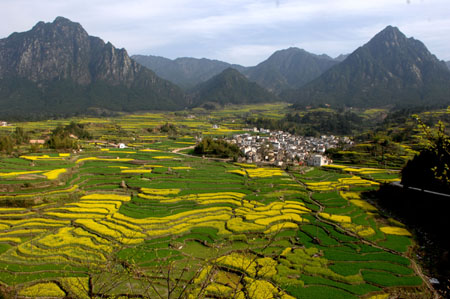
Rural land outside China’s cities belongs to collectives. When Mao won China, the Communists divided the land among villages—not individuals. Individuals do not hold title to farmland and cannot sell land that no one owns.

China saw what was happening in India when farmers sold their plots to developers.  Rural people in India flocked to the cities and built sprawling slums. To avoid that, the Chinese government created a system to keep rural people on their farms.  Another motivation was fear of another famine like the one that struck China from 1959 to 1961 killing millions from starvation. If farmers left the fields for a better lifestyle in cities, that nightmare might return.

Currently, an experiment is being tried in rural areas outside Chongqing to see if the land can be divided among individuals while increasing food production. Since the government still hasn’t figured out how to make the transition smoothly, don’t expect rural land reforms to happen quickly.

Discover China’s middle class expanding

_______________

Lloyd Lofthouse is the award-winning author of My Splendid Concubine [3rd edition]. When you love a Chinese woman, you marry her family and culture too. This is the love story Sir Robert Hart did not want the world to discover.

Subscribe to “iLook China”!
Sign up for an E-mail Subscription at the top of this page, or click on the “Following” tab in the WordPress toolbar at the top of the screen.

About iLook China


Freedom’s Evolution

May 11, 2010

A debate took place on Left of the Right, not by Devin Barber, the Blog’s host, but between me and another person who called him or herself Timothy. This person made comments calling me an asshole and a propaganda spewing scumbag among other insults, because he disagreed with my opinions regarding China even though I supported most or all of my opinions with facts. You may read the entire debate by clicking on the above link to see an example of Timothy’s conservative beliefs.

One of my last responses was a comparison between America and China and the trail to freedom that both counties have followed and are still traveling. What follows is a slightly edited version.

In 1781, the American War for Independence from the British Empire ended, but there was still slavery in the Southern States.

American Revolution

In 1861 to 1865, (eight-four years after America’s revolution) America divided and fought a bloody Civil War that ended slavery. More than six hundred thousand Americans died in that conflict. 

However, women still could not own property or vote. Women were considered chattel.  The women’s rights movement started in 1848. In 1920 (seventy-two years later), the 19th Amendment to the US Constitution granted women the vote.

American history is full of facts about how people of color were discriminated against and were second-class citizens until the Civil Rights Movement between 1955 to 1968.  It took one-hundred-and-three years after the end of slavery to end discrimination against people of color—at least legally.

_________________

The bloody and painful evolutionary trail to freedom in China started in 1913 when warlords ended Imperial rule.  Eventually a dictatorship replaced the warlords.  The Kuomintang under Chiang Kai-shek was a dictatorship under martial law even in Taiwan until the 1980s when the first election was held there.

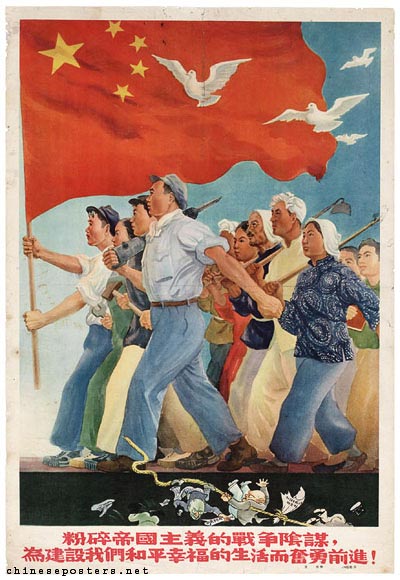
Another step back was World War II with the Japanese invading China that cost about 30 million Chinese their lives. That ended in 1945, followed by the revolution between the Communists and Kuomintang dictatorship.  Soon after Mao won that revolution in 1949 and took over China to become China’s modern emperor for twenty-seven years, he declared that women were equal to men.  Then there was the Great Leap Forward, which was more like two leaps back followed by the Cultural Revolution that cost another thirty-seven million Chinese their lives.
Chinese Revolution

After Mao died in 1976, the Communist Government under Deng Xiaoping’s guidance rewrote their constitution, repudiated Marxist, Maoist revolutionary doctrine and opened China to the world launching a market economy, which is on steroids today.

Since that new start, amendments have been added to the Chinese Constitution. Read it carefully and you will see that freedom of speech in China is limited by a constitution that is taught in the schools and in the factories. Although some Chinese dissidents have been arrested for speaking and jailed with other criminals, 98.8% of the population remains free and appears to have no problem obeying that law.

America’s journey to become a nation where ALL citizens are protected by the Bill of Rights took one-hundred-and-eight-seven years from 1781 to 1968.

China, after Mao, has had only thirty-four years to evolve.  Who knows where China will be in another century and a half. Timothy sees the glass half-empty. Since I watch China, I’ve seen the small steps that China has been taking, and I see the cup half-full and improving with time. I hope I’m right, because Timothy seems to believe that China is evil and will invade the United States in a few decades. What do you think?

____________________________

Lloyd Lofthouse is the author of the award winning novels My Splendid Concubine and Our Hart. He also Blogs at The Soulful Veteran and Crazy Normal.

Sign up for an RSS Feed for iLook China

Confucius Returns

May 11, 2010

Confucianism is making a comeback in modern China. For the government, the philosophy’s emphasis on respect for authority appeals to the Communist Party. For parents, Confucianism is a way to raise obedient children who won’t forget their culture. Source: Chinh’s news

If you followed the series about Confucius in this Blog, you may be interested in the film with Chow Yun-Fat that was released in China in January 2010. Trailer: First-Showing.net

Chow Yun-Fat as Confucius

The movie was filmed in Hebei province, and its release marked the 60th anniversary of the People’s Republic of China and Confucius’ 2,560th birthday. The movie comes amid a surge in interest in the philosopher, who was practically outlawed during Mao’s Cultural Revolution. However, as China’s recent economic boom put stress on the country’s Marxist ideologies, officials began to promote Confucian virtues as a way of addressing the gap between the rich and poor. Source: BBC

However, Murphy’s Law says, “Anything that can go wrong, will go wrong”. Kong Jian, claiming he is a direct descendent of Confucius, filed a lawsuit demanding that scenes be removed from the film that do not depict Confucius as he was in real life. Source: Global Times

Confucius was a scappy guy, so it makes sense that anyone with his DNA, no matter how far removed, would be the same.

____________________________

Lloyd Lofthouse is the author of the award winning novels My Splendid Concubine and Our Hart. He also Blogs at The Soulful Veteran and Crazy Normal.

Sign up for an RSS Feed for iLook China


Update on China’s Health Care

May 10, 2010

Under the old socialist system, China had grave-to-cradle health care that improved life expectancy from 35 in 1952 to 69 in 1982 despite limited resources.

After the transition to a market economy in the late 1970s, the old health care system was dismantled. In urban areas, hospitals had to operate independently.

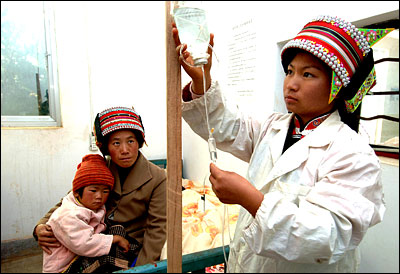
In rural areas, the “Barefoot Doctors” lost incentives to carry on the old practices and either became profit-driven or changed professions. Source: Minnesota 2020

In 2005, China launched a new health care plan, The New Rural Co-operative Medical Care System. However, major medical care is still centered in the larger cities.

One reason is that most doctors do not want to live in rural China. Source: Healthcare reform in the People’s Republic of China

Vineet Arora, MD wrote on Kevin MD.com that she and her husband spent four days visiting the Wuhan Medical School in Hubei Province in Central China. She learned that Chinese medical students watched Grey’s Anatomy and House, MD and wondered if that is what practicing Western medicine was like…

One of the interns said she lives at the hospital (in a dorm) working 6 days a week with one day off working roughly 70-80 hours per week….

Interns and doctors in America and other Western countries work similar hours increasing the risk of making mistakes.

In China, rural health care tends to be traditional while health care in the cities blends in Western style medicine.

Learn more about Attitudes Toward Health in China

______________

Lloyd Lofthouse is the award-winning author of the concubine saga, My Splendid Concubine & Our Hart. When you love a Chinese woman, you marry her family and culture too.

If you want to subscribe to iLook China, there is a “Subscribe” button at the top of the screen in the menu bar.


Food and China’s Eating Culture

May 10, 2010

China is an eating culture and always has been.  Although Today’s Chinese do not eat the quantities of meat the average American does, China accounts for half of global pig production because pork is the popular meat to eat.  Small farmer producers raise ninety-nine percent of pork in China. Source: China Translated

Chinese Farmer

Even when grain production falls in China that does not translate into a shortage since China has historically kept large food-grain stockpiles and those individual small farmer/producers help ensure food security. Source : China Through a Lens

As China’s economy continues to grow a spreading middle class with money to spend, food demand and eating habits are changing along with waistlines.  To meet this demand, Chinese have set up large pork and chicken operations in Australia to meet the growing demand for meat on the mainland. Source: Food Crisis

To insure a dependable supply of food to feed 1.3 billion people, Chinese companies have also bought or leased land in Africa sending Chinese laborers to produce crops for sale on the world market – and back home.  Source: Telegraph.co.uk

Discover Tofu

______________

Lloyd Lofthouse is the award-winning author of the concubine saga, My Splendid Concubine & Our Hart. When you love a Chinese woman, you marry her family and culture too. 

If you want to subscribe to iLook China, there is a “Subscribe” button at the top of the screen in the menu bar.