History’s Meaning of the Mandate of Heaven – Part 2/5

October 14, 2010

In the last few years, China has revived some of the old Confucian traditions that were stopped during the Cultural Revolution.

Today, actors reenact the ancient traditions for tourists and many of the tourists are Chinese, who are rediscovering roots not seen since 1949.

The Chinese Communists believed they could do away with the old traditions and replace them with something new.

However, just when they thought they had shaken it, it appears that the past has found a way of returning.

The ancient Chinese believed that earth, nature and the cosmos were part of a harmonious natural order, the Tao or Path.


The search for the right path, Taoism, is the second-great stream of Chinese thought — a natural mysticism beside the natural common sense of Confucius, which wasn’t an alternative, but the other half of a necessary life balance.

Western culture sees nature in terms of control and exploitation. However, to the Chinese, it is the source of all harmony and balance.

The little Taoist Temple on the top of sacred Taishan Mountain was wrecked during the Cultural Revolution. Now, it has been rebuilt and real Taoist monks and nuns returned in 1985 to live there and be committed to the old ways.

More than two thousand years ago, after the Silk Road opened, the Chinese gained the wisdom of the Buddha.

To the Chinese, the Western concept of God was foreign, but Buddhism, with its atheistic and democratic message and deep care for ritual was different.

Buddhism was the third-great stream making up the current of Chinese civilization.

Along with Confucian wisdom and Taoist mysticism, it was believed that these three philosophies contained the essential ideas of civilization and without them, life would be unbalanced.

Return to History of the Mandate of Heaven – Part 1

______________

Lloyd Lofthouse is the award-winning author of the concubine saga, My Splendid Concubine & Our Hart. When you love a Chinese woman, you marry her family and culture too. 

If you want to subscribe to iLook China, there is a “Subscribe” button at the top of the screen in the menu bar.


History’s Meaning of the Mandate of Heaven – Part 1/5

October 14, 2010

China was the last of the great civilizations to develop independently in the old world — a thousand years after the first civilization in Iraq.

However, the Chinese concept of civilization differed completely from that of the West. For the Chinese, the goal was a moral order on earth sustained by virtue, ritual and reverence of ancestors.

These ancient ideas permeated all aspects of Chinese life even to this day. 

Even the Communist revolution to the crushing of the so-called democracy movement in 1989, played out against these deeper forces, which have shaped China for thousands of years.

The discovery of the origins of Chinese history took place in 1899, when a Chinese scholar found a few (dragon) bones with engravings on them. 

His search for the source of the bones took him to the site of the ancient capital of the Shang Dynasty (1766 – 1122 B.C.).


Chinese civilization first arose on the banks of the unpredictable Yellow River, which has destroyed cities and killed millions.

Along the banks of this river, unlike Western civilizations, the source of political power did not lie in control of nature but in control of the past.

In the strange markings on the dragon bones, the Chinese scholar found the beginning of the I-Ching, the great Chinese book of wisdom.

Then there was Confucius.

The teachings of Confucius (551 – 470 B.C.) were the ideal of Chinese government for two thousand years, and Confucius was not concerned with God or the afterlife or heaven as those in the West were and still are today.

Instead, Confucius wanted to build a just and stable society. He believed that goodness was most important, and if people were taught goodness, they would regulate themselves.

For the rulers, to ignore this meant risking losing the Mandate of Heaven, which even the Communist Party that rules China today has discovered.

______________

Lloyd Lofthouse is the award-winning author of the concubine saga, My Splendid Concubine & Our Hart. When you love a Chinese woman, you marry her family and culture too. 

If you want to subscribe to iLook China, there is a “Subscribe” button at the top of the screen in the menu bar.


Comparing India and China’s Economic Engines

October 13, 2010

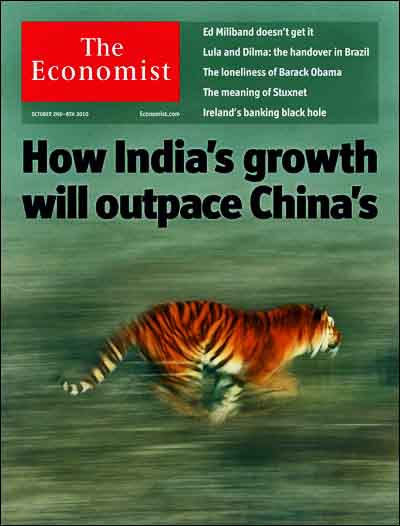
The cover for The Economist of October 2 – 8, 2010, is betting on a race that cannot be won by India.


I opened the magazine and read the two pieces that the cover was about.  One is about India’s surprising economic miracle and the second piece was A bumpier but freer road.

On page 11, I read, “many observers think China has done a better job than India of curbing corruption…”

On page 77, a Western banker was quoted saying, “It’s much easier to deal with the well-understood ‘org chart’ of China Inc than the freewheeling chaos of India.”

After reading both pieces comparing China with India, it was obvious that India would never beat China economically.

The Economist wants India to win this race, because it is called a democracy as is the U.S., but what isn’t mentioned is that China is becoming a republic with a Chinese twist, which is what Dr. Sun Yat-sen wanted.

The reason The Economist is wrong about India is because America’s Founding Fathers hated democracy and they had a good reason.

The Live Journal goes into detail on this topic.  To quote the Live Journal, “It would be an understatement to say that the (U.S.) Founding Fathers hated democracy. They warned against it vehemently and relentlessly. They equated it – properly – with mob rule.

“in a democracy, two wolves and a sheep take a majority vote on what’s for supper, while in a constitutional republic (which China is becoming), the wolves are forbidden on voting on what’s for supper and the sheep are well armed.…

“The Founders, who hated democracy, gave us a free country (a republic). Our (meaning many Americans) ignorance of history, which has lead to a love of democracy, is causing us to surrender our freedoms at an alarming rate.”

Dr. Sun Yat-sen (1866 – 1925), known as the father of modern China, said he wanted to model China’s government after America but by combining Western thought with Chinese tradition.

When he said this, it was 1910, and America, by definition, was still a republic. Once you read the two pieces in The Economist, you may understand why India’s democracy cannot beat China’s evolving republic.

This topic is continued (with more details and facts) at India Falling Short

_______________

Lloyd Lofthouse is the award-winning author of My Splendid Concubine [3rd edition]. When you love a Chinese woman, you marry her family and culture too. This is the love story Sir Robert Hart did not want the world to discover.

Subscribe to “iLook China”!
Sign up for an E-mail Subscription at the top of this page, or click on the “Following” tab in the WordPress toolbar at the top of the screen.

About iLook China


A Foul Taste in the Mouth of a Falun Gong Fanatic

October 13, 2010

On October 5, a comment appeared from someone called JJYZ to The Falun Gong Machine , which appeared in June 2010.

JJYZ says, “I leave this discussion with a foul taste in my mouth.” He or she also says, “Lloyd (me) has swallowed CCP propaganda hook, line, and sinker.” (This post is a short version of a reply to JJYZ’s comment)

I have news for JJYZ. My opinions formed from direct interactions with the Falun Gong.

I’ve had Falun Gong members sitting around my kitchen table. I’ve attended a Falun Gong Chinese New Year’s musical production at a theater in San Francisco and discovered that it was propaganda designed to recruit and retain religious cult members

I’ve also written other posts on the topic of Chinese religious cults: The Millennium Cult and The White Lotus Mutation.

JJYZ provides a link to a site called “defend democracy.org”, which doesn’t make much sense unless it is another gear in the Falun Gong running machine.

China has NEVER been a democracy so what is there to defend against. In 1982, the structure of China’s government became a one party republic, which offers more representation than any government in China’s history.

In fact, Chinese culture has never accepted organized religions or cults as a permanent element of the culture as the West and the Middle East have done.

There were four Buddhist persecutions in China carried out between the fifth through the tenth centuries by four Chinese emperors. Source: Four Buddhist Persecutions in China

The most brutal was in 845 AD by Emperor Wuzong of the Tang Dynasty. He decided that the Buddhists were growing too influential and wealthy so he outlawed the religion.

Wuzong also persecuted Christians, Muslims, Jews and other organized religions.

As for the bad taste in JJYZ’s mouth, this symptom may be a side effect of being brainwashed by a religious cult and becoming a fanatic.

______________

Lloyd Lofthouse is the award-winning author of the concubine saga, My Splendid Concubine & Our Hart. When you love a Chinese woman, you marry her family and culture too. 

If you want to subscribe to iLook China, there is a “Subscribe” button at the top of the screen in the menu bar.


Influenced by the Mandate of Heaven

October 13, 2010

Although I wrote on the Mandate of Heaven in April, I didn’t see how deeply that belief was influencing China’s Communist Party.

The epiphany took place soon after reading page 235 in Living With Evolution.

At the same time, I realized that America’s judgment of China’s Communist Party was in part due to half a century of entitlement programs for minorities and the disadvantaged in the U.S. — often rewarding those who were less qualified and punishing those who were successful through merit by holding him or her back.

However, in China after Mao was gone and Deng Xiaoping opened the country to world trade, meritocracy was back with a vengeance.

Meritocracy is a system in which the talented succeed and move ahead based on his or her achievement.

The Chinese for almost four thousand years believed that humans were responsible for how events unfolded on earth with human actions subject to the approval or disapproval of heaven.

Successful actions were held to be those that heaven approved of and unsuccessful actions were held to be those heaven did not approve of.

What this means is that anyone, regardless of his or her social status could challenge the elite and rise to the top on the claim that it was legitimate according to the Mandate of Heaven — a concept that was also quintessentially meritocratic.

This explains why China’s central government treats political and/or religious activists, who challenge the status quo, so harshly. 

If the Communist Party allows the Falun Gong, Tibetan and Islamic separatists or Western style human rights activists to have the kind of freedom of expression that is allowed in the West, most Chinese, including the Communist Party, may see this as a sign of weakness.

In fact, the Dalai Lama’s popularity in the West is seen as a challenge to the Party’s mandate to rule. The same could be said about the rival government in Taiwan.

To have a better understanding of what this mean, you may want to start reading the Living With Evolution Blog

______________

Lloyd Lofthouse is the award-winning author of the concubine saga, My Splendid Concubine & Our Hart. When you love a Chinese woman, you marry her family and culture too. 

If you want to subscribe to iLook China, there is a “Subscribe” button at the top of the screen in the menu bar.