Magic

March 27, 2019

Magic is not exclusive to any culture or race, but in China, “the art of magic has (more than) a two-thousand-year-old history,” gbtimes.com says. “Traditional Chinese magic was developed by peasants in the northern part of the country where harsh conditions and the need to survive influenced the development of skills like street acrobatics and magic tricks in order to bring in extra money.”

In addition, China Underground.com reports, “In Chinese folklore, especially in the South, … Gu magic was used to manipulate the will of others, partners, to make people ill and not least cause death. According to Chinese folklore, a Gu spirit was able to transform into different animals: snakes, worms, earthworms, frogs, dogs or pigs. … The name Gu has ancient origins dating back to the oracle inscriptions of the Shang Dynasty (fourteenth century BC).”


In “The Sorcerer and the White Snake” Jet Li stars as a sorcerer monk in an epic special effects fantasy film based on a Chinese legend. This complete film runs more than an hour and a half.

Encylopedia.com tells us, “Magic and mantic arts are endemic in Chinese life and prominent in the religions of China, both in popular religion and in Buddhism and Daoism.”

Practicing magic in China was also risky. Ancient Origins.net says, “The rules of the time (during the Han Dynasty) declared the use of magic as a capital offense. It was especially unforgivable amongst the nobility, including the royal family.” … “Black magic was well known in Ancient China, but research related to this topic is still full of gaps. It is known, however, that one of the most famous methods for practicing magic was ‘magic mirrors’”. As M. V. Berry explained.

It seems that black magic also cast its spell over Chinese movie audiences in 1975, starting a few months before Mao died in 1976. “Between the late 70s and early 80s,” Den of Geek.com says, “Chinese black magic movies were pumped out en masse, feeding audiences their fill of evil sorcery and twisted moralizing. The formula usually featured some poor schmuck enlisting a dark wizard to help them achieve something (more often than not, something sexual)”

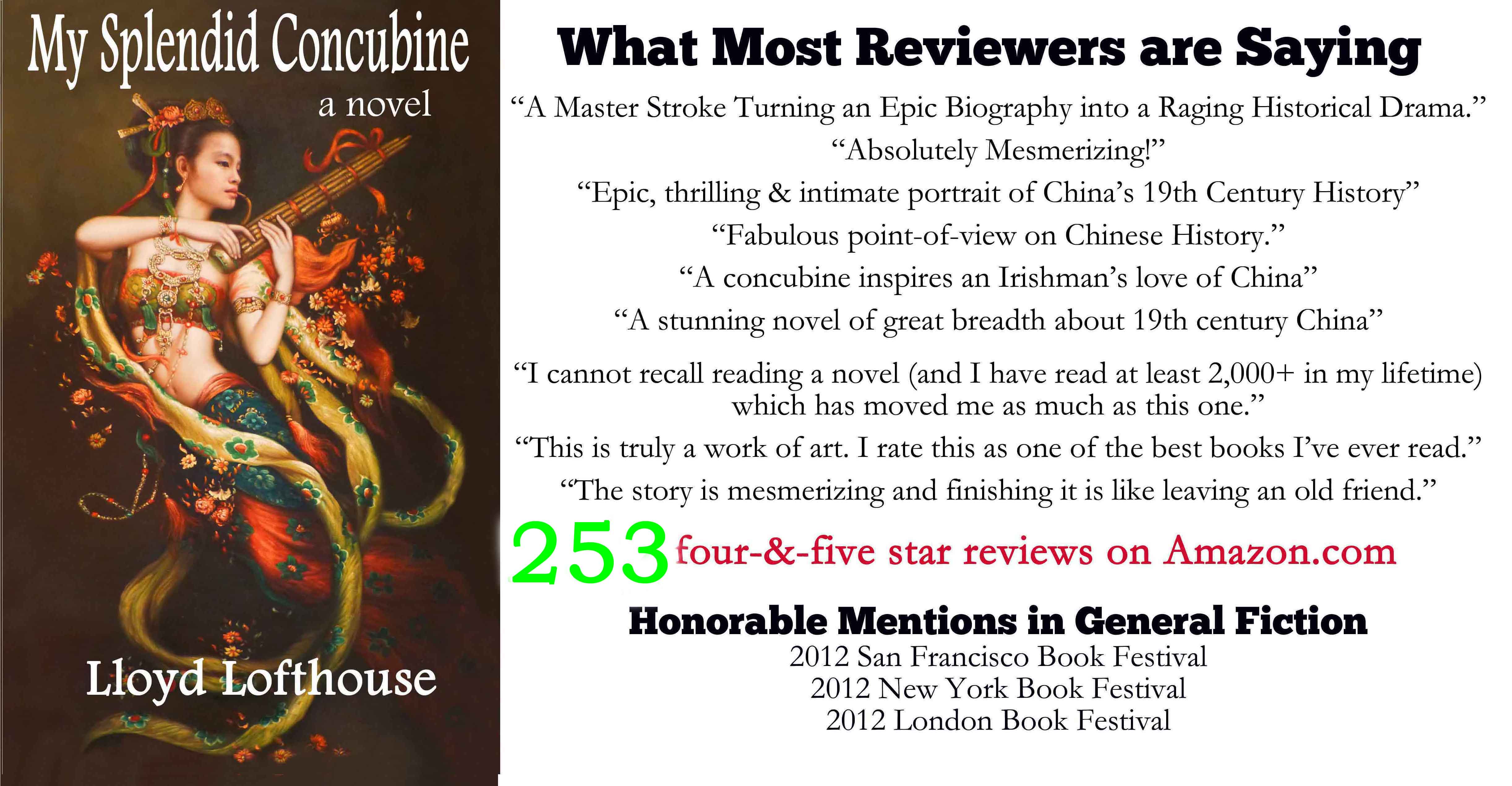
Lloyd Lofthouse is the award-winning author of My Splendid Concubine, Crazy is Normal, Running with the Enemy, and The Redemption of Don Juan Casanova.
Where to Buy

Subscribe to my newsletter to hear about new releases and get a free copy of my award-winning, historical fiction short story “A Night at the Well of Purity”.

About iLook China


GUANXI

March 13, 2019

The more China changes, the more it stays the same.

Just because China has a one-party political system that calls itself the Chinese Communist Party (CCP), that doesn’t mean the government is not Chinese. In fact, the CCP maintains that despite the co-existence of private capitalists and entrepreneurs with public and collective enterprises, China is not a capitalist country because the party retains control over the direction of the country, maintaining its course of socialist development.

In China, Guanxi is a complex system of social networks and influential relationships which facilitate business and other dealings. Because Guanxi is built into social networks and influential relationships, it also runs deep through the CCP like threads through a complex interwoven, handmade tapestry.

Sir Robert Hart (1835 – 1911), the godfather of China’s modernization and the main character in my historical fiction novel, My Splendid Concubine, discovered the importance of Guanxi soon after he arrived in China and eventually went to work for China’s Emperor. Hart quickly learned that a ‘supreme value of loyalty glued together China’s structure of personal relationships.’

In addition, Robert Hart wrote in a letter in 1891, “These people (referring to the Chinese) never act too soon, and, so far, I have not known of their losing anything by being late. To glide naturally, easily and seasonably into the safe position sequence as circumstances make, is probably a sounder though less heroic policy for a state than to be forever experimenting …”

To translate, it takes time to develop Guanxi through relationships, friendships, and trust where everyone benefits. In China, one must prove they can be trusted before being accepted into a Guanxi social and/or business network.

There are several elements and layers to Guanxi. First, Guanxi is based on a Confucian hierarchy of familial relationships, long-term friendships, classmates, and schoolmates that no stranger, Chinese or foreign, will ever have access to.

Guanxi developed over millennia because China did not have a stable and effective legal system similar to the one that developed in western countries.

And thanks to the greed, insanity, and incompetence of President Donald Trump and the Libertarian movement in the United States, China will probably never become a capitalist kleptocracy like the U.S. is fast becoming. Guanxi will make sure that never happens in China, and corrupt individuals like Donald Trump will never understand how Guanxi works because of his inability to be honest and trust others. To Trump, he must always win and everyone else must lose.

Lloyd Lofthouse is the award-winning author of My Splendid Concubine, Crazy is Normal, Running with the Enemy, and The Redemption of Don Juan Casanova.

Where to Buy

Subscribe to my newsletter to hear about new releases and get a free copy of my award-winning, historical fiction short story “A Night at the Well of Purity”.

About iLook China


COLORS

March 3, 2019

Colors are important in Chinese culture and some colors come with lucky meanings. For instance the three main colors considered lucky in people’s daily lives as well as on special occasions are red, yellow, and green.

However, it isn’t that simple.

Allegravita.com reports, “While every world culture has its own unique symbolism and taboos, it’s fair to say that the ancient and very complex Chinese culture is the big daddy of cultural symbolism. Highly resonant symbolic memes run so old and deep that it’s impossible to summarize them into one blog post, or even a hundred posts.”

Associated with but ranked above brown, yellow signifies neutrality and good luck. Yellow is sometimes paired with red in place of gold. Yellow was the emperor’s color in Imperial China and is held as the symbolic color of the five legendary emperors of ancient China.

Nations Online says, “Historically, people actually worshipped the color yellow during the reign of the legendary Chinese sage king, a chief deity of Taoism, Huang Di or Huang Ti, better known as the Yellow Emperor. He is the emperor that is said to be the ancestor of all Han Chinese people and is believed to have reigned around 2697 BC to 2598 BC.

“Huang Di was coined the name Yellow Emperor because his army tribe honoured the value of the ‘Yellow Earth’ which was the symbol of farming and the ‘Yellow River’ of the central land (China).”

Nations Online also lists the colors and what they mean. For instance, RED: “traditional bridal color, expansive, blooming, dynamic, enthusiastic, reaching upwards, good luck, celebration, happiness, joy, vitality, long life; red purple brings luck and fame, money, recognition, propriety, creativity, joy vs. over excitation.”

In the West, North America, and Europe, white is usually the traditional bridal color.

Today in China

“Yellow is still reserved for royalty. Clothing and objects that are yellow in color still resemble a higher social status. Although each dynasty designated each official rank with their own color, yellow is reserved for the emperor himself.

“The color yellow and its shades are also the main color of Buddhism; thus it represents being free from worldly cares.

“Red is still used for happiness and joy. In fact, after the Ming Dynasty, only the Emperor’s close relatives could have homes with red walls and yellow roof tiles. Peasants could only live in homes made with blue bricks and roof tiles. Today though, most houses are made of black tiles and white walls.

“Blue-green is still a symbol of spring when everything is filled with vigor and vitality. Therefore, someone that is hoping for longevity and harmony will decorate with blue-green colors.

“White is a symbol of the unknown and purity. The color white is used during the time of mourning, death, and during ghost festivals. Therefore Chinese people will wear white during a funeral or while summoning ghosts.

“Black is used as the symbol of winter and the westerly skies which behold the heavens. It is used for times of the unknown and for the winter months.”

Lloyd Lofthouse is the award-winning author of My Splendid Concubine, Crazy is Normal, Running with the Enemy, and The Redemption of Don Juan Casanova.

Where to Buy

Subscribe to my newsletter to hear about new releases and get a free copy of my award-winning, historical fiction short story “A Night at the Well of Purity”.

About iLook China


What came first the soybean or tofu?

January 16, 2019

The answer to the question in the title is simple. Soybeans came first. Tofu-making was first recorded during China’s Han dynasty more than 2,000 years ago. Chinese legend credits its invention to Prince Liu An (179–122 BC).

We learn from Soya.be that “Soybeans originate from China. In 2853 BC, Emperor Sheng-Nung of China named five sacred plants – soybeans, rice, wheat, barley, and millet. Soybean plants were domesticated between 17th and 11th century BC in the eastern half of China where they were cultivated into a food crop.”

And Eating China reports, “But while those ancient farmers had discovered a new food source, only their descendants, almost 1,000 years in the future would begin to fully understand the nutritional value of the soybean. The long history of domestication resulted in a great variety of upright hardy soy plants that do well in a wide range of soil and weather conditions. The main types of soybeans are categorized by seed color: green, black and by far the most common, yellow, the variety that inspired the bean’s other name, Yellow Legume, Huang Dou.” …

“Making soy milk was one of the early methods. Soy milk is nothing more than a milky liquid that results from boiling and mashing whole beans, so we can assume that it was not long before soy milk was ‘invented.’ Initially it may have been eaten as bean meal soup. Even today in China soy milk remains a drink that is processed and consumed in simple ways, though it is often sweetened and occasionally salted.”

I can attest that fresh soy milk in China is much better than most soy milk you buy in supermarkets in the United States. When visiting China, I get up early to go to the nearest market that makes fresh soy juice and buy it without sugar or sweetener added. There is no comparison. It’s warm. It’s fresh. It’s China. It’s different from the genetically altered, American, factory-farmed soy juice sold in American markets. That stuff is “yuk” and I don’t touch it.

I’ve even made tofu chocolate pie at home. The Chinese invented tofu, but I was introduced to Chocolate Tofu Pie at Mother’s Market in Costa Mesa, California. Then I figured out how to make it at home by experimenting. You may find the recipe HERE.

Then there is stinky tofu, another of my favorites. When visiting Nanjing Road in Shanghai between People Square and the Bund, we always stop at the same shop, and I order deep fried, fresh chou dofu (stinky tofu) with peppercorn sauce that’s spicy hot enough to make me sweat.

Medical News Today.com says, “Tofu is made from soybean curds. It is naturally gluten-free and low in calories. It contains no cholesterol and is an excellent source of iron and calcium.” It is also an important source of protein, especially for vegans and vegetarians. “It also contains isoflavones such as phytoestrogens. Isoflavones may have both estrogen-agonist or estrogen-antagonist properties. These may help protect against some cancers, heart disease, and osteoporosis.”

Then there are the health benefits from soybean sprouts. Livestrong.com says, “Even though you can sprout seeds from any type of bean, the two most common types are mung bean and soybean sprouts, according to the University of Florida IFAS Extension. Bean sprouts give you an easy way to boost the nutrients in your diet. Toss them onto your salad, use them in a sandwich or add them to soups and casseroles, and you’ll quickly increase the amount of protein, B vitamins and vitamin C.”

In fact, the Chinese learned how to sprout beans on their sailing ships to protect Chinese sailors from scurvy long before the west discovered that vitamin C prevented the disease. Our Everyday Life.com says, “Soy bean sprouts, which are germinated soy beans, have been used for human consumption for more than 5,000 years.” Just one of the benefits: “Soy bean sprouts provide the B vitamin, folate, which is essential for the synthesis of DNA and red blood cells. One cup of raw soy bean sprouts has 120mcg of folate. Adults need 400mcg of folate daily, according to the National Academies’ Institute of Medicine. Soy bean sprouts are also a source of vitamin C and pantothenic acid.”

Soy bean sprouts were not the only source of vitamin C for ancient Chinese sailors. Asian cultures have relied on fermented cabbage to survive long winters between fruit seasons for thousands of years. Kimchi, sauerkraut’s Korean cousin, was historically used during winter to stave off vitamin deficiencies, while early records show workers building the Great Wall of China ate fermented cabbage regularly when fruit was not available.

Lloyd Lofthouse is the award-winning author of My Splendid Concubine, Crazy is Normal, Running with the Enemy, and The Redemption of Don Juan Casanova.

Where to Buy

Subscribe to my newsletter to hear about new releases and get a free copy of my award-winning, historical fiction short story “A Night at the Well of Purity”.

About iLook China


Winter Fun in China

January 2, 2019

The annual winter Harbin International Ice and Snow Sculpture Festival (January 5 – February 5) was first celebrated in 1963 and is now the largest ice and snow festival in the world. The average temperature is a (minus) – 16.8 degrees Celsius or 1.76 Fahrenheit. On the Fahrenheit scale, the freezing point of water is 32 degrees, so the cold is below frigid.

“Traditionally, the Harbin International Ice and Snow Sculpture Festival open around Dec 24-25 and lasts to the end of February. But its official opening ceremony is usually held on January 5th each year.” According to IceFestivalHarbin.com, if you plan to visit, avoid February 4 – 10, 2019, and escape the crush during the Chinese New Year that is based on the lunar calendar.

The annual Harbin International Ice and Snow Sculpture Festival was first held in 1963, but it was interrupted during Mao’s Cultural Revolution. Mao died in 1976, and it took time for China’s economic engine to recover. The fact that the festival resumed in 1985 was an early sign of the changes soon to take place in China.

Since 1985, China has transformed itself by rebuilding the old cities while building more than a hundred new ones in addition to the explosion of a middle class that equals or surpasses the entire population of the United States with plans to double that middle class in the next decade or two.

China has also crisscrossed the country with new highways and railroads that include more high speed rail than the rest of the world combined. China has also built more than 500 new airports while America’s airports are way overdue for an upgrade along with the rest of U.S. infrastructure that is out of date and falling apart. In fact, Money reports the U.S. is ranked #28 for average mobile internet speed.

Lloyd Lofthouse is the award-winning author of My Splendid Concubine, Crazy is Normal, Running with the Enemy, and The Redemption of Don Juan Casanova.

Where to Buy

Subscribe to my newsletter to hear about new releases and get a free copy of my award-winning, historical fiction short story “A Night at the Well of Purity”.

About iLook China