Wolf Totem – the book vs the film

September 22, 2015

I walked to town recently to see the film of a book I read several years ago. The theater I saw it in was huge and there were only three of us there. Wolf Totem was in Mandarin with English subtitles. Fortunately for the audience, there isn’t much dialogue so there isn’t that much to read if you don’t speak the language but the story—through the panoramic visuals—had a powerful message about mankind meddling with nature. In China, this film has earned more than $110 million U.S. I couldn’t find out how much it has earned in the U.S. where I saw it.

Consider the fact that pollution is not exclusive to China, and the United States, for instance, has more than 1,300 superfund sites—Superfund sites are polluted locations requiring a long-term response to clean up hazardous material contaminations. – epa.gov

In addition, the book and the film also offer another way to learn about China, it’s people and their humanity.

Jiang Rong is the pen name for Lu Jiamin, the author, a Chinese citizen. Set during the Cultural Revolution, Wolf Totem describes the education of an intellectual living with nomadic herders in the grasslands of Inner Mongolia.

The publisher of Wolf Totem said the novel was an epic Chinese tale and that’s true. Wolf Totem taught me a lot about this almost extinct culture. I learned about the fascinating connection between wolves and Mongolians and why this connection may have been the reason why Genghis Khan was so successful in his conquests.

I recommend the film more than the novel to anyone who wants to learn about the life of the Mongols and another perspective of Mao’s Cultural Revolution. If you can’t see the film, then the book is worth reading too.

However, the theme that runs through the novel of maintaining a balance with nature is a bit overdone—I didn’t get this impression from the film. In the novel, I got the message the first time the characters talked about it but then the topic comes up repeatedly—a bit too much but an insignificant criticism of a book worth reading and a film that I think is even more powerful.

I won’t give away the ending, but don’t expect it to be happy. Most Chinese novels don’t end with happy endings. The ending for the film was different than the novel, and I actually liked it better—a powerful and breathtakingly beautiful film.

______________________________

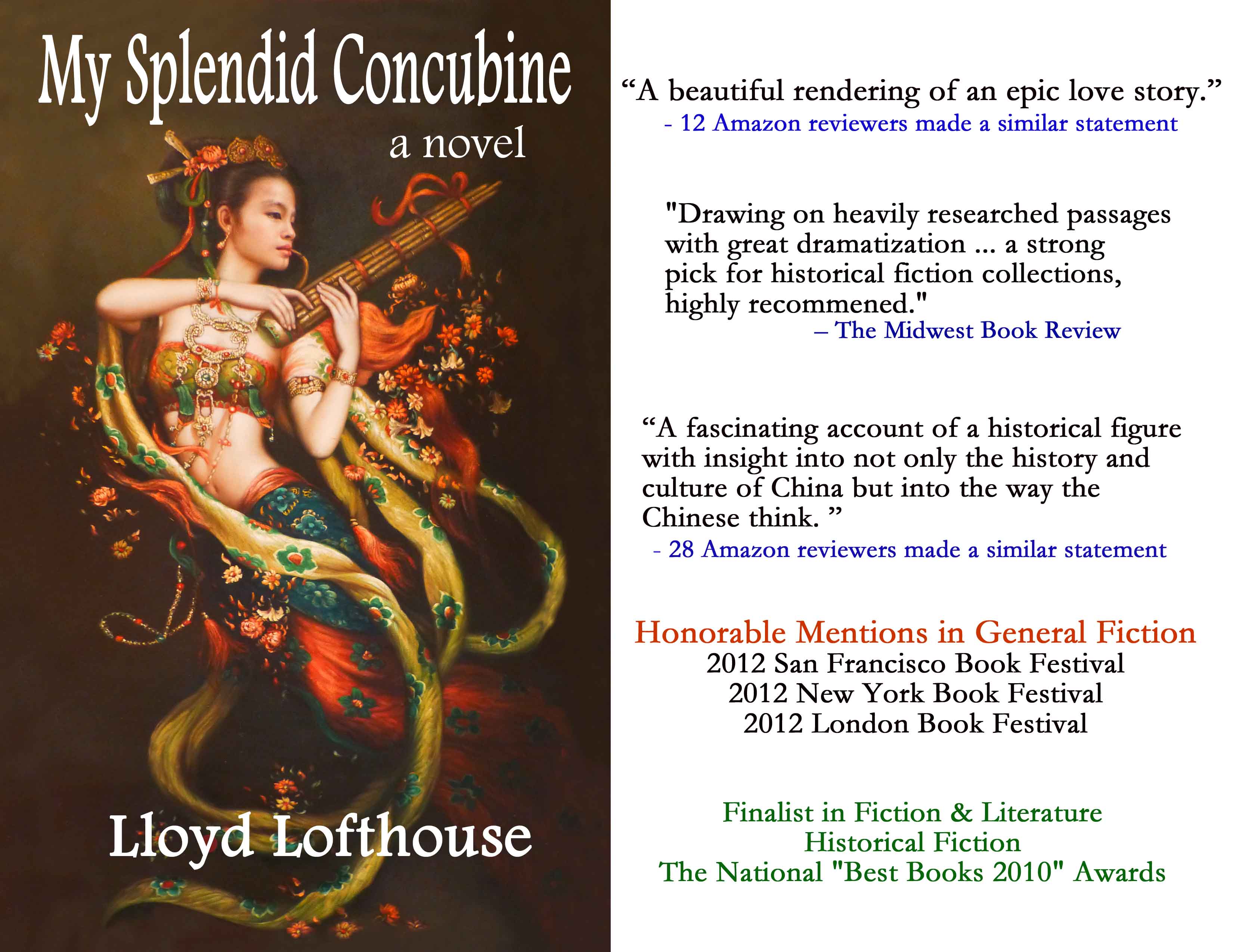
Lloyd Lofthouse is the award-winning author of My Splendid Concubine [3rd edition]. When you love a Chinese woman, you marry her family and culture too. This is the lusty love story Sir Robert Hart did not want the world to discover.

#1 - Joanna Daneman review posted June 19 2014

Where to Buy

Subscribe to “iLook China”!
Sign up for an E-mail Subscription at the top of this page, or click on the “Following” tab in the WordPress toolbar at the top of the screen.

About iLook China

China’s Holistic Historical Timeline


Diving Deep into China with Isham Cook “At The Teahouse Café”

September 8, 2015

At The Teahouse Cafe, 15 essays by Isham Cook, delves into East Asian Culture and a number of related issues and topics.

Isham Cook has been based in China since 1994, more than twenty years. Writing with the perspective of an American expatriate who has lived in East Asia that long offers readers a view from someone on the ground, and I think that Cook does not disappoint.

The topics of his 15 essay range, for instance, from China’s Great Firewall, the complexity and meaning of Chinese “face”, music, China’s education system to the aversive racism of the term “yellow fever”—something that I’ve also been accused of. Cook goes into detail of why men are attracted to specific women of any race, and I think he is right.

And for his essay on The Chinese University, I Hi-Lited: “The problem with the Chinese university is not the people, it is the system in control, which paralyzes, demotivates and demoralizes.”

The reason why I Hi-Lited that one phrase while reading the book was because it described what is happening in the United States. Since 2001 and President G. W. Bush’s No Child Left Behind Act, and then President Obama’s attempt to seize control of America’s public schools with the so-called Common Core State Standards and the high stakes test meant to rank teachers, fire them and close public schools, that quote describes what is happening in the U.S.

Isham Cook At The Teahouse Cafe

You have been gone too long, Isham. The U.S is under attack by a flock of oligarchs and autocrats that might even shock or impress the Chinese Communist Party because of their tactics to mislead and fool as many people as possible in the U.S. In fact, while China is struggling to lift as many of its people out of poverty as possible, what’s going on in the U.S. is increasing poverty at a frightening pace, especially among children.

Anyway, Isham Cook delves deep into many topics about China, it’s culture and people based on his own experiences living there and interacting with the Chinese. He discusses the bad and the good and doesn’t spare the United States either, and I think that is a good thing because far too many ignorant Americans think the U.S. can do no wrong.

My own interaction with the Chinese pales in comparison. My wife is Chinese, her family is Chinese—mostly born and raised in China during the Mao era—and I’ve been to China nine or 10 times but never lived or worked there, and my last trip was in 2008 when the air pollution in Shanghai contributed to a sinus and respiratory infection that sent me flying home several weeks earlier than planned to recover.

I recommend At The Teahouse Cafe for anyone who wants to get a serious, intellectual dose of the real China from an American who has lived and worked there as long as Isham Cook has. This book should open your eyes as long as your thinking isn’t a closed, dead-end street.

______________________________

Lloyd Lofthouse is the award-winning author of My Splendid Concubine [3rd edition]. When you love a Chinese woman, you marry her family and culture too. This is the lusty love story Sir Robert Hart did not want the world to discover.

#1 - Joanna Daneman review posted June 19 2014

Subscribe to “iLook China”!
Sign up for an E-mail Subscription at the top of this page, or click on the “Following” tab in the WordPress toolbar at the top of the screen.

About iLook China

China’s Holistic Historical Timeline


Long before Romeo and Juliet there was China’s Butterfly Lovers

August 25, 2015

The legend of The Butterfly Lovers first appeared in 618 AD during the Tang Dynasty, and it’s a tragic Chinese love story similar to Romeo and Juliet.

The basic premise is of a young woman in China wanting to go to school. Since boys were the only ones allowed to attend school, this young woman, like Barbara Streisand in the movie Yentl (1983), disguised herself as a boy.

Yentl was based on Isaac Bashevis Singer’s (1902 – 1991) short story Yentl the Yeshiva Boy.

When I talked to my wife about this, she found her copy of a popular theme song from The Butterfly Lovers played as a violin solo by Yu Lina. As the house filled with the music, which may also be found on the next embedded YouTube video, my wife started to dance.

She said, “This is one of my favorites. I cannot resist dancing when I hear it.”

In fact, Yentl the Yeshiva Boy and Shakespeare’s (1564 – 1616) Romeo and Juliet must be combined to become The Butterfly Lovers. What starts as a charade becomes a love story ending in the suicide of the two young lovers.

The love story of Liang Shanbo and Zhu Yingtai is one of four Chinese folk legends and one of the most influential and best known in China.

China has traded with the West since the Han Dynasty (206 BC – 219 AD). There was an overland route in the north and a sea route in the south, which the Roman Empire used around the time of Christ.

Since China traded with the West for more than two thousand years, it is conceivable that The Butterfly Lovers reached the West and was adapted by Shakespeare and then Singer after being exposed to the plot.

______________________________

Lloyd Lofthouse is the award-winning author of My Splendid Concubine [3rd edition]. When you love a Chinese woman, you marry her family and culture too. This is the lusty love story Sir Robert Hart did not want the world to discover.

2015 Promotion Image for My Splendid Concubine

Subscribe to “iLook China”!
Sign up for an E-mail Subscription at the top of this page, or click on the “Following” tab in the WordPress toolbar at the top of the screen.

About iLook China

China’s Holistic Historical Timeline


Searching for Shakespeare’s Romeo and Juliet in China

August 4, 2015

Shakespeare’s drama Romeo and Juliet is often taught to ninth graders in US high schools. Other Shakespeare plays are studied at other grade levels and in college.

However, you may be surprised to discover Shakespeare is probably more popular in China since his work is taught in most Chinese universities, both in English and in Chinese, and Shakespearean texts are easily available in China in both languages.

When Mao ruled China (1949 to 1976), Shakespeare was banned as was Aristotle and other Western philosophers.  Mao died in 1976, and that ban was lifted in 1978.

In fact, according to Cheng Zhaoxiang, the author of Teaching Shakespeare in China, “It is no exaggeration to say that every educated Chinese knows something about Shakespeare.”

However, when produced in China on stage, the plot may not stay true to the original Shakespeare.

Writing for the The People’s Republic of Shakespeare, Adventures in Chinese Research, Meammi says, “My interest in this topic started when I noticed that many of the Romeo and Juliets performed in China are either parodies or rewrites where one of the lovers survives in the end.

“China has their own pair of star-crossed lovers (The Peony Pavilion – 1598 AD), who tragically die for love and their plight is described in a much more mournful tone than Shakespeare’s version.

“Some Chinese theater companies state in interviews that their audiences have too much sadness in their lives so Romeo just can’t die in the end of their performance.”

______________________________

Lloyd Lofthouse is the award-winning author of My Splendid Concubine [3rd edition]. When you love a Chinese woman, you marry her family and culture too. This is the lusty love story Sir Robert Hart did not want the world to discover.

IMAGE with Blurbs and Awards to use on Twitter

Subscribe to “iLook China”!
Sign up for an E-mail Subscription at the top of this page, or click on the “Following” tab in the WordPress toolbar at the top of the screen.

About iLook China

China’s Holistic Historical Timeline


China’s Answer to Harry Potter

July 15, 2015

Guest review by Tom Carter

China’s love affair with superstition, pseudoscience and the fantastical may be traced back over five millennia, whence some of history’s oldest myths and legends originated.

Journey to the West (Xi You Ji), published anonymously by scholar Wu Cheng’en in the 16th century Ming Dynasty, remains China’s most beloved fantasy story.  Considered one of the “Four Great Classical Novels” of Chinese literature, the 100 chapters of ‘Journey’ are replete with monkey kings, flesh-eating demons, immortal sages and celestial battles.

When science fiction became all the craze in 1950’s America, Red China followed suit by founding its first sci-fi periodical.

However, unlike the west, where rapid advances in the tech sector fueled science fiction, China promoted sci-fi to help inspire its own dormant technological progress.

Conversely, about the same time during the 70s when American director George Lucas was preparing to film a little space opera called Star Wars, the Cultural Revolution was banishing all China’s scientists to hard-labor communes.

Indeed, where the Chinese have categorically failed in speculative fiction (programming on the Communist-controlled CCTV is evidence enough that future perspective is held in little regard here: of China’s 19 official television channels, all feature serials set in olden times, some in the present, none about the future), they remain masters of mythology and purveyors of the past.

Present-day PRC is seeing a renaissance of the fantasy genre.  The wuxia-inspired Chinese film Crouching Tiger, Hidden Dragon was a critical and commercial success, generations of young, Chinese cyber-punks are hopelessly addicted to the virtual sorcery of World of Warcraft, and Harry Potter remains China’s “most pirated novel ever”.

Even so, no Chinese author has ever been able to replicate the success of Journey to the West; as a result, publishing houses in the Middle Kingdom prefer to translate western best-sellers such as Lord of the Rings and Narnia rather than take their chances on local fantasy fiction writers.

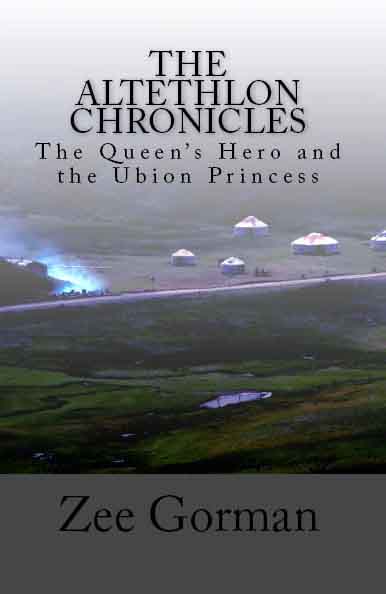
Enter Zee Gorman (nee Yan Zi-hong) China’s response to J.K. Rowling.

Born in Guangdong province during the Cultural Revolution (both her parents were exiled to the countryside for being “intellectuals”), Zee was raised on a literary diet of propaganda and scar literature.

Rather than publish a clichéd daughter-of-the-Revolution memoir about her hardships, the aspiring author opted for the escapism of fantasy. Hence, her decades-in-the-making debut novel, The Altethlon Chronicles.

A high-fantasy fiction set in a parallel universe either far in China’s future or in its past, The Altethlon Chronicles is a complex blend of military, history, romance and sorcery.

Leading the rich cast of green-eyed, purple-skinned characters is the royal yet rebellious teen Ximia (“what kind of princess are you anyway, running around like a wildcat?”) and her forbidden lover, Nikolas, the leader of a rival tribe – a tumultuous relationship most likely inspired by Zee’s own experience with cultural clash when she immigrated to the U.S. and married an American.

Ximia is misled into believing that Nikolas has been killed during an escape attempt, whereby the princess is married off by her father to a dastardly lord.  The two young warriors go on to lead their respective armies until the day when destiny arranges for them to meet again in battle.

Lots of magic, weird names and epic battles of Tolkien proportions (note: this reviewer has never actually read a J. R. R. Tolkien book; I just thought it sounded cool to say that) ensue.

In creating this alternate world, Zee draws heavily on her Chinese heritage.

Kingdoms such as Manchuli, Dalong and Taklaman are each reminiscent of real regions in China.

Nonetheless, Zee, who is bi-lingual and holds dual degrees in English Literature, chose to write The Altethlon Chronicles in her second language and self-publish in America rather than risk having it pirated in China’s nascent fantasy market.

Some realities are worth escaping.

____________________

Travel photographer Tom Carter is the author of CHINA: Portrait of a People, a 600-page book of photography from the 33 provinces of China, which may be found on Amazon.com.

If you want to subscribe to iLook China, there is a “Subscribe” button at the top of the screen in the menu bar.