Mao Zedong, the Poet

July 27, 2010

Many outside China think of Mao Zedong (1893 – 1976) as a brutal dictator. Yet, he was fifty-six when he became the ruler of China and seventy-two at the beginning of The Cultural Revolution.

In fact, while commanding the Red Army during The Long March (1934-1935), we see a man who respected China’s peasants proving he was more of a nationalist than a Communist. Then there was the move away from Communist Russia after Nixon’s visit to China in 1972, when Mao said, “Our common old friend, Generalissimo Chiang Kai-shek, doesn’t approve of this.”

In 1935, Mao’s poem, “The Long March”, reveals an awareness of the sacrifice and the willingness to suffer to accomplish great things.

The Red Army fears not the trials of the March,
Holding light ten thousand crags and torrents.
The Five Ridges wind like gentle ripples
And the majestic Wumeng roll by, globules of clay.
Warm the steep cliffs lapped by the waters of Golden Sand,
Cold the iron chains spanning the Tatu River.
Minshan’s thousand li of snow joyously crossed,
The three Armies march on, each face glowing.

Mao was a complex man, and it wasn’t until after the failure of the The Great Leap Forward (1958 – 1961) that the fatal attraction and power of leadership corrupted him leading to the horrors of The Cultural Revolution (1966 – 1976), which Mao’s critics in the West use to define him.

Anyone who follows all of Mao’s life instead of relying on his last decade would understand that he cared deeply about the common people while punishing the landowners and wealthy, who abused them.  On the other hand, his foe, Chiang Kai-shek, supported the landowners and wealthy while crushing the peasants and workers.

There is a post on About China.info that says, “Mao’s poetry exhibits a spirit of boldness and power, weaving together history, reality and commitment… Bold transformation of myth and literary quotations are a distinct feature of Mao’s poetry.”

At Mao Zedong Poems, Two Birds” A Dialogue (1965), reveals what Mao may have been thinking about as President Johnson increased America’s involvement in Vietnam. Was Mao also warning us of what he was about to do in 1966, when he launched The Cultural Revolution?

Two Birds: A Dialogue (1965)

The roc wings fanwise,
Soaring ninety thousand li
And rousing a raging cyclone.
The blue sky on his back, he looks down
To survey Man’s world with its towns and cities.
Gunfire licks the heavens,
Shells pit the earth.
A sparrow in his bush is scared stiff..
“This is one hell of a mess!
O I want to flit and fly away.”
“Where, may I ask?”
The sparrow replies,
“To a jewelled palace in elfland’s hills.
Don’t you know a triple pact was signed
Under the bright autumn moon two years ago?
There’ll be plenty to eat,
Potatoes piping hot,
Beef-filled goulash.”
“Stop your windy nonsense!
Look, the world is being turned upside down.”

Through Mao’s poetry, we learn more about the man—not the modern emperor.

Discover China’s Privately Passionate Poetry

______________

Lloyd Lofthouse is the award-winning author of The Concubine Saga. When you love a Chinese woman, you marry her family and culture too. This is the love story Sir Robert Hart did not want the world to discover.

Subscribe to “iLook China”!
Sign up for an E-mail Subscription at the top of this page, or click on the “Following” tab in the WordPress toolbar at the top of the screen.

About iLook China


China’s Privately Passionate Poetry

July 26, 2010

I’m sure that most Westerners do not think of love poems when they think of China. However, there has to be a reason for more than 1.3 billion people besides the Great Wall of China, the Pacific Ocean and the biggest mountain range on the planet, the Himalayas, which helped wall China from the violence that rocked the rest of the world for centuries—at least until the Opium Wars.

For poetry lovers, this book imparts a sense of the private passion that beats in the Chinese heart. The three arts of poetry, calligraphy and painting, the Triple Excellence, are represented on the pages.

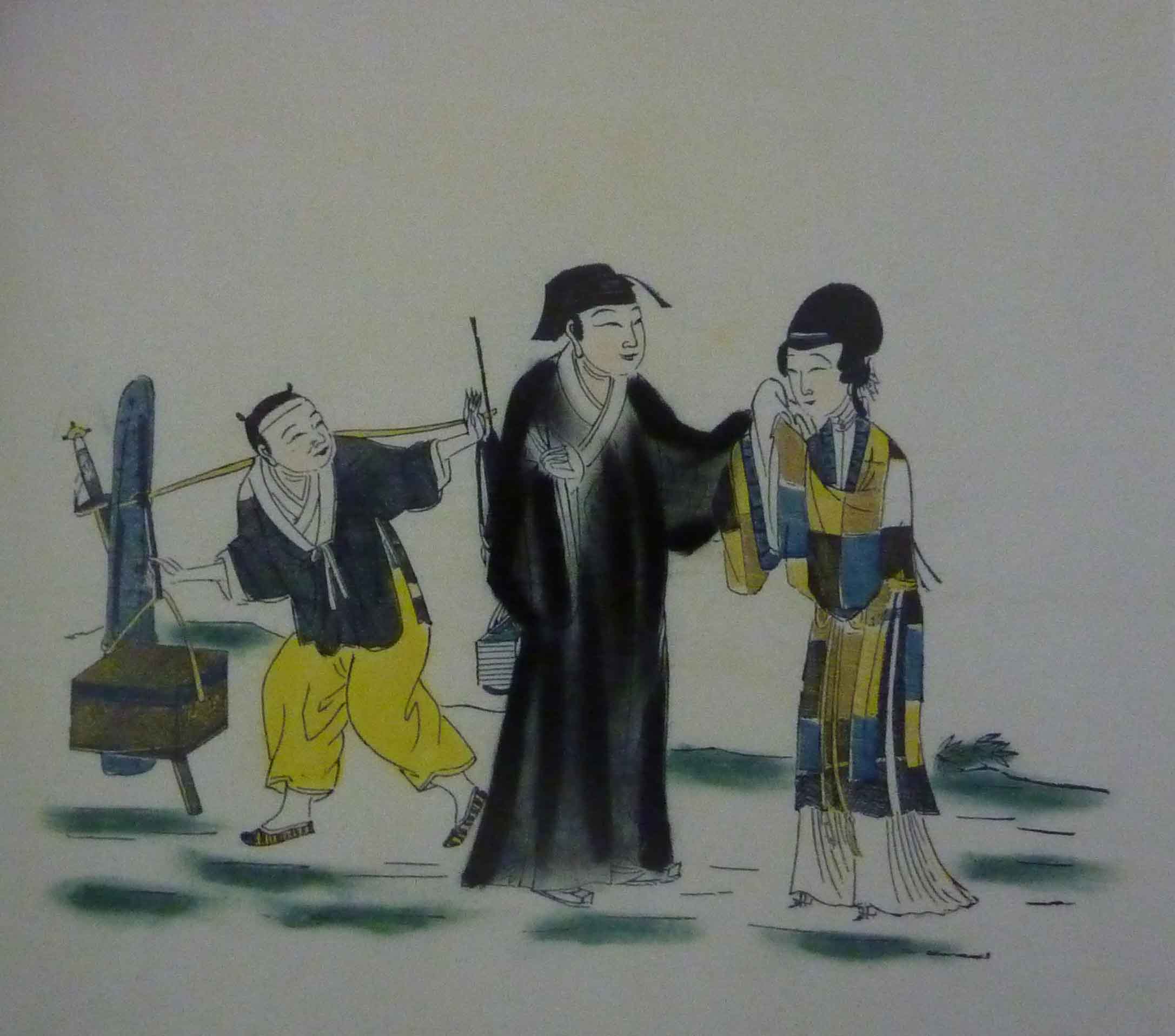
The painting, lady weeping at parting from husband, 17th century, comes from the Qing Dynasty and the book says it is a color woodblock print on paper.

Chinese poetry is frequently personal and often linked to a particular occasion (page 9).

Deeply in love, but tonight
we seem to be passionless;
I just feel, before our last cup of wine
a smile will not come.
The wax candle has sympathy ­­–
weeps at our separation:
Its tears for us keep rolling down
till day breaks.

by Du Mu (803-852 AD)

As you can see, the Chinese are a passionate people—they just don’t dramatize these passions publicly as many in the West do—at least until the West invaded China to force—if possible—a different set of values on China’s collective culture.

The Golden Age of Poetry in China was in the Tang Dynasty (618-906 AD).  This book of Chinese Love Poetry was edited by Jane Portal (© 2004) and published by Barnes & Noble Books (ISBN 0-7607-4833-0).

discover China’s Sexual Revolution or Yu Opera with Mao Wei-tao

_______________

Lloyd Lofthouse is the award-winning author of My Splendid Concubine [3rd edition]. When you love a Chinese woman, you marry her family and culture too. This is the love story Sir Robert Hart did not want the world to discover.

His latest novel is the multiple-award winning Running with the Enemy.

Subscribe to “iLook China”!
Sign up for an E-mail Subscription at the top of this page, or click on the “Following” tab in the WordPress toolbar at the top of the screen.

About iLook China

China’s Holistic Historical Timeline


Invented in China—Printing

July 9, 2010

Six hundred years after paper was invented, the Chinese invented printing and the first printed work was Buddhist scripture during the Tang Dynasty (618 – 906). The most basic printing techniques are older. Engraving came later. The carving, printing technique originated during the Tang Dynasty

When we talk about paper and printing, it is to collect knowledge, preserve and share it.

Once there were paper books being printed to share Buddhist ideas, the religion spread through China into Korea and Japan. Over a thousand years printing techniques continued to improve until there were multi-colored printings.

Then during the Sung Dynasty, the printing board was invented, which used clay characters. One character was carved into a small block of clay. Then the clay was put in a kiln to heat into a solid block. This method was efficient for printing thousands of sheets. These blocks would be placed together to create sentences and paragraphs of Chinese characters.

Later, the characters were carved into wood. Over time, printing was developed into an art.  In fact, Ancient Chinese culture was preserved due to the invention of paper and these printing methods, which wouldn’t reach Europe until after 1300 AD, almost 800 years later.

Without the Chinese invention of printing, Christianity, Islam and Buddhism may not have spread to the extent that they have.

See With or Without Paper

_________________________

Lloyd Lofthouse is the award-winning author of the concubine saga, My Splendid Concubine & Our Hart. When you love a Chinese woman, you marry her family and culture too. 

To subscribe to “iLook China”, look for the “Subscribe” button at the top of the screen in the menu bar, click on it then follow directions.


Caressing Nature with Chinese Calligraphy

July 3, 2010

It would be difficult to talk about Chinese art without understanding Chinese calligraphy and its artistic inspiration. A painting has to convey an object, but a well-written character conveys only its beauty through line and structure.

In Shanghai, or Beijing, I’ve watched men with longed handled brushes, as seen in the first video, using water for ink and concrete for paper. With grace, they exhibit the skills of a Rembrandt breathing life to the characters.

Lin Yutang writes in My Country and My People that Western art is more sensual, more passionate, fuller of the artist’s ego, while the Chinese artist and art-lover contemplates a dragonfly, a frog, a grasshopper or a piece of jagged rock—more in harmony with nature.

Owing to the use of writing calligraphy with a brush, which is more subtle and more responsive than the pen, calligraphy as art is equal to Chinese painting. Through calligraphy, the scholar is trained to appreciate, as regards line, qualities like force, suppleness, reserved strength, exquisite tenderness, swiftness, neatness, massivness, ruggedness, and restraint or freedom.

Maybe this helps explain why the Chinese are not as warlike as Christian and Islamic cultures.

See Chinese Yu Opera with Mao Wei-tao

______________

Lloyd Lofthouse is the award-winning author of the concubine saga, My Splendid Concubine & Our Hart. When you love a Chinese woman, you marry her family and culture too.

If you want to subscribe to iLook China, there is a “Subscribe” button at the top of the screen in the menu bar.


Kun Opera

June 4, 2010

Kun Opera is the most refined and literary form of Chinese opera with a six hundred year history.  This opera is known as the “mother” of a hundred Chinese operas.  Kun Opera ushered in the second Golden Era of Chinese drama and almost vanished when it was suppressed during Mao’s Cultural Revolution.

When Kun Opera was dying in China during Mao’s rule, it was still being performed in the British Crown Colony of Hong Kong.  Prior to the Cultural Revolution, there were over 500 classical Kun Operas. Today there are about 100 that have survived.

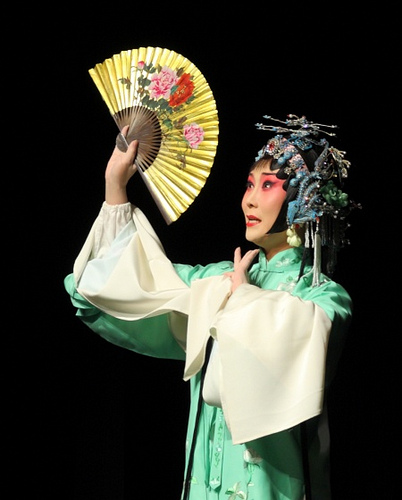
Kun Opera is known for the tenderness of the actor’s voices, delicate hand gestures, dramatic facial expressions, beautifully abstract movements, gorgeous costumes and stage design.  The Peach Blossom Fan is considered a landmark in this form of Chinese opera.

See a scene from the Peony Pavilion, another classical Kun Opera.

If you enjoyed this presentation, discover Huangmei Opera.

_____________________

Lloyd Lofthouse is the author of the award winning novels My Splendid Concubine and Our Hart. He also Blogs at The Soulful Veteran and Crazy Normal.

Sign up for an RSS Feed for iLook China