Chinese Poetry during the Tang Dynasty

October 22, 2012

The Tang Dynasty (618 to 907 AD) is regarded as one of the most prosperous times in China’s long history.

It was also the golden age of Chinese art and literature.

Crossing the Han River
Song Zhi-wen (656 – 712 AD)

No news, no letters – all winter, all spring —
     Beyond the mountains.
With every homeward step more timid still
I dare not even inquire of passerby
.

Song Zhi-wen, the poet, was found guilty of accepting bribes and executed. He had good reason to fear returning home from exile.


In this video is a famous Tang poem.

The classical form of Chinese poetry developed in the late Han Dynasty (206 BC – 220 AD) and reached its peak during the Tang Dynasty.

Most Tang poems have four or eight lines, with five and seven Chinese characters in each line following certain rules.

Another example of Tang Dynasty poetry is Spring Perspective by Du Fu (712 – 770 AD).

When the post of prime minister was awarded to a cousin of the imperial concubine, there was the military rebellion of An Lu–shan in 755 AD.

The nation has fallen, the land endures
Spring trees and grasses flourish in the town.
Troubled by the times — flowers bring tears;
Dreading parting — birds startle the soul.

With turmoil of battle three months on end,
A letter from home is worth a fortune in gold.
As it is, they can barely hold a pin.

This poem demonstrates what happens when the Chinese people get tired of nepotism and corruption, which should be heeded as a warning today to crack down on corruption in Communist China.

The next poem is one of many that Yuan Zhen (779 – 831 AD) wrote for his dead wife, who he married when he was poor. She did not live long enough to share his fame and fortune.

In former years, we chatted carelessly of death and what it means
     to die.
Since then, it’s passed before my very eyes.
I’ve given almost all your clothes away
But cannot bear to move your sewing things.
Remembering your past attachments, I’ve been kind to maids you
     loved.
I’ve met your soul in dreams and ordered sutras sung.
Certainly, I know this sorrow comes to all
But to poor and lowly couples, everything life brings is sad.

See Mao Zedong, the Poet

______________

Lloyd Lofthouse is the award-winning author of The Concubine Saga. When you love a Chinese woman, you marry her family and culture too. This is the love story Sir Robert Hart did not want the world to discover.

Subscribe to “iLook China”!
Sign up for an E-mail Subscription at the top of this page, or click on the “Following” tab in the WordPress toolbar at the top of the screen.

About iLook China


China’s Cezanne

October 15, 2012

If our brains work, we all live and learn daily.

This morning I awoke to discover two books printed in Mandarin, not English, that had been tossed on the floor. It seems my wife read both books in one night and didn’t get much sleep. She reads much faster in Mandarin than in English and can polish off books as if she were eating cookies.

When I asked about the two books, it turned out that one of the books was the biography of Wu Guanzhong (1919 – 2010), the father of Chinese Expressionism. This was the first I’d heard of him.

I learned he is considered the Chinese Cezanne. In fact, he is one of the fathers of expressionism.

Wu was born in Yixing, Jiangsu Province, China. He was a graduate of the National Art College in 1942, and then studied oil painting in Paris from 1947-1950.

When Wu returned to China in 1950, he taught Western art to his students at the Central Academy of Fine Art in Beijing to 1953. He then taught art at Tsinghua University in Beijing 1953 – 1964.

Due to criticism that Wu had been influenced by Western Bourgeois ideas, in 1966, during the beginning of Mao’s Cultural Revolution, Wu was told he could not paint or write about art. To avoid persecution and possibly execution by the rampaging teenage Red Guard, he burned many of his paintings.

In 1970, he was separated from his wife and spent three years working at hard labor in the countryside as part of Mao’s re-education program.

After Mao died in 1976 with China now led by Deng Xiaoping, Wu was allowed to paint again. He had his first professional solo exhibition in 1979, and succeed as a professional artist in the 1980s.

His painting of Shakespeare’s hometown was listed to sell for
RMB: 2 million ($US 318,878) – 2.5 million ($US 398,597).

During his life as an art teacher and a professional artist, his goal was to introduce French modernism to the Chinese world of art while preserving China’s cultural identity.

Wu combined his French training and Chinese background to develop a semiabstract style to depict scenes from the Chinese landscape. Before he died, Wu had solo exhibitions in major art galleries and museums around the world, including Hong Kong, Singapore, Tokyo, Taipei, Korea, England and the US.

In 1992, Wu was honored by the French Ministry of Culture. He died at age 90. You may see a sample of his art from the embedded video.

Discover Silence to Beauty

______________

Lloyd Lofthouse is the award-winning author of The Concubine Saga. When you love a Chinese woman, you marry her family and culture too. This is the love story Sir Robert Hart did not want the world to discover.

Subscribe to “iLook China”!
Sign up for an E-mail Subscription at the top of this page, or click on the “Following” tab in the WordPress toolbar at the top of the screen.

About iLook China


China’s Huangmei Opera

October 8, 2012

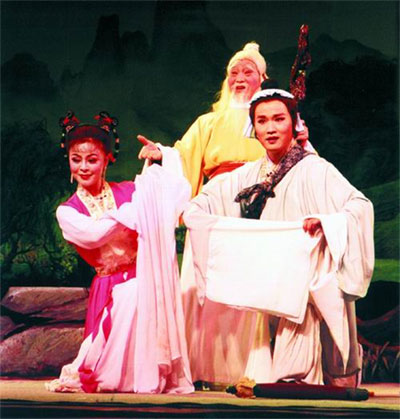
Anqing, in Anhui Province, is regarded as the hometown of Huangmei Opera and Hui Opera. Anqing was first built in 1217 and is almost eight-hundred years old, but Huangmei Opera first appeared about two centuries ago as a simple drama of song and dance.


Huangmei Opera Troupe

Huangmei opera did not involve the traditional opera gestures which often-used sleeves and step movements. The music is performed with a pitch that hits high and stays high and does not sound like the typical rhythmic Chinese opera.

The fairy tale of the Cowherd and the Weaving Girl is one of the four most famous folktales of ancient China. It is a classic love story between a fairy and a human being and has a widespread influence. The Qixi Festival is said to have something to do with the fairy tale, and the seventh day of every seventh month of the lunar calendar has become the Chinese Valentine’s Day.

Chinese opera together with Greek tragic-comedy and Indian Sanskrit Opera are the three oldest dramatic art forms in the world.

Discover Peking Opera

______________

Lloyd Lofthouse is the award-winning author of The Concubine Saga. When you love a Chinese woman, you marry her family and culture too. This is the love story Sir Robert Hart did not want the world to discover.

Subscribe to “iLook China”!
Sign up for an E-mail Subscription at the top of this page, or click on the “Following” tab in the WordPress toolbar at the top of the screen.

About iLook China


The Music of China – the Erhu

September 25, 2012

An erhu is a Chinese two-stringed instrument similar to a fiddle. The erhu has a thin, slightly reedy sound. Since the erhu is so widely used, foreigners see it as an example of Chinese music.

The erhu

However, once you recognize the sound of an erhu, it can usually be readily picked out from other musical instruments, because it is unique.

The history of the erhu spans more than a thousand years. The first erhu was heard during the Tang Dynasty (618 – 907 AD).

Since the traditional Chinese character for “erhu” indicates it has two strings, the erhu has probably changed little over the centuries. Alternate names for the erhu include huqin or hu, and Westerners sometimes call the instrument a “Chinese violin”.

If you enjoyed learning about and listening to the erhu, discover Mao Wei-Tao’s Chinese Yu Opera

______________

Lloyd Lofthouse is the award-winning author of The Concubine Saga. When you love a Chinese woman, you marry her family and culture too. This is the love story Sir Robert Hart did not want the world to discover.

Subscribe to “iLook China”!
Sign up for an E-mail Subscription at the top of this page, or click on the “Following” tab in the WordPress toolbar at the top of the screen.

About iLook China


Visiting The Great Wall Part – Part 3/3

July 25, 2012

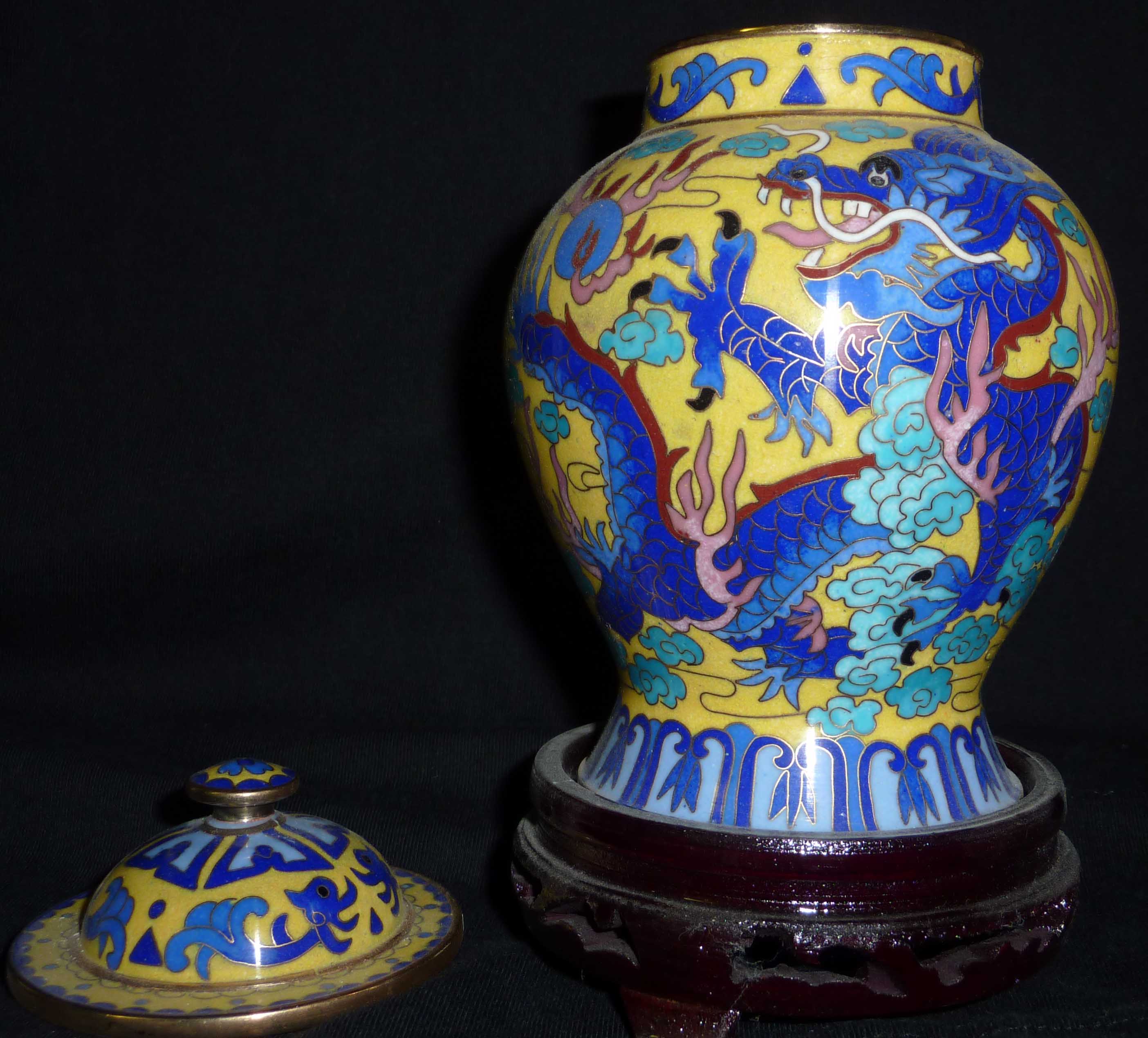
On our way back to Beijing from the Great Wall at Mutianyu, our driver stopped at a factory-showroom where we learned about the manufacturing techniques for Cloisonné brass vases.

I’ve read some tourists/expatriates complain of these sort of stops, but I enjoy window shopping and this was something new—sometimes I even buy something.  In this case, I bought three vases (photos are included here).

First, we went on a tour where we watched men and women creating vases. Once the tour was over, we went into the showroom.

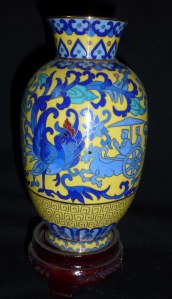
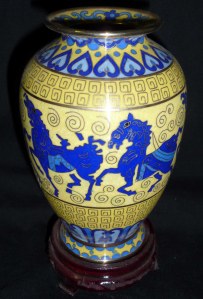
The vases I bought (after negotiating the price) are yellow with a blue trim.  One has a blue dragon on it, the second a phoenix beside a chariot, and the third running horses. Each one is about the size of my hand (see photos)

The cloisonné process is enamel on copper craftwork. It first appeared in Beijing in the Yuan Dynasty (1271-1368) and continued during the Ming Dynasty (1368-1644). Cloisonné vases are crafted by using a copper porcelain process. The vase is made from copper with brass wires soldered to the body. Then a porcelain glaze is applied to cells between the brass wires.

After a series of complex procedures, such as burning, burnishing and gilding, the cloisonné vase is done. Chinese name: 景泰蓝(jǐng tài lán)

Return to Visiting The Great Wall – Part 2 or start with Part 1

______________

Lloyd Lofthouse is the award-winning author of The Concubine Saga. When you love a Chinese woman, you marry her family and culture too. This is the love story Sir Robert Hart did not want the world to discover.

Subscribe to “iLook China”!
Sign up for an E-mail Subscription at the top of this page, or click on the “Following” tab in the WordPress toolbar at the top of the screen.

About iLook China