China’s Ancient Capital: Part 3 of 5

January 28, 2016

From the Qin Dynasty (221 – 206 BC) to the Tang Dynasty (618 – 907 AD), 62 emperors ruled China from Qin Xianyang and Han Chang’an. The China Daily reported that there are about 500 burial mounds where the remains of emperors and aristocrats rest.

The largest tombs mark the resting place of Emperors Qin Shi Huangdi (259 – 210 BC), Tang Gaozong (628 – 683 AD), and his wife Empress Tang Wu Zetian (624 – 705 AD).

Map of China showing location of Chang'an

When I mentioned Neville Gishford’s documentary, China’s Most Honourable City, in Part 2, Chang’an was the capital of the Tang Dynasty with a population of over a million — six times the size of ancient Rome.

The Daming Palace, where the Tang Emperors ruled China, was 800 years older and nearly five times larger than Beijing’s Forbidden City, and this huge palace was built in one year.

However, it wasn’t the Daming Palace that made Chang’an powerful. Long before Manhattan, Hong Kong, Paris and Dubai, Chang’an was where the world came to shop.

Over a thousand years ago, the wealth of the West poured into China and arrived at Chang’an over the Silk Road.

But wealth wasn’t the only thing China gained. Major religions also arrived in China at this time.

Islam was barely a century old when Silk Road traders brought this religion to Chang’an. In another post, A Road to the Hajj from China, I wrote, “The ancient city of Xi’an in Shaanxi province is home to about 60,000 ethnic Chinese Muslims.”

Chang’an and Xi’an have a Muslim history going back thirteen hundred years when Islam was first introduced to China in 650 AD.

In fact, the oldest mosque in China was built in 685-762 AD in Chang’an during the reign of Emperor Xuanzong of the Tang Dynasty.

Continued on January 29, 2016 in Part 4 or Return to Part 2

______________________________

Lloyd Lofthouse is the award-winning author of My Splendid Concubine [3rd edition]. When you love a Chinese woman, you marry her family and culture too. This is the unique love story Sir Robert Hart did not want the world to discover.

#1 - Joanna Daneman review posted June 19 2014

Where to Buy

Subscribe to “iLook China”!
Sign up for an E-mail Subscription at the top of this page, or click on the “Following” tab in the WordPress toolbar at the top of the screen.

About iLook China

China’s Holistic Historical Timeline


China’s Ancient Capital: Part 2 of 5

January 27, 2016

In Part One, I mentioned the subway system under construction in modern Xi’an.  That was in September 2008.

For an update, Travel China Guide.com says, “The Xi’an subway system is scheduled to have 6 lines, with a total length of 251.8 kilometers… While the first phase of subway Line 2 has been in use since Sep 16, 2011, the other five lines are designed to be finished in 2018 in sequence.”

When the second phase is completed, the full length of Line 2 will be 26.64 kilometers (about 16.5 miles).

The population of Xi’an has also increased since Neville Gishford hosted The Discovery Channel’s documentary of China’s Most Honourable City. Today, there are more than 8 million people living there.

Gishford’s documentary started with Archaeologist Charles Higham (born 1939), a world famous authority on ancient Asian cities. Higham is a British archaeologist most noted for his work in Southeast Asia. Among his noted contributions to archaeology are his work (including several documentaries) about the Angkor civilization in Cambodia, and his current work in Northeast Thailand. He is a Research Professor at the University of Otago in Dunedin, New Zealand.

Higham said, “A delegation of jugglers from Roman Emperor Marcus Aurelius (161-180 AD, who is regarded as one of the greatest emperors in Roman history) traveled and performed in the Han Court of Chang’an.”

More than two thousand years ago, the walls of Chang’an were made of rammed (compressed) earth and much of the city from kiln fired clay bricks, which was a revolutionary building material at the time that changed the history of architecture.

The builders of Han Chang’an used this new technology in revolutionary ways. For instance, building an underground sewer system connected to the moat that surrounded the city.

Continued on January 28, 2016 in Part 3 or Start with Part 1

______________________________

Lloyd Lofthouse is the award-winning author of My Splendid Concubine [3rd edition]. When you love a Chinese woman, you marry her family and culture too. This is the unique love story Sir Robert Hart did not want the world to discover.

IMAGE with Blurbs and Awards to use on Twitter

Where to Buy

Subscribe to “iLook China”!
Sign up for an E-mail Subscription at the top of this page, or click on the “Following” tab in the WordPress toolbar at the top of the screen.

About iLook China

China’s Holistic Historical Timeline


China’s Ancient Capital: Part 1 of 5

January 26, 2016

China’s Ancient Capital: Part 1 of 5

Most people outside of China only know of Beijing—first known as Peking—as the capital of China. However, another city was China’s capital for more than a thousand years, and more than 4,000 historical sites and tombs have been excavated there.

That city was Chang’an and it served as the capital of China from the Han to the Tang Dynasty spanning more than eleven hundred years. It was also the cultural center of the Silk Road.

In 2008, the last time we visited Xi’an (near the original site of Chang-an), subway construction was running behind schedule due to a law that does not allow the destruction of historical sites such as the tombs of emperors.  There are so many of these tombs below ground that the subway tunnels must be diverted to avoid them causing construction delays.


This is the first part of a documentary about Xian produced by the Discovery Channel. I watched the five-part series on You Tube in 2011 but only found Part 1 to share with this series of Blog post.

To learn about Chang’an and Xi’an’s also teaches us a lot about China’s civilization.

In the Discovery Channel’s documentary, Neville Gishford said, “It (Han Chang’an) was more powerful than Rome. If any Roman army had actually gone there, they would have been absolutely annihilated.”

The city of Han Chang’an was larger than Constantinople and richer than Egypt’s Alexandria.

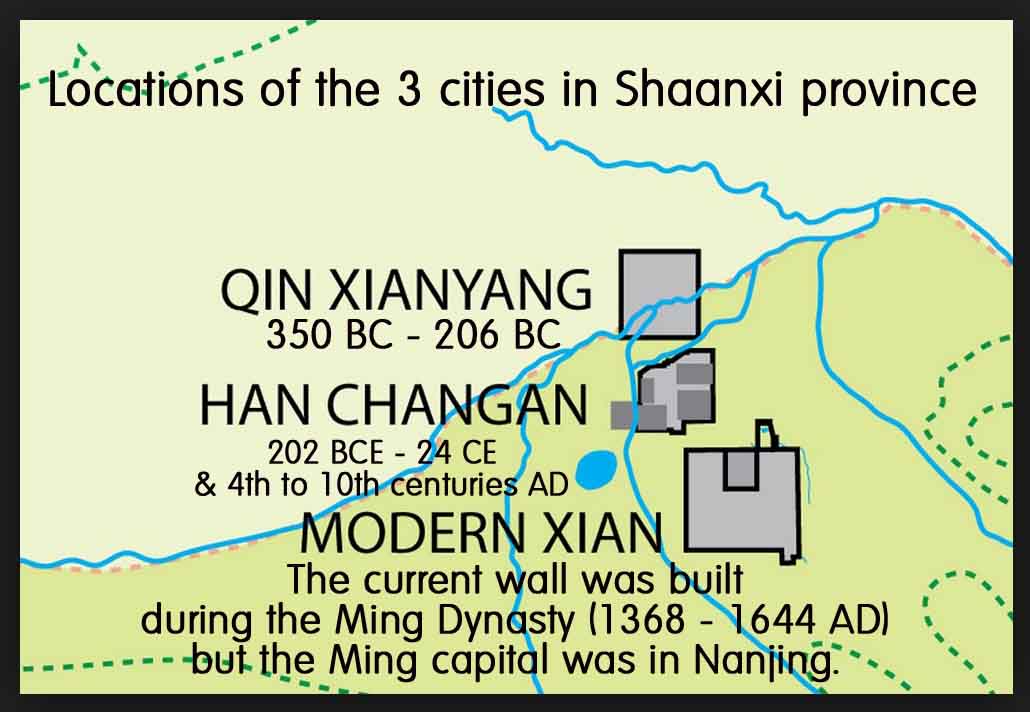
The three cities of Xian

Today, another city called Xi’an, near the original location of Chang’an, is home to millions of people and thousands of men made of clay, the Terra Cotta Warriors guarding China’s first emperor.

In addition, the current massive city wall for Xi’an is more than six hundred years old and longer than 12 kilometers. Cracks are appearing and an engineering team keeps close watch and makes repairs

Soon after the Qin Dynasty capital of Xianyang was destroyed, the Han Dynasty built the second city Chang’an, which is close to the modern city of Xi’an, and the old eroding walls of Chang’an are still visible.

Covering 36 square kilometers, Han Chang’an (202 BCE – 24 CE and again in the 4th to 10th centuries AD) was more than one and a half times the size of Rome.

Continued January 27, 2016 in Part 2

______________________________

Lloyd Lofthouse is the award-winning author of My Splendid Concubine [3rd edition]. When you love a Chinese woman, you marry her family and culture too. This is the unique love story Sir Robert Hart did not want the world to discover.

#1 - Joanna Daneman review posted June 19 2014

Where to Buy

Subscribe to “iLook China”!
Sign up for an E-mail Subscription at the top of this page, or click on the “Following” tab in the WordPress toolbar at the top of the screen.

About iLook China

China’s Holistic Historical Timeline


Taiwan: does democracy work in Asia? Part 6 of 6

January 24, 2016

The last alleged Asian democracy to shine a brief spotlight on is Taiwan, which isn’t really a country, since the United States and most other significant nations recognize one China and thus include the boundaries of Taiwan as being part of the boundaries of (mainland) China.

In fact, China claims Taiwan as its province, and the international community does not want to contradict China, so Taiwan is not a member of the United Nations.

Although local elections were allowed in Taiwan as early as the 1950s, the Kuomintang (KMT) ruled Taiwan with martial law under Chiang Kai-shek (1887 – 1976), and repressed democracy advocates for more than three decades—sometimes brutally.

For instance, there was another massacre “I never heard of” that I stumbled on by accident while researching another post, the 2/28 Massacre in Taiwan. Estimates of the number of deaths vary from 10,000 to 30,000 or more. The massacre marked the beginning of the Kuomintang’s White Terror period in Taiwan, in which thousands more inhabitants vanished, died, or were imprisoned. Has anyone heard the U.S. media remind Americans of the massacre in Taiwan that murdered as many as 10 times the casualties that have been reported annually about the alleged 1989 massacre in China’s Tiananmen Square?

After Chiang Kai-shek’s death, in 1976, the KMT held onto power until 2000. Then in direct elections, the Taiwanese people voted for a president in 1996, 2000, 2004, 2008 and 2012, but corruption reared its ugly head again.

In 2009, Time World reported on former President Chen Shui-bian‘s corruption trial. Chen was accused of taking $9 million dollars in personal kickbacks on a state-sanctioned land deal, embezzling over $3 million from a state fund and laundering millions to overseas accounts.

Then in 2010, the Taipei Times reported, “A former president (Chen Shui-bian) jailed for graft, a retired head of military police indicted for embezzlement, three top judges accused of taking bribes — the list goes on. Taiwan has a problem with corruption.”

In addition, New York Times reported, “Lee Teng-hui, a former president (served 1996 – 2000), who moved the self-governing island toward democracy, was indicted … on charges of embezzling $7.79 million from a state fund, becoming the second former president of Taiwan to be charged with corruption.”

One good thing to say for Taiwan is a low poverty level similar to mainland China. However, in the world’s most powerful democracy, the U.S. 2010 Census says 15.7 percent of Americans live in poverty and that is 47.8 million people—more than twice the population of Taiwan.

After discovering the track record of these so-called multi-party democracies in Asia, do you think mainland China’s growing middle class will eventually want a multi-party democracy?

For one answer, Professor Stephen Kobrin of the Wharton School of Knowledge at the University of Pennsylvania says, “We tend to assume all middle-class people have certain values.”

Kobrin points to the common assertion that people rising into the middle class will press for democracy. However, that does not seem to be happening in China where he suggests that people may be willing to accept more autocratic regimes in return for stability and a middle-class consumer lifestyle.

“The assumption has been that there’s a link between capitalism and democracy, that as incomes rise and people become educated, they will increase pressure for democracy and freedom and civil liberties,” notes Kobrin. “That may or may not be true.”

What do you think—is democracy in Asia working and should China give it a try?

Return to India in Part 5 or start with Japan in Part 1

______________________________

Lloyd Lofthouse is the award-winning author of My Splendid Concubine [3rd edition]. When you love a Chinese woman, you marry her family and culture too. This is the unique love story Sir Robert Hart did not want the world to discover.

IMAGE with Blurbs and Awards to use on Twitter

Where to Buy

Subscribe to “iLook China”!
Sign up for an E-mail Subscription at the top of this page, or click on the “Following” tab in the WordPress toolbar at the top of the screen.

About iLook China

China’s Holistic Historical Timeline


India: does democracy work in Asia? Part 5 of 6

January 23, 2016

Among the alleged Asian democracies, India is next.  The Guardian says of corruption in India that “All your life you pay for things that should be free.”

The Guardian reported that “one ordinary man” had to pay at least a third of his income to survive. “Of the 40,000 rupees (£520) I earn a month from my restaurant, I pay at least a third in bribes,” Vishal, 26, said. But bribery also extends into his personal life. Vishal has two young children and to get the eldest into the best local school he paid a “donation” of 25,000 rupees (£340) in cash to the headmaster.”

Economy Watch.com said, “India’s underground economy is believed to be 50 percent of the country’s GDP – US$640 billion at the end of 2008,” and Janamejayan’s Weblog goes into detail of one scam that cost $40 billion, which is 3% of India’s GDP.


Poverty in India, 2011

In addition, there is confusion over how many live in poverty in India.

In 2009, the United Nations Development Programme reported that literacy in India was about 74 percent, while the CIA Factbook set the literacy rate at 61 percent (literacy and poverty are linked), which explains The World Bank’s estimates of poverty in India at 41.6 percent.

However, the Hindustan Times says for 2011 that there are 406 million poor in India, which is a third of the population—an increase of 8% since 2009.

In addition, a study by the Oxford Poverty and Human Development Initiative using a Multi-dimensional Poverty Index (MPI) found that there were 645 million poor living under the MPI in India

In 2009, India’s population was about 1.2 billion, and the country had six nationally recognized political parties and about 46 recognized state/provincial parties. Source: List of Recognized Political Parties in India (Wiki)

India has been the world’s largest democracy since 1947, and although India claims to have reduced poverty from about 53% in 1973-74 to 25.6% in 1999-2000, the definition and difficulty in reporting the exact numbers casts doubt on this claim.

However, in the same time span, China reduced poverty from 64% to less than 3%, and China is not a multi-party democracy. If China had been a multi-party democracy like India, would poverty have been reduced so dramatically?

In addition, according to Time’s Global Spin, a blog about the world, its people and its politics, “The size of India’s middle class was 50 million in 2005, according to this report by McKinsey,” and McKinsey may be wrong and the number may be lower.

In contrast, Martin Trieu, President of Tourmaline Capital, estimates “there are at least 250-300 million people (in China) who now fall into this (middle class) category.”

Helen H. Wang of Forbes Magazine’s China Tracker agrees with Trieu, and says, “Today, China’s middle class is already larger than the entire population of the United States and is expected to reach 800 million in fifteen years.”

How precious is freedom when you are too poor to enjoy it?

Continued with Taiwan on January 24, 2016 in Part 6 or return to Part 4

______________________________

Lloyd Lofthouse is the award-winning author of My Splendid Concubine [3rd edition]. When you love a Chinese woman, you marry her family and culture too. This is the unique love story Sir Robert Hart did not want the world to discover.

#1 - Joanna Daneman review posted June 19 2014

Where to Buy

Subscribe to “iLook China”!
Sign up for an E-mail Subscription at the top of this page, or click on the “Following” tab in the WordPress toolbar at the top of the screen.

About iLook China

China’s Holistic Historical Timeline