The Statutory Woman

March 15, 2016

An honest comment for my first novel My Splendid Concubine gave me the idea for this post on the history of the changing attitudes of when a female child becomes a woman. The comment said, “The girls (the two concubines in the story) were younger than 15, for goodness sake. I had a hard time getting past that.”

According to Live Science.com, “A woman can get pregnant and have a baby as soon as she begins ovulating, or producing eggs. This typically occurs about a year after they first begin menstruating, which for North American women, usually happens between the ages of 11 and 12.”

But according to the law in the United State, a female child isn’t legally a woman until age 16, 17 or 18 depending on which U.S. state you live in.

But the age of consent laws in China in the middle of the 19th century, the time period of My Splendid Concubine, that was based on a real-life story, were not the same as they are today, and China is not the United States.

To understand the difference between now and then, today in the People’s Republic of China, the age of consent for sexual activity is 14, regardless of gender and/or sexual orientation. In Hong Kong, it is 16 and 17 in Macau.

In fact, “Depictions of ‘child-romance’ in ancient or modern Chinese literature are not difficult to find. They include passages on joyous heterosexual or homosexual activities by children as young as 12 to 13 years old with one another or with adults. Children are usually described as natural sexual beings and erotic stimulation and sex-play are seen as beneficial to their healthy development (Chen 2000). … For most of Chinese history, the minimum marriage age suggested by the government had ranged between 12 and 16.” – Department of Psychiatry, University of Hong Kong

What about the United Kingdom around the time period of my historical novel? In 1875, a concern that young girls were being sold into brothels caused Parliament to change the age of consent to 13. Prior to that, the age of consent was 12.

However, in the United States in 1875, each state determined its own criminal laws and the age of consent ranged from 10 to 12 years of age. It would not be until after the 1930s that the term jailbait came into use in America as the age of consent laws changed.

I could have sanitized My Splendid Concubine and made both Ayaou and her sister Shao-mei much older to fit the politically correct attitudes of today, but that would have been historically incorrect. Sterling Seagrave in his book Dragon Lady, the Life and Legend of the Last Empress of China, wrote, “He (Robert Hart) had just turned twenty. Ayaou was barely past puberty but was wise beyond her years.”

If Ayaou, one of the concubines in the novel, was barely 14, then there was only a six-year gap between the two, while Hart’s arranged marriage to a young Irish woman named Hester Jane Bredon a decade later sees the gap double to twelve years when he was thirty and she was eighteen. Seagrave says, “He (Hart) sought a wife as straightforwardly as he had bought a concubine.” After returning to Ireland for a brief stay in 1866, Robert proposed marriage to Hester five days after he met her. The courtship lasted three months before they were married.

Should authors ignore historical fact and rewrite history to reflect the moral sensitivities of today’s readers?

Lloyd Lofthouse is the award-winning author of My Splendid Concubine [3rd edition]. When you love a Chinese woman, you marry her family and culture too. This is the unique love story Sir Robert Hart did not want the world to discover.
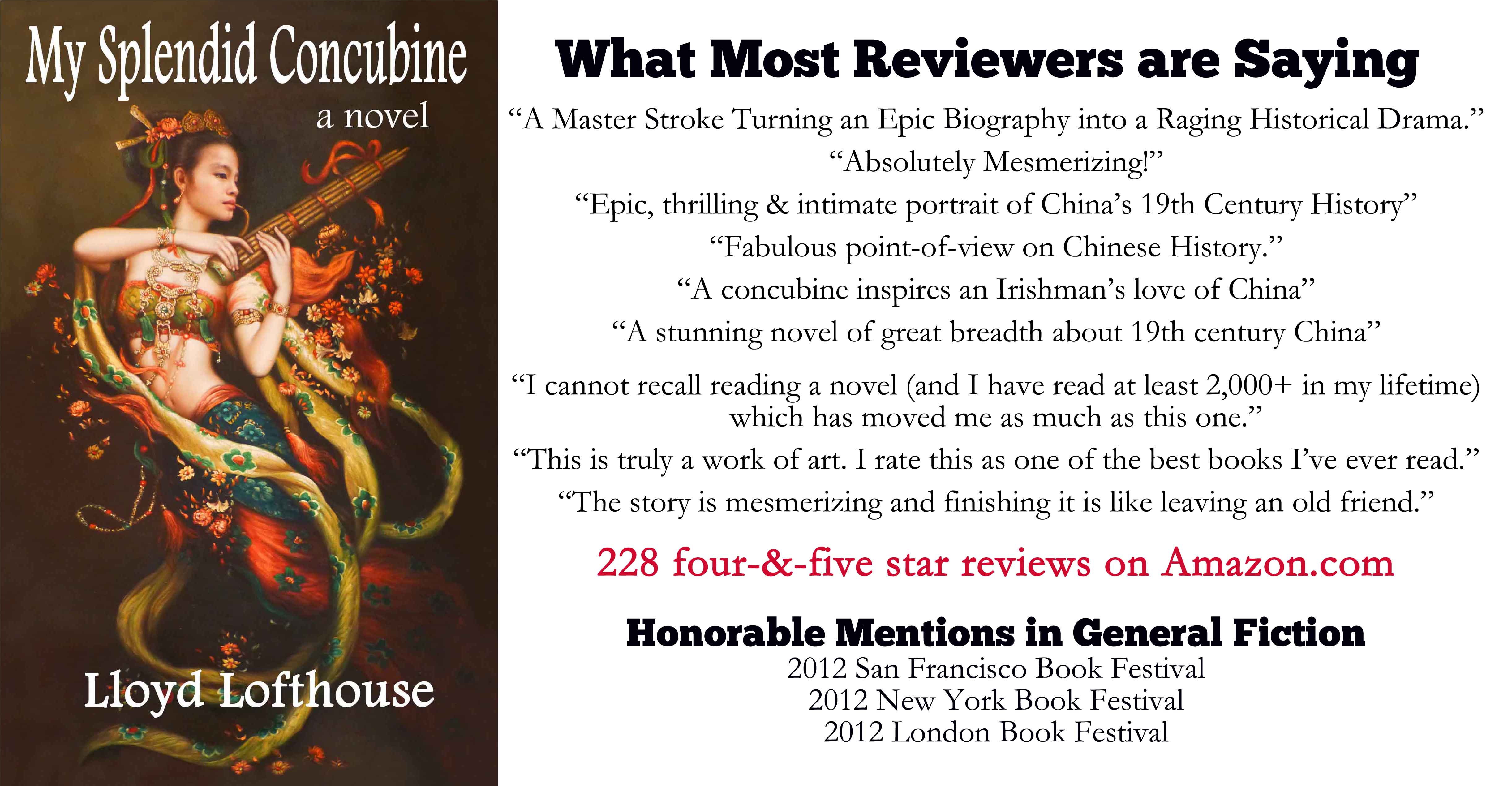
A1 on March 13 - 2016 Cover Image with BLurbs to promote novel

Where to Buy

Subscribe to “iLook China”!
Sign up for an E-mail Subscription at the top of this page, or click on the “Following” tab in the WordPress toolbar at the top of the screen.

About iLook China

China’s Holistic Historical Timeline


Is the Nap at risk in China?

March 9, 2016

Napping is a custom in much of China. My father-in-law, for instance, who is 84, naps every afternoon, and I thought it was due to his age.

Then after more than a decade of marriage, I asked my wife if her father had always taken afternoon naps. She said yes and that even at work in Shanghai during the Cultural Revolution, the Chinese Communist Party bosses made everyone take a long nap after lunch—about two hours every day.

Deciding to learn more, I turned to Google and found that “The Chinese, particularly those in the southern and south-eastern regions, take what could be called an afternoon siesta that lasts from approximately 12 noon to 2:30 p.m.”

I learned that afternoon naps in China are common, but that doesn’t mean everyone does it.  I also learned that the Internet and the modern-urban lifestyle have cut into the old habit of napping.

In fact, micro-blogging in China has had an impact on this centuries old custom. MSNBC.com reported that the Chinese government “sensitive to public opinion, especially stories of lazy or corrupt bureaucrats carried by massively popular micro-blogging sites,” cracked down on napping at meetings in an attempt to “instill a greater sense of duty into its officials.”

If this trend continues, this might seriously impact public health, creativity and learning in China.

Han Fang, a professor at Peking University People’s Hospital, says, “Lack of sleep can cause a significant lowering of immunity…”

In addition, the New York Times reported, “New research has found that young adults who slept for 90 minutes after lunch raised their learning power, their memory apparently primed to absorb new facts.”

“Other studies have indicated that sleep helps consolidate memories after cramming, but the new study suggests that sleep can actually restore the ability to learn,” and that might explain why “most Chinese schools have a scheduled half-hour nap right after lunch.” – Wiki.answers.com

“According to the advocates, a short 10-20 minute nap in the middle of a working day can increase productivity by over 30 percent and alertness by 100 percent as well as improve memory and concentration. They also claim that it can reduce stress and the risk of heart disease by 34 percent.”

I’m struggling to cultivate the habit of napping, but it’s hard to break old habits when you grew up in the United States where it is customary to make people work long hours for poverty wages even when they are exhausted.

______________________________

Lloyd Lofthouse is the award-winning author of My Splendid Concubine [3rd edition]. When you love a Chinese woman, you marry her family and culture too. This is the unique love story Sir Robert Hart did not want the world to discover.

IMAGE with Blurbs and Awards to use on Twitter

Where to Buy

Subscribe to “iLook China”!
Sign up for an E-mail Subscription at the top of this page, or click on the “Following” tab in the WordPress toolbar at the top of the screen.

About iLook China

China’s Holistic Historical Timeline


Who was the first Cinderella?

March 8, 2016

There is a myth that the earliest version of the Cinderella story appeared in Egypt around the first century. If true, since Egypt didn’t have printing presses back then, this may have been an oral story told around camp fires.

However, in 850 AD during the Tang Dynasty, the first known literary version of Cinderella was published in China, and it was about a girl named Yeh-Shen set in the Qin and Han dynasties centuries before the birth of Jesus Christ.

Although there are claims the Chinese Cinderella, Yeh-Shen, had bound feet,  foot binding didn’t appear in China until the Sung Dynasty (960-1276 AD), more than a century after this Chinese Cinderella story was first published. – Bound Feet Women

The French version of Cinderella wouldn’t be published by Charles Perrault until 1697 — more than eight centuries later.

Another version of Cinderella would appear in 1867 and again in 1894 in England.

In 1945, the Bolshoi Theatre in Moscow would present the premiere of Sergei Prokofiev’s ballet of Cinderella.

Walt Disney wouldn’t publish a version of Cinderella until 1946, more than a thousand years after Cinderella first appeared in China based on a story that is alleged to have taken place about 206 BC.

Lloyd Lofthouse is the award-winning author of My Splendid Concubine [3rd edition]. When you love a Chinese woman, you marry her family and culture too. This is the unique love story Sir Robert Hart did not want the world to discover.

#1 - Joanna Daneman review posted June 19 2014

Where to Buy

Subscribe to “iLook China”!
Sign up for an E-mail Subscription at the top of this page, or click on the “Following” tab in the WordPress toolbar at the top of the screen.

About iLook China

China’s Holistic Historical Timeline


The 2,553 year old Chimes of Marquis Yi

March 2, 2016

In 1977, a discovery was made in China—a complete set of chime bells was unearthed from the tomb of Marquis Yi, who lived during the Warring States Period (475 to 221 BC). These chimes were older than the Qin Dynasty’s famous Terra Cotta warriors (221 to 206 B.C.) that guard the tomb of Qin Shi Huangdi, the emperor that unified China.

When the chimes were discovered in Hubei Province (located in Central China), a plot of land was being leveled to build a factory.  The Red Army officer in charge of the work had an interest in archeology.

The officer discovered that the workers were selling the ancient bronze and iron artifacts they were digging up. He convinced local authorities there might be an ancient tomb buried below the site.

When the tomb was unearthed, a set of chime bells was found.  These musical instruments were an important part of ritual and court music dating. An American professor in New York City even called these chimes the eighth wonder of the ancient world.

The sixty-five chime bells weighed about 5 tons.

No other set of chimes like these had been discovered in China before, and this set was in excellent condition.

A project was launched in 1979 to duplicate four sets of these chimes. More than a 100 scientists and technicians were recruited.  In 1998, twenty years after the discovery, the project was completed. One of the sets was sent to Taiwan as a gift.

Lloyd Lofthouse is the award-winning author of My Splendid Concubine [3rd edition]. When you love a Chinese woman, you marry her family and culture too. This is the unique love story Sir Robert Hart did not want the world to discover.

IMAGE with Blurbs and Awards to use on Twitter

Where to Buy

Subscribe to “iLook China”!
Sign up for an E-mail Subscription at the top of this page, or click on the “Following” tab in the WordPress toolbar at the top of the screen.

About iLook China

China’s Holistic Historical Timeline


What happens when any Form of Government becomes destructive and many people suffer?

March 1, 2016

I was recently asked, “What can China learn from the US political model? American government is looking more and more like ‘of the 1% by the 1% and for the 1%’!”

My answer follows: If China learns anything from what is happening in the U.S., it’s to keep a balance between socialism and capitalism and not let socialism dominate capitalism and capitalism dominate socialism.

Capitalism benefits the 1% – everyone cannot be a winner even though many of the wealthy think everyone can make it like they did and they look down on and discriminate against everyone who doesn’t make it. After all, everyone has the right to work harder to make it, right, even on poverty wages with no benefits?

Socialist programs benefits the other 99% where many can end up suffering horribly without a safety net.

I’m not talking about pure socialism where the state—representing the people—own everything: the land and everything built on and under it, the means of production and the retail sector that sells what’s produced. I’m talking about social safety-net programs like affordable and/or free universal health care for every citizen no matter how much they earn, a livable wage, Social Security for when people are old and retire, unemployment insurance for people who have lost their jobs, labor unions that represent the workers, and disability insurance for workers injured on the job and even from accidents outside of work, who can no longer work because of the injury.

The capitalists, the 1%, will moan and groan because of these social programs that protect 99% of the people—the workers that helped make the 1% wealthy and powerful. The 1% will moan and groan because enough is never enough and the social programs that protect the 99% cut into the profits and the growth of their wealth and power. Angry, the 1% will bribe as many leaders in the country as possible to get rid of the socialist programs that protect the 99%. The corruption and lies will be rampant, because money buys power and power corrupts and absolute power corrupts absolutely. Wealth and power is similar to cancer and to contain that disease and protect the 99%, the government must walk a fine line to keep the balance.  The 99% must be stopped from destroying the 1% and the 1% must be stopped from causing the 99% from suffering due to the greed of the 1%.

The 99% can cause tyranny and suffering too because the mob is dangerous and powerful when united against tyranny, and the 1% can quickly become the tyranny behind the suffering caused to the 99%. That is what is happening in the United States today. The 1% is systematically attacking every public sector socialist program that protects the quality of life for the 99%.

The U.S. Declaration of Independence, that is not the law of the United States—the U.S. Constitution and Bill of Rights is the law that guides America—says it best:

“We hold these truths to be self-evident, that all men are created equal, that they are endowed by their Creator with certain unalienable Rights, that among these are Life, Liberty and the pursuit of Happiness.–That to secure these rights, Governments are instituted among Men, deriving their just powers from the consent of the governed, — That whenever any Form of Government becomes destructive of these ends, it is the Right of the People to alter or to abolish it, and to institute new Government, laying its foundation on such principles and organizing its powers in such form, as to them shall seem most likely to effect their Safety and Happiness. Prudence, indeed, will dictate that Governments long established should not be changed for light and transient causes; and accordingly all experience hath shewn, that mankind are more disposed to suffer, while evils are sufferable, than to right themselves by abolishing the forms to which they are accustomed. But when a long train of abuses and usurpations, pursuing invariably the same Object evinces a design to reduce them under absolute Despotism, it is their right, it is their duty, to throw off such Government, and to provide new Guards for their future security.–Such has been the patient sufferance of these Colonies; and such is now the necessity which constrains them to alter their former Systems of Government. The history of the present King of Great Britain is a history of repeated injuries and usurpations, all having in direct object the establishment of an absolute Tyranny over these States. To prove this, let Facts be submitted to a candid world.”

A government’s struggle to keep that balance between capitalism and socialism never ends because the temptations to lean toward capitalism’s 1% are many, and it has been said through the ages that every person has a price and can be bought one way or the other. Government also must resist the cry of the mob, loud and organized factions of the 99%, that demand more from the social safety net. In the end, it is up to knowledgeable, honest voters to help keep that balance in place.

Lloyd Lofthouse is the award-winning author of My Splendid Concubine [3rd edition]. When you love a Chinese woman, you marry her family and culture too. This is the unique love story Sir Robert Hart did not want the world to discover.

#1 - Joanna Daneman review posted June 19 2014

Where to Buy

Subscribe to “iLook China”!
Sign up for an E-mail Subscription at the top of this page, or click on the “Following” tab in the WordPress toolbar at the top of the screen.

About iLook China

China’s Holistic Historical Timeline