China’s challenge to preserve its arable land

September 7, 2016

Arable land is where countries grow the food people eat. According to Nation Master, the U.S. has 174.5 million hectares (one hectare is almost 2.5 acres) of arable land, India has almost 160 million hectares, Russia almost 122 million, but China has less than 105 million (almost 40 percent less than the U.S). The trouble with that is that China has more than 1.3 billion people to feed compared to America’s 320 million.

Then there’s the water. Live Science.com reports that after 3 days, you’ll need water or you’ll die, but you can survive for 3 weeks without food.

To make China’s challenge more daunting, it almost has the same amount of total renewable water that the U.S. has at 2,813 billion cubic meters vs. 2,818 for the U.S.

Don’t forget that China has more than four times the people to feed.

That’s why it is vital that China protects as much arable land as possible while conserving water. That challenge is tough because almost one third of China’s land is desert — a process that has accelerated due to development and human activities. The deserts of China have also become a tourist attraction and that doesn’t help.

In addition, another third of China is mountainous with an additional 10% covered with hills. Combine deserts, mountains and hills and that accounts for about 70% of the country’s land surface.

One strategy to slow the spread of the deserts has been to create a grid of plant growth that will hold the sand in place. The Economist reported that since 1978, 66-billion trees have been planted by Chinese citizens with the goal that by 2050, there will be a forest stretching 2,800 miles along the edges of China’s northern deserts that will increase the world’s forest cover by more than a tenth.

However, due to the natural resources needed to fuel China’s growth and a huge population, northern China has become a boomtown and is attracting millions of people because of the opportunities to earn better money. At the same time herders have also been restricted from allowing their animals to graze on the areas that are being reclaimed from the desert.

This has caused a reduction in the size of herds, for instance, sheep and goats.

Yet, even with these challenges, China still produces more food than any other country on the planet. Agriculture is a vital industry in China, employing over 300 million farmers. China ranks first in worldwide farm output, primarily producing rice, wheat, tomato, sorghum, peanuts, tea, millet, barley, cotton, oilseed and soybeans. Although accounting for only 10 percent of arable land worldwide, it produces food for 20 percent of the world’s population.

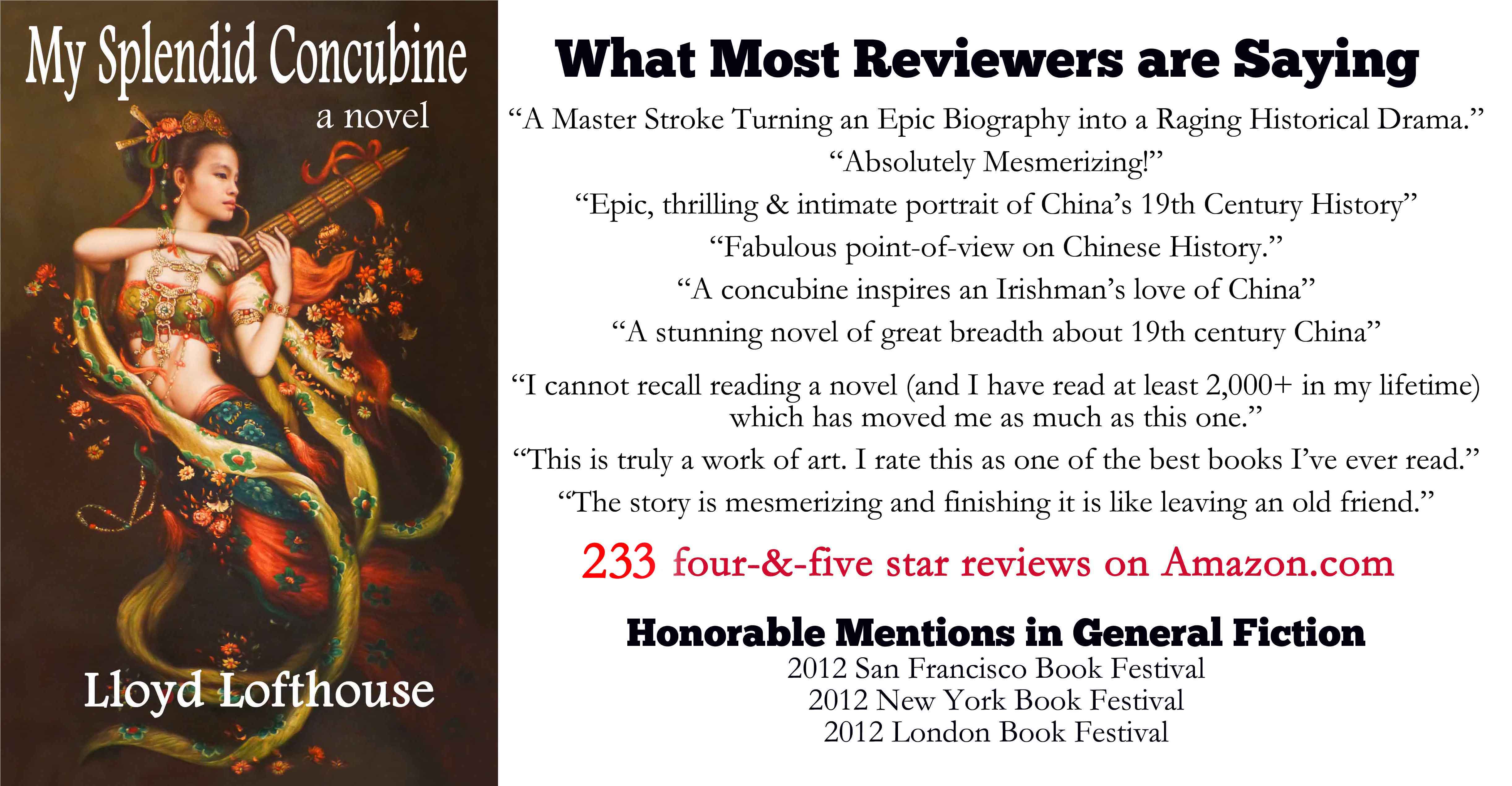
Lloyd Lofthouse is the award-winning author of My Splendid Concubine [3rd edition]. When you love a Chinese woman, you marry her family and culture too. This is the unique love story Sir Robert Hart did not want the world to discover.
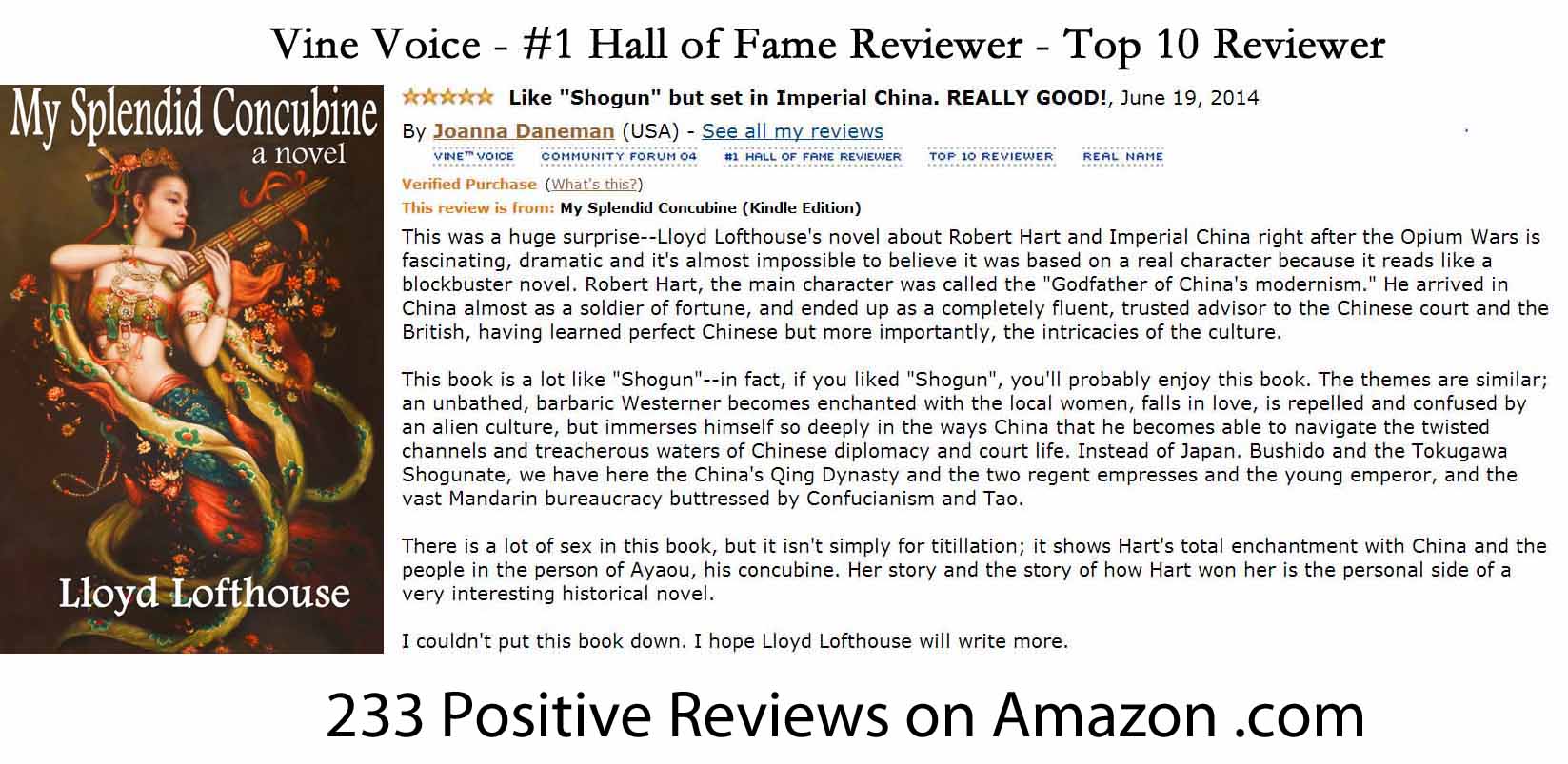
#1 - Joanna Daneman review posted June 19 2014

Where to Buy

Subscribe to “iLook China”!
Sign up for an E-mail Subscription at the top of this page, or click on the “Following” tab in the WordPress toolbar at the top of the screen.

About iLook China

China’s Holistic Historical Timeline


Jack London Accused of Racism after Visiting China in 1904

September 6, 2016

The experiences Jack London (1876 – 1916) had in Korea and China in 1904 led to an essay and a story that ignited a debate that he was a racist. At the time, London also took photographs during the Russo-Japanese War in Korea and Manchuria.

He wrote the The Unparalleled Invasion, which takes place in a fictional 1975, when the West decides to destroy China (for no good reason) by using biological warfare.

London’s 1904 essay, The Yellow Peril, contributed to the claim that he was a racist. Using Google, I found sites that support this theory.

The New World Encyclopedia says, “Many of Jack London’s short stories are notable for their empathetic portrayal of Mexicans (The Mexican), Asian (The Chinago), and Hawaiian (Koolau the Leper) characters. But, unlike Mark Twain, Jack London did not depart from the views that were the norm in American society in his time, and he shared common Californian concerns about Asian immigration and ‘the yellow peril’ (which he actually used as the title of an essay he wrote in 1904; on the other hand, his war correspondence from the Russo-Japanese War, as well as his unfinished novel “Cherry,” show that he greatly admired much about Japanese customs and capabilities.”

In addition, Jack London, Photographer (ISBN 978-0-8203-2967-3) by Jeanne Campbell Reesman, Sara S. Hodson and Philip Adam is a beautiful book showing that London had talent beyond writing stories such as White Fang or Call of the Wild.

On page 57, the caption says, “London had his camera confiscated in Japan and was often detained by Japanese officials when he got too close to the front lines, especially as the war spread to the Yalu River, the boundary between Korea and Manchuria.”

After seeing the pictures in Jack London, Photographer, it’s difficult to believe he was a racist. There have also been rumors that London committed suicide, but there’s no evidence to support that theory either.

If London were a racist, why did his Japanese servant Tokinosuke Sekine stay loyal to the end even after London was bankrupt and his ‘fair weather’ friends had abandoned him?

Lloyd Lofthouse is the award-winning author of My Splendid Concubine [3rd edition]. When you love a Chinese woman, you marry her family and culture too. This is the unique love story Sir Robert Hart did not want the world to discover.

A1 on June 22 - 2016 Cover Image with BLurbs to promote novel

Where to Buy

Subscribe to “iLook China”!
Sign up for an E-mail Subscription at the top of this page, or click on the “Following” tab in the WordPress toolbar at the top of the screen.

About iLook China

China’s Holistic Historical Timeline


Discover the history of China’s drums

August 31, 2016

The earliest evidence of the use of drums in China was found in Oracle inscriptions from the Shang Dynasty (1783-1123 BC).

Drums were used to motivate troops, set a marching pace and for sending orders or announcements.

The drum had a purpose in almost all elements of Chinese life. Copper drums come from southern China and date to almost a thousand years before Christ.  The copper drum was also called the war drum.

The Han Dynasty used copper drums for war too.

The Fengyang Drum Dance originated in Anhui Province and was used by traveling musicians and dancers in the streets of villages and towns. In time, it would represent poverty.

Tibetan drums, and Tibet is part of China, are part of the Sholdon (Yogurt) Festival, which occurs in late August.

Drums are also used for the traditional Chinese New Year’s Lion Dance.

Discover China’s First Emperor Qin Shi Huangdi, the man that unified China more than 2,000 years ago.

Lloyd Lofthouse is the award-winning author of My Splendid Concubine [3rd edition]. When you love a Chinese woman, you marry her family and culture too. This is the unique love story Sir Robert Hart did not want the world to discover.

#1 - Joanna Daneman review posted June 19 2014

Where to Buy

Subscribe to “iLook China”!
Sign up for an E-mail Subscription at the top of this page, or click on the “Following” tab in the WordPress toolbar at the top of the screen.

About iLook China

China’s Holistic Historical Timeline


The influence of U.S. universities on students from China

August 30, 2016

Millions of students from Communist China have attended American universities and colleges and earned degrees.

The American impression of China hasn’t stopped some of China’s top leaders sending their children to universities in the West. For instance China’s first-daughter, Xi Mingxi, the only child of Xi Jinping, the President of China, graduated from Harvard in 2014 under a pseudonym.  The New Yorker reported she “studied psychology and English and lived under an assumed (fake) name.”

In November 2015 Foreign Policy Magazine reported, “Out of the more than 974,000 international students currently in the United States, almost one in three is now Chinese.”

According to Foreign Policy Magazine there is a benefit gained from this. “Having these Chinese students on U.S. campuses helps to build a bridge between China and the United States.”

This exchange isn’t free. In fact, it’s expensive for a foreign student to attend a college or university in the U.S., and Foreign Policy says, “In the 2014-2015 academic year, Chinese students pumped $9.8 billion into the U.S. economy through tuition and fees.”

It may come as a surprise to most Americans to discover that families in China that have the money to send their children to the U.S. mostly belong to the Communist Youth League or the Chinese Communist Party and more of them are going home after graduation.

The South China Morning Post reported, “For decades, the rate of return to China remained low as students with advanced degrees did not see opportunities for research at home. Last year, more than 272,000 Chinese returned after completing their education abroad, 86,700 more than in 2011; a 46 percent increase, according to the Ministry of Education.”

When China’s evolution as a modern nation is complete, will it become a republic influenced by America’s “so-called” socialist, liberal institutions of higher education, but with Chinese characteristics like Sun Yat-sen, the father of China’s republic, said he wanted. After all, Sun Yat-sen was influencd by what he learned while attending high school and then one semester of college in Hawaii before he went home to launch a revolution that toppled China’s last imperial dynasty in 1912.

What do most Chinese students think after spending several years in the United States? Another Foreign Policy piece attempts to answer that question and reports, For many Chinese students, it’s not that simple. “I like the U.S.,” one survey respondent wrote. “But I love China; it’s my motherland.”

Lloyd Lofthouse is the award-winning author of My Splendid Concubine [3rd edition]. When you love a Chinese woman, you marry her family and culture too. This is the unique love story Sir Robert Hart did not want the world to discover.

A1 on June 22 - 2016 Cover Image with BLurbs to promote novel

Where to Buy

Subscribe to “iLook China”!
Sign up for an E-mail Subscription at the top of this page, or click on the “Following” tab in the WordPress toolbar at the top of the screen.

About iLook China

China’s Holistic Historical Timeline


The Historical Social Networks and Influential Relationships of China

August 24, 2016

The title of this post refers to Guanxi. I first heard of Guanxi from the China Law Blog, which referred to the Silicon Hutong Blog.

After reading the China Law Blog’s post, I did more research and also watched a few videos on the subject.

I learned that Guanxi is an aspect of Chinese culture that does not translate easily.

There are several elements and layers to Guanxi. First, Guanxi is based on a Confucian hierarchy of familial relationships, long-term friendships, classmates, and schoolmates and to those no stranger—Chinese or foreign—will ever have access to. (Silicon Hutong)

Guanxi evolved over the millennia because China didn’t have a stable and effective legal system. In fact, the legal system in China today is relatively new and made its appearance after the 1982 Chinese Constitution was established.

Since 1982, there have been several amendments to the Constitution as China adapts its evolving legal system.

In time, this legal system may replace Guanxi since business law modeled on Western law with Chinese characteristic is developing faster than civil law.

Through the centuries, merchants in China needed a way to avoid disputes and problems in the absence of a well-developed legal system. To survive, a complex system called Guanxi developed with many components such as partnerships, trust, credibility, etc.

Guanxi developed organically in civil society due to the absence of a uniform, government mandated legal system, and maintaining Guanxi is different than how relationships are maintained in other cultures. The embedded videos with this post offers a more detailed explanation.

The China Law Blog’s had more than twenty comments, and it was a lively discussion worth reading if you are interested in discovering more on this topic.

Learn about “face” and discover how it might affect Guanxi.

Lloyd Lofthouse is the award-winning author of My Splendid Concubine [3rd edition]. When you love a Chinese woman, you marry her family and culture too. This is the unique love story Sir Robert Hart did not want the world to discover.

#1 - Joanna Daneman review posted June 19 2014

Where to Buy

Subscribe to “iLook China”!
Sign up for an E-mail Subscription at the top of this page, or click on the “Following” tab in the WordPress toolbar at the top of the screen.

About iLook China

China’s Holistic Historical Timeline