The Story of Stone and China’s Star Crossed Lovers.

October 12, 2016

The Dream of the Red Chamber (also known as The Story of Stone) is generally considered one of the four greatest Chinese classical novels. The story is so popular in China that it has had several versions and translations and was made into a TV series.

The author, Tsao Hsueh-chin (1715-1763) came from a powerful and wealthy family and lived a privileged life as a child in Nanjing. Later, he became poor and struggled to survive. Going from wealth to poverty provided him with the necessary experiences to write this tragic story.

Although this novel (English translation available on Amazon in addition to a film selection) has great literary merit on many levels, readers might have difficulty keeping the characters straight, because there are more than four hundred characters and almost thirty are major ones.

Nevertheless, readers and students of Chinese history and culture should read this book to develop a better understanding of Imperial China during the Ch’ing Dynasty. The novel paints a vivid portrait of a corrupt feudal society on the verge of the capitalist, market economy we see flourishing in China today.

Another plot is the Romeo and Juliet love story between Chia Pao-yu and Lin Tai-yu, who, like Romeo and Juliet, wanted to be free to marry anyone they desired.

CliffsNotes has also covered Dream of the Red Chamber.

Discover China’s First Emperor Qin Shi Huangdi, the man that unified China more than 2,000 years ago.

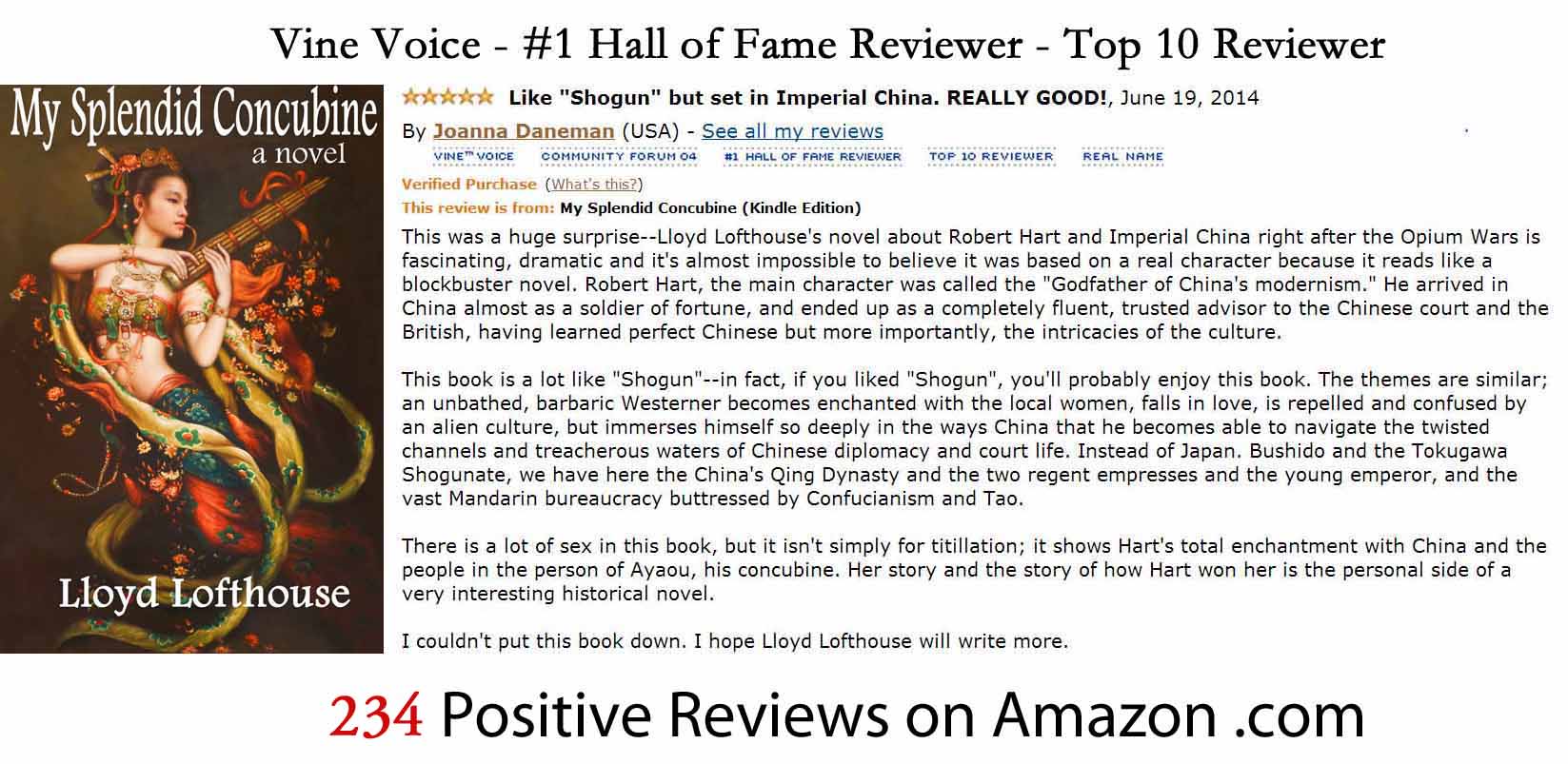
Lloyd Lofthouse is the award-winning author of My Splendid Concubine [3rd edition]. When you love a Chinese woman, you marry her family and culture too. This is the unique love story Sir Robert Hart did not want the world to discover.
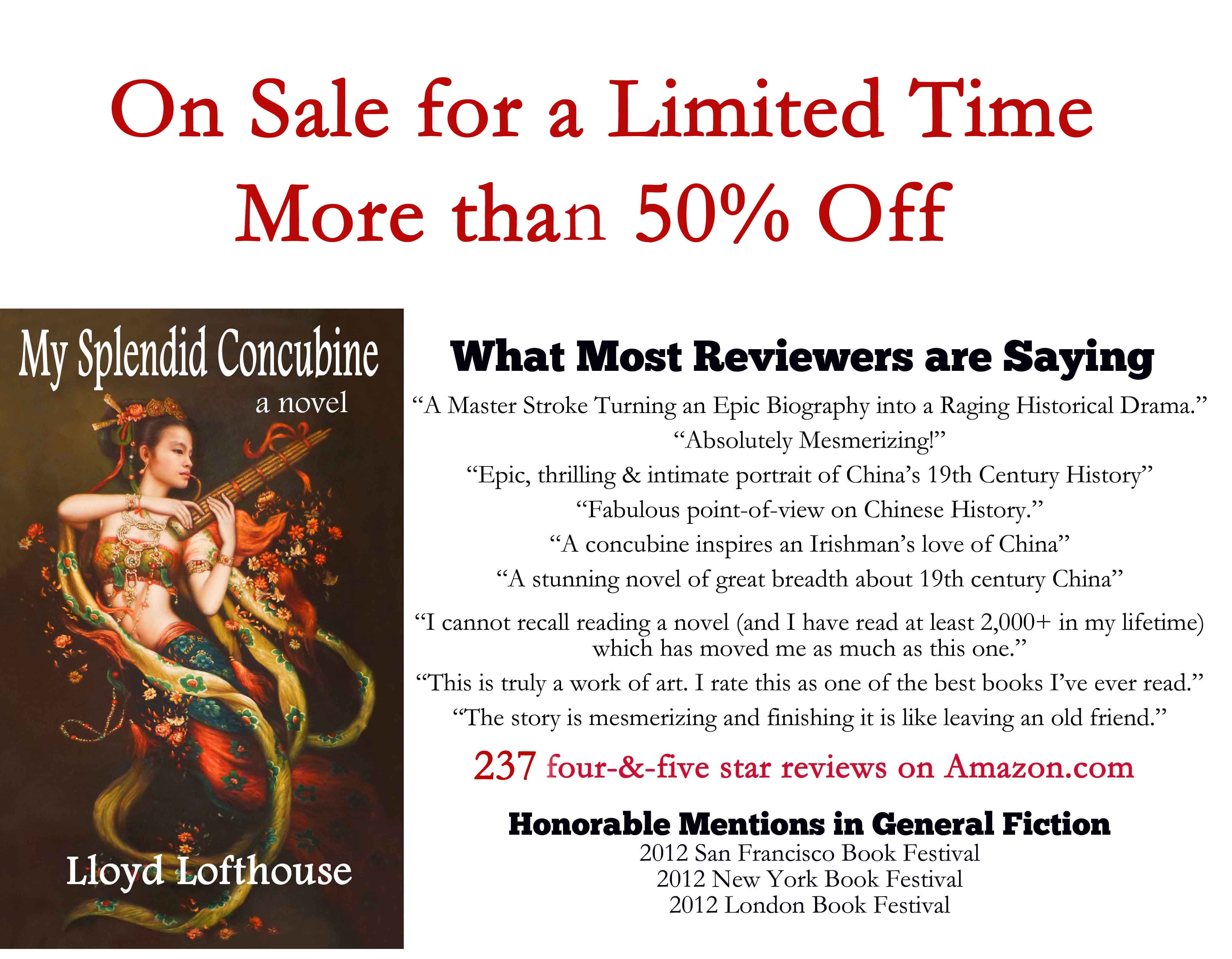
on-sale-for-limited-time-oct-nov-2016

Where to Buy

Subscribe to “iLook China”!
Sign up for an E-mail Subscription at the top of this page, or click on the “Following” tab in the WordPress toolbar at the top of the screen.

About iLook China

China’s Holistic Historical Timeline


The Peasant Cult that Defeated the Yuan Dynasty

October 11, 2016

Religions, as Christians, Jews and Muslims practice them, have seldom played a major role in Chinese Culture and Politics. Even today, more than 800 million Chinese say they don’t belong to any religion and the largest religion in China is Buddhism with about 10% of the population.  Even during Imperial times, most members of government didn’t belong to organized religions. The same is true today with the Chinese Communist Party.

China’s struggle with pagan cults (for instance, the White Lotus Society) stretches back almost a thousand years. The White Lotus Society appealed to poor Han Chinese peasants and more so to women, who found peace in worshiping the Eternal Mother, Wusheng Laomu. It was believed that this Eternal Mother would gather all her children at the millennium into one family.

White Lotus Societies started out seeking tranquility through a combination of Buddhism with some elements of Daoism (Taoism) and other native Chinese religions. Even in the 12th century, the Yuan Dynasty was distrustful of the Yellow Lotus Society, which didn’t fit comfortably with Confucianism.

Persecution of the White Lotus Society started during the Mongol Yuan Dynasty (1271 – 1368 AD), the first dynasty that was not led by the Han Chinese. Due to this, the White Lotus Society changed from one of peace and tranquility and organized protests to violence against the Mongol rulers.

Since Yuan Imperial authorities distrusted the White Lotus Society, the Dynasty banned them, and the White Lotus went underground.  The White Lotus predicted that a messianic, Christ like figure would come and save them from persecution. That man was Zhu Yuanzhang, a Buddhist monk.

The White Lotus led revolution started in 1352 near Guangzhou before Zhu Yuanzhang joined the rebellion. But soon, he became the leader by forbidding his soldiers to pillage in observance of White Lotus religious beliefs.

By 1355, the rebellion had spread through much of China. In 1356, Zhu Yuanzhang captured Nanjing and made it his capital. Then Confucian scholars issued pronouncements supporting Zhu’s claim of the Mandate of Heaven, the first step toward establishing a new dynasty.

Zhu Yuanzhang liberated China from the Mongols and became the founding Emperor of the Ming Dynasty (1368 – 1643). Known as the Hongwu emperor, he was cruel, suspicious, and irrational, behavior that grew worse as he aged.

Discover Wu Zetian, China’s only female emperor

Lloyd Lofthouse is the award-winning author of My Splendid Concubine [3rd edition]. When you love a Chinese woman, you marry her family and culture too. This is the unique love story Sir Robert Hart did not want the world to discover.

#1 - Joanna Daneman review Updated August 26 - 2016_edited-2

Where to Buy

Subscribe to “iLook China”!
Sign up for an E-mail Subscription at the top of this page, or click on the “Following” tab in the WordPress toolbar at the top of the screen.

About iLook China

China’s Holistic Historical Timeline


Marco Polo

October 5, 2016

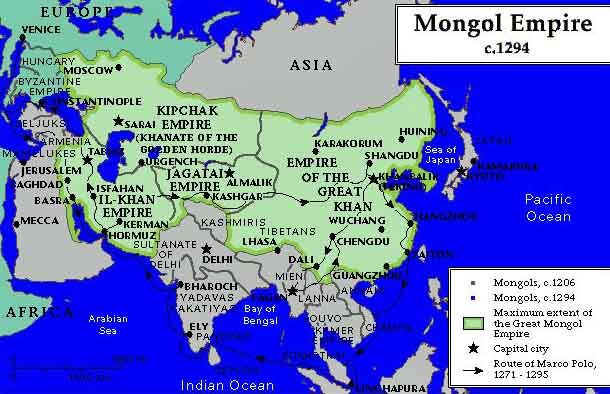
As a child I was fascinated with Genghis Khan (1162 – 1227 A.D.) and his grandson Kublai Khan (1215 – 1294), who was the 5th Khagan (Great Khan of the Mongol Empire), and the 1st Emperor of the Yuan Dynasty in China (1271 – 1368).  He was the first non-native emperor to conquer all of China. This fascination is why I knew a little bit about Marco Polo. In fact, I’ve known about Marco Polo most of my life but not much detail about what he actually accomplished in China.

map-of-mongol-empire

Marco Polo lived in China for 17 years and loyally served Kublai Khan.  I’ve never seen the first television miniseries (8 episodes) originally broadcast by NBC in 1982, but I have watched season one of the recent Marco Polo series produced by Netflix.

Halfway through Seasons One’s Netflix series, I wanted to know how accurate this fascinating interpretation of Marco Polo’s life in China was and did some digging with help from Google.

In the Bonus material for the 1st season, there’s a thirty-eight minute documentary that I recommend watching before starting the episodes, so you have a better idea of who Marco was and what he did in China.  That way you won’t have to do what I did. Watching the documentary will help you separate fact from fiction while watching the series. I didn’t know about the documentary until I finished watching the episodes.

What I found interesting when I did my research about Marco’s years in China (1275 – 1292) was the show’s ratings on Rotten Tomatoes.  The thirty-three critics gave the show a rating of 4.7 out of 10, but the audience of 2,162 gave the show a rating of 9 out of 10. It was easy for me to side with the audience.

I bought the DVDs for Marco Polo Season 1 from Amazon where it has 4.6 of 5 stars from the 90 customer reviews.

Discover Wu Zetian, China’s only female emperor

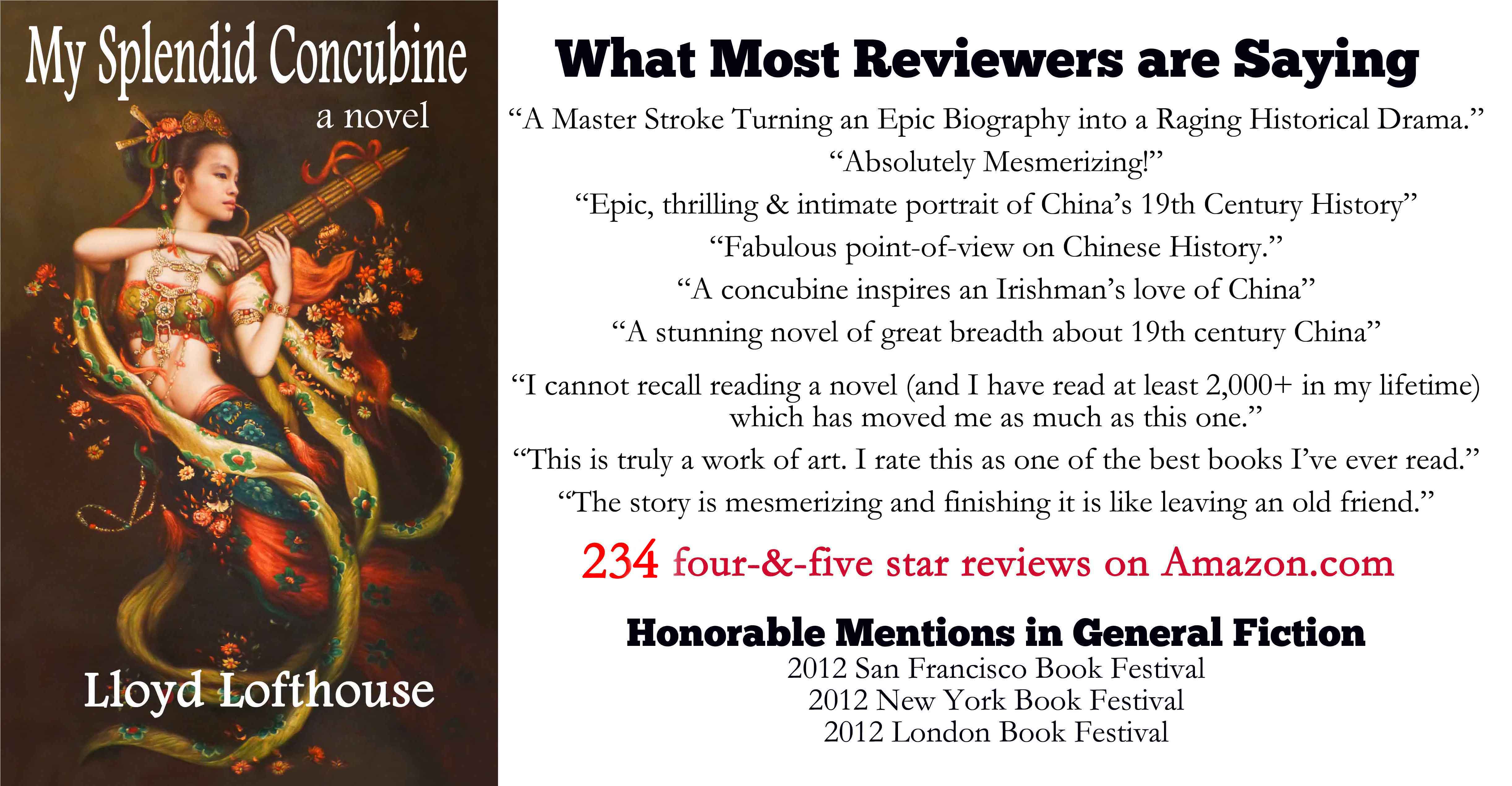
Lloyd Lofthouse is the award-winning author of My Splendid Concubine [3rd edition]. When you love a Chinese woman, you marry her family and culture too. This is the unique love story Sir Robert Hart did not want the world to discover.

a1-on-august-26-2016-cover-image-with-blurbs-to-promote-novel_edited-1

Where to Buy

Subscribe to “iLook China”!
Sign up for an E-mail Subscription at the top of this page, or click on the “Following” tab in the WordPress toolbar at the top of the screen.

About iLook China

China’s Holistic Historical Timeline


The Eunuch Who Beat Columbus by Almost 90 Years

October 4, 2016

The New York Times reported, “The Chinese map, which was drawn in 1763 but has a note on it saying it is a reproduction of a map dated 1418, presents the world as a globe with all the major continents rendered with an exactitude that European maps did not have for at least another century, after Columbus, Da Gama, Magellan, Dias and others had completed their renowned explorations.”

The voyages of Chinese Admiral Zheng He’s armada were rediscovered in Fujian province in the 1930s. The story was etched in a pillar. By the final, seventh voyage, the fleet had covered over 50,000 kilometers or 30,000 miles and was comprised of three hundred ships and 28,000 men.

But when the Yongle Emperor died in 1424, China’s Hongxi Emperor stopped the voyages of China’s largest fleet. – BBC

A century later, about 1529, another Ming Emperor burned all records of the fleet. This decision to withdraw from the world may have resulted in China not being ready to confront the Western Imperial powers that arrived in the 19th century starting the Opium Wars that devastated China leading to a century of war and unrest.

For a comparison, Christopher Columbus set sale in 1492 with 3 small ships and 88 men. Erik the Red, a Viking explorer, also crossed the Atlantic in even smaller ships to build a settlement in Greenland around 1,000 AD. Some archeologists suggest that the Phoenicians may have reached the Americas before the Vikings and Columbus around 500 BC. Some even say as early as 1500 to 1200 BC.

Columbia.edu says, “From 1405 until 1433, the Chinese imperial eunuch Zheng He led seven ocean expeditions for the Ming emperor that are unmatched in world history.” To learn more about the seven voyages, click the link in this paragraph.

In fact, many layers of myth surround China’s ancient mariner. According to Kenyan lore, some of his shipwrecked sailors survived and married local women in Africa. DNA tests have reportedly shown evidence of Chinese ancestry and a young Kenyan woman, Mwamaka Shirafu, was given a scholarship to study Chinese medicine in China.

Discover China’s First Emperor Qin Shi Huangdi, the man that unified China more than 2,000 years ago.

Lloyd Lofthouse is the award-winning author of My Splendid Concubine [3rd edition]. When you love a Chinese woman, you marry her family and culture too. This is the unique love story Sir Robert Hart did not want the world to discover.

#1 - Joanna Daneman review Updated August 26 - 2016_edited-2

Where to Buy

Subscribe to “iLook China”!
Sign up for an E-mail Subscription at the top of this page, or click on the “Following” tab in the WordPress toolbar at the top of the screen.

About iLook China

China’s Holistic Historical Timeline


Eating Bird Nests

September 28, 2016

The idea of eating soup made from bird saliva gives me the shivers. However, there is a history behind this Southeast Asian delicacy and there may be health benefits but also some degree of danger for a few people.

Myths say the Chinese have been eating bird saliva for 1,500 years since the Tang Dynasty (618-907 AD). But another myth says China’s most famous eunuch, Admiral Zheng Hi, brought these nests made from bird saliva back to China in the 15th century.

What we do know for sure is that the Chinese have been making soup from imported swiftlet nests from Southeast Asia for centuries.

A few comprehensive scientific studies in Asia and China in the 1990s revealed that this particular bird saliva appears to play a crucial role in major normal cellular processes and may help resist the effects of aging.

However, the Malaysian Society of Allergy and Immunology reported that for a few people there is a major risk of an allergic reaction after eating Bird’s Nest Soup that might cause death.

To be fair to the birds and their saliva, eating peanuts, tree nuts, milk, soy, shellfish (Medical Daily), and getting flu shots (CDC) can also end in allergic reactions with severe symptoms for a few.

Discover Wu Zetian, China’s only female emperor

Lloyd Lofthouse is the award-winning author of My Splendid Concubine [3rd edition]. When you love a Chinese woman, you marry her family and culture too. This is the unique love story Sir Robert Hart did not want the world to discover.

#1 - Joanna Daneman review Updated August 26 - 2016_edited-2

Where to Buy

Subscribe to “iLook China”!
Sign up for an E-mail Subscription at the top of this page, or click on the “Following” tab in the WordPress toolbar at the top of the screen.

About iLook China

China’s Holistic Historical Timeline