Does China have its own version of Halloween?

October 31, 2016

The closest celebration in China to Halloween in the United States is The Hungry Ghost Festival celebrated the 14th or 15th night of the 7th lunar month in July or August. This year that day fell on August 17th.

The Ghost Festival, also known as The Hungry Ghost Festival, is a traditional Chinese festival and holiday celebrated by Chinese in many countries, in which ghosts and/or spirits of deceased ancestors come from the lower realm and/or hell to visit the living.

Buddhists and Taoists in China claim that the Ghost Festival originated with the canonical scriptures of Buddhism, but many of the visible aspects of the ceremonies originate from Chinese folk religion, and other local folk traditions (The Ghost Festival in Medieval China by Stephen Teiser).

In America, most children wear costumes and go door to door collecting free candy.  In China, the opposite takes place; food is offered to dead ancestors, joss paper is burned, and scriptures are chanted.

Chinese Culture.net says the Hungry Ghost Festival is “Celebrated mostly in South China, Hong Kong, Taiwan and especially in Singapore and Malaysia.” It is believed by many Chinese that during this month, the gates of hell are opened to let out the hungry ghosts who want food.

By comparison, History.com says, “Halloween’s origins date back to the ancient Celtic festival of Samhain (pronounced sow-in). The Celts, who lived 2,000 years ago in the area that is now Ireland, the United Kingdom and northern France, celebrated their new year on November 1. This day marked the end of summer and the harvest and the beginning of the dark, cold winter, a time of year that was often associated with human death. Celts believed that on the night before the New Year, the boundary between the worlds of the living and the dead became blurred.”

I think it’s interesting that the dead linked both America’s Halloween and China’s Hungry Ghost Festival, at least historically.

As a child, I loved wearing a costume on Halloween and going out “trick-or-treating” at night to return home with a heavy bag (usually a pillowcase) filled with candy.

I still remember how much my stomach hurt and how terrible I felt after gorging myself on all that free processed sugar.

Today, due to the epidemic of diabetes and overweight or obese children in the United States (also in China mostly among its new middle class), I stopped celebrating Halloween years ago, and do not give candy to children. The last time I gave treats to children on Halloween, I handed out small boxes of raisins (sweet dried grapes) instead of candy, and one mother called me cheap.

But Science Daily.com comes to my defense with: “Teenagers who consume a lot of added sugars in soft drinks and foods may have poor cholesterol profiles—which may possibly lead to heart disease in adulthood, according to first-of-its-kind research reported in Circulation: Journal of the American Heart Association.”

In fact, the Centers for Disease Control and Prevention reports, “Teenagers and young adults consume more sugar drinks than other age groups and have been linked to poor diet quality, weight gain, obesity, and, in adults and children, type 2 diabetes.”

The American Diabetes Association says, “25.8 million children and adults in the US have diabetes while 79 million have prediabetes. Due to excessive sugar consumption, the risk of diabetes may lead to heart disease, stroke, high blood pressure, blindness, kidney disease, nervous system disease, and/or amputation of feet and legs.”

Maybe Americans should learn something from the Chinese Hungry Ghost Festival. Do not feed that sweet addictive candy to children.  Instead, give the sugar to the dead and have your children eat apples, because there’s a lot of truth to the old saying that if you eat an apple a day, it will help keep the doctor away. If you doubt that, read this from Science Daily.

Discover Anna May Wong, the woman that died a thousand times.

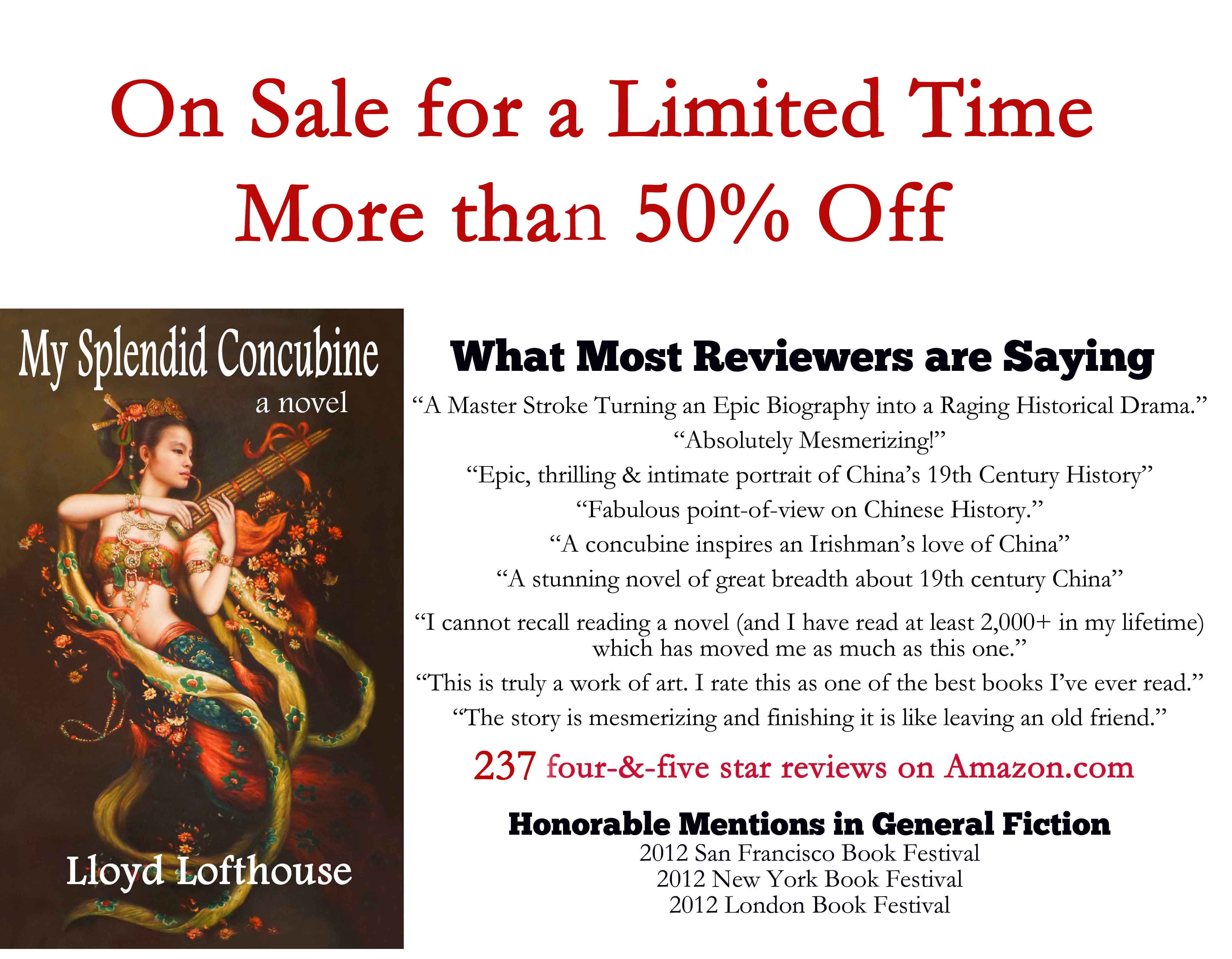
Lloyd Lofthouse is the award-winning author of My Splendid Concubine [3rd edition]. When you love a Chinese woman, you marry her family and culture too. This is the unique love story Sir Robert Hart did not want the world to discover.

on-sale-october-november-2016

Where to Buy

Subscribe to “iLook China”!
Sign up for an E-mail Subscription at the top of this page, or click on the “Following” tab in the WordPress toolbar at the top of the screen.

About iLook China

China’s Holistic Historical Timeline


Trading Tea for Tibetan Horses

October 26, 2016

Many have heard of or read about the Silk Road between China and Europe, but I think few have heard of the ancient Tea Horse Road (also known as the Tea-Horse Trade Route), which I first read about in the May 2010 issue of National Geographic Magazine (NGM).

Legend says that tea from China arrived in Tibet as early as the Tang Dynasty (618- 906 A.D.). After that, the Chinese traded tea for horses, as many as 25,000 horses annually.

Zhang Yun writes, at The Wandering.com, “Horses obtained from the tea-horse trade between the Song Dynasty and Tibetans could be classified into two kinds: one were good horses from Gansu and Qinghai and Tibet’s Nagqu by way of the tea-horse trade, which could serve as warhorses; the other was horses given as tribute, most of which came by the Sichuan-Tibet Route or from various areas in the southwest. Most of these, however, could only be used as farm horses …”

But that isn’t what struck me the most about the NGM piece. It’s the example that demonstrated why most if not all Chinese peasants loved and possibly worshiped Mao Tse-Tung.

For more than a thousand years, men fed their families by carrying hundreds of pounds of tea on their backs across the rugged mountains into Lhasa. Some froze and died in blizzards. Others fell to their deaths from the narrow switchbacks that climbed to the clouds.

This all ended in 1949 when Mao had a road built to Tibet and farmland was redistributed from the wealthy to the poor. During China’s long Civil War, Mao promised land reforms to the landless peasants who were no better than slaves for the few who owned most of the land and wealth.

“It was the happiest day of my life,” said Luo Yong Fu, a 92-year-old dressed in a black beret and a blue Mao jacket, whom the author of the National Geographic piece met in the village of Changheba.

Discover China’s First Emperor Qin Shi Huangdi, the man that unified China more than 2,000 years ago.

Lloyd Lofthouse is the award-winning author of My Splendid Concubine [3rd edition]. When you love a Chinese woman, you marry her family and culture too. This is the unique love story Sir Robert Hart did not want the world to discover.

on-sale-for-limited-time-oct-nov-2016

Where to Buy

Subscribe to “iLook China”!
Sign up for an E-mail Subscription at the top of this page, or click on the “Following” tab in the WordPress toolbar at the top of the screen.

About iLook China

China’s Holistic Historical Timeline


The Cultural Importance of Education in China Caught on Film

October 25, 2016

In the Chinese film Not One Less (1999), a thirteen-year-old girl is asked to be the long-term substitute teacher in a small Chinese village.  The teacher says to her that when he returns, if he finds all the students still there, he will pay her ten yuan, less than two American dollars at the time.

When one student, Zhang Huike, stops coming to school, Wei Minzhim, the thirteen-year-old substitute teacher, follows him to the city.

There are several themes in this film. The most powerful was the value of an education and not losing face. If Wei loses Zhang, she will fail the teacher who gave her the responsibility to teach the village children. To her, that means she must keep all the students.

This film reveals one of the greatest cultural differences between the United States and China. More than 2,000 years ago, Confucius taught that an education was the great equalizer and the key to leaving poverty behind. In the United States, for the last several decades, corporations in the private-sector education industry that profit off high-stakes tests claim high-test scores will lift children out of poverty, and low test scores are the fault of teachers, not children who don’t study for whatever reason.

Today many Chinese, not all, and most Asians outside of China still believe with a passion that education is the key, and this belief may explain why the on-time high school graduation for Asian-Americans in the United States is the highest when compared to all other racial groups.

U.S. News.com reports that Asian/Pacific Islander students comprised the only subgroup with a higher (on-time high school) graduation rate than white students (in the U.S.).

In the United States, teachers are often blamed for the lower graduation rates of Hispanics (more than 74 percent) and Blacks (71 percent), while in China parents take the blame when their children are not successful in school.

This is another significant difference between China and the United States. In China it would be unthinkable to wage war against the nation’s teachers for children who don’t learn. Instead, parents, who cared, and teachers work together to do what they can as partners to make sure children learn.

And for children that live in poverty and/or with parents that don’t care, a Stanford University Researcher discovered “There is an achievement gap between more and less disadvantaged students in every country, surprisingly, that gap is smaller in the United States.”

Zhang Yimou was the director of this film. He said, “Chinese culture is still rooted in the countryside. If you don’t know the peasant, you don’t know China.” Because of this, there is a strong message in this film about the urban–rural divide in China, which is being addressed as China sews the nation together with high-speed rail and electricity.

This a powerful movie about children, education, and poverty that shows the challenges China (and every country) faces in improving the lifestyles of almost 8-hundred million Chinese, who don’t live in the cities. The challenge is to do this without losing the cultural values that flow through Chinese history like a powerful river.

Discover Wu Zetian, China’s only female emperor

Lloyd Lofthouse is the award-winning author of My Splendid Concubine [3rd edition]. When you love a Chinese woman, you marry her family and culture too. This is the unique love story Sir Robert Hart did not want the world to discover.

on-sale-october-november-2016

Where to Buy

Subscribe to “iLook China”!
Sign up for an E-mail Subscription at the top of this page, or click on the “Following” tab in the WordPress toolbar at the top of the screen.

About iLook China

China’s Holistic Historical Timeline


Giant Pandas Are No Longer Endangered but still face Serious Threats

October 19, 2016

The giant panda is popular.  I just Googled “Giant Panda” and there were almost 5 million hits, and a Google Blog search resulted in 4.27 million hits.

But China isn’t happy about the Panda’s success because recently this cuddly bear was removed from the IUCN’s Endangered List. Nature World News.com reports, “According to the World Wide Fund (WWF), the IUCN announced that a nationwide census counted 2,060 giant pandas (1,864 of which are adults) in the wild, which means that there has been a 17 percent rise in its population in China since 2014.”

Is the Panda really safe? The Los Angeles Times reports, “Pandas   removed from international endangered list, but China says they still face serious threat.”

The giant panda, because it’s so cute with its black-and-white coloring, is considered by many of the bear’s fans as docile, but it has been known to attack humans. In fact, The Daily Mail in the UK reported “They’re not all cuddley!”

On the other hand, China Highlights.com says, “Because of their low-energy diet they avoid stressful situation and exertion, preferring shallow slopes and solitary living.”… “In addition to eating for about half a day, the giant pandas spend the rest of their time in sleeping.”

China’s giant pandas are considered a living treasure. Although the dragon has historically served as China’s national emblem, recently the giant panda has also served as an emblem for the country.

To discover more, I suggest reading what the Smithsonian’s National Zoo & Conservation Biology Institute has to say about the Giant Panda.

Discover Anna May Wong, the woman that died a thousand times.

Lloyd Lofthouse is the award-winning author of My Splendid Concubine [3rd edition]. When you love a Chinese woman, you marry her family and culture too. This is the unique love story Sir Robert Hart did not want the world to discover.

on-sale-for-limited-time-oct-nov-2016

Where to Buy

Subscribe to “iLook China”!
Sign up for an E-mail Subscription at the top of this page, or click on the “Following” tab in the WordPress toolbar at the top of the screen.

About iLook China

China’s Holistic Historical Timeline


Music with Two Strings

October 18, 2016

If you Google the name for this two stringed instrument, you may find the same name is used for girls names and a railroad that runs between Beijing and Shanghai. Jing is for the capital and Hu for Shanghai.

Since Chinese is a tonal language, each word is pronounced in a different tone.  The word is also written differently in Chinese when used for a girl’s name or the railroad.

京胡
for the musical instrument


Beijing-Shanghai

The Jing-Hu I’m writing about is a two-stringed instrument often used with Beijing Opera. The Jing-Hu first appeared during the Qing Dynasty (1644 – 1912).  In the 17th century the strings were made of silk. Today, they are often made of steel or nylon.  The Jing-Hu is the smallest of the Chinese fiddles and is related to the larger Erhu.

Discover China’s First Emperor Qin Shi Huangdi, the man that unified China more than 2,000 years ago.

Lloyd Lofthouse is the award-winning author of My Splendid Concubine [3rd edition]. When you love a Chinese woman, you marry her family and culture too. This is the unique love story Sir Robert Hart did not want the world to discover.

on-sale-october-november-2016

Where to Buy

Subscribe to “iLook China”!
Sign up for an E-mail Subscription at the top of this page, or click on the “Following” tab in the WordPress toolbar at the top of the screen.

About iLook China

China’s Holistic Historical Timeline