For thousands of years, Chinese astronomers studied the stars and planets moving in their endless repeating paths across the night sky.
The Oracle bones from the Shang Dynasty (1766 – 1122 B.C.) recorded eclipses and as many as ninety supernovas, a star that suddenly increases greatly in brightness because of a catastrophic explosion that ejects most of its mass.
For about two thousand years, the Chinese used the constant North Star to map the location of all the other stars in the sky.
This method of mapping stars is called the equatorial system. The West would not use this method to map the heavens for almost two thousand years after the Chinese invented it.
In the early 1980s, a tomb was found at Xi Shui Po (西水坡) in Pu Yang, Henan Province where clamshells and bones were found that formed the images of the Azure Dragon, the White Tiger, and the Northern Dipper. It is believed that this tomb belonged to the Neolithic Age about 6,000 years ago.
Star names relating to Chinese astrology’s 28 Mansions of the Lunar Calendar were found on oracle bones dating back to the Wuding Period about 3,200 years ago. “Since ancient times, while classical Chinese astrology, based on the observation and movement of stars, sun, comets, moon and planets, was the exclusive privilege of the emperor, many alternative systems were consequently developed that were not based on the direct observation of the sky. Their basic principles rely mainly on numerology in association with the calendar.”
The internet is a battleground and no one is safe. In fact, recently my desktop was hijacked by ransomware. I didn’t pay the ransom, but I did pay a local computer business to fix the problem and that cost me several hundred dollars.
This year, at the G-20 Summit, Trump met with Putin for a scheduled thirty-minute talk that turned into several hours behind closed doors, and The Daily Beast says, “Donald Trump Just Set the Table for Vladimir Putin’s Next Election Hack.”
But Russia is not the only player in the cyber-warfare battlefield. The German Police and Intelligence Agencies hired a company to create Trojans capable of capturing traffic from Skype and SSL, and in 2001, the recording industry wanted the right to hack into our computers and delete stolen MP3s.
After a Chinese fighter collided with an American surveillance plane in April 2001, Chinese hacker groups cyber-attacked American businesses causing millions of dollars in damage.
“The Carders“, cyber-criminals that specialize in using a sophisticated and automated process to steal information from credit cards, have made off with billions.
When the Cult of the Dead Cow gains access to a computer, they can spy on all of us through our own webcams and microphones. Imagine what the Dead Cows discover and maybe film if that webcam is in your bedroom or bathroom.
The American National Security Administration’s (NSA) Red Team is suspected of distributing malicious software across the web acting as illegal hackers, but they do it legally under the protection of U.S. law. In 2008, an elite U.S. Military Unit shut down a Saudi-CIA Website that was seen as a threat to US security. Learn more from the NSA’s disturbingly successful hack of the American military.
Mother Jones reports that Britain’s NSA [the GCHQ] listens to its citizen’s phone calls too, and recently Reuters reports, “The U.S. government will seek to collaborate with Israel and other countries to develop new ways to thwart computer hacks and other cyber-attacks.”
While Russia is ramping up cyber-attacks and the alleged U.S. President Donald Trump ignores the evidence, The New York Times reported in 2016, “Nine months after President Obama and President Xi Jinping of China agreed to a broad crackdown on cyberespionage aimed at curbing the theft of intellectual property, the first detailed study of Chinese hacking has found a sharp drop-off in almost daily raids on Silicon Valley firms, military contractors, and other commercial targets.”
Now that Trump is president and reversing everything that Obama accomplished, is that good-deal dead too?
On December 10, 1948, the Universal Declaration of Human Rights (UDHR) was adopted by fifty-six members of the United Nations. The vote was unanimous, although eight nations chose to abstain (not vote).
At the time, the most powerful countries in the world was the members of the alliance that won World War II. It would take another sixty-three years for the rest of the world (minus three) to join and reach 193 countries. That means in 1948, twenty-nine percent of the world’s countries decided what human rights was.
Although Nationalist China was one of the original fifty-one members of the UN in 1945, Communist China (established in 1949 after the end of the Chinese Civil War) didn’t become a member until October 25, 1971, when the UN General Assembly expelled the Republic of China (Taiwan), and admitted the People’s Republic of China as one of the five permanent members of the U.N. Security Council. – Growth in United Nations membership, 1945-present
The five most powerful countries are on the U.N. Security Council: China, Russia, France, United Kingdom, and the United States. They are also the five most powerful countries that worked together to defeat Nazi Germany and Japan in World War II. Six of the eight that abstained and did not vote were members of the Soviet Union’s Communist Bloc in Eastern Europe.
Merriam-Webster defines human rights as: “rights (such as freedom from unlawful imprisonment, torture, and execution) regarded as belonging fundamentally to all persons.”
When I read A Different Turning Point for Mankind by G. W. Bowersock in the May 9, 2013 issue of The New York Review of Books, I had one of those “Aha!” moments while I was reading about the history of several different cultural philosophies and ideologies.
For millennia, the major cultural influences on the planet have been: Greek, Roman, Jewish, Christian, Chinese, Hindu, Islamic, and Buddhist.
But the concept of human rights that dominates the planet today has its roots from ancient Greece and Rome, not China, Africa, India, or the Middle East.
China focused on poverty reduction first over human rights. After all, what good are human rights if you are poor and starving?
This Western, Greek-Roman concept of human rights that evolved over a period of centuries to dominate the planet today came about due to the fire and brimstone of the colonial era of the 18th and 19th centuries where European countries such as Spain, England, France, Germany, Portugal and Italy ruled, often brutally, over most of the planet as colonial powers. Later the United States joined in building its own global empire once again based on a Greek-Roman, Christian foundation.
When Western citizens criticize China or Asia, the Middle East, or Africa for human rights violations, these cultures are not being judged by their own perception of what human rights might mean. Instead, the West, especially the United States, is forcing its beliefs on those cultures.
In the West, human rights are based on the ideology of the self that emphasizes autonomy, but this is not relevant to a Confucian based society that stresses the primacy of community and the person’s obligation to others. – University of Illinois Press
And for the Islamic Middle East, Professor Abdullahi Ahmed An-Na’im says, “Shari’ah, which is the historical foundations of Islamic law, directly affects the millions of Muslims around the world. Because of its moral and religious authority, it has great influence on the status of human rights for Muslim countries.”
Words for thought: are claims of human rights violations outside of Western countries based on the status of human beings as individuals or as a member of a community or group of people, because traditional cultures do not always view the individual as an autonomous being possessed of rights above society? – Asia-Pacific Human Rights Information Center
In addition, hunger and poverty also influence the concept and evolution of human rights. “The United Nations Food and Agriculture Organization estimates that nearly 870 million people, or one in eight people in the world, were suffering from chronic undernourishment in 2010-2012. Almost all the hungry people, 852 million, live in developing countries, representing fifteen percent of the population of developing counties.” – World Hunger.org
If you were one of the almost one billion people around the world suffering from chronic undernourishment (starving), would you be sitting around debating freedom of expression, religion, democracy, and equal pay for men and women? If you have never experienced living in a so-called democracy, how can you be expected to understand what that’s like?
Believe me when I suggest avoiding driving or taking a taxi in Beijing unless it is midnight and the city is sort-of sleeping. Beijing is one of the worst cities in the world to drive in. This is probably true for most of China’s crowded cities.
To give you an idea of what I mean by crowded, New York City has a population of about 8.5 million and is ranked #1 in the United States with Los Angeles #2 with less than 4 million people. There are 160 cities in China with a population of over 1 million vs only 10 in the United States.
Here are China’s top five cities ranked by population.
Shanghai – 22 million
Beijing – 10 million
Guangzhou – 11 million
Tianjin – 11 million
Shenzhen – 10 million
I have been to Shanghai and Beijing several times between 1999 – 2008, and have been stuck in Beijing traffic breathing toxic fumes and watching the taxi’s meter adding numbers to the cost of the trip when we could have walked faster for free.
The other choice is Beijing’s subway system built for the 2008 Beijing Olympics (and it’s still expanding), which I prefer using. It’s fast and efficient, but wear a money belt because it can become sardine-can crowded creating a perfect environment for pickpockets. I didn’t even wear my backpack on my back. I put it on my chest where I could keep an eye on it. To be fair, Smarter Travel.com warns us of the dangers of pickpockets in New York City. The same advice will help in any major city you visit.
This video was filmed in 2013 when only one subway line was open. Today, Xian has three subway lines with sixty-six stations and an average of 1.5 million people riding the subway daily. Last time I was in Xian in 2008, the subway system was still under construction.
Then there is China’s high-speed rail. It didn’t exist in 2008, and I haven’t been back to China since. Why fly when you can see China from a bullet train moving at 120 – 160 mph (or faster). The Economist reports, “Less than a decade ago China had yet to connect any of its cities by bullet train. Today, it has 20,000km (12,500 miles) of high-speed rail lines, more than the rest of the world combined. It is planning to lay another 15,000km by 2025.”
“China’s high speed trains make travelling the country easy and quick but there are certain things you should know that’ll make using the high speed trains in China a painless process!” – Learn how to ride high-speed rail in China from The Adventurer
Here is the simple answer. Since World War II, the U.S. has spent about $33-Trillion on its military budgets and fighting endless wars in Korea, Vietnam, Iraq, and Afghanistan causing millions to be killed and/or maimed. Without those wars, there would probably be no ISIS. Then there is the fact that since President Reagan in the 1980s, the focus in the United States has been on cutting taxes mostly for corporations and the wealthiest Americans. That has led to about $20 trillion in debt for the federal government. During this time, the U.S. has not kept its infrastructure up-to-date – improvements that would have provided millions of new jobs and benefited the American people.
If the United States had avoided starting so many wars and had a military budget equal to China (ranked #2 in the world), it would have saved about $32-Trillion since World War II. There would be no national debt and the U.S. might even have its own bullet trains speeding from coast to coast.
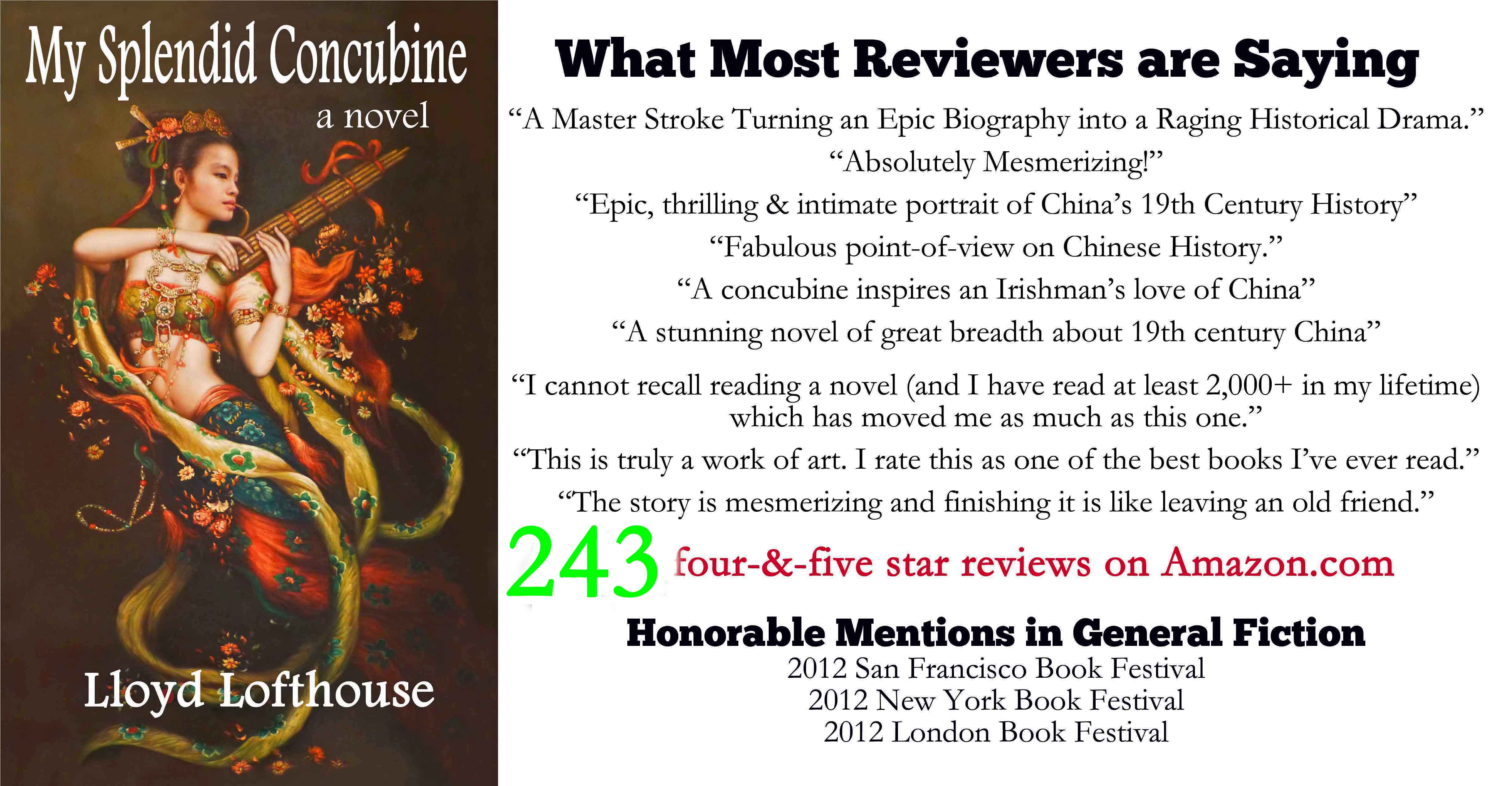
China may be the only ancient culture that survived the spread of Islam and Christianity and managed to keep its unique identity. The following passage comes from My Splendid Concubine, my first published novel was historical fiction based on a real life story and it earned fifteen literary awards. In the novel, Guan-jiah is Robert Hart’s servant.
– the following scene is from CH-4 of My Splendid Concubine –
“Guan-jiah,” Robert said, “before I came to China I read The Travels of Marco Polo. Do you know who he was?”
“No, Master,” Guan-jiah replied.
“He came to China from Europe more than six hundred years ago and served Kublai Khan during the Yuan Dynasty. Polo wrote that Hangzhou was the finest and noblest city in the world.”
“Hangzhou was the capital of the Southern Sung Dynasty, Master,” Guan-jiah said. “I’ve heard it is beautiful. Sung philosophy says that we have the power in our minds to overcome our emotions.”
“Marco Polo believed it was God’s will that he came back from China so others in the West might know what he’d seen.” Robert turned to his servant, who was the last in line. “Do you believe in this Sung philosophy, Guan-jiah?”
“The Sung said that if you know yourself and others, you would be able to adjust to the most unfavorable circumstances and prevail over them.”
“That’s admirable, Guan-jiah. You never mentioned you were a scholar. If the Sung Dynasty was that wise, I want to see Hangzhou one day.”
“I am no scholar, Master, but I must believe in the Sung philosophy to survive. I have read and contemplated much literature. However, I am like a peasant and have never mastered calligraphy. It is a skill that has eluded me.”
“How old were you when you studied this philosophy?”
“I was eleven, Master, two years after I was sent to Peking.”
The 3 teachings of Taoism, Buddhism, and Confucianism have been the backbone of Chinese culture since the bronze age, and are still intertwined strongly with today’s China. They are different interpretations to China’s core philosophies of life. Over time, different dynasties favored different ideas, if only to define themselves against their predecessor. Ultimately though, it’s all about the philosophy of combining spirituality with the reality of everyday life.


 Posted by Lloyd Lofthouse
 iLook China
