Someone Teach Donald Trump How Not to Lose a War

September 12, 2017

A recent Quinnipiac University Poll reports, “A total of 78 percent of voters are ‘very concerned’ or ‘somewhat concerned’ about the U.S. getting into a war in Syria, like the wars in Iraq and Afghanistan. A total of 72 percent of voters are ‘very concerned’ or ‘somewhat concerned’ that U.S. involvement in Syria could lead to armed conflict with Russia.”

In addition, in January 2017, Atlantic.com revealed, “In dozens of interviews with U.S. officials and coalition military commanders—from the White House to America’s war room in Tampa, the command in Baghdad, forward control centers and training grounds in Kurdistan, defense minister meetings in Paris, and NATO headquarters in Brussels—one thing was clear and consistent. On the whole, America’s military leaders do not want to be here any longer than they must. … They don’t want to defeat ISIS only to become an occupying force of sitting ducks.”

Knowing these two facts, we learn from the wisdom in the “Art of War” by Sun Tzu that there is a high-possibility of defeat for the United States.

Who better to turn to than Sun Tzu to see if it is possible to achieve victory with Donald Trump as the president of the United States. After all, Sun Tzu has to be really good to still be taken seriously and studied about 2,500 years later.

That’s why it is time to reexamine the master that U.S. West Point cadets still study. Sun Tzu dates to China’s Warring States Period (476 – 221 BC). Traditional accounts place him in the Spring and Autumn Period of China as a military general serving under King Helu of Wu (544-496 BC).

Three Important points of advice from Sun Tzu

  1. Know your enemy and know yourself — understanding your opponent is crucial to victory.
  2. Sun Tzu prizes the general who can outwit instead of outfight his opponent — to subdue the enemy without fighting is the height of skill.
  3. Avoid what is strong. Attack what is weak.

About 500 BC, the King of Wu summons Sun Tzu, one of the greatest military minds in history, to save his kingdom from a more powerful enemy.

Sun Tzu was a warrior and a philosopher. He had a cohesive, holistic philosophy on strategy. Compare Sun Tzu to Fake President Trump, who was a draft dodger during the Vietnam War, a cheat and a fraud in business, and with several bankruptcies behind him, a loser at business too. He is also a serial liar and proud of not reading books.

Sun Tzu tells the King of Wu he can defeat the enemy with a smaller army. Doubting him, the king challenges Sun Tzu to turn the palace concubines into a fighting force and Sun Tzu accepts.

Sun Tzu shows the concubines what to do, selects the best two students and puts them in charge of the others. When Sun Tzu orders the exercise to begin, the women laugh.

He tries again but the concubines laugh again. Sun Tzu says, “If instructions are not clear and commands not explicit, it is the fault of the general (or Donald Trump). But if the orders are clear, and my orders are clear, it is the fault of the subordinate officers.”

Donald Trump orders are never clear. Often, almost daily, he sends out tweets that shock and surprises his own staff.

Without warning, Sun Tzu beheads the two concubines he selected to lead the others. To Sun Tzu, war is a matter of life and death. This is the key principal of his teachings. Once understood, everyone from the general to the solider will be motivated to win. Without warning Trump fires people or doesn’t hire people to do the jobs in the government that must be done to keep America safe.

It is a fact that politics and public opinion decide the rules of the battle field, and this is where Donald Trump fails repeatedly.

Back to Sun Tzu. While the bodies of the first two concubines are still warm, Sun Tzu appoints two new concubines to lead the others. This time the concubines follow his orders without hesitation. The king of Wu is convinced and appoints Sun Tzu commander of the Wu army.

Sun Tzu trains an army of 30-thousand troops to fight a force ten-time larger. Outnumbered ten to one, Sun Tzu doesn’t build his defenses and then wait to be attacked. Instead, he does the unexpected. He invades Chu.

He doesn’t attack Chu’s main army. Instead, he attacks outposts and weaker targets. When Chu sends an army to fight, Sun Tzu slips his force away emphasizing maneuver, surprise and deception.

After every battle, Sun Tzu learns more about his enemy.

Sun Tzu wrote, “It is more important to outthink your enemy than outfight him. In war, numbers alone confer no advantage. Do not advance relying on sheer military power.”

Sun Tzu liked the enemy to maneuver and respond to his moves. This way he was in charge of the battlefield. Sun Tzu said, “Once you know the enemy’s strengths and weaknesses, you can avoid the strengths and attack the weaknesses.” As the Vietnam War continued with mounting US causalities – just like Iraq, Syria and Afghanistan, support at home shifted against the war, and that ignores another of Sun Tzu’s rules, “The skillful leader subdues enemy’s troops without any fighting. One does not win wars by winning battles.”

Sun Tzu felt spies were important, and he devoted one chapter to spies. He said, “Use your spies for every kind of business … An accurate knowledge of the enemy is worth ten divisions,” but Donald Trump does not trust any of the U.S. spy agencies. Instead he has clearly revealed he only trust one of America’s enemies, Putin.

Sun Tzu said, “Let your plans be as dark as night – then strike like a thunderbolt,” but Donald Trump has revealed U.S. secrets publicly several times in meetings with Russians, to China’s leader, and through his tweets.

Sun Tzu said, “In battle use a direct attack to engage and an indirect attack to win,” meaning to deceive your enemy so you can win your real objective. In 500 BC in China, Sun Tzu’s hit-and-run campaign against the state of Chu worked. The Chu prime minister lost the public’s support and the morale of his troops.

Throughout the countryside of Chu, there was fear of where Sun Tzu will strike next just like there is fear in the United States and Europe where Islamic terrorists will strike next. When the larger Chu army threatened one of Sun Tzu’s allies, Sun Tzu used another rule.  Sun Tzu said, “All warfare is deception. If you can deceive your enemy before battle, you are more likely to win.”

Sun Tzu won the war against Chu, which had an army ten times larger than his. He did this through preparation, deception, and indirect attacks.

After winning that war, Sun Tzu retired and wrote his masterpiece, The Art of War.

The first line of Sun Tzu’s rules of war says, “War is a matter of vital importance to the State. It is a matter of life and death, survival or ruin.

Since World War Two, almost every American president has ignored Sun Tzu’s advice, because Sun Tzu said, “Sometimes, the best way to win is not to fight.” It’s clear that bumbling Fake President Donald Trump doesn’t know this and doesn’t care.

Discover The Return of Confucious

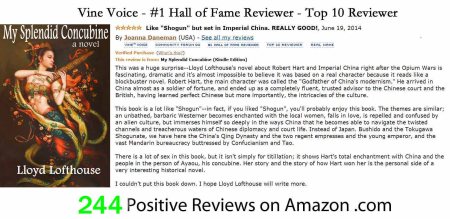
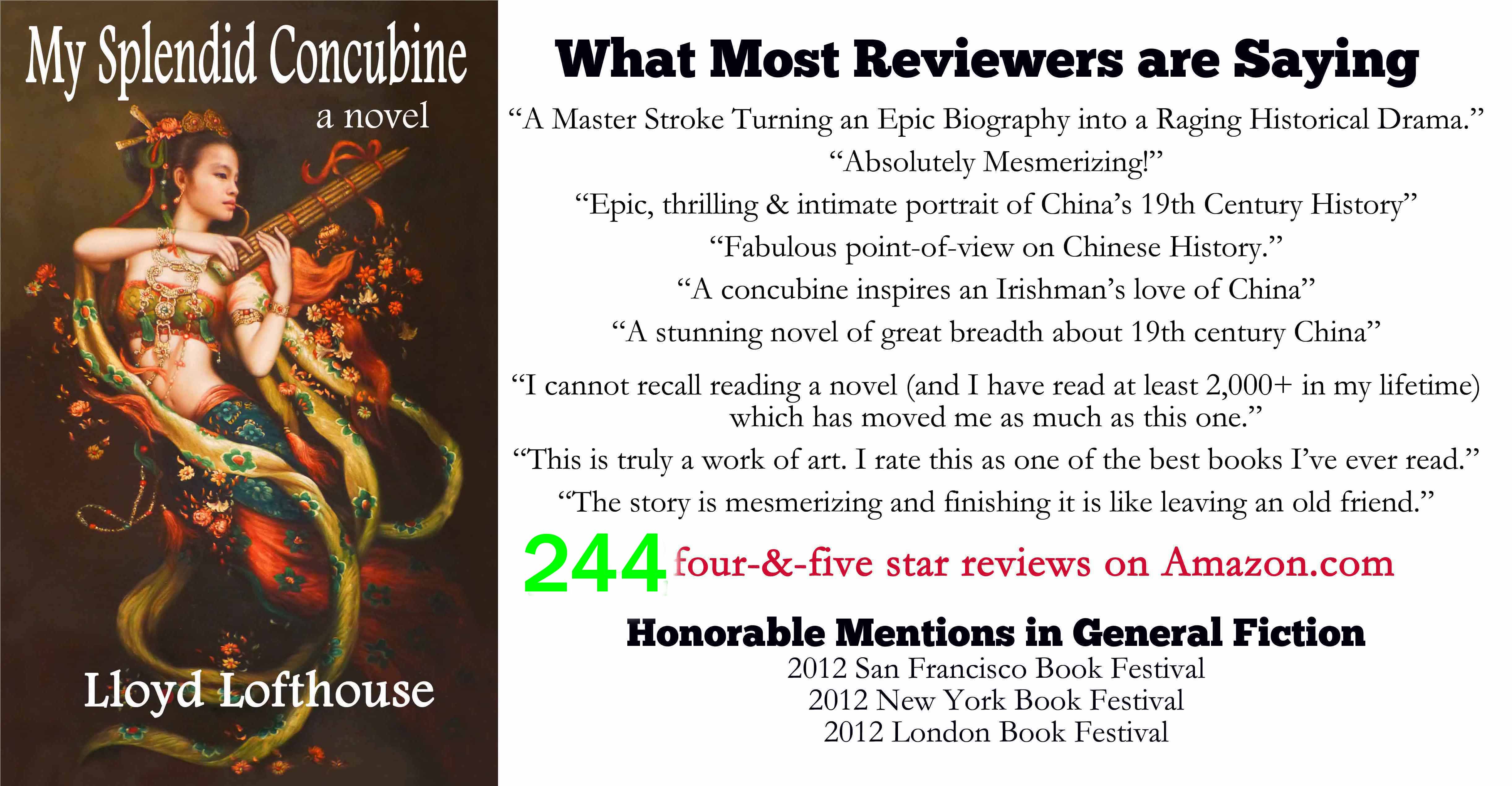
Lloyd Lofthouse is the award-winning author of My Splendid Concubine, Crazy is Normal, Running with the Enemy, and The Redemption of Don Juan Casanova.
Where to Buy

Subscribe to my newsletter to hear about new releases and get a free copy of my award-winning, historical fiction short story “A Night at the Well of Purity”.

About iLook China

China’s Holistic Historical Timeline


The Growth of Fuel-Cell Power in China

September 6, 2017

China had developed the world’s first hydrogen-powered tram. IflScience says, “China is investing a substantial amount into green energy and was even a world leader in renewable energy production back in 2013. They generate more wind power than any other country in the world and their contributions accounted for almost 30% of all global investment in clean energy. Now, continuing with their push for clean energy developments, China has just announced the production of the world’s first hydrogen-powered tram.”

In 2001, we saw the beginning of the evolution of hydrogen fuel use in China when the Chinese Academy of Science (CAS) announced it intends to make China globally competitive in the field of hydrogen technology.

Then in 2006, People.com reported, China opened its first hydrogen fueling station, which was operated in a joint venture with British Petroleum (BP). The Chinese partner, SinoHytec, is an enterprise linked to Tsinghua University—which is considered the MIT of China.

In addition, in 2006, three Daimler-Chrysler made fuel cell buses went into trial operation in Beijing and five vehicles made by Tsinghua University were tested.

In 2010, a fleet of more than 50 hydrogen fuel cell shuttle vehicles transported athletes and government officials at the Asian Games and Asian Para Games in Guangzhou City, China.

According to a report from Pike Research, more than 5,200 hydrogen-fueling stations will be operational worldwide by 2020, up from just 200 in 2010, and estimates the market for fuel-cell technology in the Asia-Pacific region will reach $6.7 billion in 2017. Japan, South Korea and China are quickly becoming leaders in the fuel cell industry through their investments in and adoption of the technology.

FuelCellCars.com reported Dec. 2016, “This plan will require China to build 300 hydrogen refueling stations by 2025 and 1,000 by 2030. In China, sales of so-called new energy vehicles—which includes hybrids, battery-electric cars and fuel-cell vehicles—are subsidized with attractive consumer incentives, as well as perks such as free parking and lower license fees.”

When China’s government decides to move, it moves fast, which is witnessed by China leading the world in solar and wind generated energy manufacturing. China also has about half the world’s hydroelectric power plants and is building safer Thorium and uranium pebble-bed reactors besides replacing old-coal burning power plants with new, modern facilities that reduce carbon emissions dramatically. I wrote about this in Doing Mankind a Favor.

Lloyd Lofthouse is the award-winning author of My Splendid Concubine, Crazy is Normal, Running with the Enemy, and The Redemption of Don Juan Casanova.

Where to Buy

Subscribe to my newsletter to hear about new releases and get a free copy of my award-winning, historical fiction short story “A Night at the Well of Purity”.

About iLook China

China’s Holistic Historical Timeline


An Erhu Master Captures a violent slice of China’s history

September 5, 2017

To understand another country’s history and culture, one should listen to its music, read that country’s novels, and see its films.

For instance, Reflection of the Moon about Ah Bing (1893 – 1950), a master of the Chinese Erhu, who in 1950, shortly before his death, became a national sensation as radios throughout China started to play his music.

Fortunate for me, this Chinese film had English subtitles, but were not the best quality and true to form for a Chinese movie filmed in 1979 (shortly after the end of the Cultural Revolution in 1976), the plot was melodramatic with traces of propaganda that favored the Chinese Communist Party (CCP).

However, to be fair, the brutal Civil War between the Communist and Nationalist Parties raged from 1927 – 1950 (with a short break during World War II to fight the Japanese invaders), and the CCP, with support from several hundred million peasants, won.

Mao’s Great Leap Forward and the Cultural Revolution would not begin for years and for those that survived the purges in 1949 and 1950 (the victims were allegedly abusive land owners and drug dealers accused of crimes by the people they allegedly abused and victimized), Mao fulfilled his promise of land reform. Many of the landowners lost their lives, and the land they had owned was divided among the peasants collectively and not individually.

To understand the era of Ah Bing’s life, much of China (including Tibet) was still feudal in nature, and the upper classes often took advantage of the peasants and workers as if they were beasts of burden treated as slaves. At the time of his death, he was 57, and the average lifespan in China was 35. Today the average lifespan is 75.5 years.

Ah Bing’s real name was Hua Yanjun. His knowledge of traditional Chinese music and his talent as a musician went mostly unnoticed until the last year of his life in 1950, shortly after the establishment of the People’s Republic of China.

In 1950, two musicologists were sent to his hometown of Wuxi to record and preserve his music. At the time, he was ill and hadn’t performed for about two years. Six of his compositions that are considered masterpieces were recorded by those musicologists. It is said that he knew more than 700 pieces and most of them were his compositions.

The lyrics of some of his music criticized the KMT (Chiang Kai-shek’s Nationalist government), and he was often punished for speaking out through his music. If you have read of The Long March, you know that the peasants did not trust the KMT, but they did trust the Communists, and most rural Chinese from that era still think of Mao as China’s George Washington.

Before the Great Leap Forward and the Cultural Revolution, China’s Communist Party treated the peasants and workers with respect while the KMT didn’t.

China Daily reported that Ah Bing’s story and music is still popular, and that the Performing Arts Company of China’s Air Force performed Er Quan Yin, an original Western-style Chinese opera, in 2010. The performance was “Based on the story of legendary Chinese erhu performer, Hua Yanjun, or Blind Ah Bing, the opera tells the story of an erhu performer, Ah Quan and his adopted daughter Ah Li, who struggle to make a living in the 1950s.”

Discover Anna May Wong, the American actress who died a thousand times.

Lloyd Lofthouse is the award-winning author of My Splendid Concubine, Crazy is Normal, Running with the Enemy, and The Redemption of Don Juan Casanova.

Where to Buy

Subscribe to my newsletter to hear about new releases and get a free copy of my award-winning, historical fiction short story “A Night at the Well of Purity”.

About iLook China

China’s Holistic Historical Timeline


How the Past Determines the Future: Part 2 of 2

August 30, 2017

When the Qing Dynasty collapsed in 1911, ending imperial rule after more than two thousand years, chaos and anarchy ruled China, while foreigners, Americans included, lived in luxury in the treaty ports that were the result of the Opium Wars and these foreign enclaves were protected by modern, foreign military forces on Chinese soil.

Imagine how Americans would feel if China deployed several of its army divisions in the United States to protect the Chinese living in America.

Then there was Mao surviving Chiang Kai-shek‘s crack down on the labor movement led by the Communist Party. During World War II, Mao’s army not only fought Chiang Kai-shek’s troops but also the Japanese, who killed between ten to twenty million Chinese in their attempt to conquer China.

The peasants trusted Mao’s troops but did not trust Chiang Kai-shek’s army. Do you know why (watch the next video to learn the answer)?

Then there were the wars in Korea (1950 – 195) with an estimated 2.5 million killed/wounded, and Vietnam (1955 – 1975) with an estimated 3.8 million killed/wounded, in addition to America’s necklace of military bases surrounding China to this day.

Mao believed that socialism was going to create a better life for the Chinese people. His failures were attempts to make China strong enough to defend itself against the foreign meddling and invasions that had plagued China since the Opium Wars.

Regardless of all the horrible facts the U.S. media keeps reminding the world about when it comes to China, there are a few facts that are not well known. When Mao became the leader of mainland China in 1949, the average lifespan was age 35. When Mao died in 1976, the average lifespan increased by twenty years to 55. Today the average life expectancy is 71.5 years. In addition, the population of China was 400-million in 1949. Twenty-seven years later when Mao’s died, China’s population had increased to 700-million. How did that happen if Mao allegedly murdered an estimated 60-million or more people?

In addition, forty-one years after Mao’s death, China has done more to reduce poverty than any other country. Ninety percent of poverty reduction in the world took place in China. When Mao came to power in 1949, 95-percent of the Chinese people lived in extreme poverty. By the time Mao died, the quality of life had improved for most Chinese and they were just poor instead of extremely poor.

Imperial records show that China had famines annually for more than 2,000 years where people in one or more provinces suffered and died of starvation. Since 1949, there has only been one famine in China and that was more than fifty-five years ago.

These facts call into question many of the alleged and inflated claims of deaths and suffering caused by the mistakes of the Great Leap Forward and the insanity of Mao’s Cultural Revolution.

Mao was not perfect but even the Chinese people, after he died, graded his leadership as 70% good and 30% bad. The Chinese people that voted lived through the Mao era. Why should their opinions count less than people that never lived in China during that time?

In 1775, Patrick Henry, one of the U.S. Founding Fathers, said, “Give me liberty or give me death.” Is there anyone in China today foolish enough to stand up and say, “Give me liberty so we can return to the good old days of chaos, drugs, war, poverty, and starvation”?

Return to or Start with Part 1

Lloyd Lofthouse is the award-winning author of My Splendid Concubine, Crazy is Normal, Running with the Enemy, and The Redemption of Don Juan Casanova.

1AA - 244 Positive Reviews - Hall of Fame Reviewer - August 26 - 2017

Where to Buy

Subscribe to my newsletter to hear about new releases and get a free copy of my award-winning, historical fiction short story “A Night at the Well of Purity”.

About iLook China

China’s Holistic Historical Timeline


How the Past Determines the Future: Part 1 of 2

August 29, 2017

Before we get to Mao, we’ll discover why #FakePresident Donald Trump lives in the U.S. White House. It started when Richard Nixon declared war on drugs and caused the U.S. prison population to explode until the United States has the largest prison population in the world.  China with more than four times the population has the 2nd largest prison population on Earth but it is a distant 2nd to the United States. Then President Ronald Reagan doubled down on Nixon’s war on drugs and the prison population more than doubled. Reagan also ended the use of the Fairness Doctrine in the media giving birth to the conspiracy-theory generating; hate promoting Alt-Right lying media that generates its own false facts. Reagan claimed the Fairness Doctrine violated free speech. What the Fairness Doctrine did was make it difficult to lie in the media and get away with it.


Why does #FakePresident Donald Trump want to punish immigrants and treat alleged criminals harshly? Watch the video for a possible answer.

The first paragraph is a snapshot of how history leads to what happens in the future.

In fact, understanding how the past determines the future will also help you understand why Mao caused so much suffering with his failed Great Leap Forward and The Cultural Revolution.

How many millions of Chinese were addicted to Western opium forced on China by Great Britain; France and for a short period even the United States during the Opium Wars , 1st war 1839-1842, and 2nd war 1856-1860? To the credit of the U.S., the Congress eventually voted to pull America’s troops out of the 2nd Opium War and gave back the reparations ($$$) China was forced to pay its invaders after losing the war.

“During the nineteenth century, Britain fought two wars of choice with China to force it to import opium. The opium grown in India and shipped to China first by the British East India Company and after 1857 by the government of India, helped Britain finance much of its military and colonial budgets in South and Southeast Asia. The Australian scholar Carl A. Trocki concludes that, given the huge profits from the sale of opium, “without the drug, there probably would have been no British empire.” – 5th World.com

Historians think that 20-to-100-million may have died due to the Taiping Rebellion (1850 – 1864). The Taiping Rebellion was led by a failed Confusion scholar who converted to Christianity and then claimed to be the younger brother of Jesus Christ. He even wrote his own gospel and added it to the Christian Bible.

More than 100,000 Chinese were killed during the Boxer Rebellion (1899 – 1901), which was a popular peasant uprising against Christian missionaries, and the meddling and exploitation of foreigners in China to make money.

Could these wars and rebellions all linked to Christianity and opium forced on China by Western countries have motivated Mao to launch his Great Leap Forward and to declare war on religions in China during his Cultural Revolution?

Part 2 will continue on August 30, 2017.

Lloyd Lofthouse is the award-winning author of My Splendid Concubine, Crazy is Normal, Running with the Enemy, and The Redemption of Don Juan Casanova.

Where to Buy

Subscribe to my newsletter to hear about new releases and get a free copy of my award-winning, historical fiction short story “A Night at the Well of Purity”.

About iLook China

China’s Holistic Historical Timeline