Learning what Win-Win Really Means from China

February 12, 2011


Living With Evolution or Dying Without It by K. D. Koratsky
Publisher: Sunscape Books
ISBN: 978-0-9826546-0-6
Reviewed by Lloyd Lofthouse

Koratsky’s book is a heavily researched, scholarly work that gathers what science has discovered since Darwin’s discoveries and fills in the gaps explaining why evolution has something to teach us if humanity is to survive.

The other choice is humanity going the way of the dinosaurs into extinction.

I started reading in early 2010 and took months to finish the 580 pages. The Flesch-Kincaid Readability level would probably show this book to be at a university graduate level leaving at last 90% of the population lost as to the importance of its message.

For months, it bothered me that so many in the United States do not have the literacy skills to understand an important work such as this (the average reader in the US reads at fifth grade level and millions are illiterate). This is certainly not a good foundation to learn how precarious life is if you do not understand how brutal the earth’s environment and evolution has been for billions of years.

As I finished reading Living With Evolution or Dying Without It, I realized that it would only take a few key people in positions of power to understand the warnings offered by Koratsky and bring about the needed changes in one or more countries so humanity would survive somewhere on the planet when the next great challenge to life arises.

On page one, Koratsky starts 13.7 billion years ago with the big bang then in a few pages ten billion years later, he introduces the reader to how certain bacteria discovered a new way to access the energy required to sustain an existence.

By the time we reach humanity’s first religion on page 157, we have discovered what caused so many species to die out and gained a better understanding of what survival of the fittest means.

To survive means adapting to environmental challenges no matter if they are delivered by the impact of a monster asteroid to the earth’s surface, global warming (no matter what the reason) or by competition with other cultures or animals competing for the earth’s resources.

In fact, competition is vital to the survival of a species for it is only through competition that a species will adapt to survive.

The book is divided into two parts.  The first 349 pages deals with where we have been and what we have learned, and the two hundred and eleven pages in Part Two deals with current ideas and policies from an evolutionary perspective.

I suspect that most devout Christians and Muslims would dismiss the warnings in this book out-of-hand since these people have invested their beliefs and the survival of humanity in books written millennia ago when humanity knew little to nothing about the laws of evolution and how important competition is to survival.

Koratsky is optimistic that the United States will eventually turn away from the political agenda of “Cultural Relativism” that has guided America since the 1960s toward total failure as a culture.

The popular term for “Cultural Relativism” in the US would be “Political Correctness”, which has spawned movements such as race-based quotas and entitlement programs that reward failure and punish success

Even America’s self-esteem movement is an example of “Cultural Relativism”, which encourages children to have fun and praises poor performance until it is impossible to recognize real success.

The current debate started by Amy Chua’s essay in The Wall Street Journal is another example of “Cultural Relativism” at work.

After reading Living with Evolution or Dying Without It, it is clear that Amy Chua’s Tiger Mother Methods of parenting are correct while the soft approach practiced by the average US parent is wrong and will lead to more failure than success.

Koratsky shows us that the key to survival for America is to severely curtail and eventually end most US entitlement programs. While “Cultural Relativism” is ending, competition that rewards merit at all levels of the culture (private and government) must be reinstituted.

He points out near the end of the book that this has been happening in China and is the reason for that country’s amazing growth and success the last thirty years.

In the 1980s, merit was reinstituted at the bottom and most who prosper in China today earned the right to be rewarded for success by being more competitive and adapting. Even China’s state owned industries were required to become profitable or perish.

The earth’s environment does not care about equality or the relativists’ belief that everyone has a right to happiness even if society must rob from the rich and give to the poor.

This book covers the evolution of the universe, the planet, all life on the planet including the reasons why most life that lived on the earth for hundreds of millions of years before humanity is now gone; the beginnings of the human species; religion in all of its costumes; the growth of civilizations and the competitions that led to the destruction and collapse of so many such as the Roman Empire and the Han Dynasty two millennia ago.

The environment and evolution says that all life on the planet is not equal and no one is born with a guaranteed right to success, happiness and fun. To survive means earning the right through competition and adaption.

If you don’t believe Koratsky’s warning, go talk to the dinosaurs and ask them why they are gone.

______________

Lloyd Lofthouse is the award-winning author of the concubine saga, My Splendid Concubine & Our Hart. When you love a Chinese woman, you marry her family and culture too.

If you want to subscribe to iLook China, there is a “Subscribe” button at the top of the screen in the menu bar.


Ma Yan’s Story – Part 2/2

February 11, 2011

A few days after Ma Yan hears that her family cannot afford to continue her education past fifth grade, Pierre Haski, the French journalist, visited her village.  After seeing the diaries, Haski promised that he would help her continue school then go to a university or even further than that.

Needless to say, after the publication of her diaries, Mao Yan continued on to middle school along with lots of attention from the media.

Ma Yan says that most of the media asked her about her experience at school and she wanted to tell them what it was like so the world would hear of the other poor children that wanted to go to school longer.

Because of that media attention, the students at her elementary and middle schools received offers of help.

That outpouring of interest led to the founding of Children of Ningxia, which will soon celebrate its tenth anniversary. The Children of Ningxia reports that the nonprofit has reached out to more than 2,500 students, scholarships to more than 150 and fourteen have finished their university studies since 2009.

China’s government also abolished school fees through ninth grade but many remote, rural families still struggle to pay for boarding fees.

One student, who is still in school, said she would have been doing farm work if it hadn’t been for Children of Ningxia.

As the Al Jazeera segment of Ma Yan’s Story ends, I thought of the billion people living in poverty around the world.  Less than 10% of those people live in China and this story is only of a few of those people.

Return to Ma Yan’s Story – Part 1

______________

Lloyd Lofthouse is the award-winning author of the concubine saga, My Splendid Concubine & Our Hart. When you love a Chinese woman, you marry her family and culture too.

If you want to subscribe to iLook China, there is a “Subscribe” button at the top of the screen in the menu bar.


Ma Yan’s Story – Part 1/2

February 10, 2011

In January 2010, Al Jazeera Witness reported the story of Ma Yan, a young Chinese girl that lived in rural China in the same poverty that rural Chinese have lived with for centuries and how The Diary of Ma Yan was published in many countries including China (where it was a best seller) and the US.

The village where Ma Yan lived is described in Edgar Snow’s Red Star Over China, but since that time, few outsiders have visited it. The United Nations says this is a region unfit for human habitation. Source: China.org.cn

Contrary to popular opinion, the poor in China did not get this way because of the Communists. The hardship and poverty of Ma Yan’s people and many others in China has been that way for centuries.

It didn’t help when the Communists won China’s civil war and the defeated Nationalists took the nation’s treasury and most of the ancient Imperial treasures to Taiwan leaving China nothing but people and the land.

In this segment of Witness, we travel with Mao Yan as she breaks the cycle of poverty.

By chance in 2001, a French journalist was visiting remote Ningxia province in northwest China when a Muslim woman wearing the white headscarf of the Hui people thrust her daughter’s diaries into his hands.

Ma Yan writes that the economy where she lives has not been developed. However, Mao Yan is not alone wanting to escape the hardship of poverty.  She wrote that her life was like a death sentence.

Then the French journalist read the diary Mao Yan’s mother had given him and was so impressed, he arranged for excerpts to be published in one of the French daily newspapers.

By 2007, Ma Yan passed a university exam and was one of the first girls from her village to be eligible for a university education. Her next move was to Paris where she lives with a French family and attends a university there.

Discover Mao Zedong and Edgar Snow, who wrote Red Star Over China.

______________

Lloyd Lofthouse is the award-winning author of the concubine saga, My Splendid Concubine & Our Hart. When you love a Chinese woman, you marry her family and culture too.

If you want to subscribe to iLook China, there is a “Subscribe” button at the top of the screen in the menu bar.


China Reaching out to South Africa

February 9, 2011

Aaron Back of India Real Time reports that Brazil, Russia, India and China have invited South Africa to join their group of emerging economies referred to as the BRIC possibly changing that acronym to BRICSA.

Aaron asks how South Africa could join the BRIC when the “rainbow nation” lacks the main unifying characteristic of the group: a fast-growing economy.

However, my answer to Aaron is that India Real Time may have missed the fact that Brazil’s economy was also sluggish until China became a major trading partner. Now Brazil is growing at about 8% a year.

Another factor is that China is now South Africa’s largest trading partner, and Radio Netherlands Worldwide says South Africa (unlike the US) enjoys a trade surplus with China that may only grow. The Chinese ambassador Zhong Jianhua, says that it is the warm diplomatic ties between China and SA since 1998 matched by growing economic engagement, which has put SA among China’s top three African trading partners.

South Africa also has another alternative to a fast-growing economy. The CIA says, South Africa is rich in these natural resources — gold, chromium, antimony, coal, iron ore, manganese, nickel, phosphates, tin, rare earth elements, uranium, gem diamonds, platinum, copper, vanadium, salt, natural gas.

The South African Guide says, the mining industry is one of the most productive in the world and raw materials make up about 60% of the country’s exports… South Africa is also the single country in the world to produce fuel from coal.

Then the BBC reports that South Africa faces major problems. Many South Africans remain poor and unemployment is high—about 25%.

After all, what South Africa has, China needs to continue the growth of its middle class, and it was these same factors that caused China to become Brazil’s major trading partner. As the trade surplus grows in South Africa’s favor, unemployment will shrink.

______________

Lloyd Lofthouse is the award-winning author of the concubine saga, My Splendid Concubine & Our Hart. When you love a Chinese woman, you marry her family and culture too.

If you want to subscribe to iLook China, there is a “Subscribe” button at the top of the screen in the menu bar.


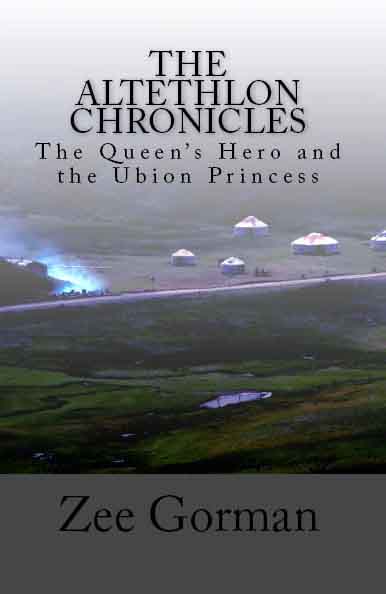
“The Altethlon Chronicles” – China’s Answer to Harry Potter

February 8, 2011

Guest review by Tom Carter

China’s love affair with superstition, pseudoscience and the fantastical may be traced back over five millennia, whence some of history’s oldest myths and legends originated.

Journey to the West (Xi You Ji), published anonymously by scholar Wu Cheng’en in the 16th century Ming Dynasty, remains China’s most beloved fantasy story.  Considered one of the “Four Great Classical Novels” of Chinese literature, the 100 chapters of ‘Journey’ are replete with monkey kings, flesh-eating demons, immortal sages and celestial battles.

When science fiction became all the craze in 1950’s America, Red China followed suit by founding its first sci-fi periodical.

However, unlike the west, where rapid advances in the tech sector fueled science fiction, China promoted sci-fi to help inspire its own dormant technological progress.

Conversely, about the same time during the 70s when American director George Lucas was preparing to film a little space opera called Star Wars, the Cultural Revolution was banishing all China’s scientists to hard-labor communes.

Indeed, where the Chinese have categorically failed in speculative fiction (programming on the Communist-controlled CCTV is evidence enough that future perspective is held in little regard here: of China’s 19 official television channels, all feature serials set in olden times, some in the present, none about the future), they remain masters of mythology and purveyors of the past.

Present-day PRC is seeing a renaissance of the fantasy genre.  The wuxia-inspired Chinese film Crouching Tiger, Hidden Dragon was a critical and commercial success, generations of young, Chinese cyber-punks are hopelessly addicted to the virtual sorcery of World of Warcraft, and Harry Potter remains China’s “most pirated novel ever”.

Even so, no Chinese author has ever been able to replicate the success of Journey to the West; as a result, publishing houses in the Middle Kingdom prefer to translate western best-sellers such as Lord of the Rings and Narnia rather than take their chances on local fantasy fiction writers.

Enter Zee Gorman (nee Yan Zi-hong) China’s response to J.K. Rowling.

Born in Guangdong province during the Cultural Revolution (both her parents were exiled to the countryside for being “intellectuals”), Zee was raised on a literary diet of propaganda and scar literature.

Rather than publish a clichéd daughter-of-the-Revolution memoir about her hardships, the aspiring author opted for the escapism of fantasy. Hence, her decades-in-the-making debut novel, The Altethlon Chronicles.

A high-fantasy fiction set in a parallel universe either far in China’s future or in its past, The Altethlon Chronicles is a complex blend of military, history, romance and sorcery.

Leading the rich cast of green-eyed, purple-skinned characters is the royal yet rebellious teen Ximia (“what kind of princess are you anyway, running around like a wildcat?”) and her forbidden lover, Nikolas, the leader of a rival tribe – a tumultuous relationship most likely inspired by Zee’s own experience with cultural clash when she immigrated to the U.S. and married an American.

Ximia is misled into believing that Nikolas has been killed during an escape attempt, whereby the princess is married off by her father to a dastardly lord.  The two young warriors go on to lead their respective armies until the day when destiny arranges for them to meet again in battle.

Lots of magic, weird names and epic battles of Tolkien proportions (note: this reviewer has never actually read a J. R. R. Tolkien book; I just thought it sounded cool to say that) ensue.

In creating this alternate world, Zee draws heavily on her Chinese heritage.

Kingdoms such as Manchuli, Dalong and Taklaman are each reminiscent of real regions in China.

Nonetheless, Zee, who is bi-lingual and holds dual degrees in English Literature, chose to write The Altethlon Chronicles in her second language and self-publish in America rather than risk having it pirated in China’s nascent fantasy market.

Some realities are worth escaping.

Discover Blond Lotus, another book review by Tom Carter.

____________________

Travel photographer Tom Carter is the author of CHINA: Portrait of a People, a 600-page book of photography from the 33 provinces of China, which may be found on Amazon.com.

If you want to subscribe to iLook China, there is a “Subscribe” button at the top of the screen in the menu bar.