China’s eBook Explosion

May 20, 2015

The first time I visited China in 1999, we visited Book City in Shanghai. It was the largest bookstore I’d seen—ever! Book City had several floors with elevators and escalators, and at each floor I had to wait in line to get on the next escalator up.

It was that busy. Bookstore owners in the US only get to dream of such traffic.

Most of the books were by Chinese authors and written in Chinese. One small segment on the fourth floor offered books from the rest of the world and most were in English.

Then, for a few years, bookstores owned by private companies—not state owned—sprouted like mushrooms, but today, as in the United States, those brick and mortar bookstores may be struggling to survive.

The Independent in the UK said, “Hard times for traditional books as China’s digital publishing industry grows. Pity the poor paperback. The days of the traditional book in China are numbered, according to figures just released by the central government, it seems more and more people are now turning their attention to digital forms of publishing.”

And the Chinese are buying eBooks with a passion, as you may witness from the next embedded video.

It you have never been to China, you should not be surprised, because China has had a thriving publishing industry for longer than a thousand years and more than 95% of its population is literate.

Vearsa.com reported (March 30, 2015), “The eBook market, and in particular the English language eBook market, in China is still in its infancy but the scope and impact of eBooks in China is evolving at an incredible pace.” In addition, Digital Bookworld.com says, “China’s book market is growing fast. And ebooks in particular are on the rise thanks largely to the worldwide mobile boom impacting publishers everywhere.”

After all, the Chinese invented paper and the printing press centuries before it appeared in Europe. In China, the printing press was invented during the Tang Dynasty between the 4th and 7th century AD. In Europe, Gutenberg’s movable type press didn’t appear until about 1450 AD—the Chinese beat the West by about a thousand years with this innovation (hundreds of other). Computer Smiths.com

______________________________

Lloyd Lofthouse is the award-winning author of My Splendid Concubine [3rd edition]. When you love a Chinese woman, you marry her family and culture too. This is the lusty love story Sir Robert Hart did not want the world to discover.
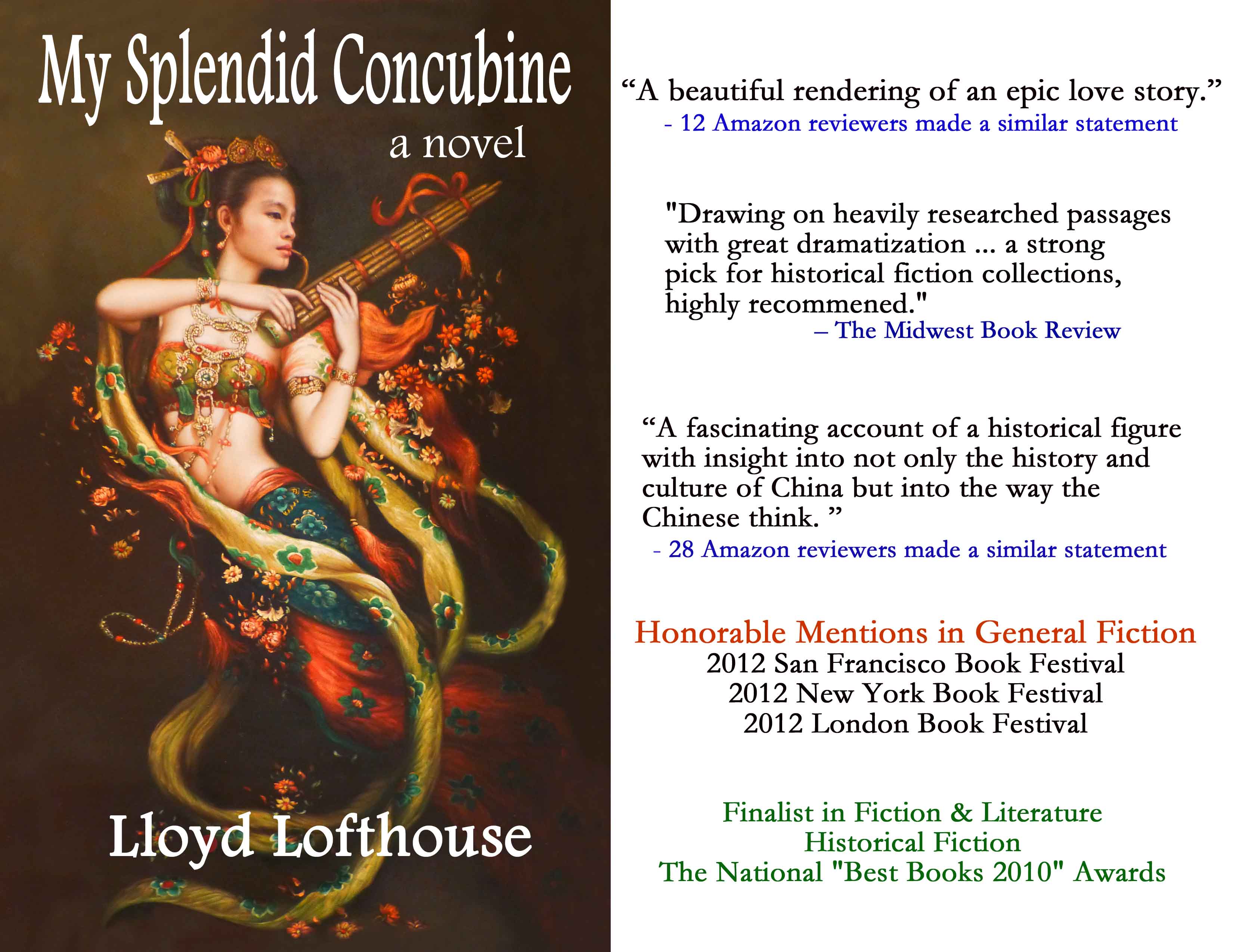
2015 Promotion Image for My Splendid Concubine

Subscribe to “iLook China”!
Sign up for an E-mail Subscription at the top of this page, or click on the “Following” tab in the WordPress toolbar at the top of the screen.

About iLook China

China’s Holistic Historical Timeline


The World’s Two Peace Prizes: Confucius versus Nobel

May 19, 2015

Michael Martina of Reuters reported on The Confucius Peace Prize. The headline read, China stood up by winner of ‘Confucius peace prize’.

The headline used for this Reuters news made mockery of what a few Chinese citizens attempted and the lead paragraph goes, “It was meant to be China’s answer to the Nobel Peace Prize …”

At first, it sounds as if China’s Communist Party was behind this alternative to the Nobel Peace Prize.

After reading the rest of Martina’s piece, we learn that the Confucius Peace Prize had no connection to China’s central government. Since news of it wasn’t reported in China’s state media, few in China probably even heard of it.

A spokesperson for the Confucius Peace Prize said, This prize is from the people of China, who love and support peace.” The Confucius Peace Prize is a prize established in 2010 in the People’s Republic of China in response to a proposal by business person Liu Zhiqin on November 17, 2010. The chairman of the committee said that the award existed to “promote world peace from an Eastern perspective”, and Confucian peace specifically.

The Confucius Peace Prize may never rival the Nobel, but using Confucius’s name for a peace prize makes more sense than using Alfred Bernhard Nobel’s name.

If you compare The Life of Confucius and/or watch the Confucius film starring Chow Yun Fat you might understand why Confucius deserves the honor more.

After all, Nobel built his fortune on death. He was a Swedish chemist, engineer, innovator and armaments manufacturer. The Chinese—not Confucius—might have invented gunpowder, but Nobel invented dynamite and manufactured cannons and other more advanced weapons.

He also waited until after his death to make amends for the suffering and destruction his products had caused.

In his last will, Nobel directed that his enormous (blood drenched) fortune be used to institute the Nobel Prizes and made sure to name these prizes after himself so he wouldn’t be remembered as the “Merchant of Death” or the “Lord of War”.

To understand better who Alfred Nobel was, I suggest you watch Nicolas Cage in the Lord of War, a movie released in 2005. Although the movie was not about Nobel, it is about a “Merchant of Death”.

In fact, it may not have been Nobel’s idea to include the Peace Prize. Although Nobel never married, his first love, a Russian girl named Alexandra corresponded with him until his death in 1896. Many believe she was a major influence in Nobel’s decision to include the Peace Prize among the other prizes provided for in his will for science.

______________________________

Lloyd Lofthouse is the award-winning author of My Splendid Concubine [3rd edition]. When you love a Chinese woman, you marry her family and culture too. This is the lusty love story Sir Robert Hart did not want the world to discover.

2015 Promotion Image for My Splendid Concubine

Subscribe to “iLook China”!
Sign up for an E-mail Subscription at the top of this page, or click on the “Following” tab in the WordPress toolbar at the top of the screen.

About iLook China

China’s Holistic Historical Timeline


Chinese long history is rich in calligraphy, music, poetry, and painting

May 13, 2015

UNESCO says the Guqin represents China’s foremost solo musical instrument tradition. Legend says that the Guqin has a 5,000 year history compared to Chinese writing that dates back nearly 3,000 years.

The body of the Guqin is a long and narrow sound box made of Catalpa wood with two holes, one large and one small. The large hole is called the “phoenix pool” and the small one the “dragon pond”.

This seven-stringed instrument was played by noblemen and scholars and was not intended for public performances. Twenty years of training were often required to become proficient.

Since it is known that Confucius played the Guqin, the instrument is sometimes referred to by the Chinese as “the father of Chinese music” or “the instrument of the sages”.

For millennia, the strings of the Guqin were made of various thicknesses of silk.

However, in recent times, the silk has been replaced with nylon wound around steel strings. Some say without silk, the Guqin doesn’t sound as rich.

The Guqin was one of four subjects the ancient scholars perfected. The other three were chess, calligraphy and painting. For centuries many Chinese felt China was so civilized due to these practices that no other country would bother them. Why bother to study how to fight wars? Why spend what it would take to keep the military modern and strong?

Then in 1794 came the White Lotus Rebellion (100,000 rebels killed), followed by the Opium Wars (50,000 killed), the Taiping Rebellion (20 million killed), The Nian Rebellion (75 thousand killed), Punti-Hakka Clan Wars (500 thousand killed), Miao Rebellion (75,000 killed), Hui Rebellion (millions killed), the Du Wenxiu Rebellion (1 million killed), the Dungan Revolts (8 to 12 million killed), the Boxer Rebellion (more than 100 thousand killed), the Sino-Japanese War (10 thousand killed), the Xinhai Revolution (almost 200 thousand killed), China’s Civil War between the Communists and Nationalists (8 million killed), and Japan’s invasion of China during World War II (15 to 20 million killed).

Compared to what China suffered, during the 8-year long American Revolution, total casualties were less than 60 thousand, and in the 4-year long American Civil War there were 620 thousand casualties.

That explains why—when the gunpowder settled in 1949, after 155 years of revolution, civil war and war—after Mao came to power, he launched a series of reforms with the goal to make China strong again to stop the revolutions and invasions. These reforms ended with the Cultural Revolution—1965 – 1976, with about 1.5 million killed and millions of others suffering imprisonment, seizure of property, torture or general humiliation.

During this period, the Guqin fell out of favor as the literati were persecuted as the scape goats of China’s long suffering.

______________________________

Lloyd Lofthouse is the award-winning author of My Splendid Concubine [3rd edition]. When you love a Chinese woman, you marry her family and culture too. This is the lusty love story Sir Robert Hart did not want the world to discover.

2015 Promotion Image for My Splendid Concubine

Subscribe to “iLook China”!
Sign up for an E-mail Subscription at the top of this page, or click on the “Following” tab in the WordPress toolbar at the top of the screen.

About iLook China

China’s Holistic Historical Timeline


China’s Changing One-Child Policy

May 12, 2015

In 2008, France 24 International News provided an example of how the Chinese families could get around the one-child policy and reported how one Chinese couple wanted to have more than one child and how the couple used loopholes to have three.

The mother’s first child was a boy, and she was desperate to have a girl.

Since fines are less for a second child if delivered in a remote province, the couple moved south from Shanghai.

However, the mother discovered she was pregnant again soon after the birth of the second child, a girl.

The doctor told her that because of her health she couldn’t have an abortion.

Due to where the children were born, she was told her children would not be allowed to attend school in Shanghai. The mother was upset because she said rural schools were not as good as urban schools.

At the time, she also resented the fact that wealthy Chinese businessmen, television and movie stars often avoided the one-child policy because they have money to pay the fines. Ten percent of rich Chinese have three children and this practice is spreading among the upper-middle class.

Explaining how wealthy Chinese got away with it, Peng Xizhe, dean of social development and public policy at Fudan University, said, “In the Maoist era everyone was controlled by his work unit. It’s over now. Many workers are independent.”

Then in late 2013, China declared it was relaxing its one-child policy. The Guardian.com reported, “Experts say this only underlines a looming demographic crisis in China: low fertility rates, a rapidly ageing population and a shrinking labour force.”

______________________________

Lloyd Lofthouse is the award-winning author of My Splendid Concubine [3rd edition]. When you love a Chinese woman, you marry her family and culture too. This is the lusty love story Sir Robert Hart did not want the world to discover.

2015 Promotion Image for My Splendid Concubine

Subscribe to “iLook China”!
Sign up for an E-mail Subscription at the top of this page, or click on the “Following” tab in the WordPress toolbar at the top of the screen.

About iLook China

China’s Holistic Historical Timeline


Yuan Shikai, China’s second president and its last emperor

May 6, 2015

For thousands of years, the history of China has been defined by wars, rebellion, power struggles and famine, which explains why today’s central government worries about famine and allowing dissidents a voice.

Between 1911 and 1976, three Chinese men were responsible for much of the devastation and death that swept over China causing tens of millions of deaths (not counting what the Japanese did during World War II). Those Chinese leaders were: Yuan Shikai, Chiang Kai-shek and Mao Tse-tung.

In 1911 when the Qing Dynasty fell, Yuan Shikai was a general and commander of the most modern military force in Imperial China. He kept his position by supporting the revolutionaries that brought down the Qing Dynasty.

After the Qing Dynasty fell, rebellion spread through the Yangtze River Valley before revolutionaries from fourteen provinces elected Sun Yat-sen president of a provisional (temporary) government and in January 1912, Sun announced the establishment of the Republic of China.

However, generals controlled China’s provinces and refused to give up power. China’s young republic was essentially the capital city of Nanjing.

On March 20, 1913, Yuan Shikai’s agents assassinated Sung Chiao-jen, who helped Sun Yat-sen become the first president. Sun demanded that those responsible be brought to justice.

Yuan Shikai resisted, sparking a “so-called” second revolution and on September 15, 1913, he ordered Sun Yat-sen’s arrest. To survive, Sun fled to Japan as a political refugee. He wouldn’t return to China until a few months after Yuan Shikai’s death.

Yuan Shikai, supported financially by the British Empire, became China’s second president, but after 1914, World War I caused a reduction in Britain’s financial support.

Weakened, Yuan Shaikai was forced to accept twenty-one demands made by Japan, which included giving up Chinese territory. He agreed on May 7, 1916, which is now considered National Humiliation Day.

Yuan Shaikai was unable to establish control beyond Nanking so he declared himself emperor. His attempt to replace the republic with a monarchy and him as emperor touched off revolts in southwestern China followed by uprisings of Sun Yat-sen’s followers in several other provinces.

This resulted in twelve years of warfare between the warlord generals of China’s provinces and the weak Republic of China.

Yuan Shikai died in 1916, then Sun Yat-sen returned to lead the republic. Sun Yat-sen died in 1925, which led to the Civil War between the Chinese Communist Party and Chiang Kai-shek’s Nationalists.

______________________________

Lloyd Lofthouse is the award-winning author of My Splendid Concubine [3rd edition]. When you love a Chinese woman, you marry her family and culture too. This is the lusty love story Sir Robert Hart did not want the world to discover.

2015 Promotion Image for My Splendid Concubine

Subscribe to “iLook China”!
Sign up for an E-mail Subscription at the top of this page, or click on the “Following” tab in the WordPress toolbar at the top of the screen.

About iLook China

China’s Holistic Historical Timeline