The Asia-Pacific Journal reported, “Following Chinese economic reforms of the 1980s, U.S. consumer goods companies were increasingly drawn to China. American companies entered the country by forming joint ventures with a Chinese company or government agency. Early participants included such giants as H. J. Heinz, R. J. Reynolds Tobacco, Coca-Cola, American Express, American Motors, AMF, Inc., General Foods, Beatrice, Gillette, Pepsi-Cola, Eastman Kodak, AT&T, Nabisco, and Bell South.”
In 1970, China produced 785-thouisand tons of tobacco. By 1990 that number more than tripled to more than 2.6-million tons. With an estimated 320-million cigarette smokers in China today, annual consumption of cigarettes by each smoker would be about 240 packs. – Tobacco in the People’s Republic of China
I know firsthand how evil addictive tobacco is. I witnessed a father-in-law, my brother, a neighbor, an aunt, and my father die early from the ravages of tobacco.
The last few years of my father’s life, he wore a breathing mask attached to a tank of oxygen. His freedom was limited to the fifty-foot hose connected to that tank.
Approximately one million deaths every year in China are caused by tobacco – around one in six of all such deaths worldwide.
Approximately 100,000 people die as a result of exposure to second-hand smoke each year.
In other words, someone in China dies approximately every 30 seconds because of tobacco use; or around 3,000 people every day.
If the prevalence of tobacco use in China is not reduced, the number of tobacco-related deaths every year in China will increase to 3 million by 2050.3
China’s central government is sort of attempting to end tobacco use in China. China’s 12th Five-Year Plan calls for smoke-free public places as part of the major national goal to increase life expectancy. The “China Report on the Health Hazards of Smoking”, released by the Ministry of Health in May, 2012, outlines the hazards of tobacco use, states the health consequences of second-hand smoke, and emphasizes the importance of smoking cessation.
Subscribe to “iLook China”!
Sign up for an E-mail Subscription at the top of this page, or click on the “Following” tab in the WordPress toolbar at the top of the screen.
By definition, as you will learn from this post, 21st century China is not a socialist and/or Communist country, even though it is still labeled as one. It is also not a capitalist country.
Socialism is a system where there is no private property and the means of production are owned and controlled by the state. But in 2014 Bloomberg reported that private companies are driving China’s growth. Only 25-percent of China’s industrial output came from state-owned enterprises in 2014.
Communism is a political theory derived from Karl Marx, advocating class war and leading to a society in which all property is publicly owned and each person works and is paid according to their abilities and needs. When Mao died in 1976, China moved away from this political theory by ending Mao’s Cultural Revolution and arresting the Gang of Four, who planned to lead China and continue the Cultural Revolution’s class war forever.
Then there is capitalism that is an economic system characterized by private or corporate ownership of capital goods, by investments that are determined by private decision, and by prices, production, and the distribution of goods that are determined mainly by competition in a free market.
Since about 25-percent of China’s industry is still state-owned, China clearly isn’t a capitalist system like the United States is. The evidence for this was on display soon after the 2007–08 global financial crises created by U.S. Banks and Wall Street greed that caused millions of Chinese to lose their jobs in private sector manufacturing.
That’s when China’s government stepped in.
The Global Economic Crises and Unemployment in China reports, “The state provided subsidies and basic entitlements to urban workers and their families in an effort to maintain social and political stability within the subsystem … the government has poured billions of dollars into public works designated for road and rail transportation improvements. These projects have created many jobs for migrant labor.”
What else do we know about today’s China?
China has one political party with 85-million voting members; it’s one of the largest political parties in the world. — Britannica.com
More than 600-million rural Chinese vote in village elections. New Politics reports, “Elections of Village Committees and Village Leaders in China’s approximately 950,000 villages began in 1989 as part of a wider village self-government movement.”
China has its own Constitution from 1982 that includes Amendments. For instance, the president of China is limited to two 5-year terms and can be impeached.
However, every year, China’s president is listed as one of the world’s dictators by elements of the U.S. media, but under China’s Constitution, the presidency is a largely ceremonial office with limited powers. This doesn’t fit the definition of a dictator who holds absolute, imperious, or overbearing power or control and who is not responsible to the people or their elected representatives.
How are China’s representatives elected? About.com reports, “China’s representative elections begin with a direct vote of the people in local and village elections operated by local election committees. In cities, the local elections are broken down by residential area or work units. Citizens 18 and older vote for their village and local people’s congresses, and those congresses, in turn, elect the representatives to provincial people’s congresses.
“The provincial congresses in China’s 23 provinces, five autonomous regions, and four municipalities directly ruled by the Central Government, special administrative regions of Hong Kong and Macao, and armed forces then elect the roughly 3,000 delegates to the National People’s Congress (NPC).
“The National People’s Congress is empowered to elect China’s president, premier, vice president, and Chair of the Central Military Commission as well as the president of the Supreme People’s Court and the procurator-general of the Supreme People’s Procuratorate.”
Let’s look at how the United States elects its president. Political Parties that are private sector organizations allow party members to vote in state primaries. These primaries are not public elections because most of them only allow registered party members to vote.
Donald Trump, for instance, only won a little more than 14-million votes from registered Republicans to end up representing the Republican Party as its presidential candidate in 2016, and this is in a country that has more than 200-million registered voters. Hillary Clinton had more than 16.8 million votes from the Democratic primaries.
The winners (Trump and Clinton) moved on to campaign in the national election that is held and monitored by the public sector in each state. In the 2016 election, Donald Trump won the Electoral College vote 303 to 235, but he lost the popular vote 62,979,879 votes to Hillary Clinton’s 65,844,954.
Does this seem strange? Is there any other republic in the world where the winner loses the popular vote?
Last, a republic is a state in which supreme power is held by the people and their elected representatives, and which has an elected or nominated president rather than a monarch.
After reading this post, what type of government do you think China has?
“China’s legislature has voted to remove presidential term limits from its Constitution. That change allows China’s current president, Xi Jinping, to potentially rule indefinitely.”
When the CCP recently revised China’s Constitution and did away with term limits for its current president, the future is uncertain for the type of China’s government. The 19th century’s British Lord Acton was right when he said, ” Power tends to corrupt and absolute power corrupts absolutely.” Now that Xi Jinping can be president of China for the rest of his life, will he become another Kim Jong-un, Donald Trump and/or Putin? Only time will reveal that answer.
Subscribe to “iLook China”!
Sign up for an E-mail Subscription at the top of this page, or click on the “Following” tab in the WordPress toolbar at the top of the screen.
And those previous 5 stories are only the tip of Mt. Everest. When I Googled “U.S. Jobs Lost to China,” there were almost 70 million hits.
That’s why I find the following information so interesting: 59.2 percent of the civilian labor force age 16 and older had jobs in 1950, but in 2015, that ratio was 66.8 percent. Isn’t that an increase in jobs instead of jobs lost? – Labor Force Change, BLS.gov, table 4, page 22
In addition, Heritage.org says, “Those who attack China often do not examine real economic events: They do not measure actual failed businesses and actual job losses. Instead, they assume the U.S.–China trade deficit means that both production and production jobs are moving from the U.S. to China. … Imports do not cause unemployment; quite the opposite, they are a signal of prosperity and plentiful jobs.” The Heritage Foundation is an American conservative think tank based in Washington D.C. and the foundation took a leading role in the conservative movement during the Presidency of Ronald Reagan. Therefore, you can’t blame alleged liberals for this report.
Cato.org, an American libertarian think tank (To be clear, libertarians are not liberals.) founded by the Charles Koch Foundation, (yes, that Koch) supports what Heritage says: “In the quarter century between 1983 and 2007, as real GDP more than doubled and the real value of U.S. trade increased five-fold, the U.S. economy created 46 million net new jobs, or 1.84 million net new jobs per year.”
If what Heritiage.org and Cato.org says is true, is the United States really losing jobs?
First, after the 2007-08 global financial crises caused by U.S. Banks and Wall Street greed, trade between the United States and the world shrunk by 12 percent and almost 9 million jobs were lost in the U.S. — jobs that were not lost to China. In fact, since 2009, more than 9 million jobs were added back making up for those lost jobs.
That proves that the United States has not had a reduction in jobs, but “In the U.S., jobs paying between $14 and $21 per hour made up about 60% of those jobs lost during the recession … such mid-wage jobs have comprised only about 27% of jobs gained during the recovery through mid-2012. In contrast, lower-paying jobs constituted about 58% of the jobs regained.”
Did you know that the United States has the 2nd largest manufacturing sector in the world, and that China only became #1 recently? Brookings.edu says, “As recently as 2010, the United States had the world’s largest manufacturing sector measured by its valued-added and, while it has now been surpassed by China, the United States remains a very large manufacturer.”
I wouldn’t be surprised if you said no.
At this point you may be confused or in denial. You might be thinking that this can’t be true. How can the U.S. have such a large manufacturing sector when millions of jobs have been lost there?
Bright Hub Engineering.com offers one answer: “Robots have replaced a lot of activities formerly carried out by a human, with one robot replacing as many as ten workers.”
“In the last fifteen years, manufacturing in the United States has undergone a fundamental shift,” Arena Solutions.com reports. “As millions of U.S. manufacturing jobs have been lost to … automation, output has steadily continued to grow. And while U.S. manufacturing output has decreased by only 1% since 1990, manufacturing jobs have decreased by over 30% in the same time period.”
Losing manufacturing jobs is not only happening in the US. The Harvard Business Review.org says, “Manufacturing employment decline is a global phenomenon. As a Bloomberg story summarized: “Some 22 million manufacturing jobs were lost globally between 1995 and 2002 as industrial output soared 30 percent.”
Instead of blaming China, blame the real culprits: robots and the greedy rich who are behind the decisions to replace humans with automation. If one robot can replace ten humans, that’s a lot of increased profits, and more job losses are on the way. Earlier this year CBS Money Watch reported The robot revolution will take 5 million jobs from humans.
After all, Robots don’t need Social Security, medical care, retirement plans, paid sick leave or vacations — in fact, they don’t earn any money, even minimum wage with no benefits, making robots better than human slaves.
China is also going through its own robot revolution. FT Magazine reported this June that “Factories in China are replacing humans with robots in a new automation-driven industrial revolution.”
The manager of one Chinese company that makes stainless steel sinks in Guangdong talked about 9 robots doing the job of 140 full-time workers, “These machines are cheaper, more precise and more reliable than people.”
But what happens when there are no human jobs left for people to earn money so they can buy stainless steel sinks and all the other consumer crap factories churn out around the world? After all, robots don’t read books, watch films, use sinks or toilets, or even eat.
Are the world’s rich and powerful planning to get rid of the rest of us and replace us with robots, because they certainly are not creating robots to replace them?
中
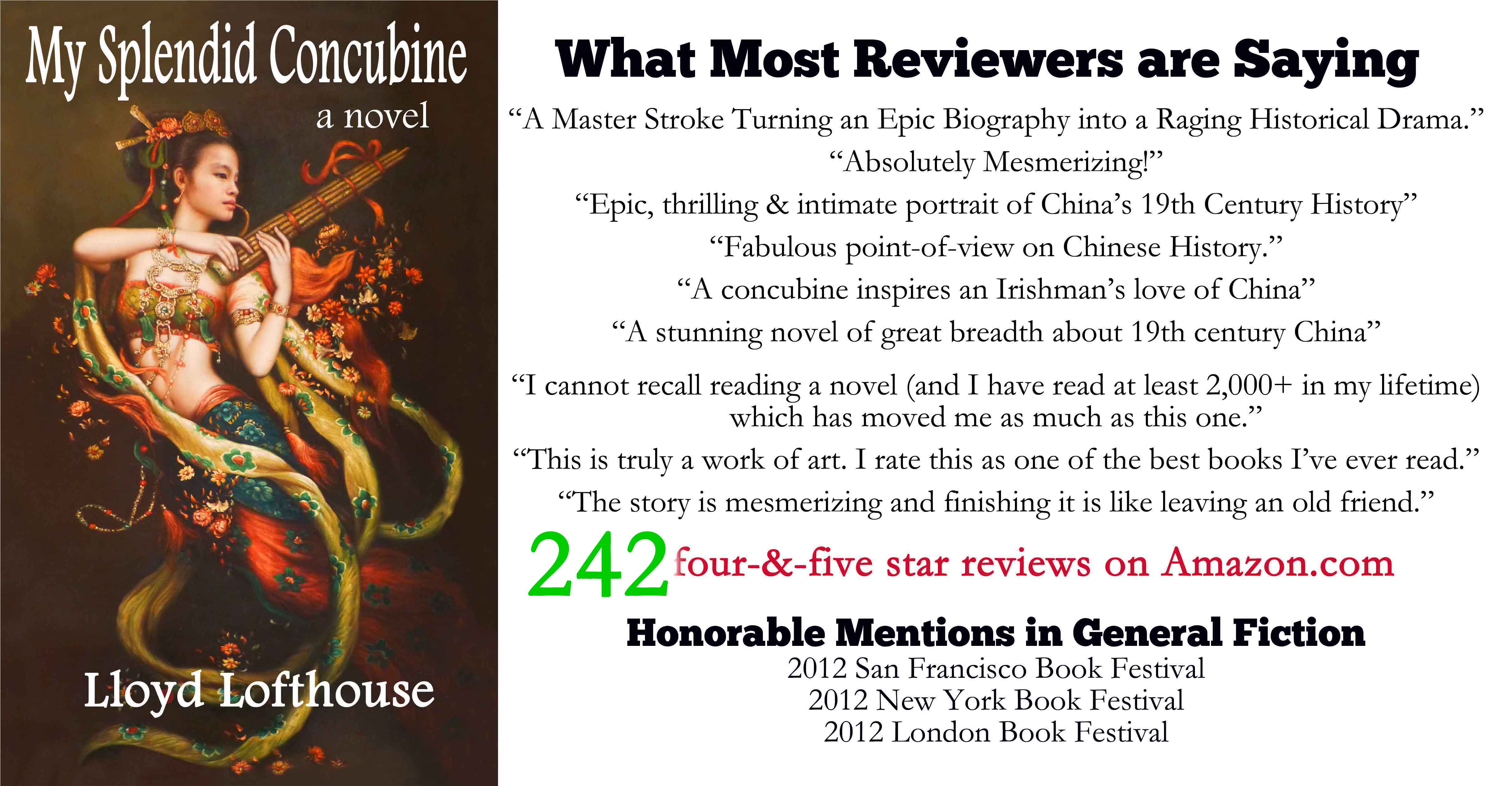
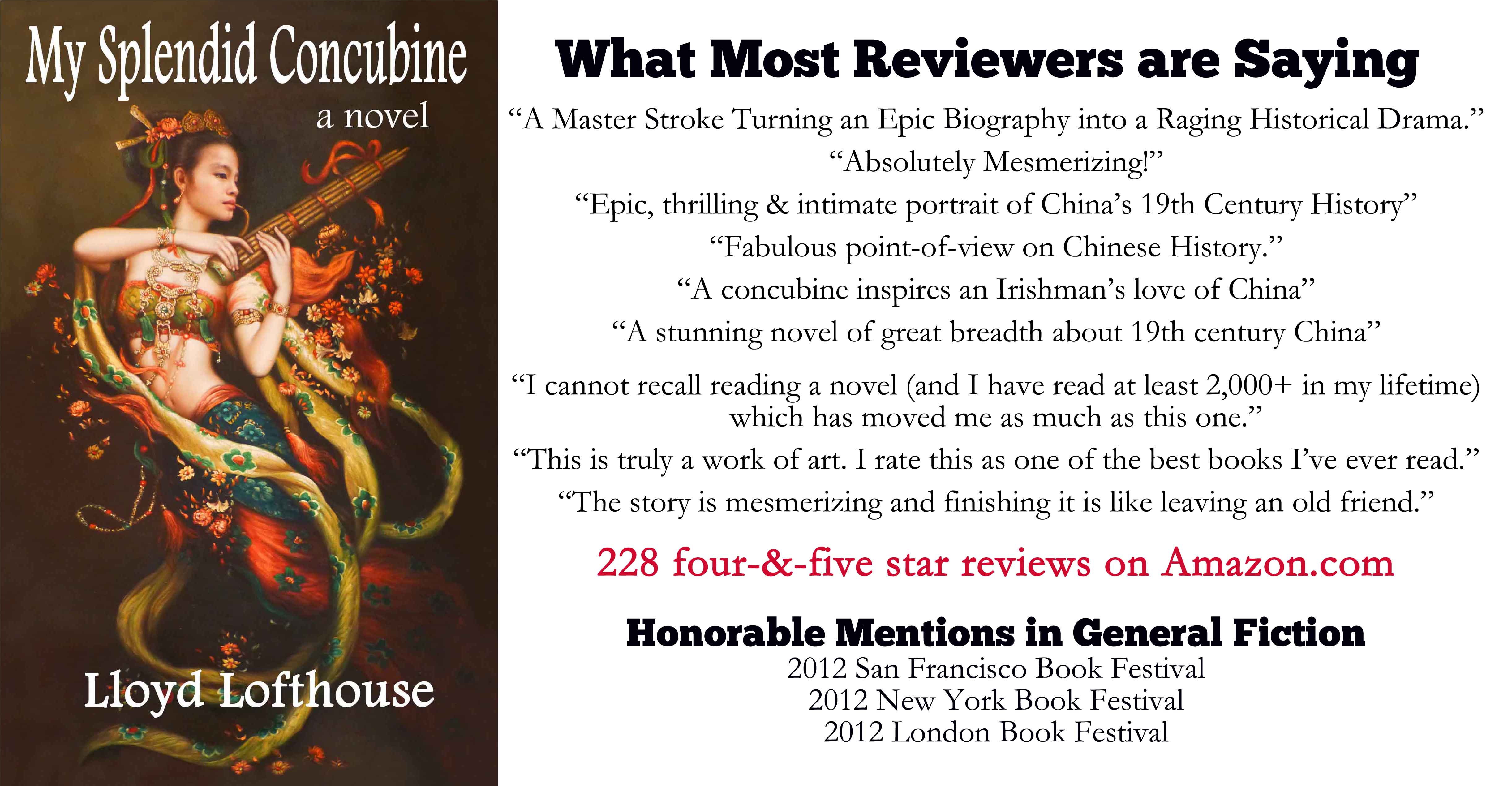
Lloyd Lofthouse is the award-winning author of My Splendid Concubine [3rd edition]. When you love a Chinese woman, you marry her family and culture too. This is the unique love story Sir Robert Hart did not want the world to discover.
Subscribe to “iLook China”!
Sign up for an E-mail Subscription at the top of this page, or click on the “Following” tab in the WordPress toolbar at the top of the screen.
From The Opium Monopoly by Ellen N. La Motte, we learn how opium addiction became an epidemic in China. Although The Chinese knew about opium for more than a thousand years, it wasn’t until the Portuguese arrived in the 18th century that the Chinese used it as a drug by smoking it. Merchants from Britain, France, Portugal, America and other nations became the drug cartels that plagued China into the 20th century.
In 1729, the emperor issued the first anti-opium edict, but the supply of opium flooding China went from 220 chests in 1729 to 70,000 in 1858.
It is estimated that before 1950, as many as 20 million Chinese were drug addicts. To solve this problem, Mao had the People’s Liberation Army execute the drug dealers and forced millions of addicts into compulsory treatment in a twenty-four hour period. — How Maoist Revolution Wiped Out Drug Addiction in China
Opium growers, who did not want to comply, fled into the Golden Triangle Region of Southeast Asia where many of Chiang Kai-shek’s nationalist troops had gone to escape defeat. Those generals also did business with the CIA, and American soldiers in Vietnam became the new customers. It is estimated that at least 20% of the almost nine million American troops that served in Vietnam became addicted.
China remained free of drugs until Deng Xiaoping declared, “Getting Rich is Glorious” and opened China to world trade. In 2003, it was estimated that China had four million regular drug users—even with China’s strict laws concerning illegal drug use.
And in America, where human rights are king and fear of Communism by Capitalists is supreme, drug users and sellers often end up in prison costing taxpayers an average of $47,000 annually explaining why America has more people serving time in prisons than any other country on the planet; that price tag is more than $90-billion a year. Where are the protests and the accusations? Instead, the U.S. has a presidential candidate, a billionaire called Donald who wants to build the Great Wall of Trump between the United States and Mexico.
中
Lloyd Lofthouse is the award-winning author of My Splendid Concubine [3rd edition]. When you love a Chinese woman, you marry her family and culture too. This is the unique love story Sir Robert Hart did not want the world to discover.
Subscribe to “iLook China”!
Sign up for an E-mail Subscription at the top of this page, or click on the “Following” tab in the WordPress toolbar at the top of the screen.
As of 2014 there were more than 460 Hooters company-owned locations and franchises throughout the United States. The company has restaurants in 44 U.S. states, the US Virgin Islands, and Guam. Hooters also operates restaurants in 24 other countries, and China is one of them. In fact, the first Hooters in China opened October, 2004.
With more than 234 million middle class Chinese, 113 million more than the United States, the fact that Hooters is doing business in China shows how fast China is changing as the Middle Kingdom evolves into an Asian Super Power that is beginning to look more like the U.S. China is roaring toward capitalism with all the trappings of a consumer society.
Will the two countries become equal partners one day, because of companies like Hooters, McDonalds, KFC, Pizza Hut, Ford and GM? For instance, KFC has more than 4,500 outlets in China and Chinese buyers are obsessed with Buick. According to the New York Times, Buick is the hottest luxury brand in China. Imagine the profits that American companies would lose if China and the U.S. went to war.
I’ve never been to a Hooters in any country, but on my next trip to China, I might visit one since they are six spread out between Shanghai, Beijing, Xi’an and Chingdu. I’ve already watched the YouTube videos. See for yourself.
As fast at McDonald’s, KFC, Pizza Hut, Starbucks, GM, and Ford are all growing in China (and making money), it’s easy to imagine that Hooters may have more stores in China one day than the U.S.
中
Lloyd Lofthouse is the award-winning author of My Splendid Concubine [3rd edition]. When you love a Chinese woman, you marry her family and culture too. This is the unique love story Sir Robert Hart did not want the world to discover.
Subscribe to “iLook China”!
Sign up for an E-mail Subscription at the top of this page, or click on the “Following” tab in the WordPress toolbar at the top of the screen.


 Posted by Lloyd Lofthouse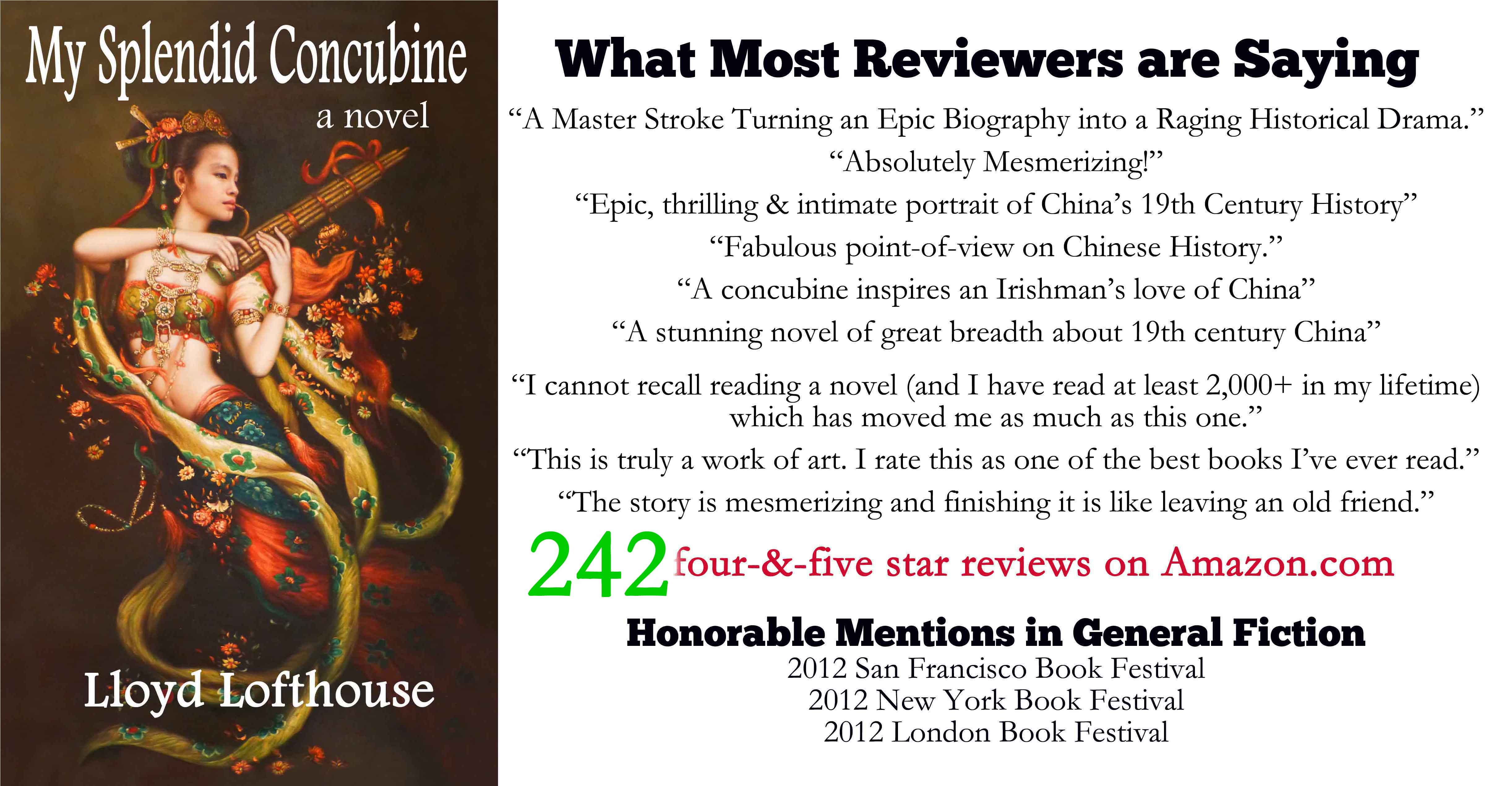

 iLook China