More than Money

March 16, 2010

The S’ung dynasty cautiously issued true-paper money in 1023, in small amounts in a limited area good for a specific time period. The notes would be redeemed after three years, to be replaced by new notes for a 3% service charge. source
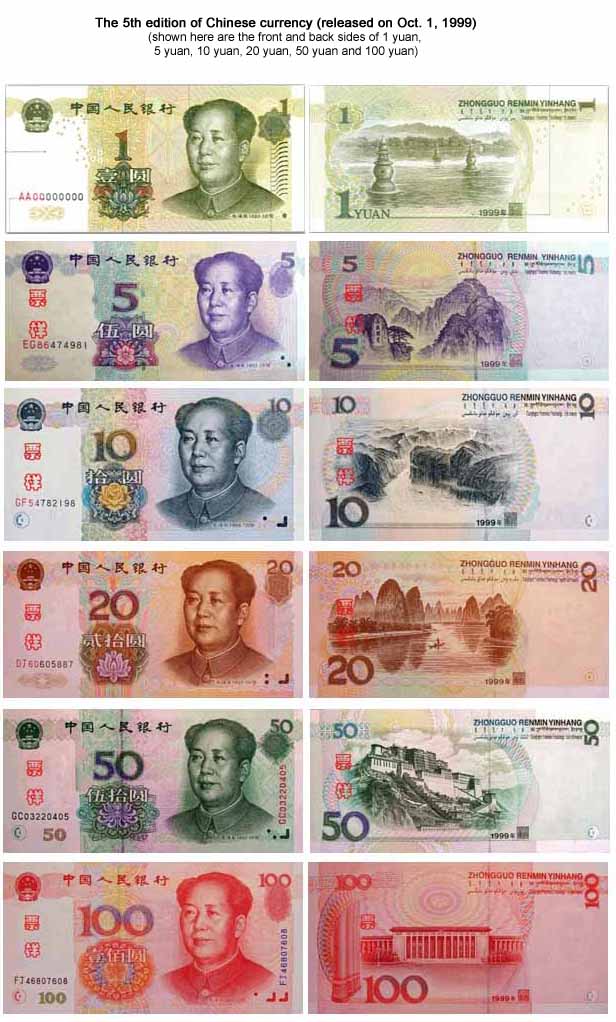
Chinese money – Yuan

With the United States wanting (source) China to devalue their currency, China finds itself between a rock (1.3 billion Chinese) and a hard place (America). If China caves in and does as America wants, products manufactured in China would cost more. If that happened, demand for Chinese products from other countries would decline and Chinese people would lose jobs.

Labor unrest in China is already increasing. source People want jobs and higher pay so they can join the growing middle class and buy more things like Americans do. To get ready, China’s police  are undergoing special training to deal with expected social unrest over factory closings that have left millions of migrant workers out of jobs.

What’s happening in China today is similar to what happened in America during the 1860s and ’80s. source

It’s the same old story—the rich want to keep the money while workers want to earn more.

Discover Deng Xiaoping’s 20-20 Vision

_______________

Lloyd Lofthouse is the award-winning author of My Splendid Concubine [3rd edition]. When you love a Chinese woman, you marry her family and culture too. This is the love story Sir Robert Hart did not want the world to discover.

His third book is Crazy is Normal, a classroom exposé, a memoir. “Lofthouse presents us with grungy classrooms, kids who don’t want to be in school, and the consequences of growing up in a hardscrabble world. While some parents support his efforts, many sabotage them—and isolated administrators make the work of Lofthouse and his peers even more difficult.” – Bruce Reeves.

lloydlofthouse_crazyisnormal_web2_5

Subscribe to “iLook China”!
Sign up for an E-mail Subscription at the top of this page, or click on the “Following” tab in the WordPress toolbar at the top of the screen.

About iLook China

China’s Holistic Historical Timeline


The Qianlong Emperor and Google

March 16, 2010

On Friday, March 12, the BBC reported that the Chinese Minister of Industry and Information Technology Li Yizhong adopted a tough stance during a legislation session. “I hope that Google will abide and respect the Chinese government’s laws and regulations,” he said.  “But, if you betray Chinese laws and regulations … it means that you are unfriendly, irresponsible, and you will have to pay the consequences.”

Qianlong Emperor

Google doesn’t get it.  If they read what the Qianlong Emperor (1736-1796) wrote in his famous letter to King George the III in 1793—when China was strong enough to resist external influence—they might understand.

China is a family oriented culture, and the individual is not as important. Public freedom of expression does not fit the Confucian, Taoist foundation that begins in the family where you do not publicly criticize your elders or your leaders and expect to get away with it.

Starting with the first Opium War in 1840 until Mao won China in 1949, China was weak and was bullied by Imperial powers. Now that China is strong, they are saying “NO” as the Qianlong Emperor did.

Discover The Influence of Confucius

______________

Lloyd Lofthouse is the award-winning author of the concubine saga, My Splendid Concubine & Our Hart. When you love a Chinese woman, you marry her family and culture too.

If you want to subscribe to iLook China, there is a “Subscribe” button at the top of the screen in the menu bar. 


Hitting Endless Home Runs

March 15, 2010

First home run—China is becoming the world leader in green energy. You may read about it in China Going Green.

Second home run—Although America has ample supplies of rare earth elements (in the ground) needed for high-tech products, China is the only country processing these elements. The cost to build a processing plant in the United States runs between 500 million and one billion. Source: Holding a Vital Key to Humanity’s Future

“U.S. Rare Earths’ Chief Executive Officer Edward Cowle explained that rare earth elements have become increasingly common in high technology equipment including:

  • computer hard drives and cellular phones
  • MRI machines
  • environmental products such as electric cars, wind turbines and solar panels
  • military weapons, including the electronic controls and electric motors used in missiles

“U.S.-based production for these important manufacturing and military applications may be in jeopardy because China currently supplies the majority of rare earth elements that are used in these applications.” Source: Technology Metals Research

High speed rail in China

Third home run—Now, using French, German and Japanese technology, China plans to bid for contracts to build high-speed rail for the U.S. market and is already exporting this technology to Europe and Latin America. The White House recently announced $8 billion in grants for rail projects including the high-speed systems in California, Florida and Illinois. Source: The Huffington Post

See China’s Fast Track Growth

______________

Lloyd Lofthouse is the award-winning author of The Concubine Saga. When you love a Chinese woman, you marry her family and culture too. This is the love story Sir Robert Hart did not want the world to discover.

To subscribe to “iLook China”, look for the “Subscribe” button at the top of the screen in the menu bar, click on it then follow directions


Health Care, Urban Real Estate and Renewable Energy Update

March 9, 2010

Rural citizens of China have been protesting the lack of quality health care outside the cities where eight hundred million Chinese live. This topic was also a subject for debate in China’s legislature, known as the National People’s Congress. (see Basic Health Care in China (http://wp.me/pN4pY-bO)

Another complaint China’s government wants to deal with is the shocking price increases to buy a home in one of China’s cities. Housing costs in seventy Chinese cities jumped 9.5% from a year earlier. The government wants to bring those prices down to make housing more affordable.

During the Copenhagen Climate Summit, China was criticized for not signing a pledge to reduce carbon emissions. China recently announced that it is planning to reduce its carbon footprint by 40-45% (from 2005 levels) and generate 15% of its electricity from renewable technologies by 2020. Over the next ten years, we should see these changes taking place. Since most of China’s leaders are engineers, they often set long-term goals.

Chinese Wind Farms

By comparison, President Obama said at Copenhagen that the United States intended to reduce its greenhouse gas emissions “in the range of” 17% by 2020.  Since the Chinese government doesn’t have to deal with American conservatives, who do not believe carbon emissions are causing global warming and block legislation and spew confusion at every chance, I’d place my bet on China achieving their goals first.


Smoking Gun

March 5, 2010

The smoking gun I’m writing about in this post is complements of American tobacco companies earning huge profits in China. Isn’t the market-economy great?

Chinese child smoking

“Antismoking advocates often complain about smoking levels in Canada but our problems pale beside those of China, where it is estimated that 300 million people already smoke and more are being encouraged to do so by Western advertising. To its credit, the Chinese government is taking steps to discourage smoking as it prepares to host the 10th World Conference on Tobacco and Health in 1997. By 2025, smoking-related disease is expected to kill 2 million Chinese a year.” Source: CMAJ-JAMC

Big Tobacco in China

Yes, smoking is a problem in China. When we go out to eat, there will usually be people smoking in restaurants.  In cities, we use the subways, and I haven’t seen or smelled anyone smoking there.

When we travel in China, we often stay in a Jinjiang Inn, a chain of reasonably priced, modern, clean hotels that serve a complimentary breakfast. There are hundreds of Jinjiang inns in most if not all of China’s major cities. This chain caters primarily to the Chinese middle class or Asian business people.  Most foreign tourists stay in more expensive, upscale hotels.  We prefer the Jinjiang Inn.

However, even when we request a smoke-free room or floor, we often will smell drifting cigarette smoke coming from other rooms.

Bob Grant talks about the Chinese smoking in his guest post.

______________

Lloyd Lofthouse is the award-winning author of The Concubine SagaWhen you love a Chinese woman, you marry her family and culture too. This is the love story Sir Robert Hart did not want the world to discover.

Subscribe to “iLook China”
Sign up for an E-mail Subscription at the top of this page.

About iLook China