China is Serious about UFOs

July 29, 2010

The Huffington Post mentioned recent UFO sightings in China, “four lantern-like objects forming a diamond shape…hovered over the city’s Shaping Park for over an hour…. Last week, flights were diverted in Hangzhou, also in eastern China – after a mysterious object was seen hovering in the sky.”

I wrote about descriptions that sounded like UFOs in God, Ancient Astronauts and China’s Yellow Emperor.

In fact, Early Chinese texts tell of long-lived rulers from the heavens who flew in “fire-breathing dragons”.

In Tibet there is a book called the Kantyua, which means “the translated word of Buddha”. It tells of flying “pearls in the sky” and of transparent spheres carrying gods to visit man. Source: NetScientia.com

In 1947, a Chinese newspaper, the Commons Daily, reported that witnesses saw UFOs appearing over Wuhan.

Then in The Chinese Roswell by Hartwig Hausdorf, the author spent years in China uncovering tell-tale traces of an alien mind which may have passed that way millennia ago.

“It shouldn’t come as a surprise that many fascinating accounts of flying machines, unexplained celestial observations and close encounters with strange beings can be found quite extensively in historical and literary works from China.” Source: Open Minds

Conservative state-run newspapers and television media often report UFO sightings. China has a bimonthly UFO magazine devoted to UFO research, The Journal of UFO Research, which was launched in February 1981, circulation 400,000. Source: The Independent

______________________________

Lloyd Lofthouse is the award-winning author of the concubine saga, My Splendid Concubine & Our Hart. When you love a Chinese woman, you marry her family and culture too. 

Sign up for an RSS Feed for iLook China


Invented in China—Printing

July 9, 2010

Six hundred years after paper was invented, the Chinese invented printing and the first printed work was Buddhist scripture during the Tang Dynasty (618 – 906). The most basic printing techniques are older. Engraving came later. The carving, printing technique originated during the Tang Dynasty

When we talk about paper and printing, it is to collect knowledge, preserve and share it.

Once there were paper books being printed to share Buddhist ideas, the religion spread through China into Korea and Japan. Over a thousand years printing techniques continued to improve until there were multi-colored printings.

Then during the Sung Dynasty, the printing board was invented, which used clay characters. One character was carved into a small block of clay. Then the clay was put in a kiln to heat into a solid block. This method was efficient for printing thousands of sheets. These blocks would be placed together to create sentences and paragraphs of Chinese characters.

Later, the characters were carved into wood. Over time, printing was developed into an art.  In fact, Ancient Chinese culture was preserved due to the invention of paper and these printing methods, which wouldn’t reach Europe until after 1300 AD, almost 800 years later.

Without the Chinese invention of printing, Christianity, Islam and Buddhism may not have spread to the extent that they have.

See With or Without Paper

_________________________

Lloyd Lofthouse is the award-winning author of the concubine saga, My Splendid Concubine & Our Hart. When you love a Chinese woman, you marry her family and culture too. 

To subscribe to “iLook China”, look for the “Subscribe” button at the top of the screen in the menu bar, click on it then follow directions.


The Eighteen Levels of Chinese Hell

June 27, 2010

Many Chinese believe heaven/paradise is out of reach of ordinary mortals. However, hell is a harsh reality and the souls of the dead must go.

Buddhists brought this concept of hell to China from India, and over time, this belief grew wings and picked up baggage as it spread. Taoism, Buddhism and traditional Chinese folk religions believe that the souls of the dead must experience several tests before reaching the gates of hell, where demons demand money to enter, which might explain why many Chinese burn paper money at funerals to make sure beloved family members have some for the journey.

one of the eighteen levels to hell

There are eighteen levels on this journey—each one a test. For criminals, the souls are heavy and the trip long and painful. Chinese almanacs graphically illustrated the punishments. Good souls were light and made the journey quickly.

Today, these beliefs are probably more alive in rural China than urban areas where Mao’s Cultural Revolution had more of an impact driving out old beliefs.  Most Taiwanese and many in Hong Kong still hold to these beliefs.

If given a choice, which hell would you select—Chinese, Islamic or Christian?

Discover The Failure of Multiculturalism in the United States

_______________

Lloyd Lofthouse is the award-winning author of My Splendid Concubine [3rd edition]. When you love a Chinese woman, you marry her family and culture too. This is the love story Sir Robert Hart did not want the world to discover.

Subscribe to “iLook China”!
Sign up for an E-mail Subscription at the top of this page, or click on the “Following” tab in the WordPress toolbar at the top of the screen.

About iLook China


The Festival of the Hungry Ghost

June 5, 2010

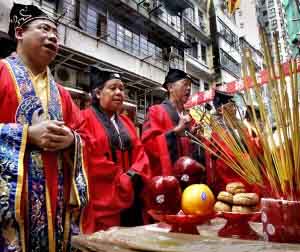
Although this festival is not celebrated in mainland China as it once was, the Festival of the Hungry Ghost was a time when ghosts that cannot rest were appeased so they would not turn from wondering ghosts to malevolent demons.  By remembering dead family members and paying tribute to them, it is believed that they will not intrude on daily life or cause misfortunes or bad luck.

One legend says that Mu Lian told his mother he wanted to be a Buddhist monk and left home.  Years later, he returned to discover that she had died. He knew that his mother had done bad things in his life and was probably in hell.  Since his mother had no one to feed her, she had to be hungry so he offered food to her hungry ghost but the food didn’t reach her.

To solve the problem, Mu Lian was told by his Buddhist master to become a vegetarian and perform spiritual deeds. After following this advice, on the 15th day of the seventh lunar month, he saved his mother from hell and she was no longer a hungry ghost.

See Honoring the Dead

_____________________

Lloyd Lofthouse is the author of the award winning novels My Splendid Concubine and Our Hart. He also Blogs at The Soulful Veteran and Crazy Normal.

Sign up for an RSS Feed for iLook China


Politically Correct Outside Tibet but Historically Wrong

May 31, 2010

In the “Contra Costa Times” this morning, I read Tibetan leaders seek East Bay help by Doug  Oakley, a politically correct news piece that’s partially accurate because Oakley only shares part of the history between China and Tibet—the part that favors Tibet’s so-called government in exile, which represents about 1% of all Tibetans—the rest still live in China.

Oakley writes that, “Tibet was invaded by the Chinese army in 1950. After the Tibetan army was defeated, both sides signed a 17-point agreement in 1951 recognizing China’s sovereignty over Tibet.” These facts are correct, but they do not tell the whole story.

Tibet, China

Any historian who checks primary sources that exist outside of Communist China will discover that Tibet was ruled by three Chinese dynasties: The Yuan, Ming and Qing Dynasties from 1277 – 1911.  Even after Sun Yat-Sen’s so-called Republic replaced the Qing Dynasty in 1911, Tibet was considered part of China.

Primary sources like the October 1912 issue of The National Geographic Magazine and more than fifty letters written by Sir Robert Hart during the 19th century support the fact that Tibet was part of China for more than six centuries prior to 1913 when the British Empire convinced Tibet to break free for political reasons.

The so-called Tibetan government in exile says they are seeking autonomy within China. In fact, China does offer a form of autonomy to the 56 minorities that live in China, but this isn’t the level of autonomy that the Dalai Lama demands, which is a return to the old Tibetan ways described in that 1912 issue of National Geographic, which is unacceptable to China.

Discover more about today’s Tibet by reading Chinese Gold from Dead Tibetan Caterpillars, Buddhism in China, The Tea Horse Road, Water – Two Countries Tell a Tale and About Tibet.

_____________________

Lloyd Lofthouse is the author of the award winning novels My Splendid Concubine and Our Hart. He also Blogs at The Soulful Veteran and Crazy Normal.

Sign up for an RSS Feed for iLook China