Who has the bloodiest hands—China, the United States or India?

September 2, 2015

Back in 2006, China was crucified in the Western media due to one unarmed Tibetan being shot dead attempting to illegally cross the border into India. It was called the Nangpa La Pass Shooting Incident. If you Google it, you’ll find a lot of anger and allegations about what happened.

USA Today reported, “China said Thursday that soldiers posted near its border with Nepal clashed with some 70 people attempting to flee the country, killing one person on the spot and injuring two others, including one who died later of altitude sickness.” io9.com says, “Altitude sickness is relatively unstudied because of how quickly and unpredictably it goes from nausea to coughing up blood to death.”

Another headline shouted: “International Anger Grows Over Tibet Shooting. Human Rights groups are calling for a UN Investigation into the killing of a nun by Chinese border patrol guards, writes Jonathan Watts in Beijing.”

Then I read another story I’d never heard of before that the U.S. media has ignored.  I read this in The Economist, a publication in the UK, of another border where similar killings happen often, but I couldn’t find any demand of a UN Investigation in the Western media or from human rights groups for those killings. Even The Economist, that reported the story, didn’t call for an investigation.

Maybe the difference is that the border killings reported by The Economist took place between two democracies—India and Bangladesh. After all democracies are special, aren’t they?


I couldn’t find a report of this India-Bangladesh incident in English on YouTube

The Economist reported, “On January 7th India’s Border Security Force (BSF) shot dead Mr. Nur Islam’s 15-year-old (daughter) Felani, at an illegal crossing into Bangladesh from the Indian state of West Bengal. Felani’s body hung from the barbed-wired fence for five hours. Then the Indians took her down, tied her hands and feet to a bamboo pole, and carried her away. Her body was handed over the next day and buried in the yard at home.”

“The BSF (India’s Border Security Force) kills with such impunity along India’s 4,100-kilometer (2,550-mile) border with Bangladesh that one local journalist wonders what the story is about. According to Human Rights Watch, India’s force has killed almost 1,000 Bangladeshis over the past ten years.”

Should we conclude from this that the one Tibetan killed attempting to illegally cross China’s border is worth more than the 1,000 who were shot dead attempting to illegally cross the border from Bangladesh to India?

What about deaths along the US border?

According to Rodolfo Acuña, Professor Emeritus of Chicano Studies at California State University, “Mexico’s Ministry of Foreign Affairs reported 117 cases of human rights abuses by US officials against migrants from 1988 to 1990, including fourteen deaths. During the 1980s, Border Patrol agents shot dozens of people, killing eleven and permanently disabling ten.”

On May 28, 2010, Anastasio Rojas, a 42-year-old Mexican migrant worker, was tased and beaten at the San Ysidro border crossing by more than a dozen U.S. Customs and Border Protection officers. According to the witnesses, he was face down on the ground and handcuffed.

On June 2010, a 15-year-old Mexican citizen was shot to death on the Mexican side of the border near El Paso, Texas. The U.S Border Patrol reported that the officers responded to a group of suspected illegal immigrants who were throwing rocks at them.

Hey, China, did you get that? China’s border guards are not allowed to shoot anyone who is illegally crossing its borders, but the United States and India can kill as many as they want—sort of like the fictional character James Bond, who has a license to kill from another democracy.

______________________________

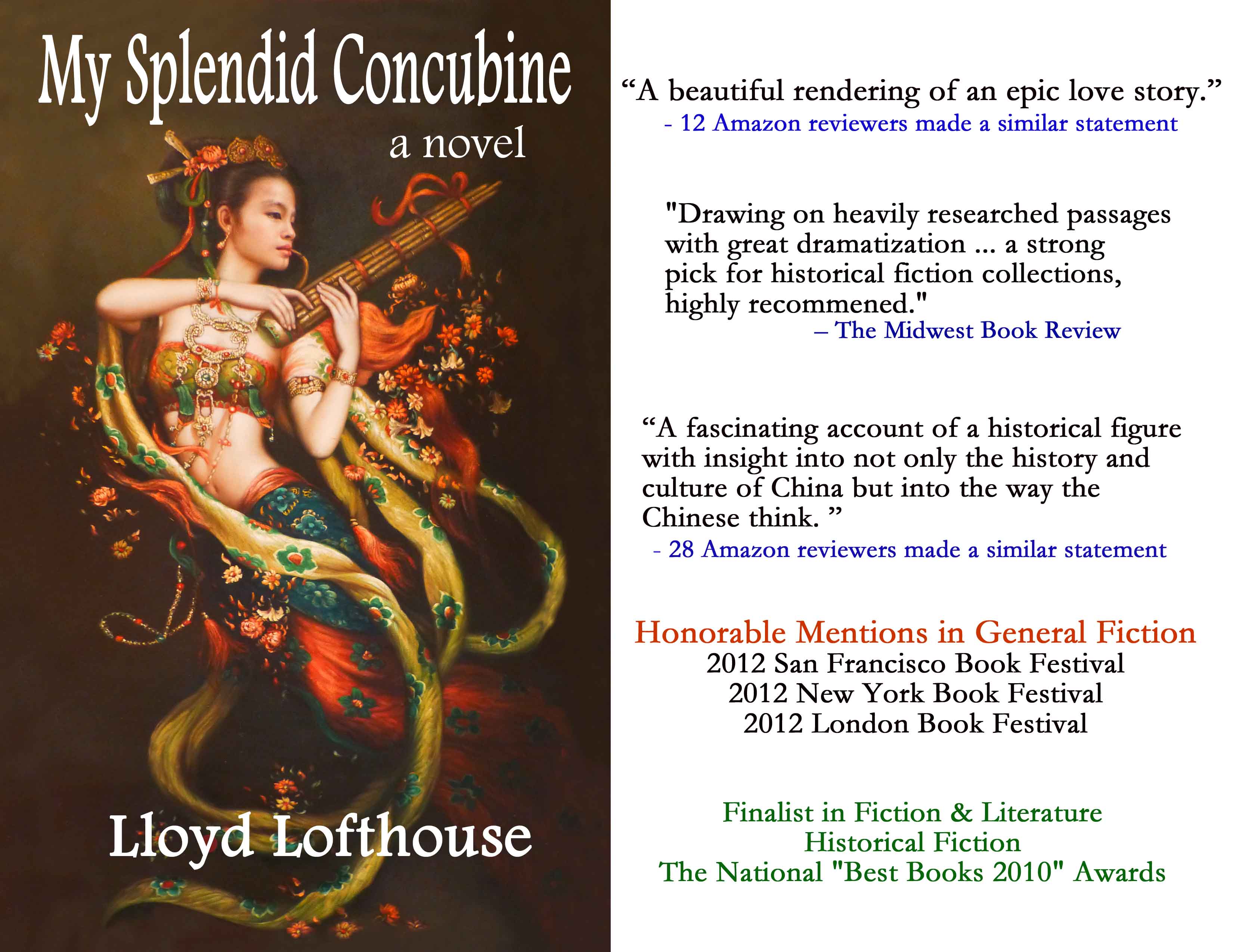
Lloyd Lofthouse is the award-winning author of My Splendid Concubine [3rd edition]. When you love a Chinese woman, you marry her family and culture too. This is the lusty love story Sir Robert Hart did not want the world to discover.

IMAGE with Blurbs and Awards to use on Twitter

Subscribe to “iLook China”!
Sign up for an E-mail Subscription at the top of this page, or click on the “Following” tab in the WordPress toolbar at the top of the screen.

About iLook China

China’s Holistic Historical Timeline


Learning the power of the Talmud in China and South Korea

September 1, 2015

According to Jewish tradition, the Torah was revealed to Moses about the time of China’s Shang Dynasty (1766 – 1122 B.C.), more than three thousand years ago.

In fact, the Talmud is an organic interpretation through discussion and debate of what the Torah means and teaches.

In most of Asia, the perception of Jews as expert moneymakers does not have the religion-based antagonism that often accompanies the same stereotype elsewhere in the world. While both Christians and Muslims have persecuted Jews for religious reasons, China hasn’t done this.

Instead, South Korea and China respect what may be learned from the wisdom of Judaism.

The Muqata says, “Close to 50 million people live in South Korea, and everyone learns Gemara (Talmud) in school. ‘We tried to understand why the Jews are geniuses, and we came to the conclusion that it is because they study Talmud,’ said the Korean ambassador to Israel.”

“In my country we also focus on family values,” The South Korean Ambassador said. “The (Jewish) respect for adults, respect and appreciation for the elderly parallels the high esteem in my country for the elderly.”

Another significant issue is the respect for education. In the Jewish tradition, parents have a duty to teach their children and devote a lot of energy and attention to it.

For South Korean parents, their children’s education is also a top priority. For contrast, in the United States too many ignorant and lazy parents blame teachers when their children are not learning, but not in Asia.

How valuable is education to Jewish tradition? “Maimonides (1135 – 1204 C.E.) in his great code of Jewish law has an entire section devoted to teaching, teachers, students and the concept of knowledge and education. The basic value is that teachers are to be respected and given honor.

“One should rise before one’s teacher, speak respectfully to one’s teacher, and treat one’s teacher with greater probity than even one’s parent.” The Talmud teaches, “parents bring a child into this world but a teacher can bring a child into the World to Come” into a world of spirit, creativity, ideas and self-worth and ultimate immortality.

In fact, “the Talmud itself attributes to God, so to speak, the attribute of being a teacher. “He Who teaches Torah to His people Israel.” Even mortal teachers are viewed in Judaism as being engaged in holy work.

These ancient Jewish values have also found a home in China.

Newsweek reported, “The apparent affection for Jewishness has led to a surprising trend in publishing over the last few years: books purporting to reveal the business secrets of the Talmud that capitalize on the widespread impression among Chinese that attributes of Judaism lead to success in the financial arts.”

Newsweek said, “Titles such as Crack the Talmud: 101 Jewish Business Rules, The Illustrated Jewish Wisdom Book, and Know All of the Money-Making Stories of the Talmud share the shelves with stories of Warren Buffet and Bill Gates.”

“The admiration for Judaism stems from a history that goes beyond business,” Newsweek continues. “About half of the dozen or so Westerners active in Mao Zedong’s China were Jewish, and that also led to increased interest in Jewish culture among Chinese intellectuals,” says Xu Xin, professor of Jewish studies at Nanjing University.

______________________________

Lloyd Lofthouse is the award-winning author of My Splendid Concubine [3rd edition]. When you love a Chinese woman, you marry her family and culture too. This is the lusty love story Sir Robert Hart did not want the world to discover.

IMAGE with Blurbs and Awards to use on Twitter

Where to Buy

Subscribe to “iLook China”!
Sign up for an E-mail Subscription at the top of this page, or click on the “Following” tab in the WordPress toolbar at the top of the screen.

About iLook China

China’s Holistic Historical Timeline


The Cultural Glue that Holds China together

August 26, 2015

Under Qin Shi Huangdi, China’s first emperor, who united China in 221 BC, a standardized written language was mandated for an empire that once resembled Europe with many countries and written languages, and this created a unique cultural identity from the rest of the world.

To understand this, I’m turning to a conversation thread from the Yuan-Xiao Festival. Alessandro, a European with a degree in East Asian studies, who lives in China with his Chinese wife, wrote a comment that helped me understand something I’d read years ago written by Lin Yutang.

Writing of the Chinese Mind on page 81 of the 1938 Holcyon House Edition of My Country and My People, Lin Yutang wrote, “The Chinese language and grammar … in its form, syntax and vocabulary, reveals an extreme simplicity of thinking, concreteness of imagery and economy of syntactical relationships.”

I didn’t clearly understand what Lin Yutan meant until Alessandro’s comment. “The Latin alphabet is a phonetic one,” Alessandro said, “and as such, it simply reproduces the sounds of the spoken language, making it more susceptible of changes whenever the spoken language changes. Chinese Hanzi, on the other hand, conveys almost no ‘phonetic’ information by itself … (and doesn’t change much in its meaning as time passes).”

 
Cultural Competence: Managing Your Prejudices

Alessandro went on to say, “Both Europe and China have had political upheavals and long periods in which they were divided, but (China) having a stable writing system that doesn’t change as much as an alphabetic one helped them not to lose an important element of cultural unity, therefore of ‘national’ identity…

“The Chinese concept of ‘nation’ has nothing to do with the ‘nation state’ concept common in Europe (and North America).

“European nation states are more or less based on ethnicity, while in China it was – and it still somewhat is – based on cultural elements.

“You were Chinese because you shared a common culture, because you acted as a Chinese and assumed Chinese customs.

“Europe never regained the unity that existed during the Roman Empire, while China always strove to regain unity after each period of division. The traditional saying 合久必分,分久必合 — means more or less ‘after unity comes division, after division comes unity’.”

While the West—North America and Europe—has many written languages, China has had one for more than two millennia and this has been the glue that creates a sense of unity and what it means to be Chinese. Westerns don’t have that sense or cultural identity or unity.

______________________________

Lloyd Lofthouse is the award-winning author of My Splendid Concubine [3rd edition]. When you love a Chinese woman, you marry her family and culture too. This is the lusty love story Sir Robert Hart did not want the world to discover.

IMAGE with Blurbs and Awards to use on Twitter

Where to Buy

Subscribe to “iLook China”!
Sign up for an E-mail Subscription at the top of this page, or click on the “Following” tab in the WordPress toolbar at the top of the screen.

About iLook China

China’s Holistic Historical Timeline


Long before Romeo and Juliet there was China’s Butterfly Lovers

August 25, 2015

The legend of The Butterfly Lovers first appeared in 618 AD during the Tang Dynasty, and it’s a tragic Chinese love story similar to Romeo and Juliet.

The basic premise is of a young woman in China wanting to go to school. Since boys were the only ones allowed to attend school, this young woman, like Barbara Streisand in the movie Yentl (1983), disguised herself as a boy.

Yentl was based on Isaac Bashevis Singer’s (1902 – 1991) short story Yentl the Yeshiva Boy.

When I talked to my wife about this, she found her copy of a popular theme song from The Butterfly Lovers played as a violin solo by Yu Lina. As the house filled with the music, which may also be found on the next embedded YouTube video, my wife started to dance.

She said, “This is one of my favorites. I cannot resist dancing when I hear it.”

In fact, Yentl the Yeshiva Boy and Shakespeare’s (1564 – 1616) Romeo and Juliet must be combined to become The Butterfly Lovers. What starts as a charade becomes a love story ending in the suicide of the two young lovers.

The love story of Liang Shanbo and Zhu Yingtai is one of four Chinese folk legends and one of the most influential and best known in China.

China has traded with the West since the Han Dynasty (206 BC – 219 AD). There was an overland route in the north and a sea route in the south, which the Roman Empire used around the time of Christ.

Since China traded with the West for more than two thousand years, it is conceivable that The Butterfly Lovers reached the West and was adapted by Shakespeare and then Singer after being exposed to the plot.

______________________________

Lloyd Lofthouse is the award-winning author of My Splendid Concubine [3rd edition]. When you love a Chinese woman, you marry her family and culture too. This is the lusty love story Sir Robert Hart did not want the world to discover.

2015 Promotion Image for My Splendid Concubine

Subscribe to “iLook China”!
Sign up for an E-mail Subscription at the top of this page, or click on the “Following” tab in the WordPress toolbar at the top of the screen.

About iLook China

China’s Holistic Historical Timeline


The Return of China’s Concubines or should we call them Independent Escorts?

August 19, 2015

A friend of mine sent me a link to an interesting post of China’s Second Wives (concubines). “A 2008 estimate says that Second Wives account for a third of the country’s consumption of luxury products.”

The area Director of JWT North Asia, Tom Doctoroff, answered questions for the piece. He said, “When I ask people how much it costs to maintain a second wife – a trophy concubine – the average I’m told is 50,000RMB (about $7,600US). This isn’t just a girlfriend, this is someone who is kept. And she is displayed as somebody that’s a result of this guy’s power and influence, and access to funds.

However, it wasn’t like that for several decades.

When the Communist Party won China’s Civil War (1927 – 1949 with a break during WWII) and drove Chiang Kai-shek’s Nationalists from China, Mao announced that women held up half the sky; the practice of bound feet ended and women were considered equal to men for the first time in China’s history.

For thousands of years, the wealthy and powerful in China often had more than one wife and several concubines. The emperor had thousands of concubines.

Between 1949 and 1976, Mao’s goal was to change China by ending the old ways and building a new China that would be stronger and more capable of defending itself from invasions. Mao denounced Confucianism and literally waged a war against Buddhism (and all religions) in China. Mao ended the practice of having concubines too.

The goal to lead China away from its ancient cultural heritage ended after Mao’s death and recently the party had a statue of Confucius erected in Tiananmen Square in an effort to bring back some of the old ways.

Now that China is a hybrid capitalist nation, powerful and wealthy men are collecting concubines (those second wives) again. In fact, “A survey in the 2000s revealed that 60 percent of respondents said they had an affair at some point during their marriage, compared to 15 percent in the 1980s. Many sociologists believe the number is increasing all the time as rising standards of living make it more feasible economically to have affairs.” – Facts and Details.com

However, there is a difference. The legal system in China sees women as equals so women cannot be legally bought and sold. This time, women have a choice to be a concubine or wife.

In the embedded YouTube video of the Young Turks, it is mentioned that some wealthy and powerful men in America have concubines too, but in the US, those women are called swingers or escorts. To learn more, read this post at The Honest Courtesan-frank commentary from an unretired call girl in the U.S.

In fact, if a Chinese wife doesn’t approve of her husband having concubines, she now has the freedom to divorce him, and divorce is on the rise in China.

______________________________

Lloyd Lofthouse is the award-winning author of My Splendid Concubine [3rd edition]. When you love a Chinese woman, you marry her family and culture too. This is the lusty love story Sir Robert Hart did not want the world to discover.

IMAGE with Blurbs and Awards to use on Twitter

Subscribe to “iLook China”!
Sign up for an E-mail Subscription at the top of this page, or click on the “Following” tab in the WordPress toolbar at the top of the screen.

About iLook China

China’s Holistic Historical Timeline