The Ancient Bells of Marquis Yi

February 7, 2018

In 1977, a discovery was made in China—a complete set of chime bells were unearthed from the tomb of Marquis Yi, who lived during the Warring States Period (475 to 221 BC). These chimes were older than the Qin Dynasty’s famous Terra Cotta warriors (221 to 206 B.C.).

When the chimes were discovered in Hubei Province, a plot of land was being leveled to build a factory. The Red Army officer in charge of the work had an interest in archeology.

The officer discovered that the workers were selling the ancient bronze and iron artifacts they were digging up. He convinced local authorities there might be an ancient tomb buried below the site.

When the tomb was unearthed, a set of chime bells was discovered.  These musical instruments were an important part of ritual and court music in ancient times. An American professor in New York City even called these chimes the eighth wonder of the ancient world.

The sixty-five chime bells weighed about 5 tons.

No other set of chimes like this had been discovered in China before and this set was in excellent condition.

A project was launched in 1979 to duplicate four sets of these chimes. More than a 100 scientists and technicians were recruited.  In 1998, twenty years after the discovery, the project was completed. One of the sets was sent to Taiwan as a gift.

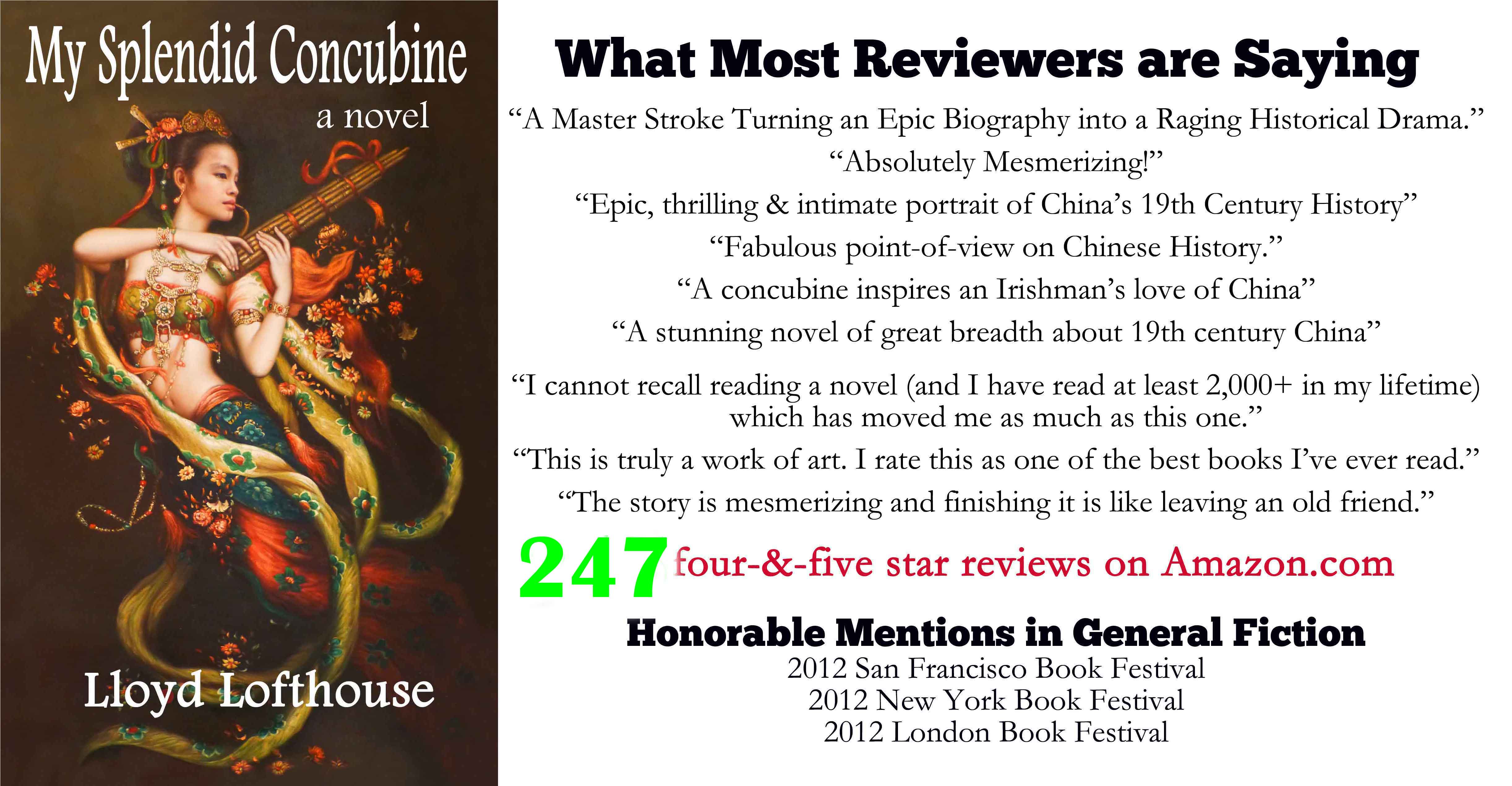
Lloyd Lofthouse is the award-winning author of My Splendid Concubine, Crazy is Normal, Running with the Enemy, and The Redemption of Don Juan Casanova.
Where to Buy

Subscribe to my newsletter to hear about new releases and get a free copy of my award-winning, historical fiction short story “A Night at the Well of Purity”.

About iLook China


The Oldest, Longest, and Greatest Canal in the World is in China

February 6, 2018

I learned about the Suez and Panama canals in grade school. In the 19th century, the French built a hundred mile long canal across the Isthmus of Suez. When it opened, the Suez Canal was only 25 feet deep, 72 feet wide at the bottom and 200 to 300 feet wide at the surface.

The Panama Canal was started in 1881 by the French but that attempt was a failure. The Americans ended up finishing the Panama Canal between 1904 – 1914, and it was 51 miles long.

Until my first trip to China in 1999, I had never heard of China’s Grand Canal, which is the oldest and longest man-made canal in the world at more than a thousand miles from Beijing to Hangzhou south of Shanghai.

The construction of China’s Grand Canal was started several hundred years before the birth of Jesus Christ and was completed centuries later, and it’s still in use today. To finish it, the Pound lock was invented in the 10th century during the Song Dynasty. There are 24 locks and about 60 bridges.

The Pound lock was pioneered by Qiao Weiyo, a government official and engineer, in 984 AD that replaced earlier double slipways that had caused trouble and are mentioned by the Chinese polymath Shen Kuo (1031–1095 AD) in his book Dream Pool Essays (published in 1088 AD), and fully described in the Chinese historical text Song Shi (compiled in 1345 AD).

In the 19th and early 20th centuries, the West built the Suez and Panama Canals that combined were 151 miles long. Both the Suez and Panama canals use the same Pound lock concept that was invented in China about one thousand years earlier.

Science Direct.com reports, “Historically, the Grand Canal was built in segments by many separated kingdoms starting some 25 centuries ago. Fuchai, the king of Wu, dug the first section named Hangou, which connected the Huai and the Yangtze rivers.”

Lloyd Lofthouse is the award-winning author of My Splendid Concubine, Crazy is Normal, Running with the Enemy, and The Redemption of Don Juan Casanova.

Where to Buy

Subscribe to my newsletter to hear about new releases and get a free copy of my award-winning, historical fiction short story “A Night at the Well of Purity”.

About iLook China


A short-and-simple intro to Confucius and his impact on China

January 31, 2018

Confucius (551-470 B.C.E.) lived during the warring states period before China was unified as one nation. Confucius is considered the founder of the Chinese ethical and moral system based on the family and his Five Great Relationships:

1. between ruler and subject
2. father and son
3. husband and wife
4. elder and younger brother
5. friend and friend

In each pair, one role was superior and one inferior; one led and the other followed. Yet each involved mutual obligations and responsibilities. Failure to properly fulfill one’s role could lead to the end of the relationship.

In Fact, Confucius taught that responsibility was not given just because you had wealth or power.  Responsibility had to be earned through compassion for others and to live in moderation and not strive for excess.

Did you notice that religion and God are not mentioned among the Five Great Relationships?

Discover The Return of Confucious

Lloyd Lofthouse is the award-winning author of My Splendid Concubine, Crazy is Normal, Running with the Enemy, and The Redemption of Don Juan Casanova.

Where to Buy

Subscribe to my newsletter to hear about new releases and get a free copy of my award-winning, historical fiction short story “A Night at the Well of Purity”.

About iLook China


Buddhism’s Journey to China

January 30, 2018

An Indian prince became the Buddha around the 6th Century BC, but Buddhism would not arrived in China for several centuries. The Buddha’s original name was Siddartha Guatama.

After he died, Buddhism split into two major branches that divided again several times over the centuries.

Today, Buddhism has almost 380-million followers and is the world’s fifth largest religion. Christianity is the largest with 2.4 billion followers. Islam is ranked #2 with 1.6 billion. Christianity and Islam also split into different sects after the founders died although Jesus Christ isn’t the real founder of Christianity. Jesus was a Jew and he died a Jew. There is no evidence that Jesus Christ wanted to launch a new religion that wasn’t Jewish. Hinduism (#3) has 1.15 billion followers with four-major sects.

The Bodhi-dharma was a Buddhist monk and a teacher who lived during the fifty and/or sixth century AD, more than a thousand years after Buddha died in India. The Bodhi-dharma traveled from India to China where he lived in a cave for 9 years.

A Sudden Dawn by Goran Powell is an epic historical fiction novel that opens with a young man named Sardili born in 507 AD to the Indian warrior caste. Sardili realizes that he would rather seek enlightenment than follow his family’s military legacy and he sets out on a life-long quest for truth and wisdom that leads him to China where he becomes the Buddhist monk Bodhidharma, known as Da Mo in China.

Da Mo establishes the Shaolin Temple as the birthplace of Zen and the Martial Arts. In ancient China, bandits and thieves were widespread and Buddhist temples were vulnerable to attack. The Da Mo taught a fighting system for the monks to defend themselves, and it proved successful. Over time, the Buddhist Shaolin style of martial arts evolved to what it is today.

Lloyd Lofthouse is the award-winning author of My Splendid Concubine, Crazy is Normal, Running with the Enemy, and The Redemption of Don Juan Casanova.

Where to Buy

Subscribe to my newsletter to hear about new releases and get a free copy of my award-winning, historical fiction short story “A Night at the Well of Purity”.

About iLook China


China’s long history with Astronomy: Part 2 of 2

January 24, 2018

Chinese astronomers named the constellations long before anyone in the west did. For instance, the Big Dipper was called The Plow. The North Star was Bei Ji. Another constellation was called the Winnowing Basket.

From the 16th century B.C. to the end of the 19th Century A.D., almost every (Chinese) dynasty appointed officials who were charged with the sole task of observing and recording the changes in the heavens.

However, the Chinese were not alone in mapping the heavens.

Ancient cultures in the West studied the skies too. The “Nebra Sky Disc”, discovered in Europe, dates to about 1,600 BC.

National Geographic says the Nebra Sky Disc is the oldest depiction of the night sky.  It is a hundred years older than the oldest images found in ancient Egypt.

The Nebra Sky Disc may be the first representation of the universe in human history.

But in China about 4,000 years ago, the oldest astronomical instrument known to man appeared. It was merely a bamboo pole planted in the ground so that the movement of the sun could be observed from the direction and length of the shadow of the pole.

The Chinese were the most persistent and accurate observers of celestial phenomena.

Return to or Start with Part 1

Lloyd Lofthouse is the award-winning author of My Splendid Concubine, Crazy is Normal, Running with the Enemy, and The Redemption of Don Juan Casanova.

Where to Buy

Subscribe to my newsletter to hear about new releases and get a free copy of my award-winning, historical fiction short story “A Night at the Well of Purity”.

About iLook China