Since the 1962 war, China and India have continued to argue about the disputed area that was created by British Explorer McMahon in the 19th century.
Parts of the frontier are still in dispute, including a portion of Kashmir and the eastern Indian state of Arunachal Pradesh.
The area in dispute now is Ladakh. For centuries, Ladakh was an independent kingdom but is now part of India. There are obvious cultural links with China.
In this area, no one knows where India ends and China begins. China and India still share the biggest stretch of disputed border in the world divided by Nepal and Bhutan from Arunachal Pradesh in the south to Kashmir in the north.
Al Jazerra English – Renewed Tension Over India-China Border
P. Chidambaram, India’s Interior Minister says that it is a disputed border area. He says that violations have taken place and are resolved by talking to each other (China with India).
India says the border violations were probably a mistake, but China says they never happened.
Diplomatic letters that Al Jazeera managed to get hold of show that both India and China are not telling the truth. Indian nomads wondered into Chinese occupied territory and were warned to leave or face the consequences.
The diplomatic letters also show that China does not accept that the area is disputed. Instead, China says it is their territory.
The Indian army had a heavy military presence on India’s side of the border. The Al Jazeera reporters could not visit the Chinese side.
Lloyd Lofthouse is the award-winning author of the concubine saga, My Splendid Concubine & Our Hart. When you love a Chinese woman, you marry her family and culture too.
To subscribe to “iLook China”, there is a “Subscribe” window at the top of the screen in the menu bar.
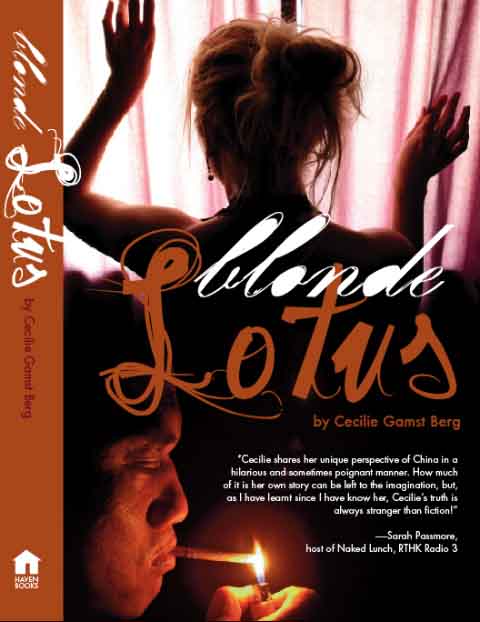
If there ever was an expat author in the Middle Kingdom whose enthusiasm and love of life was as contagious as Cecilie Gamst Berg’s, then that person has yet to be published.
Part travelogue of a directionless backpacker, part bedtime stories of a frisky European babe who enjoys seducing young Chinese guys “out of the festering prison of virginity,”
Blonde Lotus is in fact one in the same person. Gamst Berg, via her alter-ego protagonist Kat Glasø, accidentally arrives in late-1980’s China (“all I wanted was to be on the train; I had no interest in the journey’s destination, Beijing”), back when the mighty bicycle was still king of Peking and foreign tourists were a rare sighting.
Expecting a people with “long, billowing sleeves, reciting poetry and plucking at stringed instruments,” what Kat finds in New China instead are street corners populated with shady money changers and young hipsters whose knowledge of English is limited to the words ‘Okay-la’ and ‘Sex!’ Lulled by their charming incessancy, Kat shrugs her shoulders and good-naturedly gives it to them – the money AND the sex. “How could so many men find the women of a race attractive, and so few women find the men the same,” she ponders postcoitally over a shared Zhongnanhai cigarette.
Queen gweipo (devil woman in Cantonese) Gamst Berg is an unpretentious, fun-loving writer with nothing to prove. She’s not out to save China as so many a self-righteous foreigner here are (“I hope this country never modernizes” Kat admits in one of her many blunt moments of sincerity), she’s not trying to force feed them Faulkner (“I loved books and he never read one”), nor is she out to land a career in journalism like the rest of us.
No, the author is clearly just looking to have a good time (“We were young, stoned and in China”), and maybe learn some Putonghua while doing it, and therefore spares us the sappy, sympathetic observations and “deep understanding” of life in China that makes most Laowai Literature such a torture to read.
Conversely, nor is Gamst Berg out to tear Communism apart, vilify Chinese people or point and laugh at the “strangeness” of their culture, a common last-resort for some western travel writers (whom I refrain from naming as a professional courtesy) who don’t want to admit that they have learned nothing about the Chinese during their stay here.
Indeed, while her fellow expats spend their time in China sitting around at bars “shouting out orders in English, and when they weren’t understood, complained loudly to each other about how stupid the Chinese were,” rather than join in, Kat moves tables, literally and figuratively, to the Chinese side of the bar.
Instead of whining about China’s infamously filthy public toilets, Kat hangs out in them (smoking dope), then laughs when there’s a line of squeaming girls waiting to use the stall.
Rather than bitch about the People’s Republic’s chaotic queues at its railway stations, she jumps right in, elbows swinging, with the rest of the seething proletariat.
Our Blonde Lotus ain’t no saint, and she would laugh in your face if you dared suggest it. “I wanted to experience everything and sleep with everybody…” confesses, nay, asserts the Norwegian-born Kat Glasø – and then proceeds to actually do so, from coal-and-petrol-scented industrial North China all the way down to the steamy islands of Hong Kong, her final destination.
Throughout her candid memoir, the author employs an uproarious combination of reluctant intellectualism (“learning Chinese was better than being in love because there was no danger of waking next to the Chinese language wanting to kick the f*cker out of bed”) and ribald hedonism (“I felt something push into me, shudder and expire. Was it an asparagus?”) that is sure to win Gamst Berg as many fans as frighten them away.
If Blonde Lotus is a window into China, then that window has been fogged with the sultry breathe of its occupants. If it is a work of reportage; then the author was too distracted by eating, drinking, smoking and playing cards with the peasantry to be concerned about making the front page. And that nonchalance, that self-depreciating humor, is exactly this novel’s charm.
Blonde Lotus is a refreshingly unserious memoir of an infectiously upbeat young woman (this reviewer’s favorite line in the whole book: “Ha ha, life was perfect and made for me!”) who, lost in China and unsure of what she wants to do with said life – as many of our kind are – inadvertently ends up making a new, better one for herself.
The Chinese moved their Eleventh and Fifty-fifth divisions to the front.
The Indian army had four brigades set up defensive positions along the only mountain road leading south through the harsh terrain.
At the same time, India was planning to attack the Chinese army.
In a risky flanking maneuver, the Chinese sent 1,500 troops along a dangerous mountain trail to attack India’s Army in the rear and cut them in half.
The Chinese troops succeeded, and the Chinese army launched an attack from the north along the road.
India’s Sixty-second Brigade collapsed the first day. Soon after, India’s Sixty-fifth Brigade abandoned their positions without a fight.
News of the Indian army’s defeat reached New Delhi. The Indian people panicked. Large numbers of refugees started to flow south.
Chinese army troops had advanced into India past the disputed territory. China declared a unilateral cease fire.
There were abandoned Indian weapons everywhere and the Chinese troops gathered the weapons, which were returned to India. Then the Indian troops that were prisoners of war were released.
China’s army withdraw to the 1959 border keeping the disputed territory. The war ended without a treaty to resolve the border dispute.
Lloyd Lofthouse is the award-winning author of the concubine saga, My Splendid Concubine & Our Hart. When you love a Chinese woman, you marry her family and culture too.
If you want to subscribe to iLook China, there is a “Subscribe” button at the top of the screen in the menu bar.
Although Deng Xiaoping was misquoted by the Western media for saying, “Getting Rich is Glorious”, he should have the credit anyway.
By opening China to capitalism and world trade and introducing competition at all levels of society and ending the Communist, socialist economic model, Deng Xiaoping saved China.
A return to the socialist economic model means China will fall into step behind America, which is on the fast track to failure “in part” due to entitlement programs for the disadvantaged that were launched during President Lyndon Johnson’s Great Society, which was designed to reduce poverty.
The government should not have played a role in lifting people out of poverty. Those who live in poverty should accomplish that for themselves.
After reading, editing and revising Escaping the Trap, K. D. Koratsky’s guest post, I believe I understand what he meant by following evolutionary principals to compete.
President Lyndon Johnson wanted to do something for everyone and America is still paying the price.
Although many in America blame China for lost jobs in the U.S., the fault belongs in America partially because of government programs like President Johnson’s Great Society.
Creating entitlements (preferences and favoritism) to minorities, single mothers or the handicapped was one of the mistakes that contributed to America losing its competitive edge in the global-market place.
Once discrimination is removed, socialist programs that create entitlements for individuals who cannot compete and win were wrong.
The best qualified should win – not the other way around.
However, there is nothing wrong with a social-safety net designed to train individuals who lost jobs due to changes in the workplace so he or she may reenter society as a productive citizen, but only if he or she can compete without favoritism.
Evolution means competition at all levels where those who are the best qualified wins.
______________
Lloyd Lofthouse is the award-winning author of the concubine saga, My Splendid Concubine & Our Hart. When you love a Chinese woman, you marry her family and culture too.
If you want to subscribe to iLook China, there is a “Subscribe” button at the top of the screen in the menu bar.
The lead paragraph says, “An imprisoned Chinese dissident who won this year’s Nobel Peace Prize was allowed to meet Sunday with his wife and told her in tears that he was dedicating the award to the victims of a 1989 military crackdown on pro-democracy protesters…”
When I wrote about part seven of a BBC documentary of China’s Capitalist Revolution, I said, “The protesters were not demanding Western style politics or an end to Communist Party rule as many in the West believe. They wanted the government to listen to their opinions about reforms and corruption.”
The banners the protesters carried said, “We support the Great Glorious Communist Party of China.”
There was no pro-democracy movement. The protest happened impulsively and got out of control like so many things young people do.
Since when has any country allowed hormone driven college students decide the course of a nation?
The reason those students became heroes in the West was because the Western media made them heroes and turned the fiction of a pro-democracy movement into a fact believed by hundreds of millions.
It seems that Liu Xiaobo believes that fiction too.
If Liu Xiaobo wants to dedicate his Noble Peace Prize to anyone, it should be to the victims of the 2/28 Massacre in Taiwan where almost 30 thousand were killed by Chiang Kai-shek’s troops.
However, the reason few in the West know of this massacre was that Chiang Kai-shek was not only a brutal dictator but a converted Christian and an American ally.
It is regrettable that hundreds of misguided college students lost their lives during the Tiananmen Square Incident, but that doesn’t compare to what happened in Taiwan decades earlier.
In fact, what those unorganized students in Tiananmen Square accomplished in 1989 almost stopped Deng Xiaoping’s economic reforms from succeeding. Source: Chinese Pod
Lloyd Lofthouse is the award-winning author of the concubine saga, My Splendid Concubine & Our Hart. When you love a Chinese woman, you marry her family and culture too.
If you want to subscribe to iLook China, there is a “Subscribe” button at the top of the screen in the menu bar.


 Posted by Lloyd Lofthouse
 iLook China