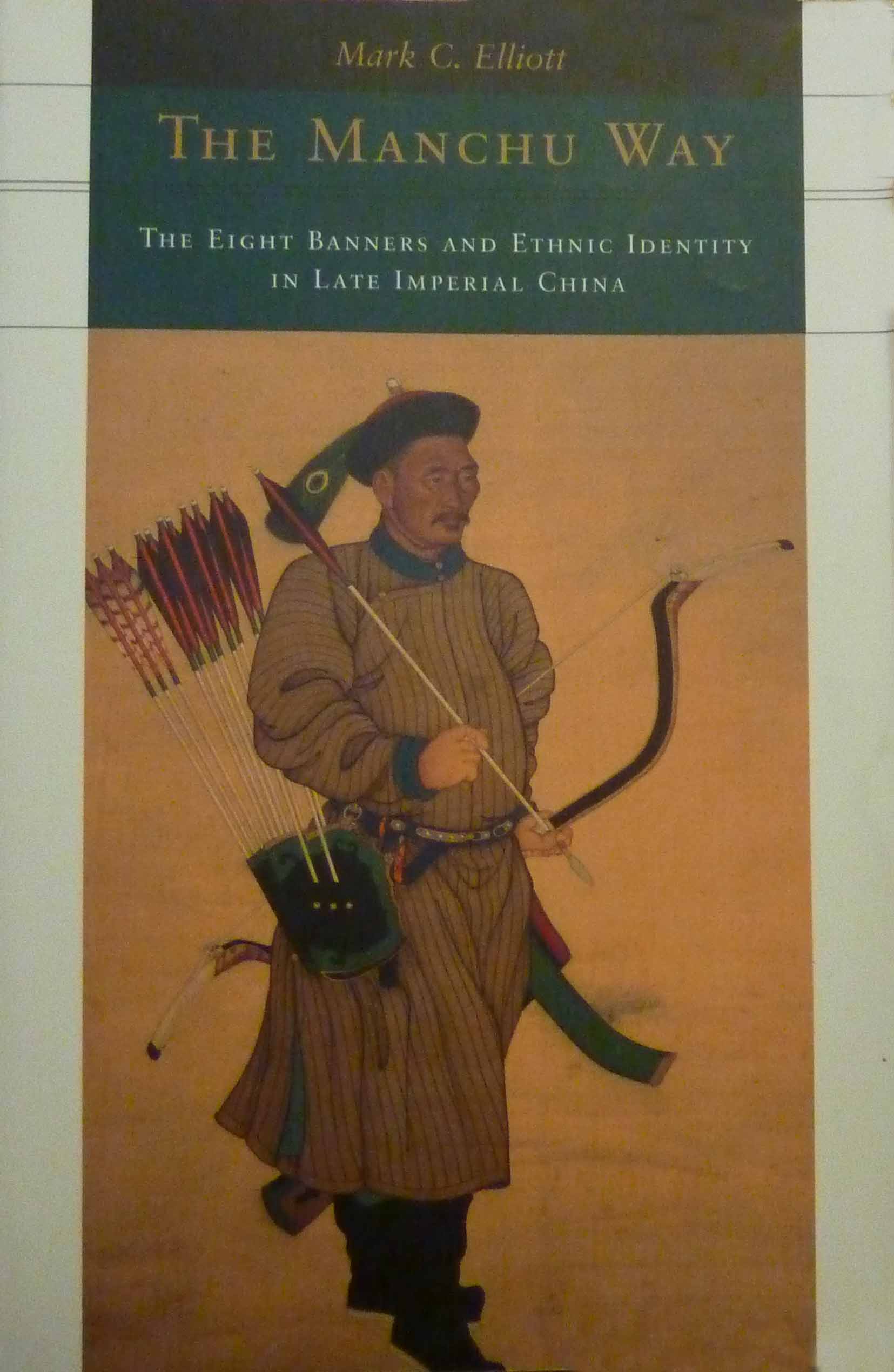
I have a book on the elite troops of China’s Qing Dynasty, and used The Manchu Way for research (along with lots of other work) while writing My Splendid Concubine and Our Hart. I spent from 1999 to late 2007 researching, writing, revising, editing and rewriting the manuscript.
I wanted 19th century China to come alive and be another character in Hart’s Concubine Saga.
Mark C. Elliott wrote The Manchu Way.I was attending a NCIBA Trade Show in Oakland, California several years ago and met Elliott.When I expressed interest in the book due to my project, he gave me a copy.
History Today said of Elliott’s book, “This is a wide-ranging and innovative book. Furthermore, it is written in a lively, accessible style… Overall, it is undoubtedly a scholarly achievement of the highest order.”
I was fortunate to have this resource while writing of Robert Hart’s early years in China. In fact, Hart was the only foreigner the emperor trusted and Hart worked for Qing Dynasty for most of his life.
The Qianlong emperor (pronounced “chien-lung”) was the fourth monarch of the Qing dynasty (1644-1911) who reigned from 1736 to 1795.
The four-minute video starts by saying that during the reign of the Qianlong Emperor there were several rebellions in Sichuan province.
The Qing banner armies fought wars against the Uyghurs, Kazakhs, Kyrgyzs, Evenks and Mongols. Unsuccessful costly wars were also fought with Vietnam and Myanmar.
Although millions of square miles or kilometers were brought into the empire, the strain on China’s treasury and military due to casualties and deaths resulted in a military decline.
This decline contributed to China’s weakness a few decades later when the British Empire and France invaded China to force the Qing Dynasty to allow opium to be sold to the Chinese people and give missionaries total freedom to convert the population to Christianity, which caused more wars and tens of millions of deaths during the 19th century.
The Qing army was divided into eight banners. Each banner had its own color scheme, which was reflected in their clothing, armor and flags. There were eight Manchu banners, eight Mongolian banners and eventually eight Han Chinese banner armies for twenty-four armies. In 1648, there were between 1.3 and 2.44 million people in the Chinese, Manchu and Mongol Banner armies.By 1720, the numbers were estimated at between 2.6 and 4.9 million.
China has a history of maintaining large armies for more than two thousand years mostly for defense.
Lloyd Lofthouse is the award-winning author of the concubine saga, My Splendid Concubine & Our Hart. When you love a Chinese woman, you marry her family and culture too.
If you want to subscribe to iLook China, there is a “Subscribe” button at the top of the screen in the menu bar.
I’ve mentioned the Taiping Rebellion often. After writing more than a thousand posts and about four hundred thousand words, it’s difficult to recall all that I’ve said of the man that started this rebellion.
There is irony in Hong Xiuquan’s choice of naming his kingdom. During the years his Christian rebellion thrived, he ruled over a third of China and had an army of more than two million troops.
Since he was a converted Christian, Hong Xiuquan made overtures to the British and French asking for an alliance to help defeat the Godless Qing (Manchu) Dynasty. The British and French turned him down.
After all, profits often come before God. Christians may always ask for forgiveness later.
Xiuquan made his mistake by wanting to rid China of opium, which British merchants along with French, Germans, Americans, etc. wanted to keep selling to the Chinese.
The embedded video is about Hong Xiuquan. Hal Holbrook is the narrator and says, “While the seventh day Sabbath doctrine was gaining ground in America in the middle of the 19th century, the Taiping Revolution was sweeping across China…”
Hong Xiuquan was the ambitious son of a poor, peasant farmer.
However, he had a goal to become successful. After failing the Chinese civil service examinations several times, he met a Chinese Christian convert passing out pamphlets published by Protestant missionaries.
Hong put the pamphlets on a shelf and forgot them. After failing several more civil service exams, Hong suffered a breakdown and had strange dreams of an old man.
Holbrook says, “Traditional Chinese would not attach any importance to dreams unless or until there was some clear connection to real life.” At first, Hong did not see a connection.
Jonathan Spence, the author of God’s Chinese Son, which is about the Taiping Heavenly Kingdom of Hong Xiuquan explains that eventually the connection was made between the dreams and the Protestant pamphlets. The old man in Hong’s dreams had to be God.
After that, Hong Xiuquan believed the purpose of his life was to establish the Taiping Heavenly Kingdom of Great Peace. His religious zeal spread among the suffering peasants and inspired the greatest revolutionary movement of the 19th century.
The Qing Dynasty successfully asked the British and French for help, which allowed the Manchu to crush Hong’s Christian rebellion in 1864. In 19 years of rebellion, more than 20 million died.
Learn more of The Opium Wars (1839 – 1852) and (1856-1860)
______________
Lloyd Lofthouse is the award-winning author of the concubine saga, My Splendid Concubine & Our Hart. When you love a Chinese woman, you marry her family and culture too.
If you want to subscribe to iLook China, there is a “Subscribe” button at the top of the screen in the menu bar.
One Chinese market sells 12 million flowers for Valentine’s Day.
In fact, Dounan Flower Market located in Yunnan’s provincial capital sells 12 million or more flowers every day and is the largest marketplace for cut flowers in China.
Due to increased sales for Valentine’s Day, Dounan Flower Market extended its trading hours 10 days ahead of the February 14 lover’s holiday. Source: Prokerala News
The real Chinese Valentine’s Day, not the one from America on February 14, is celebrated on the 7th day of the 7th lunar month in the Chinese calendar.
Sufei, the host of Sexy Beijing, hits the streets to discover Valentine’s Day in China and has fun doing it.
There is a love story about the seventh daughter of Emperor of Heaven and an orphaned cowherd.
When the couple fell in love, the emperor separated them.
The daughter was forced to move to the star called Vega and the cowherd to the star named Altair.
They are allowed to meet once a year on the 7th day of 7th lunar month. Talk about heartache.
China’s ancient Valentine Day is also called The Daughter’s Festival.
However, the foreign Valentine’s Day is gaining popularity among younger Chinese.
The China Dailyreported the “Desire for Valentine’s roses is pushing up prices.”
Liu Xu, who owns a florist shop in the capital, was quoted saying, “I think I can charge at least 15 yuan per rose on February 14. The better ones can cost up to 20 yuan each.”
Lloyd Lofthouse is the award-winning author of the concubine saga, My Splendid Concubine & Our Hart. When you love a Chinese woman, you marry her family and culture too.
If you want to subscribe to iLook China, there is a “Subscribe” button at the top of the screen in the menu bar.
Shakespeare’s drama Romeo and Juliet is often taught to ninth graders in US high schools. Other Shakespeare plays are studied at other grade levels and in college.
However, you may be surprised to discover Shakespeare is probably more popular in China since his work is taught in most Chinese universities, both in English and in Chinese and Shakespearean texts are easily available in China in both languages.
When Mao ruled China (1949 to 1976), Shakespeare was banned as was Aristotle and other Western philosophers. Mao died in 1976. That ban was lifted in 1978.
In fact, according to Zhaoxiang Cheng, the author of Teaching Shakespeare in China, “It is no exaggeration to say that every educated Chinese knows something about Shakespeare.”
However, when produced in China on stage, the plot may not stay true to the original Shakespeare.
Writing for the The People’s Republic of Shakespeare, Adventures in Chinese Research, Meammi says, “My interest in this topic started when I noticed that many of the Romeo and Juliets performed in China are either parodies or rewrites where one of the lovers survives in the end.
“China has their own pair of star-crossed lovers (The Peony Pavilion – 1598 AD), who tragically die for love and their plight is described in a much more mournful tone than Shakespeare’s version.
“Some Chinese theatre companies state in interviews that their audiences have too much sadness in their lives so Romeo just can’t die in the end of their performance.”
Lloyd Lofthouse is the award-winning author of the concubine saga, My Splendid Concubine & Our Hart. When you love a Chinese woman, you marry her family and culture too.
If you want to subscribe to iLook China, there is a “Subscribe” button at the top of the screen in the menu bar.
Koratsky’s book is a heavily researched, scholarly work that gathers what science has discovered since Darwin’s discoveries and fills in the gaps explaining why evolution has something to teach us if humanity is to survive.
The other choice is humanity going the way of the dinosaurs into extinction.
I started reading in early 2010 and took months to finish the 580 pages. The Flesch-Kincaid Readability level would probably show this book to be at a university graduate level leaving at last 90% of the population lost as to the importance of its message.
For months, it bothered me that so many in the United States do not have the literacy skills to understand an important work such as this (the average reader in the US reads at fifth grade level and millions are illiterate). This is certainly not a good foundation to learn how precarious life is if you do not understand how brutal the earth’s environment and evolution has been for billions of years.
As I finished reading Living With Evolutionor Dying Without It, I realized that it would only take a few key people in positions of power to understand the warnings offered by Koratsky and bring about the needed changes in one or more countries so humanity would survive somewhere on the planet when the next great challenge to life arises.
On page one, Koratsky starts 13.7 billion years ago with the big bang then in a few pages ten billion years later, he introduces the reader to how certain bacteria discovered a new way to access the energy required to sustain an existence.
By the time we reach humanity’s first religion on page 157, we have discovered what caused so many species to die out and gained a better understanding of what survival of the fittest means.
To survive means adapting to environmental challenges no matter if they are delivered by the impact of a monster asteroid to the earth’s surface, global warming (no matter what the reason) or by competition with other cultures or animals competing for the earth’s resources.
In fact, competition is vital to the survival of a species for it is only through competition that a species will adapt to survive.
The book is divided into two parts.The first 349 pages deals with where we have been and what we have learned, and the two hundred and eleven pages in Part Two deals with current ideas and policies from an evolutionary perspective.
I suspect that most devout Christians and Muslims would dismiss the warnings in this book out-of-hand since these people have invested their beliefs and the survival of humanity in books written millennia ago when humanity knew little to nothing about the laws of evolution and how important competition is to survival.
Koratsky is optimistic that the United States will eventually turn away from the political agenda of “Cultural Relativism” that has guided America since the 1960s toward total failure as a culture.
The popular term for “Cultural Relativism” in the US would be “Political Correctness”, which has spawned movements such as race-based quotas and entitlement programs that reward failure and punish success
Even America’s self-esteem movement is an example of “Cultural Relativism”, which encourages children to have fun and praises poor performance until it is impossible to recognize real success.
The current debate started by Amy Chua’s essay in The Wall Street Journal is another example of “Cultural Relativism” at work.
After reading Living with Evolution or Dying Without It, it is clear that Amy Chua’s Tiger Mother Methodsof parenting are correct while the soft approach practiced by the average US parent is wrong and will lead to more failure than success.
Koratsky shows us that the key to survival for America is to severely curtail and eventually end most US entitlement programs. While “Cultural Relativism” is ending, competition that rewards merit at all levels of the culture (private and government) must be reinstituted.
He points out near the end of the book that this has been happening in China and is the reason for that country’s amazing growth and success the last thirty years.
In the 1980s, merit was reinstituted at the bottom and most who prosper in China today earned the right to be rewarded for success by being more competitive and adapting. Even China’s state owned industries were required to become profitable or perish.
The earth’s environment does not care about equality or the relativists’ belief that everyone has a right to happiness even if society must rob from the rich and give to the poor.
This book covers the evolution of the universe, the planet, all life on the planet including the reasons why most life that lived on the earth for hundreds of millions of years before humanity is now gone; the beginnings of the human species; religion in all of its costumes; the growth of civilizations and the competitions that led to the destruction and collapse of so many such as the Roman Empire and the Han Dynasty two millennia ago.
The environment and evolution says that all life on the planet is not equal and no one is born with a guaranteed right to success, happiness and fun. To survive means earning the right through competition and adaption.
If you don’t believe Koratsky’s warning, go talk to the dinosaurs and ask them why they are gone.
______________
Lloyd Lofthouse is the award-winning author of the concubine saga, My Splendid Concubine & Our Hart. When you love a Chinese woman, you marry her family and culture too.
If you want to subscribe to iLook China, there is a “Subscribe” button at the top of the screen in the menu bar.