May 30, 2012

Tere Rodriguez's avatarDigital Cultures & Translation

Why does it seem to be so hard for the rest of the world to figure out this monolithic power-house that is China?

Authors Jianying Zha, Linda Jaivin and Paul French present an image of an evolving society that emerges from a defensive, stealthy, suffocating and almost blurry atmosphere to become a roaring consumer-driven semi-capitalist culture thanks in great part to “the blood and tears” of its working population.

The authors raise other pressing issues like the nearly unsustainable environmental degradation, the paranoia of a state that resorts to widespread censorship and the lack of trust among a wealth-hungry post-Tian’namen generation. And yet, they also paint a picture of a selfless China, dedicated to fight corruption and repression. A China where villagers invest great part of their time in developing effective and affordable methods of dispute resolution and improving education for their future generations. A China that sees journalists within the communist…

View original post 84 more words


“The Concubine Saga” Web Tour Schedule – June 2012

May 30, 2012

So Many Precious Books May 30 Review & Giveaway

Broken Teepee June 1 Review & Giveaway

My Little Pocketbooks June 30 Review

My Little Pocketbooks June 4 Interview & Giveaway

Bookish Dame June 6 Review

Bookish Dame G & GP June 6 Guest Post & Giveaway

J.A. Beard June 8 Interview

My Devotional Thoughts June 8 Review

My Devotional Thoughts June 9 Guest Post & Giveaway

Book Dilettante June 11 Review

Book Dilettante June 12 Guest Post

Joy Story June 12 Review

Books, Books, & More Books June 13 Review & Giveaway

Live to Read June 14 Review

Peeking Between the Pages June 14 Guest Post & Giveaway

Col Reads June 15 Review

Celtic Lady’s Reviews June 18 Review

Ink Spots & Roses June 18 Guest Post & Giveaway

The Readers Cafe June 19 Review

Knitting and Sundries June 20 Review & Giveaway

Sweeps 4 Bloggers June 21 Review & Giveaway

The Reading Life June 22 Review

The Reading Life June 21 Interview

Historical Fiction Connection June 22 Guest Post

Layered Pages June 25 Review

Layered Pages June 26 Interview
Historical Tapestry June 25 Guest Post

Peaceful Wishing June 26 Review

To Read or Not to Read June 27 Review

To Read or Not to Read June 28 Guest Post & Giveaway

M Denise C. June 28 Review

Succotash Reviews June 29 Review & Giveaway
Moonlight Gleam June 29 Guest Post & Giveaway

Jayne’s Books June 29 Review & Giveaway

___________________________________

PRESS RELEASE
FOR RELEASE before June 1, 2012
CONTACT:
Lloyd Lofthouse, author
lflwriter@gmail.com

IN THE 19th and EARLY 20th CENTURY, ROBERT HART WAS CRUCIAL TO THE SURVIVAL OF CHINA!

WALNUT CREEK, CA (3/2/12) — Robert Hart (1835 – 1911) was the ‘Godfather of China’s modernism’ and the only foreigner the emperor of China trusted. In fact, Hart played a crucial role in ending the bloodiest rebellion in history, and he owed this success largely to his live in dictionary and encyclopedia, his Chinese concubine Ayaou. In Dragon Lady, Sterling Seagrave wrote that Ayaou “was wise beyond her years”. In Entering China’s Service, Harvard scholars wrote, “Hart’s years of liaison with Ayaou gave him his fill of romance, including both its satisfaction and its limitations.”

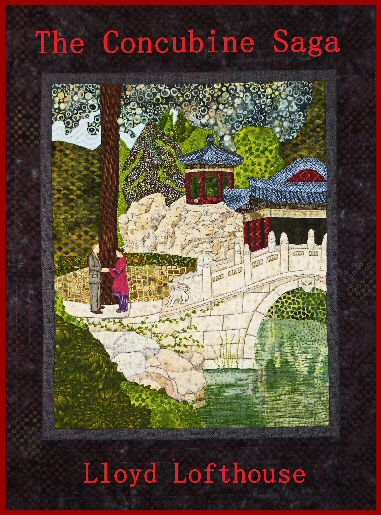
With sales in the thousands, award-winning author Lloyd Lofthouse brings My Splendid Concubine (2007) and the sequel, Our Hart, Elegy for a Concubine (2010) together in The Concubine Saga (2012).

My Splendid Concubine was the love story Sir Robert Hart did not want the world to discover.

In the sequel, Our Hart, Elegy for a Concubine, he was the only foreigner the Emperor of China trusted.

Soon after arriving in China in 1854, Robert Hart falls in love with Ayaou, but his feelings for her sister go against the teachings of his Christian upbringing and almost break him emotionally. To survive he must learn how to live and think like the Chinese and soon finds himself thrust into the Opium Wars and the Taiping Rebellion, the bloodiest rebellion in human history, where he makes enemies of men such as the American soldier of fortune known as the Devil Soldier.

My Splendid Concubine earned honorable mentions in general fiction at the 2008 London Book Festival, and in 2009 at the Hollywood Book Festival and San Francisco Book Festival.

Our Hart, Elegy for a Concubine earned honorable mentions in general fiction at the Los Angeles Book Festival, Nashville Book Festival, London Book Festival, DIY Book Festival and was a Finalist of the National Best Books 2010 Awards.

In addition, The Concubine Saga picked up an Honorable Mention in Fiction at the 2012 San Francisco Book Festival.

Lloyd Lofthouse served in the Vietnam War as a U.S. Marine and lives near San Francisco with his wife and family with a second home in Shanghai, China. As a former Marine, Lloyd earned a BA in Journalism and an MFA in writing. His Blog, iLook China.net, currently averages 600 views a day with more than 200,000 since its launch in January 2010. My Splendid Concubine.com, his Website, has had 72,000 visitors since December 2007. At Authors Den, his work has been viewed 336,000 times.

Virtual Author Book Tours.com arranged the June 2012 book tour of 27 book Blogs.

In addition, in 2008, following the launch of My Splendid Concubine, Lofthouse appeared as a China expert on more than 30 talk-radio shows from The Dr. Pat Show on KKNW 1150 AM in Seattle to The Smith and Riley Show on WFLF 540 AM in Orlando Florida.

The Concubine Saga
ISBN: 978-0-9819553-8-4

###


May 29, 2012

theimagemaker's avatarThe Image Maker

We arrived in Chengdu a few hours late – thanks for an epic flight delay from Shanghai. This was disappointing to say the least – Chengdu immediately struck a chord with us.

Its slower pace and colder climate made for a lovely atmosphere to explore the city, and as soon as our bags were set down at the Traffic Inn, we hit the streets. Using a rough tourist map as a guide, we managed to find the Wu Hou Ci Temple, dedicated to the great Zhuge Liang, a prominent military leader in the Three Kingdoms period. All of this of course found out after the fact – I must say my research for Chengdu was vastly under prepared, as I had seen it as a quick stopover to see the Pandas. Nevertheless – stepping into the temple immediately had it’s effect. Suddenly the noise from the street was cut off…

View original post 1,182 more words


Country Driving in China with Peter Hessler – Part 2/2

May 29, 2012

In the first 122 pages of Country Driving, Peter Hessler sets out to drive the entire length of the Great Wall in a rented Chinese made Jeep Cherokee and he achieves his goal. In this section, I learned that the Wall was successful most of the time and not the failure historians claim it was. Yes, in several thousand years, the wall failed a few times but it served its purpose and did protect China’s heartland for centuries. Hessler says that there is no archaeologist in the world that has studied the history of the Great Wall but wrote there are amateur experts (we meet a few in this section along with a unique view of rural China) that have proven through historical research that the wall did work.

In Part II, Hessler takes us into a small village a few hours drive outside Beijing where he rents a house and becomes accepted by the insular-rural village community making friends and becoming involved personally with local families. The man that becomes his closest contact and friend in the village eventually joins the CCP (there are only about 80 million members in China) and then uses this to his advantage as he continues to improve the quality of his family’s lifestyle.

In Part III, Hessler travels to the city of Winzhou in Southern China where he spends time developing relationships with factory bosses and workers.  In this section, the Chinese people he meets are open and friendly. Hessler sees a side of China that few witness and it is obvious that the factory workers are not victims because of low pay and long hours of work but see this new life as an opportunity.


Peter Hessler discussing his novel “Oracle Bones”

When I finished Hessler’s memoir, I walked away feeling as if I had experienced an in-depth taste of the dramatic changes that have taken place in China since Mao’s death in 1976. Since China’s critics mostly focus on the negative, which is the corruption and/or authoritarian one-party system, and never admit the good that the CCP has accomplished, most people would not understand what I discovered.  To understand what I mean, one must compare China before 1949 with today by reading such books as those written by Hessler and his wife.

Before 1949, more than 90% of the people in China lived in severe poverty, more than 80% were illiterate, the average lifespan was 35, few people owned land, and the risk of death from famine had been an annual threat for more than two thousand years. In fact, most rural Chinese were treated as if they were beasts of burden and not human.

Today, about 13% live in severe poverty and those people mostly live in remote, rugged, difficult to reach areas of China.  The lifespan is now about 73 years and Helen H. Wang writing for Forbes.com (February 2011) reported that China’s middle class is already larger than the entire population of the United States and is expected to reach 800 million in fifteen years (2026). In addition, no one has died of famine since 1959-1961.

I highly recommend Country Living for anyone that wants to learn more about today’s dramatically changing China from an unbiased perspective.

Return to Country Driving in China with Peter Hessler – Part 1

______________

Lloyd Lofthouse is the award-winning author of The Concubine Saga. When you love a Chinese woman, you marry her family and culture too. This is the love story Sir Robert Hart did not want the world to discover.

Subscribe to “iLook China”!
Sign up for an E-mail Subscription at the top of this page, or click on the “Following” tab in the WordPress toolbar at the top of the screen.

About iLook China


Country Driving in China with Peter Hessler – Part 1/2

May 28, 2012

Most books that I’ve read of China cover its history up to Mao’s death and after 1949, it is difficult to trust almost anything one reads in the West or in China, since most of this work is either biased and/or propagandized in the West or propaganda in China since the mass media is owned by the State.

However, I’m glad that I read Peter Hessler’s memoir of China, Country Driving. Rarely does Hessler intrude with his own Western bias (if there is one), which appears to make a slight appearance near the end. I suspect that his editor at Harper Collins suggested that he add it to the story, and he complied, because the few opinions he expresses near the conclusion of his memoir do not match the experiences that he shares with his readers in the rest of the book. In fact, while reading the book, I grew to trust Hessler’s perspective of today’s China.

It is obvious that Hessler honestly loves/respects China and its people and this infatuation runs throughout the memoir. He also carefully or unintentionally avoids mention of what he thinks about his own culture, which made me wonder if there is a lot he doesn’t respect about his homeland.

Maybe the reason why he continues to return to China is because of this infatuation with a culture that values family more than most Americans do.  In fact, in the memoir’s acknowledgements, I discovered that Hessler was married to Leslie T. Chang, which even my wife—a Chinese immigrant to the US, whose first book, a memoir of growing up during Mao’s Cultural Revolution, was a New York Times Notable Book of the Year—didn’t know.


Leslie Chang discussing her novel “Factory Girls”

Hessler’s wife is the author of Factory Girls, which is also about today’s China. Chang is Chinese-American and a graduate of Harvard. She is also an accomplished journalist and was raised outside New York City by immigrant parents, who forced her to attend Saturday-morning Chinese school, which is so Chinese.

For example, our daughter speaks Mandarin fluently and she was born in Chicago and is a product of the US public schools but with an immigrant mother and an American step father (me), which may explain (in part) why she is completing her second year at Stanford currently majoring in biology instead of trying out for American Idol while waiting tables in a Hollywood coffee shop.

Both Peter and Leslie have published work that went on to be honored as New York Times Notable Books.

Anyway, back to Country Driving. Much of Hessler’s memoir was connected to projects he wrote at The New Yorker or National Geographic. The memoir is divided into three sections:  Book I, The Wall; Book II, The Village, and Book III, The Factory.

Throughout the book there is a common theme: the independence and individuality of most Chinese and the failure of Chinese Communist Party (CCP) propaganda, which is there but often ignored by most of the people unless they can use the CCP to their own advantage.  That doesn’t mean the propaganda has no influence but the people seldom let it get in their way as they work to improve the quality of their lives.

In fact, it becomes clear in Hessler’s memoir that there are three Chinas: there is rural China, urban China and the Chinese Communist Party and many shades of gray among them.

Continued on May 29, 2012 in Country Driving in China with Peter Hessler – Part 2

______________

Lloyd Lofthouse is the award-winning author of The Concubine Saga. When you love a Chinese woman, you marry her family and culture too. This is the love story Sir Robert Hart did not want the world to discover.

Subscribe to “iLook China”!
Sign up for an E-mail Subscription at the top of this page, or click on the “Following” tab in the WordPress toolbar at the top of the screen.

About iLook China