Murphy’s Law says, “Anything that can go wrong, will go wrong.”
True, it happened to an advertisement of “My Splendid Concubine” scheduled to run Wednesday, September 25, 2013.
I’ll explain what happened later.
In this post, I want to share some examples of what I have done to promote my work—with results. Also more examples of Murphy’s Law.
“My Splendid Concubine” came out December 2007. But I started researching the main character—Sir Robert Hart—in 1999. The research; revisions and editing continued for more than a decade. Along the way, I researched China’s history and culture and made several trips to China with my wife and daughter. It also helped that my wife was born in China and is Anchee Min, the author of “Red Azalea”, a “New York Times Notable Book of the Year” (early 1990s) that also won the “Carl Sandburg Award”. My wife would go on to write…
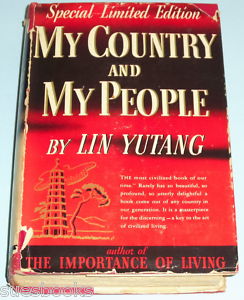
Lin Yutang (1895 – 1976) was a Chinese writer, translator, linguist and inventor. He was one of the most influential writers of his generation. In 1933, he met Pearl S. Buck in Shanghai and she introduced him, and his writings to her American publisher.
For most Chinese the end of life lies not in life after death, for the idea that we live in order to die, as taught by Christianity, is incomprehensible, nor in Nirvana, for that is too metaphysical, not in the satisfaction of accomplishment, for that is too vainglorious, nor yet in progress for progress’ sake, for that is meaningless.
The true end, the Chinese have decided in a singularly clear manner, lies in the enjoyment of a simple life, especially the family life, and in harmonious social relationships.
“The Chinese are a nation of individualists. They are family-minded, not social-minded…. It is curious that the word society does not exist as an idea in Chinese thought. In the Confucian social and political philosophy we see a direct transition from family, ‘chia’, to the state, ‘kuo’, as successive stages of human organization.…
Lin Yutang
“The Chinese, therefore, make rather poor Christian converts, and if they are to be converted they should all become Quakers, for that is the only sort of Christianity that the Chinese can understand. Christianity as a way of life can impress the Chinese, but Christian creeds and dogmas will be crushed, not by a superior Confucian logic but by ordinary Confucian common sense. Buddhism itself, when absorbed by the educated Chinese, became nothing but a system of mental hygiene, which is the essence of Sung philosophy.” Source: My Country and My People, Lin Yutang. Halcyon House, New York. 1938. Pgs 94; 101; 103; 172, and 108
Lloyd Lofthouse is the award-winning author of My Splendid Concubine [3rd edition]. When you love a Chinese woman, you marry her family and culture too. This is the love story Sir Robert Hart did not want the world to discover.
Subscribe to “iLook China”!
Sign up for an E-mail Subscription at the top of this page, or click on the “Following” tab in the WordPress toolbar at the top of the screen.
During National Library Week a few years ago, I attended the Golden Leaves event at Cal Poly Pomona’s University Library. Afterwards, I joined a conversation about China, and one American citizen who had never been to China mentioned the corruption in China and how flawed their legal system was. He was adamant that China had to change and become more democratic. He also said there were a lot of angry people in China who wanted change—how did he know that?
However, there are two sides to every story, and “While the true extent and cost of white-collar crime (in the United States) are unknown, it is estimated to cost the United States more than $300 billion annually, according to the FBI.”
The Wall Street Journal reported that the Wall Street corruption and greed in America that caused the 2007/08 global financial crises may have led to global losses of at least $15 Trillion.
In addition, a United Nations report says that by the end of 2009, the global increase in jobless persons was 27 million more than in 2007 before the financial crises hit—should we say, “Thank you, America?”
What about China?
The Economist’s View says, “For one thing, the Chinese trust their government more. According to a recent World Values Survey, 96.7 percent of Chinese expressed confidence in their government, compared to only 37.3 percent of Americans.
“Likewise, 83.5 percent of Chinese thought their country is run for all the people, rather than for a few big interest groups, whereas only 36.7 percent of Americans thought the same of their country. With this relatively higher trust, China’s government and enterprises are better able to enact and implement strict policies that promote saving and growth.”
I wonder if all the greed and corruption in China will ever threaten the global economy and cost millions of people jobs.
And what about corruption in India, the democracy next door to China? We seldom if ever hear anyone criticizing India for corruption. However, Transparency International’s Corruption Perceptions Indexranks India as more corrupt than China. In fact, there are 108 countries of 183 listed as more corrupt than China.
Why does the Western media focus so much attention on China when it comes to the topic of corruption while mostly ignoring the 108 countries worse than China? I mean, even Thailand—a staunch US ally—is more corrupt than China, and Mexico is worse than Thailand and India!
Lloyd Lofthouse is the award-winning author of My Splendid Concubine [3rd edition]. When you love a Chinese woman, you marry her family and culture too. This is the love story Sir Robert Hart did not want the world to discover.
Subscribe to “iLook China”!
Sign up for an E-mail Subscription at the top of this page, or click on the “Following” tab in the WordPress toolbar at the top of the screen.
China is making HUGE investments in education. In 1998, then-President Jiang Zemin called for a massive increase in enrollment in higher education. Since then, high school and college enrollments in China grew. Source: FP-Foreign Policy, April 14, 2010
For example: China’s enlarged enrollment to higher education started in 1999, which boasted China’s shift in higher education from elite higher education to mass higher education. The enrollment to colleges/universities increased by 42 percent, compared to the year of 1998. Source: All Academic.com
Then in March 2013, Premier Wen Jiabao announced that China’s expenditures on education had reached 4% of GDP in 2012, a goal set almost twenty years earlier. “Government spending on education totaled 7.79 trillion yuan over the past five years, increasing at an average annual rate of 21.58 percent to reach 4 percent of the GDP in 2012,” Wen said in his annual work report delivered to deputies to the top legislature. (7.79 trillion yuan is equal to $1.25 trillion). Source: China Daily
For example, during the 1967-1985 period, total government expenditure on education averaged 2% of GNP, and 7.7% of the total national budget. Source: Columbia.edu
One result: The overall literacy rate has gone from 20% in 1950 to 92.2% of the total population today.
Compared to China, in the United States, education spending peaked in 1976 at 5.9% of GDP before dropping to flat line at about 5.5% annually.
In China, more than thirty percent graduate with degrees in engineering or technology. But in the United States, only five percent of university students graduate in these fields, while U.S. universities produce more psychologists.
That is why President Obama has encouraged American students to study science. Source: White House
What’s going to happen if America’s students do not start working hard to become engineers and scientists?
In 2040, the Chinese economy will reach $123 trillion, or nearly three times the economic output of the entire globe in 2000. It’s a fact that people with an education in engineering and science earn more and are more productive. China and India combined are turning out more than 600,000 engineers a year—ten times that of the United States. Source: Rocketry Planet
Lloyd Lofthouse is the award-winning author of My Splendid Concubine [3rd edition]. When you love a Chinese woman, you marry her family and culture too. This is the love story Sir Robert Hart did not want the world to discover.
Subscribe to “iLook China”!
Sign up for an E-mail Subscription at the top of this page, or click on the “Following” tab in the WordPress toolbar at the top of the screen.
Have the Tea Baggers in the United States been learning from China, or is it the other way around?
“Another strategy is manipulation. In recent years, local and provincial officials have hired armies of low-paid commentators to monitor blogs and chat rooms for sensitive issues, then spin online comment in the government’s (China’s) favor.
“Mr. Xiao of Berkeley cites one example: Jiaozuo, a city southwest of Beijing, deployed 35 Internet commentators and 120 police officers to defuse online attacks on the local police after a traffic dispute. By flooding chat rooms with pro-police comments, the team turned the tone of online comment from negative to positive in just 20 minutes.” Source:New York Times
Isn’t this what Fox Network’sGlenn Beck, thenRush Limbaugh—who is heard on more than 600 radio stations—have been doing for years. Filling the airwaves with their opinions controlling what people hear and think. The AmericanTea Baggersare doing the same thing with the same results—behavior control.
For an example of how the media twists facts to influence public opinion one only need look closer at the George Zimmerman-Trayvon Martin incident. What does the public really know about these two individuals?
Is America really that different from China and is there anyone we can believe?
Lloyd Lofthouse is the award-winning author of My Splendid Concubine [3rd edition]. When you love a Chinese woman, you marry her family and culture too. This is the love story Sir Robert Hart did not want the world to discover.
Subscribe to “iLook China”!
Sign up for an E-mail Subscription at the top of this page, or click on the “Following” tab in the WordPress toolbar at the top of the screen.


 Posted by Lloyd Lofthouse