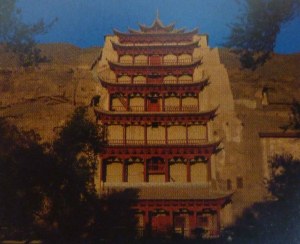
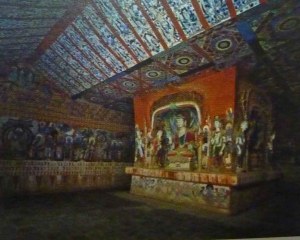
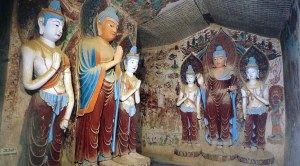
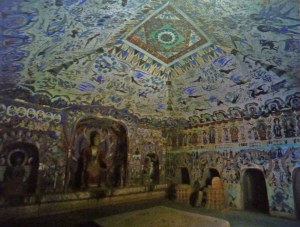
The June 2010 issue of National Geographic had a piece about the history of the Mogao caves near Dunhuang, a Silk Road oasis in northwestern China.
The Buddhist art found in almost 800 hand carved caves are considered among the world’s finest. There is nearly a half-million square feet of wall space decorated with these murals and more than 2,000 sculptures.
Between the fourth and 14th centuries AD—over a thousand years of history was documented on scrolls, sculptures and wall paintings revealing a multicultural world more vibrant than anyone imagined.
Contrary to popular belief and the Dalai Lama’s soft-spoken words of peace, Buddhism, like all large religious movements, has had a bloody and violent history depicted in the picture on page 145 of the National Geographic that shows an eighth-century heavenly armored guard with bulging eyes trampling a foreign demon.
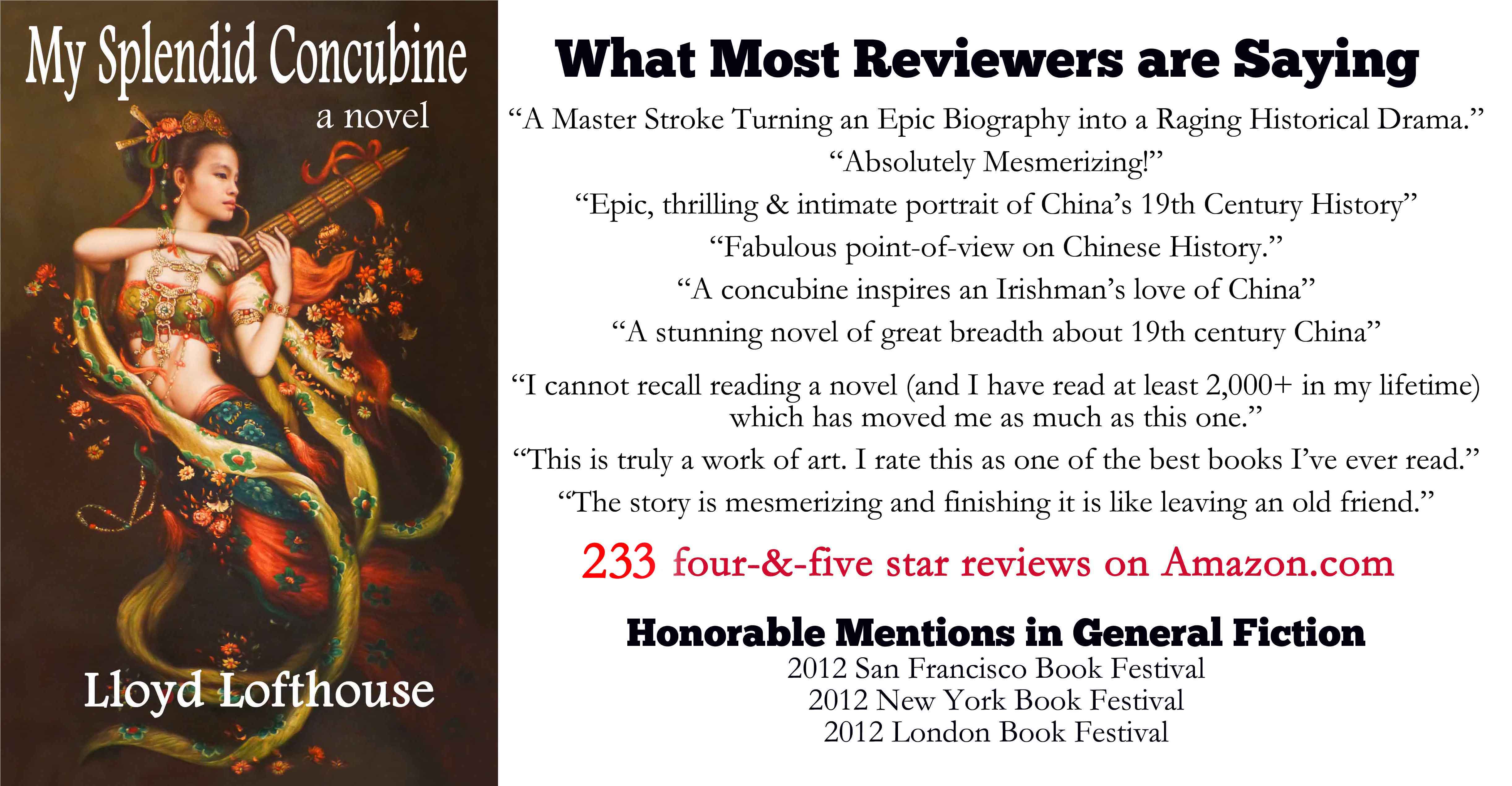
Lloyd Lofthouse is the award-winning author of My Splendid Concubine [3rd edition]. When you love a Chinese woman, you marry her family and culture too. This is the unique love story Sir Robert Hart did not want the world to discover.
Subscribe to “iLook China”!
Sign up for an E-mail Subscription at the top of this page, or click on the “Following” tab in the WordPress toolbar at the top of the screen.
Mao was fifty-six when he became China’s leader and seventy-two at the beginning of the Cultural Revolution. But who was Mao for the other fifty-five years before he ruled China?
Many outside of China only think of Mao Zedong (1893 – 1976) as a brutal dictator, but he was more than that.
For instance, as a child, his father was a stern disciplinarian who beat him and his three siblings often, and Mao became an avid reader.
And while commanding the Red Army during The Long March (1934-1935), he was a man respected by China’s peasants. Then there was Mao’s move away from Communist Russia after Nixon’s visit to China in 1972, when Mao said to Nixon, “Our common old friend, Generalissimo Chiang Kai-shek, doesn’t approve of this.”
In 1935, Mao’s poem, “The Long March”, reveals an awareness of the sacrifice and the willingness to suffer to accomplish great things.
The Red Army fears not the trials of the March,
Holding light ten thousand crags and torrents.
The Five Ridges wind like gentle ripples
And the majestic Wumeng roll by, globules of clay.
Warm the steep cliffs lapped by the waters of Golden Sand,
Cold the iron chains spanning the Tatu River.
Minshan’s thousand li of snow joyously crossed,
The three Armies march on, each face glowing.
Mao was a complex man, and it wasn’t until after the failure of the The Great Leap Forward (1958 – 1961) that the fatal attraction and power of leadership corrupted him leading to the horrors of The Cultural Revolution (1966 – 1976), that Mao’s many critics outside of China use to define him.
Anyone who follows all of Mao’s life instead of relying on his last decade would understand that he cared deeply about the common people while punishing the landowners and wealthy, who abused the people he cared about. On the other hand, his foe, Chiang Kai-shek, supported the landowners and wealthy while crushing the peasants and workers, but few outside of China condemn this brutal dictator who was a U.S. ally.
Mao Zedong Poems reveals what Mao might have been thinking about as President Johnson increased America’s involvement in Vietnam. Was Mao also warning us of what he was about to do in 1966, when he launched The Cultural Revolution?
Two Birds: A Dialogue (1965)
The roc wings fanwise,
Soaring ninety thousand li
And rousing a raging cyclone.
The blue sky on his back, he looks down
To survey Man’s world with its towns and cities.
Gunfire licks the heavens,
Shells pit the earth.
A sparrow in his bush is scared stiff..
“This is one hell of a mess!
O I want to flit and fly away.”
“Where, may I ask?”
The sparrow replies,
“To a jewelled palace in elfland’s hills.
Don’t you know a triple pact was signed
Under the bright autumn moon two years ago?
There’ll be plenty to eat,
Potatoes piping hot,
Beef-filled goulash.”
“Stop your windy nonsense!
Look, the world is being turned upside down.”
Through Mao’s poetry, we learn more about the man beyond the demonized stereotype created in the media outside of China.
And Do the Chinese People Currently Consider Mao Zedong to Be Evil or a Hero. In Forbes, Kaiser Kuo writes, “If I were forced to say there’s a dominant view of Mao among mainlanders, it would be that Mao was ‘good’ up until the very early 1950s — before the Anti-Rightist Campaign got into full swing, and before he set China on a course toward collectivization. Whether or not these beliefs can be supported by fact, it’s widely believed among Chinese that Mao led the Communist Party and its Red Army in effective resistance against the Japanese invaders; that they represented a morally superior vision over that offered by the Guomindang (the Nationalist Party) — a vision that championed egalitarianism, feminism, anti-imperialism, anti-feudalism, nationalism; and that they allowed China to ‘stand up’ after a century of abject humiliation beginning with the Opium War. After 1949, land redistribution and the Marriage Law (which was, by any measure, a very progressive piece of legislation) won them plaudits too.”
Lloyd Lofthouse is the award-winning author of My Splendid Concubine [3rd edition]. When you love a Chinese woman, you marry her family and culture too. This is the unique love story Sir Robert Hart did not want the world to discover.
Subscribe to “iLook China”!
Sign up for an E-mail Subscription at the top of this page, or click on the “Following” tab in the WordPress toolbar at the top of the screen.


 Posted by Lloyd Lofthouse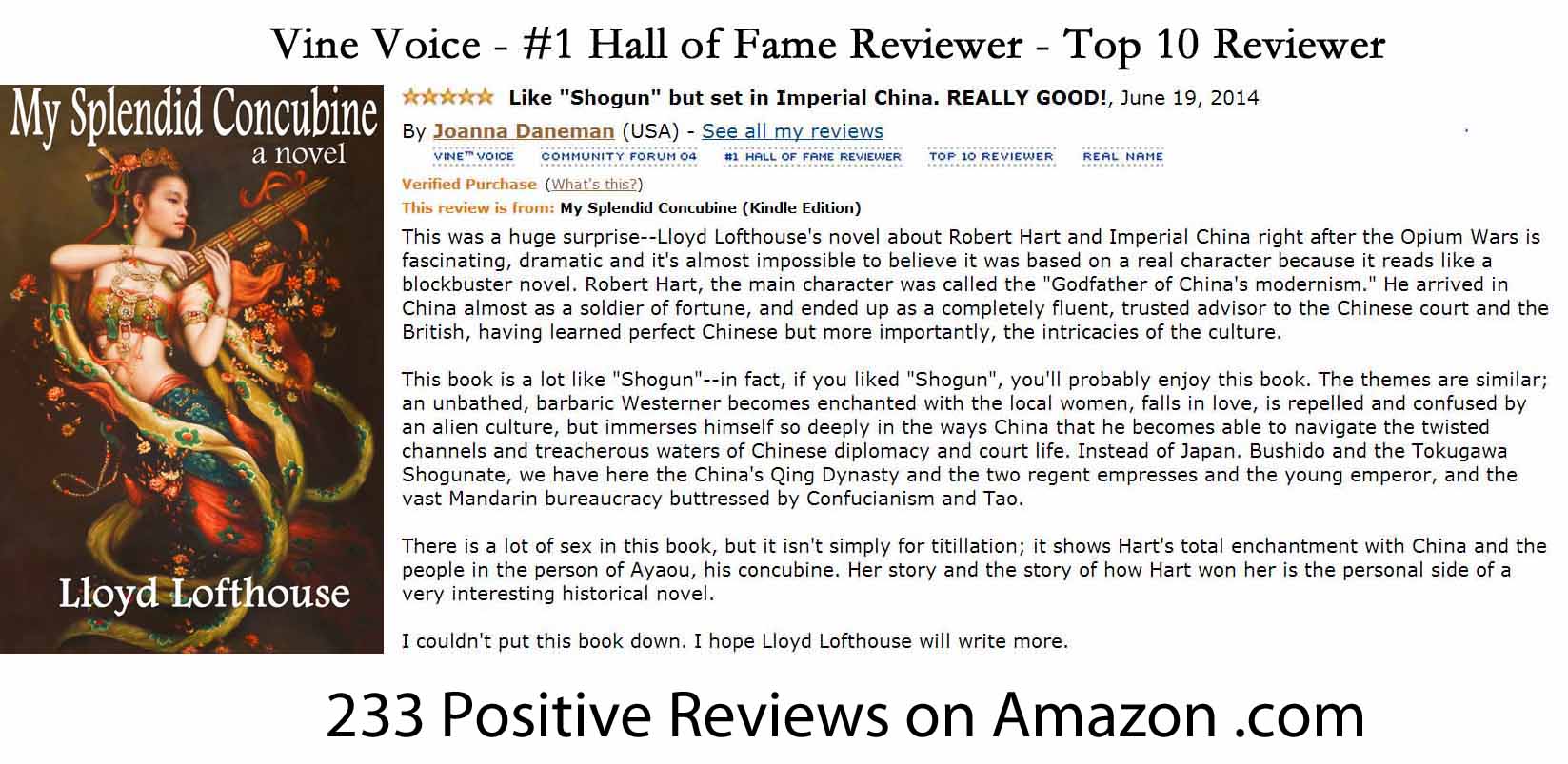
 iLook China