Meet the Winemaker from Shanxi Province

February 11, 2012

In August 2010, the China Daily reported, “The number of private enterprises reached 7.5 million, accounting for half of China’s gross domestic product, 70 percent of the nation’s technical innovations and 60 percent of its patents.” In addition, “China’s top 500 private companies have surpassed State-owned enterprises in many indicators, especially tax payments and employment creation, according to a report from the All-China Federation of Industry and Commerce.”

In fact, Bloomberg.com says, “Many of the world’s richest self-made women are Chinese,” and Psychology Today.com tells us, “Women own more than 40% of private businesses in China.”

Meet one of those women. Judy Leissner was 24 when she became the CEO and President of 168-acre Grace Vineyard in Shanxi province, south of Beijing after she quit her job at Goldman Sachs.

The first grape-vine plantings were in 1997 and the first vintage in 2001. Judy started the winery because her father liked to drink. Today, Judy produces a quality wine—about 700,000 bottles annually.

Most people do not know that quality wine is produced in China. In fact, Judy has competition since there are about 400 wineries in China.

Judy says there is an opportunity in China to make a lot of money in a short period of time, because the country is developing and growing.

The difference between the wine market in China and the rest of the world is that most drinkers in China must drink because they have to. It’s part of the culture of doing business and developing guanxi.

In an update, Grape Wall of China.com visited Grace Vineyard in September 2011, and Jim Boyce says he visited Grace CEO Judy Leisser. He says, “About a week ago, she sent an email that the wines Grace bottled under screw cap earlier this year are doing fine and, if all goes well with final trials, the winery will switch closures this year for its entry level and premium level wines. Grace’s Premium Chardonnay ranks among the better Chinese wines and is found in top hotels and restaurants in Beijing and Shanghai.”

In addition, in an interview at 24×75.com with Judy Leissner October 17, 2011, she was asked how different the work environment for Grace Vineyard was compared to Goldman Sachs where she worked prior to becoming CEO of the vineyard in Shanxi Province. She said, “Goldman Sachs is a fast-pace, can-do, efficient place.” However, for the winery, she said, “The whole atmosphere was rather sleepy.”

In another question, Judy was asked about social responsibility and what those two words mean.  She responded with, “We guarantee our growers basic income… Grace is a perfect example of an environmentally friendly and sustainable business. We provide many jobs for people from nearby villages.”

______________

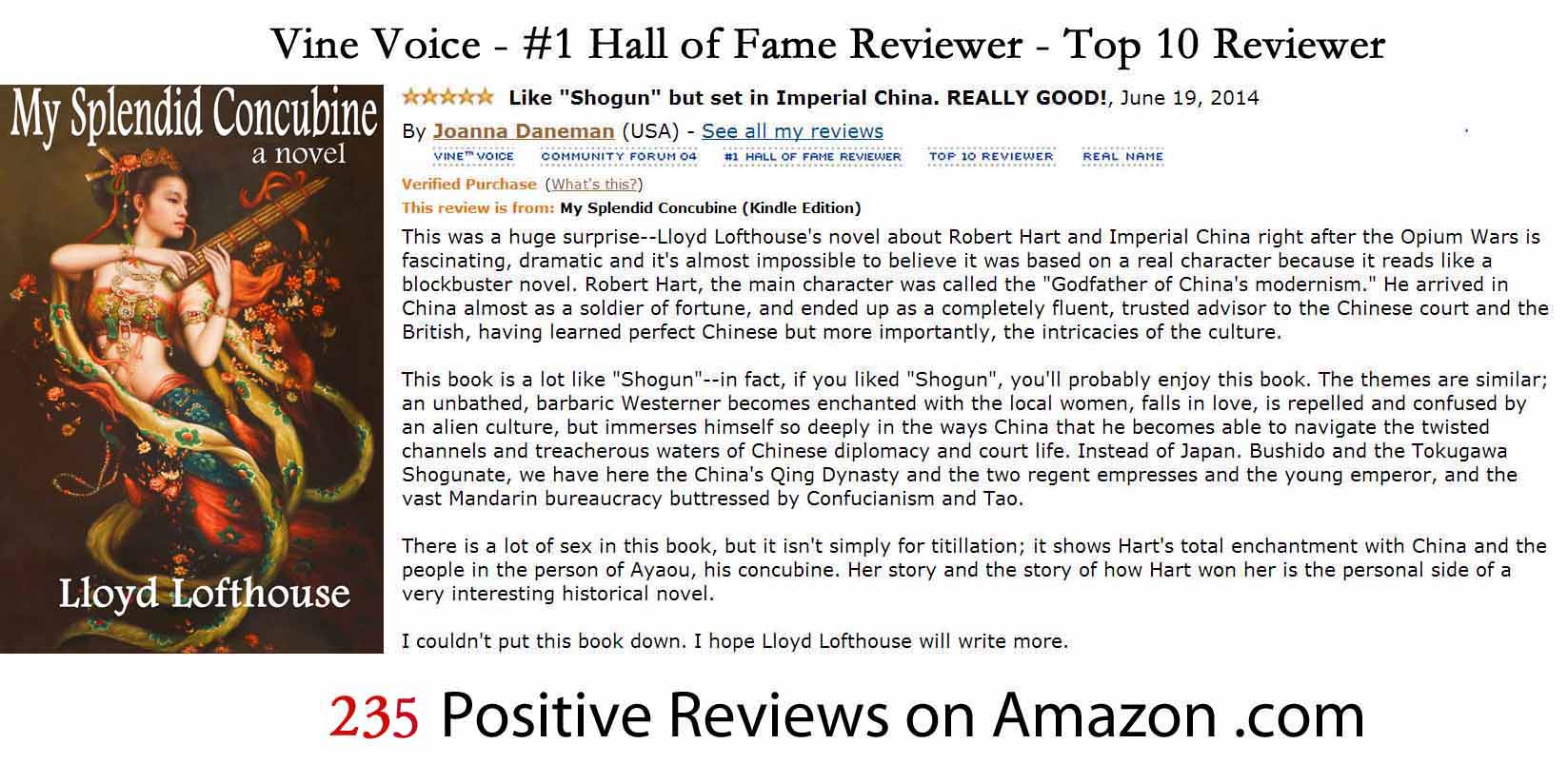
Lloyd Lofthouse is the award-winning author of The Concubine Saga. When you love a Chinese woman, you marry her family and culture too. This is the love story Sir Robert Hart did not want the world to discover.

Subscribe to “iLook China”
Sign up for an E-mail Subscription at the top of this page.

Note: This updated and revised post first appeared on November 08, 2010


Anna May Wong – the Woman that Died a Thousand Times

February 10, 2012

Almost half a century after her death, Anna May Wong (1905 to 1961) has not been forgotten.

As a child, Anna loved going to the movies and even cut school to go.

Between 1919 and 1961, she acted in 62 films. The Internet Movie Data Base says she was the “first Chinese-American movie star”.

To act, Anna had to play the roles she was given. The Western stereotype cast her as a sneaky, untrustworthy woman that always fell for a Caucasian man. The dark side of achieving her dream of acting in movies was that Anna had to die so the characters she played got what they deserved.

Anna often joked that her tombstone should read, “Here lies the woman who died a thousand times.”

Until Chinese started to emigrate to the U.S. in the mid-19th century, they had never encountered a people who considered them racially and culturally inferior.

However, the discrimination against the Chinese in America was only exceeded by the racism and hatred directed at African-Americans.

In fact, in the 1960s, many of the anti racist laws enacted during the Civil Rights era focused on protecting African-Americans, which created a protected class, and since the Chinese—due to cultural differences often did not complain—they were left behind.

In many respects, this racism toward the Chinese still exists in the US today and manifests itself through the media as China bashing, which supports the old stereotype.

When Anna May Wong visited China in 1936, she had to abandon the trip to her parent’s ancestral village when a mob accused her of disgracing China.

After her return to Hollywood, she was determined to play Chinese characters that were not stereotypes, but it was a losing battle. To escape the hateful racism, she lived in Europe for a few years.

Since U.S. law did not allow her to marry the Caucasian man she loved, and she was afraid that if she married a Chinese man he would force her to give up acting since Chinese culture judged actresses to be the same as prostitutes, she never married.

Anna May Wong smoked and drank too much. She died of a heart attack in Santa Monica, California at age 56.

Lloyd Lofthouse is the award-winning author of My Splendid Concubine [3rd edition]. When you love a Chinese woman, you marry her family and culture too. This is the unique love story Sir Robert Hart did not want the world to discover.

1-joanna-daneman-review-updated-sept-21-2016_edited-3

Where to Buy

Subscribe to “iLook China”!
Sign up for an E-mail Subscription at the top of this page, or click on the “Following” tab in the WordPress toolbar at the top of the screen.

About iLook China

China’s Holistic Historical Timeline


Party Women

February 9, 2012

Starting with the I Ching, The Book of Changes, almost five thousand years ago, the central focus of Chinese philosophy was how to live an ideal life and how best to organize society.

When the Chinese Communist Party gained power in 1949, previous schools of Chinese philosophy, except Legalism, were denounced as backward and purged during the Great Leap Forward and the Cultural Revolution.

However, the influence of China’s five-thousand year old culture did not vanish as China’s Central Committee continues to plan and modernize while leading China into the future.

Most Chinese believe that true advancement and growth should only happen slowly, at a steady, measured pace, which means to grow but grow slow like a tree while following a well thought out plan to bring about changes.

Even the United States doesn’t change quickly.

In fact, it took almost ninety years to free the slaves, and women first sought the right to vote in 1848 at the Seneca Falls Woman’s Rights Convention.

Then seventy-two years later in 1920, American women finally earned the right to vote when the Nineteenth Amendment was adopted by Congress and was ratified by the states becoming a national law.

The last time women had relative freedom in China was in the seventh century during the Tang Dynasty when Emperor Wu Zetian, a woman, ruled the country.

Since 1982, when China ratified its Constitution, women in China have gained more freedom, power and rights than at any time in China’s history including the Tang Dynasty.

Critics in the West might point out that under the Communists, no woman has ruled China, but we could say the same of the United States and many other countries.

Today, Liu Yandong, a senior Party official, serves on China’s Politburo [a group of 24 people that oversees the CCP]. She is from Nantong in Jiangsu Province and graduated from Tsinghua University in 1970 with a degree in chemistry.

In fact, Chinese women today account for 40% of government officials. At least 21.3% of National People’s Congress delegates in 2008 were women (about 636 — the latest available data, according to the All China Women’s Federation).

Another example is Li Bin, acting governor of Anhui Province. In addition, 87.1% of China’s provincial regions have female vice governors. Women are also represented in the leadership of 89.4% of the country’s municipal governments. Source: Global Times

For comparison, in the United States, 79 women (of 435 representatives or 18%) serve in the House and 17 [of 100 or 17%] in the Senate. In addition, six women serve as governors [that’s 12% of the total].

Then, ipu.org’s “Women in national parliaments” ranks China 52 [tied with Italy] of 188 countries. The United States is ranked 71, Thailand 75, South Korea 81, Japan 96 and India 99.

“Chinese women leaders have much in common. They generally all have a good education background, being mainly science majors, and solid experience in government. They are of a caliber equal to that of their male counterparts,” an All-China Women’s Federation expert said.

Why do so many of China’s critics expect China to change faster than the US did?

______________

Lloyd Lofthouse is the award-winning author of The Concubine Saga. When you love a Chinese woman, you marry her family and culture too. This is the love story Sir Robert Hart did not want the world to discover.

Subscribe to “iLook China”
Sign up for an E-mail Subscription at the top of this page.

About iLook China

Note: This updated and revised post first appeared November 11, 2010


Women’s Rights in China

February 8, 2012

Dramatic changes in women’s rights have been achieved in a culture where for millennia women were stereotyped as inferior to men, had no rights and served as slaves, concubines and prostitutes. Marriages were arranged—sometimes at infancy.

In 1949, foot binding was abolished; the All-China Women’s Federation (ACWF) was formed and supported by China’s Communist Party (CCP). Change in China, as in the United States, has been a painful evolutionary process. However, the struggle for women to gain equality appears to have moved faster in China since the CCP came to power.

After the CCP was established in 1949, it took less than a year to liberate women and pass laws to speed this process along.

For a comparison, after the United States was established in 1776, it took one hundred and forty-four years until August 26, 1920 when the Congress voted in the 19th Amendment to the US Constitution giving women the right to vote.

At the 10th National Women’s Congress in the Great Hall of the People in Beijing, in 2008, Deputy-Chairwoman HuangQingyi said, “Sex discrimination in employment should be eradicated and the income gap between men and women should be further narrowed.”

It was also been reported that domestic violence is a severe threat to women. Chinese authorities reported 50,000 complaints annually, according to figures released by the ACWF. The domestic violence fact sheet shows this is also a problem in the United States.


Role of Women in China Then and Now

Sexual discrimination was supposed to have been abolished in China back in 1949, when Chairman Mao Zedong famously announced, “women hold up half the sky”, but it wasn’t. It has only been a few years since China outlawed sexual harassment. Laws may be written to bring about change but change comes slowly.

Today, statistics show China has about 27,000 women and children’s rights protection agencies. However, China’s critics and enemies will only point out what they believe is wrong without giving credit to what has changed for the good of women in China.

______________

Lloyd Lofthouse is the award-winning author of The Concubine Saga. When you love a Chinese woman, you marry her family and culture too. This is the love story Sir Robert Hart did not want the world to discover.

Subscribe to “iLook China”
Sign up for an E-mail Subscription at the top of this page.

Note: This revised and edited post first appeared on March 21, 2010


China’s Bound-Feet Women

February 7, 2012

According to historical accounts, foot binding appeared in China during the Sung Dynasty (960-1276 AD).

The process of foot binding usually started between the ages of four and seven. Feet were soaked in a blood and herb mixture. Toes were broken. Then the arch was broken. There was extreme pain since no pain relief was used. It is estimated that in a thousand years about two billion women went through the process.


What would you do for beauty?

The Manchu leaders of the Qing Dynasty (1644 to 1911) tried with little success to stop foot binding, and Manchu women did not bind their feet. Mostly Han (the majority in China) women continued the practice.

In 1928, the Nationalist government announced plans to do away with foot binding. This attempt to end foot binding met with mixed success. In rural areas, large feet were still considered unattractive and unacceptable and the practice continued.

While working in China for National Geographic on a three part Marco Polo series, Michael Yamashita, a veteran photographer, went in search of women who had bound feet. He found them living in remote urban villages.

Even in 19th century San Francisco, there were Chinese girls and women with bound feet. Source: Virtual Museum of the City of San Francisco

In most of China, social and sexual customs resist rapid change. For millions of women, the practice would continue until 1949 when the Communists came into power.

Then the popularity of foot binding to enhance a woman’s beauty ended.

______________

Lloyd Lofthouse is the award-winning author of The Concubine Saga. When you love a Chinese woman, you marry her family and culture too. This is the love story Sir Robert Hart did not want the world to discover.

Subscribe to “iLook China”
Sign up for an E-mail Subscription at the top of this page.

About iLook China

Note: This post first appeared November 7, 2010.