Keeping China’s People Working

May 30, 2010

Marginal Revolution (MR) posted his or her “China fact of the day” and just about everyone who left a comment got it wrong—as usual.

“Of the 22 Chinese corporations listed on the Fortune Global 500, 21 are controlled by China’s central government or state-run banks.” Source of quote: New York Times

I read the The New York Times piece that was quoted by MR and the gist was that China is going through something similar to what Japan did for the four decades after World War II, and that China cannot depend on manufacturing and exporting goods to the rest of the world to maintain a healthy economy indefinitely.  China “needs” to grow a domestic economy that supports itself and that is what the Chinese are trying to do. If they get it wrong, they will pay a steep price.

The first comment to MR’s “China fact of the day” said, “So much for the triumph of capitalism.”

True, so much for capitalism. After all, it was the Republican, Reagan, Bush, Wild West, capitalist system in the US that caused China to start pumping money back into state-run businesses.

Creating Jobs for China's People

In April 2009, Time did a good job explaining why China’s state owned companies are making a comeback.  When the world’s conomy burst and deflated in 2008 thanks to Wall Street greed, exports from China fell by almost 20% and an estimated 300,000 small and medium-sized private sector companies in China collapsed. “The Crisis hits China’s private sector really hard because China’s private sector accounts for a larger share of China’s manufactured exports, says Yasheng Huang, an MIT professor.

What did China do?  China started to put the people who had lost their jobs in the private sector to work in State Run Companies.  Duh! All anyone has to do is see what happened in the United States during the Great Depression when Herbert Hoover was president to understand why China is acting this way to keep people working and earning money.

See Jobless in America and Angry at China

____________________________

Lloyd Lofthouse is the author of the award winning novels My Splendid Concubine and Our Hart. He also Blogs at The Soulful Veteran and Crazy Normal.

Sign up for an RSS Feed for iLook China


God, Ancient Astronauts and China’s Yellow Emperor

May 29, 2010

“And Moses brought forth the people out of the camp to meet with God; and they stood at the nether part of the mount. And Mount Sinai was altogether on a smoke, because the Lord descended upon it in fire: and the smoke thereof ascended as the smoke of a furnace, and the whole mount quaked greatly.”  Exodus 19:17, 18

No one knows for certain where the Yellow Emperor came from.… He was known as the Yellow Emperor in honor for his contributions to agriculture and the Chinese calendar. In addition to farming, his wife, Lei Zu, is credited for developing the idea of growing silkworms and creating silk.  The Yellow Emperor is also noted as the creator of Chinese medicine, and the origins of Taoism and Confucianism trace their roots back to this mythical Emperor, who may have lived 4000 years ago.

Then one day, a yellow dragon descended from the sky to take the Yellow Emperor back to heaven…. Myth says, he ruled for a hundred years before leaving.  Source: The Yellow Emperor

Is the Old Testament’s description in Exodus a space ship descending to Mount Sinai, and is the Yellow Emperor returning to heaven a myth or reality? In addition, consider that the Biblical Adam and the Yellow Emperor were both on the earth about 4,000 years ago.

Discover ShangDi – China’s God of Creation

_______________

Lloyd Lofthouse is the award-winning author of My Splendid Concubine [3rd edition]. When you love a Chinese woman, you marry her family and culture too. This is the love story Sir Robert Hart did not want the world to discover.

His third book is Crazy is Normal, a classroom exposé, a memoir. “Lofthouse presents us with grungy classrooms, kids who don’t want to be in school, and the consequences of growing up in a hardscrabble world. While some parents support his efforts, many sabotage them—and isolated administrators make the work of Lofthouse and his peers even more difficult.” – Bruce Reeves.

lloydlofthouse_crazyisnormal_web2_5

Subscribe to “iLook China”!
Sign up for an E-mail Subscription at the top of this page, or click on the “Following” tab in the WordPress toolbar at the top of the screen.

About iLook China

China’s Holistic Historical Timeline


The Xia — China’s Oldest Known Dynasty

May 29, 2010

At one time, the Xia Dynasty (2205 – 1783 BC) was a myth as the Yellow Emperor still  is. Then in 1959 AD, scientists excavated the city “Yanshi”, which contained large palaces, making some archaeologists think that Yanshi was the capital of the Xia Dynasty. Source: Hanna Shakeri

Chinese archaeologists recently found a large-scale building foundation in the Erlitou Ruins of Yanshi in Henan Province, which belongs to the later period of Xia Dynasty. The discovery, the first of its kind “causes great concern because it was founded at the key moment when the Xia Dynasty was replaced by the Shang Dynasty (1783 BC – 1123 BC),” said Dr. Xu Hong, head of the Erlitou Archaeological Team under the Chinese Academy of Social Sciences. “Was it built by people of the Xia or the Shang? Further excavation will help discover the final resolution….

Shang Dynasty map (The Xia Dynasty would have ruled over roughly the same territory)

“The discovery of the Yin Ruins astounded the world in the 20th century,” Dr. Xu Hong said. “We believe the Erlitou Ruins will lead the study of Chinese ancient civilization to a new stage in the 21st century.” Source: China.org

Who knows? Maybe archaeologists will discover that the myth of the Yellow Emperor, who tradition says ruled China from 2697 – 2597 BC, is true.

Discover Qin Shi Huangdi, the Emperor who made China

_______________

Lloyd Lofthouse is the award-winning author of My Splendid Concubine [3rd edition]. When you love a Chinese woman, you marry her family and culture too. This is the love story Sir Robert Hart did not want the world to discover.

Subscribe to “iLook China”!
Sign up for an E-mail Subscription at the top of this page, or click on the “Following” tab in the WordPress toolbar at the top of the screen.

About iLook China


The Dizi, a Chinese bamboo flute

May 29, 2010

The Dizi is a traditional Chinese musical instrument that was popular during the Warring States period (472-221 BC) and was used in opera during the late Ming and early Qing Dynasties.

There are two opinions about where the Dizi came from. Official Imperial documents say that a messenger for Han Emperor Wudi brought one with him from western China in 199 BC.

Chen Yue – “Touching Dizi”

However, older bone and bamboo flutes have been found in ancient tombs. One was found in an Eastern Han tomb (206BC – 9 AD).  Several bone flutes were found in Zhejiang province and more than thirty flutes have been found that were nine thousand years old.  The number of holes varies.

Discover more about Chinese music. See the Gu Zheng

_______________

Lloyd Lofthouse is the award-winning author of My Splendid Concubine [3rd edition]. When you love a Chinese woman, you marry her family and culture too. This is the love story Sir Robert Hart did not want the world to discover.

His latest novel is the multiple-award winning Running with the Enemy.

Subscribe to “iLook China”!
Sign up for an E-mail Subscription at the top of this page, or click on the “Following” tab in the WordPress toolbar at the top of the screen.

About iLook China


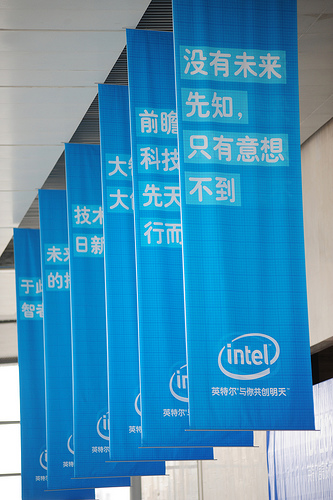
Intel in China

May 28, 2010

When you hear Americans complaining about China stealing jobs, here are a few facts to know.

Chinese consumers buy computers. In fact, there are more Chinese using the Internet than the entire population of the United States. That’s a lot of Internet surfing. Source: Internet World Stats.com

For that reason, Intel’s President and CEO, Paul Otellini said, “China is our fastest-growing major market and we believe it’s critical that we invest in markets that will provide for future growth to better serve our customers.”

Intel is one of the largest foreign investors in China and is opening a wafer fabrication facility in Dalian, Liaoning Province.  This added investment in China will cost $2.5 billion bringing Intel’s total investment to $4 billion. The last new fabrication plant Intel built was in Ireland in 1992.

Intel now has over 6,000 employees on assembly and test research and developing in 16 cities in Mainland China. Intel also has a facility in Bangalore, India. Source: Intel

In the United States, Intel has over 20 different locations. In Oregon alone, Intel has invested $22 billion and employs 15,500 Americans with an annual payroll of $1.5 billion. Source: Intel

Learn more about Chinese Stereotype Alive and Rotten in America

____________________________

Lloyd Lofthouse is the author of the award winning novels My Splendid Concubine and Our Hart. He also Blogs at The Soulful Veteran and Crazy Normal.

Sign up for an RSS Feed for iLook China