Kublai Khanwas the first significant non-Chinese to rule over the entire Chinese empire. He also had a goal to rule the entire world.
Like his grandfather, Genghis Khan, he defeated and crushed his enemies with brutal force.
However, after the conquest, he ruled his empire peacefully setting up governments and creating systems of taxation while promoting culture and commerce.
He also made Beijing the capital of the biggest empire the world has ever seen.
Kublai Khan’s empire stretched from the East China Sea to the Danube River in Europe – more than five thousand miles or eight thousand kilometers from east to west.
His military career started late in his life but his skills as a conqueror were the best.
In addition, throughout his reign, he courted the most sophisticated, intellectual, scientific and artistic minds of the day.
The Mongols were a nomadic people and Kublai Khan’s skills as a military leader would eventually lead to the conquest of the Song Dynasty of Southern China.
One of greatest influences over Kublai Khan while he was a child was his mother. Mongol women often fought beside their men and ruled tribes and territories. She insisted that he be educated in Chinese culture.
Lloyd Lofthouse is the award-winning author of The Concubine Saga. When you love a Chinese woman, you marry her family and culture too. This is the love story Sir Robert Hart did not want the world to discover.
Subscribe to “iLook China”!
Sign up for an E-mail Subscription at the top of this page, or click on the “Following” tab in the WordPress toolbar at the top of the screen.
Think of the violence and wars that religions have caused—the Crusades, the Spanish Inquisition, genocide against the Cathars (see video), the wars between Catholics and Protestants, and the persecution of Jews by both Muslims and Christians.
Then there are Islamic fundamentalists and the suffering and death caused by their religious beliefs.
Although most people in China are not religious, religions have caused uprising and wars in China too.
The Ming Dynasty (1368-1643) came about due to a rebellion against the Mongol Yuan Dynasty led by a religious sect known as the “Red Turbans” or “Red Scarves”, which included elements from “White Lotus”, a Buddhist sect from the late Southern Song Dynasty. Source: New World Encyclopedia
During the Qing Dynasty (1644-1911) when the Manchu minority ruled China, there were a number of religious uprisings.
There was the White Lotus Rebellion (1796-1804) in the mountain region that separates Sichuan province from Hubei and Shaanxi provinces. The White Lotus was a secret religious society promising salvation to its followers similar to the Falun Gong today.
A Christian convert claiming to be the younger brother of Jesus Christ led the Taiping Rebellion (1850-1864) and more than 20 million died.
The Panthay Rebellion (1856-1873) was a separatist movement led by the Hui people and Chinese Muslims.
There was also the Dungan revolt (1862-1877), led by Muslims in China’s Shaanxi, Gansu, Ningxia and Xinjiang provinces. Chinese historians and officials believed that Islam played a role in causing that uprising.
Maybe the reason China survived for thousands of years without collapsing as Western civilization did when Rome fell was the absence of a major religious movement in China stirring the peoples’ emotions.
Instead of listening to God from the mouths of Popes, prophets and priests, the Chinese had a blend of Confucianism and Taoism, which the family taught by example.
Lloyd Lofthouse is the award-winning author of the concubine saga, My Splendid Concubine & Our Hart. When you love a Chinese woman, you marry her family and culture too.
The Chinese invented rockets long before anyone in the West did. By the 15th century, the Chinese had mass rocket launchers that fired hundreds of rockets in battle. In one battle during the Ming Dynasty, more than one-hundred rocket launchers were used capable of launching 32,000 rockets in an instant.
The Chinese also invented one of the most dangerous weapons on earth—the landmine. The first landmines were invented in 13th century China. The triggering mechanism for these weapons was kept a secret until the 16th century. Then this concept was used to create the first musket.
During world war I, armies used colored flares to send messages. The Chinese invented this signal method in the 13th century.
The most important contribution to warfare took place during in the 6th century BC— The Art of War by Sun Tzu. Today, American generals study this Chinese book for fighting wars.
Some might ask, if the Chinese were so advanced in waging war, why not conquer the world? The answer—they had no desire because they were satisfied with what they had in China.
Ironically, the Mongols (Yuan Dynasty 1277 – 1367) conquered China using the weapons that the Chinese had invented.
Lloyd Lofthouse is the award-winning author of The Concubine Saga. When you love a Chinese woman, you marry her family and culture too. This is the love story Sir Robert Hart did not want the world to discover.
To subscribe to “iLook China”, look for the “Subscribe” button at the top of the screen in the menu bar, click on it then follow directions.
Andrew Clark contributed a post to Politics Daily about China’s minorities and the autonomous regions they call home. As Andrew clearly pointed out, “Han Chinese make up 92 percent of the People’s Republic of China. The remaining 8 percent is made up of minority groups, mainly Tibetan, Zhuang, Uyghur, Mongolian, Miao, Manchu, and Hui (these are the major ethnic groups — China officially recognizes 55 minority populations).”
Clark concludes with, “It remains to be seen whether the Chinese government can successfully assimilate these groups, or if consistent suppression of uprisings can force social tranquility.”
The Chinese map has inflated and deflated for more than two-thousand years. Some of these minorities have been in China longer than others. The Mongolians Clark visited, like the Tibetans and the Uyghur, are three who haven’t been inside China as long since they were conquered by the Qing Dynasty (the Manchu minority), who ruled China from 1644 – 1911.
One other minority ruled China for a brief time and that was the Mongols as the Yuan Dynasty (1277 – 1367). Both the rulers of the Qing and the Yuan were assimilated into the Han culture while they ruled China. That’s was primarily because they were surrounded by Han Chinese in the capital.
Tibet broke from China in 1913 and stayed out until 1950 when Mao sent an army into Tibet, which has always been a difficult place for China to rule since sending armies there to enforce control was difficult. But today, a highway and a railroad make that journey easy. If those transportation routes are cut, there’s still air transportation. The travel distance between Tibet and Beijing is shorter than it was a century ago.
Currently, China is adding about 40 thousand more kilometers of rail throughout China and building another grid of high-speed rail. This improved transportation system is also bringing about change and causing a Han migration that would have been unthinkable more than a century ago when most of China didn’t have electricity or roads.
For centuries, China ruled over these minorities without moving Han Chinese into their territories, but times have changed and the Han Chinese, like the Americans Europeans moving West, have been migrating into the autonomous regions for years, which may have more of an impact keeping these territories part of China than armies ever have. And if that doesn’t work, China still has the largest standing army in the world.
Clark also claimed, “the United States has seemingly countless ethnic and cultural minorities that are proud to call themselves American…” While somewhat true, many of almost 2,500 American native tribes still hold to their old ways and live on reservations proud to be Navaho or Sioux, Black Foot or Apache, maybe more so than being American.
Lloyd Lofthouse is the award-winning author of the concubine saga, My Splendid Concubine & Our Hart. When you love a Chinese woman, you marry her family and culture too.
As a child, I had a fascination for Alexander the Great and Genghis Khan. Still do. I read everything I could about these men who built empires and yet I knew little because of the cultural filters the West puts in place for any history outside Christianity and Western Civilization.
Multi-story statue of Genghis Khan in Mongolia
In Reconsidering Genghis Khan, we discover how history written from a Western perspective was misleading. Currently through November 1, Genghis Khan, The Exhibition is showing at The Tech Museum in San Jose, California. Prior to arriving in San Jose, the exhibition was on display at the Denver Museum of Nature & Science where it drew 175,000 visitors.
We now know that Genghis Khan was anything but the butcher and barbarian Western historians painted him as. Records from the period, many only now being uncovered, “give you a view of a person who is a superb organizer, a superb lawmaker, a fair and judicious ruler, somebody who supported women and gave women a lot of rights,” says William Fitzhugh, who is a consultant for the exhibition. “It’s wrong to say that Genghis created a democracy, but, for the time, he was remarkably enlightened.” Source: Mercury News
In fact, Kublai Khan, the grandson of Genghis Khan, established the Yuan Dynasty (1279-1368) in China and ruled as the Emperor from Beijing. (Genghis Khan statue )


 Posted by Lloyd Lofthouse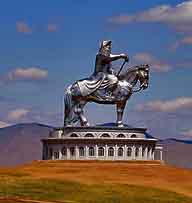
 iLook China