Teddy Roosevelt said, “Speak softly and carry a big stick.”
I’m not sure that America speaks all that softly and that stick has been around the world more than once and has been expensive. I did a bit of virtual sleuthing and the military budgets approved by the Congress between 1946 to 2009 have cost the American tax-payer about 23 trillion dollars. These figures do not include the wars since World War II.
Korea cost more than five hundred billion (2008 dollars).
The Vietnam War cost more than a trillion.
To date, the cost of war in Iraq since 2003 has cost 747.3 billion and Afghanistan 299 billion since 2001.
China intervened in the Korean War and sent hundreds-of-thousands of troops. To understand why the Chinese got involved, hear Mao’s words during the Vietnam War. “Vietnam is the gums to our teeth. What happens when the gums are gone?” Between 1965 and 1970, over 320,000 Chinese soldiers served in North Vietnam.
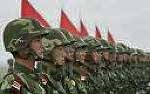
China's Military
“Rather than worrying about this development, we should understand that Beijing’s maintenance of a large, modern military is driven by history.” Source: Huffington Post “On 4 March 2010, Beijing announced China’s declared defense budget will only increase by 7.5% this year — the slowest rate in 20 years.”
I’m weighing in on the health care debate. I’m an impartial observer, because I already have socialized medicine through the VA. Serving in Vietnamearned me that benefit, and the VA works betterthan most systems.
VA Medical Facility, San Francisco
We can learn from history if we pay attention. In 141 B.C.E., a new Han emperor sat on the Dragon Throne in China. His name was Wudi. He ruled for fifty-four years. Wudi believed that all people should have the right to buy certain commodities essential to survival and they should not be included in the free-market system. He implemented government monopolies in certain critical areas like salt, alcohol and iron. Prices were controlled so everyone paid the same low price.
After his death, a national debate known as the “Debate on Salt and Iron” took place. The government monopolies were abolished, and the poor could no longer afford many essentials. The rich grew wealthier. Soon after that, the Han Dynasty entered a period of stagnation like what is taking place in America today, and the Han Dynasty eventually collapsed.
What could we learn from what happened in China during the Han Dynasty?
Isn’t health care a commodity essential to survival?
Lloyd Lofthouse is the award-winning author of the concubine saga, My Splendid Concubine & Our Hart. When you love a Chinese woman, you marry her family and culture too.
If you want to subscribe to iLook China, there is a “Subscribe” button at the top of the screen in the menu bar
It’s difficult to write when I’m gasping for air and blowing my top. When I was still teaching, walking into a classroom in the morning made me sick—and no, I wasn’t allergic to my students, but I should have been.
Then I retired and for five years, I have been free of wheezy lungs and sinus infections that always arrived with the start of each school year when I worked in those old buildings at the high school where I taught. Have you heard ofsick building syndrome? I lived it. The last time I was sick from air pollution was in Shanghai.
This new, peaceful world changed several weeks ago. Workers came with power tools and mud-caked boots. I should have fled, but I stayed at my computer as a stupid, stubborn, former United States Marine would.
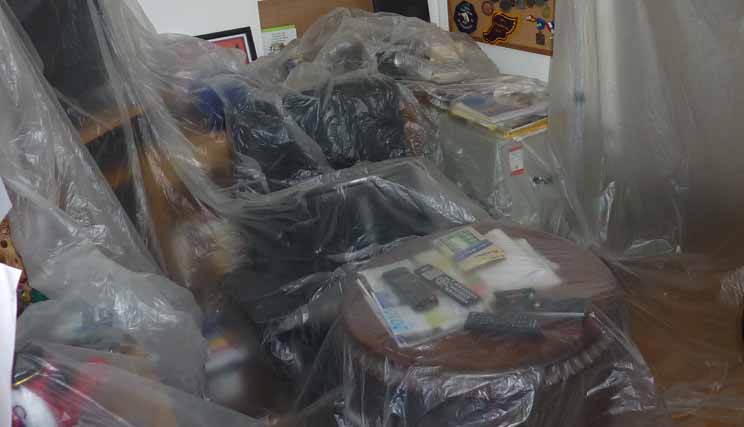
covered office furniture
My office has three doors. One that leads toward the other rooms and one that opens to the outside. Then there is the door that opens to the space under the second story and the foundation. That crew drilled, pounded, cut and tracked dirt from room to room—always in my office. I had trouble concentrating. I suffered from memory loss. Plastic tarps covered most of the furniture, and I couldn’t find things. When I left the office to find a moment of peace, I covered the computer and printers with a bed sheet. The noise reminded me of combat but worse, because I was nineteen and then twenty when I was in Vietnam—noise did not bother me as it does now.
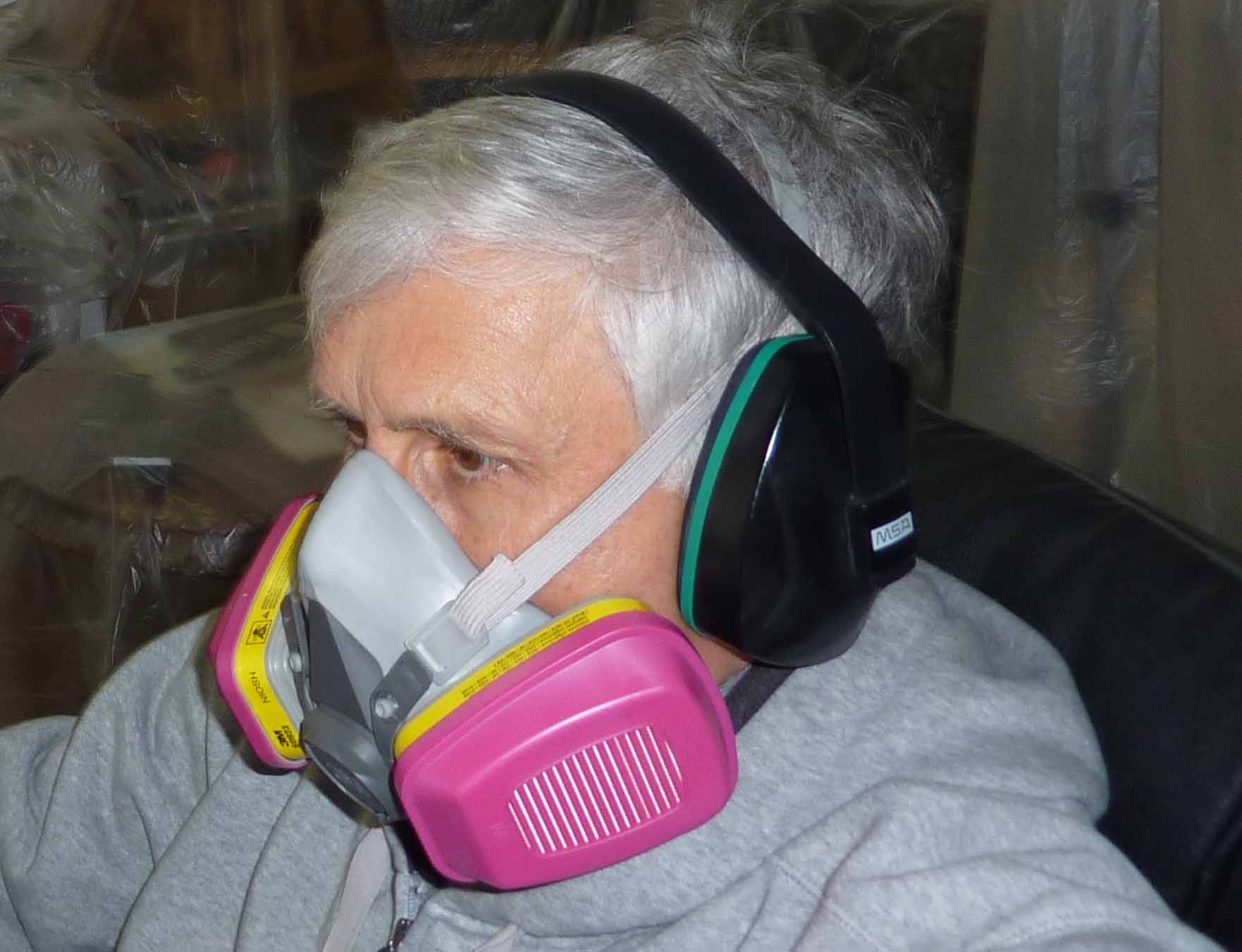
Concrete dust floated through the air and my sinuses and lungs rebelled, so I put on a 3M mask with two pink HEPA filters attached. The last time I wore a mask like this was when I was teaching. I searched the garage and found the noise suppresser to help mute the pounding and drilling. I looked like an explorer to Mars or a survivor of trench warfare struggling to write while the frigid air froze my fingers.
The crew had arrived to bolster the foundation against future earthquakes that might never arrive. Even if a hard tumbler did visit, I doubt that all that work would hold our sixty-year old hillside house together. It still might slide down the hill into the middle of the street blocking traffic.
I could have moved, but I didn’t want to disconnect all the cables and cart the equipment to another room for a few days to escape the dust and noise—something (I soon discovered) that would have been impossible without checking into a hotel.
Even with a noise suppresser covering my ears, muted sounds intruded and the last place I wanted to be was in this chair writing about China, the Vietnam War or being a teacher in the tortured American public schools. I stuck with it for days as my suppressed anger fueled by PTSD started to simmer and fume.
It was a relief when the workers finished. I thought I was going to have the tranquility back where the only noise would be the click of the keys as my warmed hands flew across the keyboard meeting my Blogging goals.
But the workers left something behind.
I started sneezing. My sinuses ran hundred mile marathons. I went to the doctor and he prescribed medications that didn’t work. The sneezing went volcanic—like Mt. Saint Helena blowing its top. One time, I sneezed so bad, I blew the 3M mask off my face—so much for a mask that’s supposed to protect you from every gas and plague Islamic terrorists can brew. Upstairs or outside, I was fine. But in my office, I was a goner. “Blam, blam, balm,” my nose exploded like rapid shots from a fifty-caliber submachine gun.
I could have opened windows, but it’s been raining for weeks. The sky has been overcast. The air breezy and cold. Then today, the sun came out and I finally let the outside in and the sneezing stopped—I’m crossing my fingers and knocking on wood. I’m afraid to close the windows, but night will come and with it lower temperatures. I fear that whatever industrial poison is haunting my once tranquil office space might return.
In America and the rest of the West, most people believe that Mao was a monster worse that Adolf Hitler or Stalin and is responsible for killing at least 30 to 60 million people during what is known as China’s Great Famine.
In fact, many Chinese also believe that millions died of starvation during The Great Famine (1958 – 1961) due to Mao’s demanding agricultural production goals during China’s Great Leap Forward.
Until recently, I also believed this without doubt since that is all I have ever heard.
The details that may have caused this famine are not common knowledge and it appears that no attempt by the Western media has been made to reveal them.
However, after discovering what happened in China and the world during Mao’s Great Leap Forward, what was once a certainty (at least to me) is now a mystery and possibly another hoax equal to the hoax that Tibet was never part of China before 1950 and there was a massacre in Tiananmen Square in 1989, which Wiki Leaks recently proved wrong.
No mention of drought, floods and severe weather that cut crop yields, and the number of deaths quoted in the video cannot be supported with evidence. In addition, evidence that does exist supports far fewer deaths.
Why Mao may have become scapegoat or victim of a hoax is worth examining.
The reason I say this is because in 1949 when Mao came to power, life expectancy in China was about 35, and then in 1960 life expectancy improved to about 60 or almost double what it had been in 1949, while the population of China increased by 19.5% with child mortality rates improving dramatically.
If Mao’s policies were responsible for these improvements in life expectancy and population growth, how could he also be the monster responsible for causing a famine that may have killed millions?
If a famine did occur, my research revealed that other factors may have contributed to the deaths and all but one of those factors did not deliberately cause people to die of starvation.
After learning of these other factors and completing the puzzle, it is obvious (at least to me) that Mao and the Communist Party did not order the deaths of 15 to 70 million people (the numbers quoted in the West vary widely because different people have made different claims without valid evidence to support those claims. There is evidence that supports the lower number.).
Before I started researching this post, I believed that Mao’s agricultural reform policies were mostly responsible for the famine, and then I learned that drought and severe weather also played a role in the famine.
The other factors that may have contributed to China’s so-called Great Famine will be listed in order of influence with the most damaging factor listed first and the least damaging last.
The first factors that may have contributed to the famine were droughts, floods and general bad weather.
In 1959 and 1960, the weather was less favorable, and the situation grew considerably worse, with many of China’s provinces experiencing severe famine.
Droughts, floods, and bad weather caught China completely by surprise, and in July 1959, the Yellow River flooded in East China and directly killed,either through starvation from crop failure or drowning, an estimated 2 million people.
In fact, droughts and famine are common in China. Between 108 BC and 1911 AD, there were no fewer than 1,828 major famines in China or one nearly every year in one or another province.
In the West, most if not all of what we hear about Mao is that he was a brutal monster responsible for the deaths of about 30 million people during the Great Leap Forward as if he pulled the trigger and ordered others to deliberately kill people by the millions as Hitler and Stalin did.
However, the facts do not support this claim.
The first time I heard that droughts and extremely bad weather also played a role in the so-called Great Famine was early July 2011 while I was researching another topic for this Blog and stumbled on that mostly unknown fact by accident.
Then I discovered another more insidious factor when I started working on this post, which may have contributed significantly to the early deaths of millions in China and no one in China was responsible for this one.
This factor was influenced by both American and Chinese paranoia generated by the Korean War (1950 – 1953), America’s involvement in Vietnam (1955 – 1975), McCarthyism‘s Red Scare (1947 – 1957) and the Cold Warwith Communist Russia (1945 – 1991).
The War in Korea (1950 – 1953), Vietnam (1955 – 1975), McCarthyism (1947 – 1957) and the Cold Warwith the USSR (1945 – 1991) set the stage for what may have contributed to mass deaths by starvation in China during the Great Leap Forward.
During the McCarthy era (1947 – 1957), thousands of Americans were accused of being Communists or communist sympathizers and became the subject of aggressive investigations and questioning before government or private-industry panels, committees and agencies.
In 1950, since China fought alongside North Korea against allied UN forces under the leadership of the US, the United States implemented a “complete embargo” that forbade all financial transaction with Communist China.
The US also convinced many of its allies to join this “complete embargo” to cut China off from the world.
After the Korean war, the United States did not lift this embargo for the next twenty years (1949-1969), with a goal to disrupt, destabilize, and weaken China’s communist government by causing the people to suffer and this “complete embargo” was one of the tools to achieve this.
The US embargo on China was a “complete embargo”, whch certainly must have contributed to the death toll of the Great Famine, a factor never mentioned before.
High American government sources have admitted that the objective of the economic warfare was aimed at causing a breakdown of Communist China. The idea was that problems in the Chinese economy would lead to loss of support from the people causing the collapse of the Communist Republic. Source: China for all.info and Asia for Educators – Columbia.edu
This embargo was lifted in 1969, when Richard Nixon was President. Source: Washington Post.com
However, while people were starving in China and US officials were waiting for Communist China to collapse, Washington D.C. had no idea how much suffering the Chinese people were capable of enduring and that even with the drought and famine, most Chinese were better off than they had been in centuries.
The evidence that the quality of life was improving was the fact that in 1949 when Mao came to power, life expectancy in China was 35, and by 1960 life expectancy had improved to age 60 or almost double what it had been in 1949, while the population of China increased by 19.5% with child mortality rates improving dramatically.
Field-studies in the 1930s revealed that in all parts of China, large numbers of landless laborers lived in tremendous poverty, and their situation had not changed since the sixteenth century. Source: China for all.info
If you want more evidence, I refer you to Pearl S. Buck’s “The Good Earth”.
We may never know how much of an impact America’s “economic warfare” against China crippled its ability to import food to feed its starving people in a time of drought and famine. In fact, this may have also influenced Mao’s decisions since he wanted the world to see China as strong and capable of feeding itself.
If anyone pulled a trigger on China’s people, it was not Mao. It was Washington D.C. fueled by fear of everything Communist caused by the Korean War, Vietnam, McCarthyism’s Red Scare and the Cold War with Communist Russia.
The last damaging factors that may have led to millions of deaths due to famine and starvation was the statistical lies of rural farmers and local party bosses reporting crop yields in rural China and Mao’s impossible goals to create a miracle in five years.
Mao’s five-year plan for the Great Leap Forward set quotas (goals) to develop agriculture and industry so China would catch up to America and the other Western nations that had invaded China during the 19th century (England, France, Japan, Germany, Russia, America, etc.)
Mao believed that both agriculture and industry had to grow to allow the other to thrive.
Industry could only prosper if the workers were well fed, while the agricultural workers needed industry to produce the modern tools needed for modernization.
For this to happen, rural China was reformed into a series of giant communes.
However, the droughts, floods and other severe weather arrived soon after this five-year plan was implemented and set the stage for a tragedy caused by nature and supported by American “economic warfare” in the form of a “complete embargo” of China.
Due to quotas set by Mao’s agricultural policies, no one wanted to be seen as a failure and/or unpatriotic so this generated boastful claims about output that were followed by more boastful claims of incredible crop yields.
Nobody – least of all the central government in Beijing – knew the real output figures and nobody was trying to find out. Instead, there was a sense of general euphoria in Beijing that China was succeeding.
While rural farmers and party posses lied about crop yields, China started exporting rice and wheat to other countries as a source of revenue, since Beijing believed there was a bumper crop. The result was that only urban areas suffered with reduced rations but with still enough food to survive.
However, the situation was different in the areas that lied the most and resulted in mass starvations largely confined to rural China, where, because of drastically inflated production statistics, very little grain was left for the peasants to eat.
Food shortages were bad throughout the country. However, the provinces, which had adopted Mao’s reforms with the most energy, zeal and the highest boasts, such as Anhui, Gansuand Henan, tended to suffer disproportionately.
Sichuan, one of China’s most populous provinces, known in China as “Heaven’s Granary” because of its fertility, is thought to have suffered the greatest absolute numbers of deaths from starvation due to the vigor with which provincial leader Li Jinquan undertook Mao’s reforms.
Once the central government in Beijing discovered the truth, the Chinese Communist Party acted quickly to correct the errors in national agricultural decision-making, to conserve food, and to save as many lives as possible implementing drastic measures to feed those in need and to restore agricultural productivity.
Grain exports were stopped, and imports from Canada and Australia (in spite of America’s complete embargo) helped to reduce the impact of the food shortages. Source: Library Index.com
The final question is: Would Mao’s Great Leap Forward have been more successful if there had been no drought, no floods and no “complete (U.S.) embargo” and the people had not lied about crop yields?
It is no secret that millions of rural people starved to death in China during the famine of 1959 – 1960, but it was a “great” tragedy caused by a complex series of circumstances and was not murder.
In addition, the actual number of deaths was significantly lower than what has been claimed in the West.
The CCP’s lofty goal was to prove to the world that the Party ruled China successfully by boosting crop yields and industrial output.
Another reason the CCP set such unrealistic goals for the five-year plan that contributed to the tragedy that was Great Leap Forward was because of Taiwan, which was recognized by the world as the official government of China and still held its seat in the United Nations.
It wouldn’t be until 1971 that the U.N. recognized the People’s Republic of China instead, and the United States wouldn’t switch diplomatic relations with China from Taipei to Beijing until 1979, finally recognizing the Communist Party as the legitimate ruler of China.
From Griffith University, Australia, Poverty, by David C. Schak, Associate Professor
______________
Lloyd Lofthouse is the award-winning author of The Concubine Saga. When you love a Chinese woman, you marry her family and culture too. This is the love story Sir Robert Hart did not want the world to discover.
To subscribe to “iLook China”, look for the “Subscribe” button at the top right of the screen.


 Posted by Lloyd Lofthouse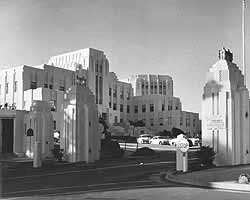
 iLook China