Is China Shifting Gears?

May 19, 2011

Is China shifting gears to avoid the Japanese Syndrome, which is what happened to Japan in the 1990s and was known as the Lost Decade? American economist Paul Krugman has described Japan’s Lost Decade as a liquidity trap, in which consumers and firms saved too much overall, causing the economy to slow too much.

In addition, on November 13, 2009, The Economist said, in The Dragon still roars, “Some analysts claim that China today looks ominously like Japan in the late 1980s… Banks’ non-performing loans will surely rise in 2010, and unless the government tightens monetary policy it will store up future problems which could harm economic growth.”

However, on April 10, 2011, Lianting Tu reported for CNBC that China is “Taking a cue from the larger economy, which is looking to make the transition from quantity to quality, China’s four biggest banks have decided to slow down growth and focus instead on better profit margins.”

What Lianting means is China’s banks are not loaning as much money, are making better loans and charging higher interest rates, which boosts profits.

She also writes, “Non-Performing Loans are a Non-Issue” in China.  She says, “For the four major Chinese banks, the average non-performing loan, or NPL, ratio dropped to around 1.1 percent in 2010 from 2 percent in 2009 and is expected to decline further this year, compared with 20 percent in 1990 and around 5 percent only 3 years ago.”

Compared to the United States, China is in good shape. According to the Federal Reserve Bank of St. Louis, total non-performing loans in the US flew from less than 2% in 2007 to almost 6% in 2010—the opposite of China, which has been reducing non-performing loans.

A Chinese friend said most loans get paid off because in China when a loan is made, entire working families cosign, which may be another benefit of a collective culture instead of one based on individualism. In China, mostly everyone in an extended family has to lose jobs and income to default on a loan.

In fact, in the US, bankruptcy cases filed in federal court for the 12-month period ending September 30, 2010 totaled 1,596,355, up 13.9 percent over the same period in 2009.  In 2007, before the 64 trillion dollar global financial crises caused by greed from Goldman Sachs, Wall Street and much of the US banking system, the bankruptcies were about 50% less. Source: Bankruptcy Action.com

Discover Deng Xiaoping’s 20/20 Vision

______________

Lloyd Lofthouse is the award-winning author of the concubine saga, My Splendid Concubine & Our Hart. When you love a Chinese woman, you marry her family and culture too.

To subscribe to iLook China, look for the “Subscribe” button at the top of the screen in the menu bar, click on it then follow directions.


Chicken Little-Henny Penny says, “China’s Bubble is Bursting!”

May 17, 2011

The Chicken Little-Henny Penny story is a fable about a chicken that believes the world is ending. The phrase “The sky is falling!” features prominently in the story and is now a common idiom indicating a hysterical or mistaken belief that disaster is imminent.

Chicken Little’s warnings or predictions of calamity, especially without justification, dates from 1895.

Because of this, the tale has become politicized and one example appeared on ZeroHedge.com when Tyler Durden submitted this post, “Chinese Real Estate Bubble Pops: Beijing Real Estate Prices Plunge 27% In One Month”.

Durden writes, “Prices of new homes in China’s capital plunged 26.7% month-on-month in March, the Beijing News reported Tuesday, citing data from the city’s Housing and Urban-Rural Development Commission.”

Durden says, “IF” the pummeling in the Beijing real estate market shifts to other cities not only is the Chinese tightening regime over, but the SHCOMP (?) in the next few weeks could get very interesting as people understand the world’s biggest marginal bubble has popped.”

“IF” I had a dollar for every time I’ve read a “Sky is Falling” prediction of China’s economy, I’d take my wife out to dinner, shopping at Nordstrom’s and a movie on the weekend.

China’s real estate market only represents about 15% of China’s GDP while in America, that number is more than 70% of GDP, which explains why America is in the cellar with its economy and China is still growing but just slower.

Meanwhile, Tory Capital.com reports “China’s First Quarter 2011 GDP Rises 9.7 Percent,” while Mostly Economics.com compares that to the US annual rate of 3.1%.

A better, possibly more informed comparison between China and America’s economies may be found at Heritage.org where Derek Scissors, Ph.D. writes, “Its (China) raw population means that the PRC will likely pass the U.S. at some point after a resumption of market reform.”

However, Scissors says for that to happen, “The 2012 Communist Party Congress (must) nullify actions by the 2002 Party Congress and restore Deng Xiaoping’s economic model—this would enable roughly two more decades of rapid growth, perhaps in the 7 percent to 8 percent range, then gently decreasing to the 5 percent to 6 percent range over time. China would then surpass the U.S.” as the world’s largest economy.

Back to Durden’s Chicken Little-Henny Penny statement. The drop in “new housing prices” in Beijing may be a response to complaints from the people that prices were out of reach of many. Instead of a bubble bursting, the Party may have let some air out so it would not explode as it did in the US in 2008.

Discover The Fear of Mao Buying the World

______________

Lloyd Lofthouse is the award-winning author of the concubine saga, My Splendid Concubine & Our Hart. When you love a Chinese woman, you marry her family and culture too.

To subscribe to iLook China, look for the “Subscribe” button at the top of the screen in the menu bar, click on it then follow directions.


The “Mandate of Heaven’s” Gobal Revelation – Part 2/2

May 15, 2011

Global history shows that not all previous civilizations collapsed at the same time.

After the Western Roman Empire (500 AD) and the Han Dynasty (219 AD) were gone, the Byzantine Empire thrived in the Middle East for almost a thousand years (500 – 1453 AD), while the Tang Dynasty survived until 906 AD and the Yuan Dynasty (the Mongols) to 1368 AD to be replaced by the Ming then Qing Dynasties.

The British Empire survived until 1947 then vanished as an empire as the United States became a global super power after World War II.

However, many people are not aware of The Mandate of Heaven’s cycle, which leads to behavior that repeats the same mistakes that caused the fall of other civilizations.

American style democracy, capitalism, socialism, jet planes, the combustion engine, telephones, electricity, the Internet, and the iPad are not going to save civilization, as we know it today.

The reason for this is that human nature is what causes the downfall of civilizations.

History shows that during the good times at the height of a civilization such as Rome or the Han Dynasty, most people take the quality of life for granted as if it will never end.  Once that happens, the end begins.


The Mandate of Heaven explained on a global scale by Warren Edward Pollock

In the video, Warren Pollack explains how the Communist Party returned China to stability after chaos and anarchy swept China after the fall of the Qing Dynasty. If the Party continues to maintain domestic stability and keep people working, China may survive as the civilization it is becoming for a few centuries before the next collapse.

Since Mao died in 1976, the internal goal of the People’s Republic of China has been domestic stability. With domestic stability, we see China returning to that period in the dynastic cycle where harmony and prosperity rules leading to a period of stability.

To understand what happened in China, I suggest reading The Roots of Madness.

Edward Pollock says, “If China stood as the world’s top country, it would not act like the United States, which has been irresponsible, lazy and greedy and engaged in robbery and cheating. They (US)  have brought economic recession to the whole world.”

If we look to the dynastic cycle as a guide, it would seem that the United States has entered the cycle’s stage of decay moving toward a collapse.

However, with the weapons of mass destruction that America has in its arsenal (more than any other nation even the USSR), could the US, like a drowning man, pull the rest of global civilization down with it?

Return to The Mandate of Heaven’s Global Revelation – Part 1

______________

Lloyd Lofthouse is the award-winning author of the concubine saga, My Splendid Concubine & Our Hart. When you love a Chinese woman, you marry her family and culture too.

To subscribe to iLook China, look for the “Subscribe” button at the top of the screen in the menu bar, click on it then follow directions.


Border Crossings and the Blood on Our Hands

March 11, 2011

In 2006, China was crucified in the Western media due to a few unarmed Tibetans being killed attempting to illegally cross the border into India.

Buzzle.com repeated this news that originally ran in the UK’s Guardian. I recall the incident because it was on the news in the US at the time.

Of these few border deaths in China, Buzzle says, “A Romanian cameraman, whose footage of the incident revealed that snipers shot the unarmed Tibetans as they waded through thick snow. The shaky video shows two figures in a column of refugees fall to the ground. “They’re shooting them like, like dogs,” says a witness next to the cameraman.”

The headline shouted “International Anger Grows Over Tibet Shooting. Human Rights groups are calling for a UN Investigation into the killing of a nun by Chinese border patrol guards, writes Jonathan Watts in Beijing.”

Recently, I read another story I’d never heard of before from The Economist of another border where similar killings happen often, but I found no demand for a UN Investigation in the Western media. Even The Economist, which reported the story, did not call for an investigation.

Instead, The Economist concludes with, “Shooting the people you claim to want to do business with is a poor start.”

Maybe the difference is that the border killings reported by The Economist took place between two democracies — India and Bangladesh.


I couldn’t find a report of this India-Bangladesh incident in English on YouTube

The Economist says, “On January 7th India’s Border Security Force (BSF) shot dead Mr. Nur Islam’s 15-year-old (daughter) Felani, at an illegal crossing into Bangladesh from the Indian state of West Bengal. Felani’s body hung from the barbed-wired fence for five hours. Then the Indians took her down, tied her hands and feet to a bamboo pole, and carried her away. Her body was handed over the next day and buried in the yard at home.”

“The BSF (India’s Border Security Force) kills with such impunity along India’s 4,100-kilometer (2,550-mile) border with Bangladesh that one local journalist wonders what the story is about. According to Human Rights Watch, India’s force has killed almost 1,000 Bangladeshis over the past ten years.”

How many were reported killed by witnesses of the China incident? Two or three?

What about deaths along the US border? The Snow Report says, “Border deaths for illegal immigrants hit record high in Arizona sector.”

The Snow Report says, “The discovery of record numbers of bodies along the Tucson sector of the US-Mexico border suggests that border crossings for illegal immigrants are becoming deadlier as heightened security forces migrants into remoter and more forbidding areas.”

Maybe democracies (which are billed as better places to live), sort of like James Bond, get a free pass from the Western media to kill.

Discover more about India Falling Short

______________

Lloyd Lofthouse is the award-winning author of the concubine saga, My Splendid Concubine & Our Hart. When you love a Chinese woman, you marry her family and culture too.

If you want to subscribe to iLook China, there is a “Subscribe” button at the top of the screen in the menu bar.


Comparing India and China’s Economic Engines

October 13, 2010

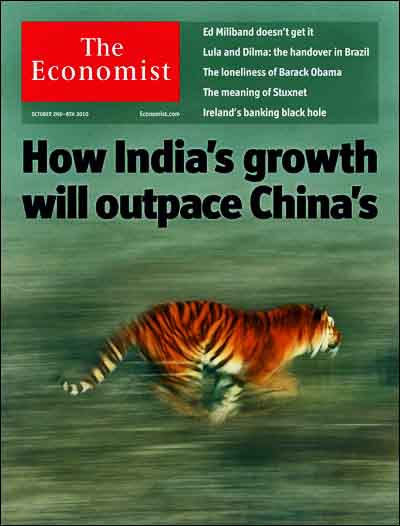
The cover for The Economist of October 2 – 8, 2010, is betting on a race that cannot be won by India.


I opened the magazine and read the two pieces that the cover was about.  One is about India’s surprising economic miracle and the second piece was A bumpier but freer road.

On page 11, I read, “many observers think China has done a better job than India of curbing corruption…”

On page 77, a Western banker was quoted saying, “It’s much easier to deal with the well-understood ‘org chart’ of China Inc than the freewheeling chaos of India.”

After reading both pieces comparing China with India, it was obvious that India would never beat China economically.

The Economist wants India to win this race, because it is called a democracy as is the U.S., but what isn’t mentioned is that China is becoming a republic with a Chinese twist, which is what Dr. Sun Yat-sen wanted.

The reason The Economist is wrong about India is because America’s Founding Fathers hated democracy and they had a good reason.

The Live Journal goes into detail on this topic.  To quote the Live Journal, “It would be an understatement to say that the (U.S.) Founding Fathers hated democracy. They warned against it vehemently and relentlessly. They equated it – properly – with mob rule.

“in a democracy, two wolves and a sheep take a majority vote on what’s for supper, while in a constitutional republic (which China is becoming), the wolves are forbidden on voting on what’s for supper and the sheep are well armed.…

“The Founders, who hated democracy, gave us a free country (a republic). Our (meaning many Americans) ignorance of history, which has lead to a love of democracy, is causing us to surrender our freedoms at an alarming rate.”

Dr. Sun Yat-sen (1866 – 1925), known as the father of modern China, said he wanted to model China’s government after America but by combining Western thought with Chinese tradition.

When he said this, it was 1910, and America, by definition, was still a republic. Once you read the two pieces in The Economist, you may understand why India’s democracy cannot beat China’s evolving republic.

This topic is continued (with more details and facts) at India Falling Short

_______________

Lloyd Lofthouse is the award-winning author of My Splendid Concubine [3rd edition]. When you love a Chinese woman, you marry her family and culture too. This is the love story Sir Robert Hart did not want the world to discover.

Subscribe to “iLook China”!
Sign up for an E-mail Subscription at the top of this page, or click on the “Following” tab in the WordPress toolbar at the top of the screen.

About iLook China