Americans doing Business in China – Part 16/16

March 7, 2012

Note from Blog host — another example of East meets West through business and trade:  “Avon, the first direct-sales company in China, has 85,000 agents knocking on doors and yurts in every region except Tibet, racking up sales of $68 million in 1996. A year before, Mary Kay opened its first cosmetics plant outside the U.S. in Hangzhou. Demand has been so keen that the Texas-based firm has already broken ground on a new China factory, 15 times larger than the first one…

“China’s American embrace is most fervent at the cathedral to Yankee culture, the cinema. Beijing still allows distribution of a handful of imported flicks each year, but the ration is no longer a forced diet of scratchy Hollywood flops. These days Chinese eschew the patriotic reels still churned out by government filmmakers for the latest Sylvester Stallone and Tom Cruise blockbusters, which laud Western excesses…

“Mainland TV, undergoing its own revolution, offers another shock to seasoned sinologists. Thanks partly to satellite TV, Chinese soaps and historical serials now compete against programs that would have seemed unimaginable only a few years ago: episodes of Baywatch and The X-Files.” Source: The Americanizaton of China

______________________

Part 2 – In the PBS documentary of foreign entrepreneurs in China we discover (when the US financial crises hit the world causing more than $64US trillion in global loses while those who caused the crises walked away with fortunes) China experienced a slowdown in economic growth in 2008.

One foreign entrepreneur, Ed Hung, talks of the clothing store he co-founded, NLGX Design, which opened in Beijing in 2008. He said rent was still increasing.

Ed Hung was born and raised in San Francisco. His business partner, Michel Sutyadi, was born and raised in Germany. They met in Beijing while studying Mandarin in 2005.

Ed Hung says modern Beijing is becoming a consumer culture.

Then Doug Ma, a co-founder of Go Tour-ING, talks of how the global financial crisis (which was started in America) has affected business.

In the spring of 2008, Dough Ma left his job at an investment bank to travel. He wrote a post for Jet Set Zero in July 2009, and said, “It has been quite a challenge starting up Tour-ING. For one thing, it has been a tough year for the tourism industry. Less people are traveling due to the global economy and the outbreak of swine flu has hindered a lot of travel plans.”

Brian Sloan, CEO of Robotic Blow Job, says the sex toys he manufactures and sells seem more popular in hard economic times since people spend less money going out and stay home more so they need a method of self-entertainment.

Due to legal problems in Chicago, Sloan took his business to China because, “In China, people respect what I do as a business,” he says.

Note from Blog host – If you plan to do business in China, I recommend visiting the China Law Blog first.

Return to Americans doing Business in China – Part 15 or start with Part 1

______________

Lloyd Lofthouse is the award-winning author of The Concubine Saga. When you love a Chinese woman, you marry her family and culture too. This is the love story Sir Robert Hart did not want the world to discover.

Subscribe to “iLook China”
Sign up for an E-mail Subscription at the top of this page.

About iLook China

Note: This post first appeared on January 24, 2011


Americans doing Business in China – Part 15/16

March 6, 2012

Note from Blog host — another example of East meets West through business and trade: Recently, the Future of US China Trade.com reported the results of a survey of 434 multinational companies doing business in China. “78% percent of companies surveyed rank China among their top three priority locations for investment. Only 7% rank China as ‘not a high priority’.”

_______________________                

Part 1 – Young and Restless in China was filmed over a period of four years starting in 2004 for the Public Broadcasting Service (PBS).

Paris Franz, a student, blogger and writer with a passion for history, art and travel, wrote a post about Young and Restless in China for Suite 101.com.

This two-part segment is about foreign entrepreneurs in China. I plan to also feature other segments of this PBS Frontline documentary because it demonstrates how much China is changing. The more I learn, the more it appears that there is more freedom in China than most people outside China are aware of.

Franz wrote, “The film highlights what is unique about China at the beginning of the twenty-first century.

“The entrepreneurs – starting up tailoring, hotel and internet café businesses – are full of optimism, supremely confident that their hard work is going to make them rich. As one of them says, China today is “the land of opportunity.”

Part One starts with “there is this misconception of China that it is not modern, that it is still changing, but if you come and see with your own eyes you will discover that (urban) China (where about 500 million people live) is as modern as any city in the world.

One entrepreneur says, if you visit Beijing and see the architecture, you will see that it is leaps and bounds ahead of the US.

Another entrepreneur says, China is a melting pot for all types of entrepreneurs in Beijing… For young entrepreneur it is cheap to start something new in China compared to the US.

In fact, as the economic tide turns against the west, younger, foreign talents are taking their entrepreneurial ambitions to China because the market is right for starting a business.

One American entrepreneur says he graduated from law school at Penn State in 2005. He then talks about how he arrived in China to create, manufacture and sell his own brand of sex toys and fetish clothing.

Note from Blog host – If you plan to do business in China, I recommend visiting the China Law Blog first.

Continued March 7, 2012 in Americans doing Business in China – Part 16 or return to Part 14

______________

Lloyd Lofthouse is the award-winning author of The Concubine Saga. When you love a Chinese woman, you marry her family and culture too. This is the love story Sir Robert Hart did not want the world to discover.

Subscribe to “iLook China”
Sign up for an E-mail Subscription at the top of this page.

About iLook China

Note: This post first appeared on January 23, 2011


Americans doing Business in China – Part 14/16

March 5, 2012

Note from Blog host — another example of East meets West through business and trade: China Daily.com says, “The world’s largest retailer, Wal-Mart Stores Inc, says its inventory of stock produced in China is expected to hit US$18 billion this year…”

However, trade is global. Wal-Mart has stores in 26 countries outside the continental US—including China.

Walmart entered the Chinese market and opened its first Supercenter and Sam’s Club in Shenzhen in 1996. Currently, Walmart operates a number of store formats in China including Supercenters, Sam’s Clubs, and Neighborhood Markets. As of August 5, 2010, Walmart had 189 units in 101 cities, and created over 50,000 job opportunities across China.  Source: Wal-Mart China.com

______________________

Guest Post by Bob Grant — publisher/editor for Speak Without Interruption, an international online magazine.

The world is a global market – those businesses that don’t believe this, or embrace it, will go by the wayside.

In 2002, I was an independent manufacturer’s rep and one of my customers said that I should look at branching out – representing products “outside” of the U.S.

I thought this was good advice, so I first started looking in Europe. For many reasons – after trying many companies and products – I decided that Europe was not for me.

I then looked and visited Korea, Malaysia, Indonesia, and China.

I settled on China because I felt that was a country that could best provide me with the products I needed to succeed.

Once I settled on a product category, I then knew that I needed one key person inside China to make it all come together and become successful.

It took me a year to find that person and his name is David. Without David, I would not be where I am today and I am forever indebted to this young man.

David and I had some very productive years together.

Then like most things that are successful – there was a down turn. This was due to the world economy and actions taken by both the Chinese and U.S. Governments.

Through no fault of our own our business died. However, David has stuck with me and I with him. We are now working on new projects that we both hope – and feel – will get us back some of the volume we have had in the past.

I never had a son and David became that son to me. He and his family have also adopted me as part of their own.

It saddens me when I read statements about China and its people that just are not true. I can only testify to my own experiences and connections inside China but I would not trade the relationships I have made for anything.

David and his family are a key part of my life and forever will be – regardless of what the governments of our respective countries might say and do.

Note from Blog host – If you plan to do business in China, I recommend visiting the China Law Blog first.

Continued March 6, 2012 in Americans doing Business in China – Part 15 or return to Part 13

______________

Lloyd Lofthouse is the award-winning author of The Concubine Saga. When you love a Chinese woman, you marry her family and culture too. This is the love story Sir Robert Hart did not want the world to discover.

Subscribe to “iLook China”
Sign up for an E-mail Subscription at the top of this page.

About iLook China

Note: This guest post first appeared on September 30, 2010


Americans doing Business in China – Part 13/16

March 4, 2012

Note from Blog host — another example of East meets West through business and trade: Miller-McCune says, “Since the 1990’s dot-com boom, “tens of thousands of Ph.D.s, primarily from China, have arrived to staff American university laboratories, and the information industry has padded its ranks with temporary workers who come largely from India.”

However, The New York Times reports,, “No Chinese-born scientist has ever been awarded a Nobel Prize for research conducted in mainland China, although several have received one for work done in the West…” In addition, “Recently, though, China has begun to exert a reverse pull. In the past three years, renowned (Chinese) scientists…have begun to trickle back. And they are returning with a mission: to shake up China’s scientific culture of cronyism and mediocrity, often cited as its biggest impediment to scientific achievement… They are lured by their patriotism, their desire to serve as catalysts for change and their belief that the Chinese government will back them.”

_______________________

Guest Post by Bob Grant — publisher/editor for Speak Without Interruption, an international online magazine.

For various reasons, my business in China declined a little over two years ago, and I have not had occasion to visit there during that time period. A lot has happened—both within the U.S. and China—since my business went south.

I do miss China – its people – its culture – its smell. This might seem like an irrational statement since China is suppose to be one of the most polluted countries in the world, but it is not the smell of pollution that sticks in my memory.

Our China office was located in Guangdong Province, which is in the southern part of China near Hong Kong. Traveling around that province, I always remember the fresh scents of flowers, rain, trees, grass, and meals being prepared for daily consumption.

I tended to visit factories that were in outlying areas—their conference rooms, factories, reception rooms, and gardens all had a smell that I grew to welcome during each of my visits. As I made trips and visits to other parts of China, I felt they each had their own unique smells and aromas that I have not found any other place in the world that I have traveled.

I have written other posts regarding my feelings about the Chinese people—those have not changed. I am not certain that I will ever have occasion to visit China again but the smells and memories of that country and its people will remain with me forever.

Note from Blog host – If you plan to do business in China, I recommend visiting the China Law Blog first.

Continued March 5, 2012 in Americans doing Business in China – Part 14 (a guest post) or return to Part 12

______________

Lloyd Lofthouse is the award-winning author of The Concubine Saga. When you love a Chinese woman, you marry her family and culture too. This is the love story Sir Robert Hart did not want the world to discover.

Subscribe to “iLook China”
Sign up for an E-mail Subscription at the top of this page.

About iLook China

Note:  This guest post first appeared on April 27, 2010


Americans doing Business in China – Part 9/16

February 29, 2012

Note from Blog host — another example of East meets West through business and trade: Higher education is a business, and the number of international students at U.S. colleges and universities reached 723,277 during the 2010-11 academic year.  China, the top country of origin for international students, sent 157,558 undergraduate and graduate students to America, up 23% from the previous year.

International students and their dependents contributed more than $20 billion to the U.S. economy that academic year. For Chinese students, that means about $4.4 billion came from China.

Ann Stock, assistant secretary of the US State Department says, “Young people who study abroad gain the global skills necessary to create solutions to 21st-century challenges. In turn, international students globalize our campuses and communities.” SOURCE: USA Today

_____________________

Guest Post by Bob Grant — publisher/editor for Speak Without Interruption, an international online magazine.

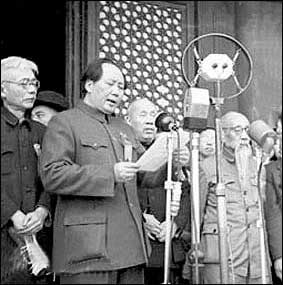
On October 1, 1949 the People’s Republic of China was formally established in a speech given by Mao Zedong from the Imperial Gate at Tiananmen Square. I stood at the very spot where Mao gave his speech and took a photo. From speaking with people – in China – who lived through his reign it was beyond believable. What he put his people through is an unforgivable act of power and brutality.

However, it is images from Mao’s era that some – outside of China – still have of the Chinese people. Nothing could be farther from the truth!

I never met a Chinese government official – did not even see one at least that I can recall. What I did meet were the people of China – the people with whom I had my business and personal interactions. I did not ask them questions about their government nor did they ask questions of mine.

The only political statement that I ever heard was a reference that China’s policy would probably change when the younger generation came into power, someday.

In meetings, over two years ago, I heard about the oil pipeline being built directly from Iran to China. None of the people in that meeting expressed an opinion one way or the other regarding this pipeline. It was a decision the Chinese government made.

Maybe my associates did not approve of dealing with Iran—maybe they did? The point being here is their government made this decision—not my associates.

Whether the officials in power in the US are republican or democrat, they have all made decisions of which I don’t agree. They did not consult me or ask my opinion—am I my government in these situations?

The point I am trying to make is that I found the Chinese people I met just like me in a lot of respects. I enjoyed doing business with them – learning their culture – and becoming their friend. No government – or its actions – is ever going to change that for me!

Note from Blog host – If you plan to do business in China, I recommend visiting the China Law Blog first.

Continued March 1, 2012 in  Americans doing Business in China – Part 10 (a guest post) or return to Part 8

______________

Lloyd Lofthouse is the award-winning author of The Concubine Saga. When you love a Chinese woman, you marry her family and culture too. This is the love story Sir Robert Hart did not want the world to discover.

Subscribe to “iLook China”
Sign up for an E-mail Subscription at the top of this page.

About iLook China

Note:  This guest post first appeared on March 9, 2010