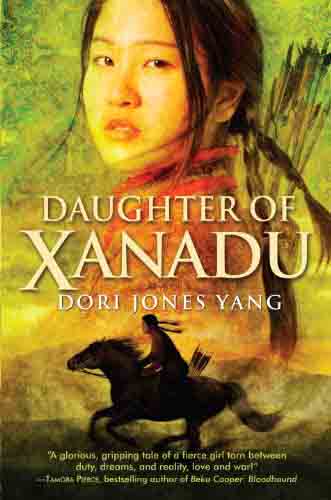
The merchants’ young son turns out to be one Marco Polo, the now-legendary Venetian journeyer credited for introducing Asian culture to the west.
To Emmajin, however, he is just another “colored-eye man,” a court curiosity from Christendom whose gallantry and romantic gestures are as ridiculous to the manly Mongolians as his facial hair (“his beard was so thick I could imagine food sticking in it”).
Try as she might, however, Emmajin, caught in the peak of puberty, is unable to resist Marco’s western charm, and quickly finds herself enamored by his worldly vision (“I had learned to see the world through Marco’s eyes”) as well as his pelt.
“What would the hair on his arm feel like?” she often fantasized about at night.
But she was a Mongolian first, and reluctantly sacrifices her blossoming relationship with the foreigner to complete her spy mission (“He was not a friend but a source of information.”).
Who would win in a fight: Mulan or Emmajin Beki or Teenage Angst, Mongolian-style? “Can you imagine, a mere girl fighting on the battlefield?”
The role of females in combat is a debate as timeless as war itself, and one that remains divisive and unresolved to this century.
While present-day arguments for and against allowing women in the military revolve around psychological and biological issues, back in olden times, one needed only cite “tradition” and “familial roles” to silence the detractors.
The teenaged heroine of Dori Jones Yang’s new 13th-century historical fiction novel, Daughter of Xanadu, is one such detractor, albeit immutable.
Often imagining herself on the battlefield, “the son my father never had,” Emmajin Beki, the granddaughter of Mongolian king (and emperor of China’s Yuan Dynasty) Khubilai Khan (1215-1294), learned to ride a horse before she could walk and can outshoot all her cousins in archery.
She confidently and outspokenly aspires to emulate her female ancestors who assisted Chinggis Khan in conquering Asia (“the blood of all these earlier strong women flowed in my veins”).
Unfortunately, for this princess, “the days of strong women had ended once luxurious court life had begun.”
The Mongols, fattened, lazy and resting on their laurels, now prefer to tell stories of battles-past over lavish “orgies of excess” rather than engage in new wars, much to Emmajin’s restless discontent.
When she makes known her desire to “become a legend” like real-life women warriors Aiyurug Khutulun and Hua Mulan of China, the great Khan placates her by sending her on a secret mission to spy on a family of foreign merchants currently visiting the Mongol court.
China’s love affair with superstition, pseudoscience and the fantastical may be traced back over five millennia, whence some of history’s oldest myths and legends originated.
Journey to the West (Xi You Ji), published anonymously by scholar Wu Cheng’en in the 16th century Ming Dynasty, remains China’s most beloved fantasy story. Considered one of the “Four Great Classical Novels” of Chinese literature, the 100 chapters of ‘Journey’ are replete with monkey kings, flesh-eating demons, immortal sages and celestial battles.
When science fiction became all the craze in 1950’s America, Red China followed suit by founding its first sci-fi periodical.
However, unlike the west, where rapid advances in the tech sector fueled science fiction, China promoted sci-fi to help inspire its own dormant technological progress.
Conversely, about the same time during the 70s when American director George Lucas was preparing to film a little space opera called Star Wars, the Cultural Revolution was banishing all China’s scientists to hard-labor communes.
Indeed, where the Chinese have categorically failed in speculative fiction (programming on the Communist-controlled CCTV is evidence enough that future perspective is held in little regard here: of China’s 19 official television channels, all feature serials set in olden times, some in the present, none about the future), they remain masters of mythology and purveyors of the past.
Present-day PRC is seeing a renaissance of the fantasy genre. The wuxia-inspired Chinese film Crouching Tiger, Hidden Dragon was a critical and commercial success, generations of young, Chinese cyber-punks are hopelessly addicted to the virtual sorcery of World of Warcraft, and Harry Potter remains China’s “most pirated novel ever”.
Even so, no Chinese author has ever been able to replicate the success of Journey to the West; as a result, publishing houses in the Middle Kingdom prefer to translate western best-sellers such as Lord of the Rings and Narnia rather than take their chances on local fantasy fiction writers.
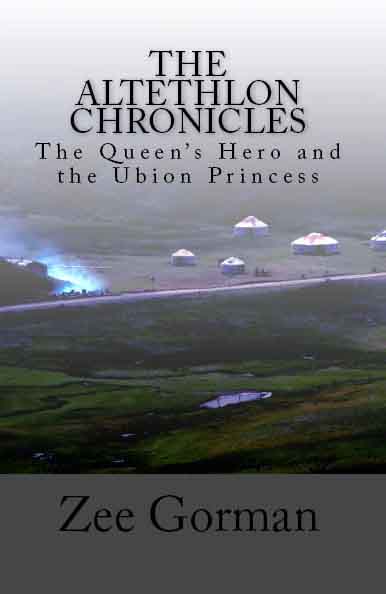
Enter Zee Gorman (nee Yan Zi-hong) China’s response to J.K. Rowling.
Born in Guangdong province during the Cultural Revolution (both her parents were exiled to the countryside for being “intellectuals”), Zee was raised on a literary diet of propaganda and scar literature.
Rather than publish a clichéd daughter-of-the-Revolution memoir about her hardships, the aspiring author opted for the escapism of fantasy. Hence, her decades-in-the-making debut novel, The Altethlon Chronicles.
A high-fantasy fiction set in a parallel universe either far in China’s future or in its past, The Altethlon Chronicles is a complex blend of military, history, romance and sorcery.
Leading the rich cast of green-eyed, purple-skinned characters is the royal yet rebellious teen Ximia (“what kind of princess are you anyway, running around like a wildcat?”) and her forbidden lover, Nikolas, the leader of a rival tribe – a tumultuous relationship most likely inspired by Zee’s own experience with cultural clash when she immigrated to the U.S. and married an American.
Ximia is misled into believing that Nikolas has been killed during an escape attempt, whereby the princess is married off by her father to a dastardly lord. The two young warriors go on to lead their respective armies until the day when destiny arranges for them to meet again in battle.
Lots of magic, weird names and epic battles of Tolkien proportions (note: this reviewer has never actually read a J. R. R. Tolkien book; I just thought it sounded cool to say that) ensue.
In creating this alternate world, Zee draws heavily on her Chinese heritage.
Kingdoms such as Manchuli, Dalong and Taklaman are each reminiscent of real regions in China.
Nonetheless, Zee, who is bi-lingual and holds dual degrees in English Literature, chose to write The Altethlon Chronicles in her second language and self-publish in America rather than risk having it pirated in China’s nascent fantasy market.
Some realities are worth escaping.
Discover Blond Lotus, anotherbook review by Tom Carter.
German businessman Bernd Hagemann arrived in China in 2002 amidst media reports of China’s impending rise to global domination. “News outlets around the world,” he writes, “were warning us about… how fast China is developing, how competitive it is, and what a tense life the Chinese people must live.”
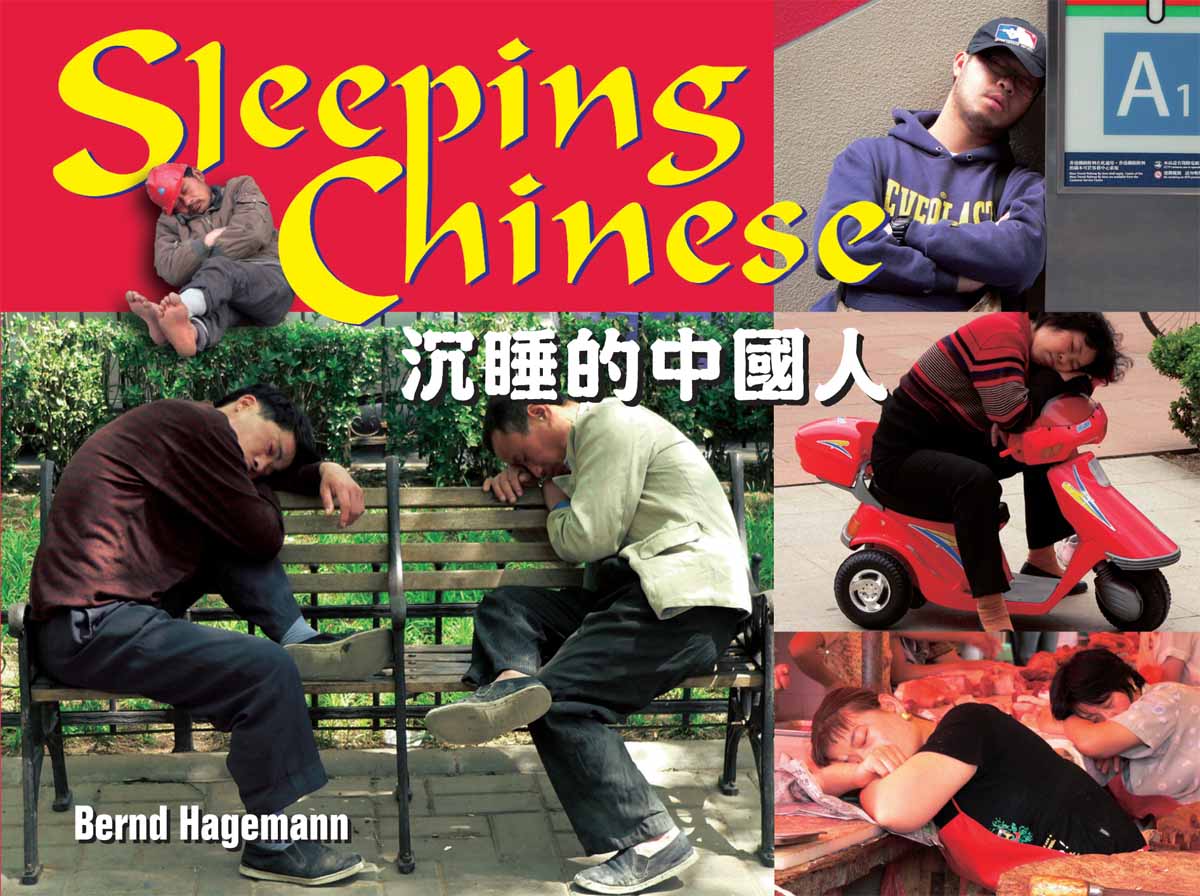
Casual strolls down the streets of China in between boardroom meetings and networking, however, soon revealed to Hagemann a far less threatening side of China. So he took out his point-and-shoot camera and documented what he saw all around him. In just 148 pages, Hagemann’s debut photography book Sleeping Chinese swiftly dispels 9 years of chest-pounding by the PRC propaganda machine.
Sleeping Chinese is a fun little novelty item the exact same dimensions as a postcard that will leave you either laughing out loud or scratching your head in perplexity. The pages are divided into 3 parts: Hard Sleepers, Soft Sleepers and Group Sleepers, a clever allusion to China’s train carriage classification system.
Hard Sleepers: “Those who snooze in hard and uncomfortable places can fall asleep anywhere – even on a pile of bricks in a construction site!” Hagemann defines.
Witness, then, the dozens of people who have drifted into deep slumber atop stones, wood, mortar blocks, concrete and even cold slabs of raw meat. The most comical of the chapter being the dozing shoe repair man balancing precariously on a saw horse with an extra 2×4 for a pillow.
Soft Sleepers: “A little more fussy than their hard sleeper comrades,” the chapter intro explains, “fussy” meaning in plastic wash bins, hammocks slung under freight trucks, sleeping lengthwise across a motor scooter and even a laborer using a tape measure to cover his eyes.
Group Sleepers: “A traveling family needs no pillows when they have each other’s knees.” Truly, the photo of the family of five all huddled together like newborn puppies gives greater meaning to ‘jiating,’ China’s family unit.
Some Chinese might take offense to Hagemann’s photographic agenda, but anyone with a sense of humor will see that the book was made out of affection.
“I’d like to express my appreciation of the hard work and effort put in by migrant workers who play a central role in China’s success story but seldom receive the attention they deserve,” writes Hagemann.
Indeed, anyone who has spent quality time in China knows that these laborers, more than anyone else, deserve their rest — anywhere they can get it.
None of the snapshots in Sleeping Chinese were staged. Any foreign tourist in China who bothers to stray from his package tour group or get out of his hotel for a jaunt off the tourist trail will see these exact same sights, and more.
Incidentally, taking and publishing photos of sleeping Chinese people will often land a foreign tourist in hot water if caught by the authorities (the subjects themselves tend not to mind).
People’s Daily newspaper, the official mouthpiece of the Politburo, even attempted to put a socialist spin on Hagemann’s revealing imagery in an article about Sleeping Chinese: “If (we) are tired, (we) lie down anywhere and anytime and sleep. This shows (our) society’s accepting attitude.”
Regarding the western media’s scare tactics of China’s “waking dragon,” this reviewer is reminded by Sleeping Chinese of a particular song from old-school hip-hop artists Public Enemy (who I had occasion to watch perform during their 2007 tour through Beijing): Don’t Believe the Hype!
Belief in vampires is not confined to the people of Transylvania, and half humans able to transform themselves into monsters are no strangers to Chinese folklore. Some tales may be traced back to the third century AD.
Since Bram Stoker’s Dracula was published in 1897, this makes a case that vampire folklore may have originated in China and traveled west along the Silk Road almost two thousand years ago.
The Chinese vampire is called a Jiang-shi (also spelled Kaing-shi or Chiang-shih). However, Chinese vampires are different from Dracula or Anne Rice’s vampires.
Chinese folklore says the Jiang-shi is stiffened by rigor mortis and these vampires have to hop to get around. The Jiang-shi also finds its victims by smelling your breath, so if a hungry Jiang-shi is about, it is best to stop breathing.
In the 1980s, there was a series of vampire movies produced in Hong Kong. The first in the series was Mr. Vampire (you may watch Mr. Vampire here. For parts two through ten, scroll down to the embedded YouTube series at the bottom of this post).
Mr. Vampire – Part 1/10 with English subtitles
Ricky Lau directed Mr. Vampire and the producer was Sammo Hung.
Chopper Time says, “Almost all of these movies are pretty watchable, but the best of the bunch was the first one, an expert horror-comedy called Mr. Vampire.”
There were a few Taiwanese vampire films, which include The Vampire Shows His Teeth (a series of three films (1984-1986), New Mr. Vampire (1985), Elusive Song of the Vampire (1987) and Spirit versus Zombie (1989).
Today, Vampires stories are becoming popular in mainland China. Tom Carter, an American author and expatriate living in China, says Twilight is a popular pirated novel and some Twilight fans are now writing their own fan-fiction and vampire stores in Chinese on their Blogs.
In fact, a shop called the Vampire opened its doors recently in Beijing to sell vampire, zombie, and werewolf blood along with Satan poison and UFO fuel.
“The shop, which opened September 20, is reportedly the first of its kind in Beijing. The storefront also has a stained-glass window adorned with a miniature vampire model sucking blood from a cup held in his skeletal hand.”
Another excellent Chinese movie is Farewell My Concubine but there are no vampires in this film.
______________
Lloyd Lofthouse is the award-winning author of the concubine saga, My Splendid Concubine & Our Hart. When you love a Chinese woman, you marry her family and culture too.
If you want to subscribe to iLook China, there is a “Subscribe” button at the top of the screen in the menu bar.
 A review (guest post) by Tom Carter of Daughter of Xanadu by Dori Jones Yang


 Posted by Lloyd Lofthouse


 iLook China