China’s Fighting Singing Crickets

September 4, 2010

The first time I read about China’s singing crickets was in “Empress Orchid” by Anchee Min.  Retired concubines spent time carving gourds where these crickets lived to entertain empresses, emperors and princes.

I learned about China’s fighting critics from a comment on this Blog and there was a link included.  

While writing this post, I Googled the subject. In Gardening4us.com, Catherine Dougherty tells us, “cricket culture in China dates back to the Tang Dynasty (618 – 906 AD).” 

She says, “It was during this time the crickets first became respected for their powerful ability to ‘sing’ and a cult formed to capture and cage them. And in the Sung Dynasty (960 – 1276 AD)… cricket fighting became popular.”

In TrueUp.net, Kim says, “The Chinese consider the cricket to be a metaphor for summer and courage…”

We learn from Pacific Pest Inc. that, “Crickets are popular pets and are considered good luck in some countries; in China, crickets are sometimes kept in cages, and various species of crickets are a part of people’s diets … and are considered delicacies of high cuisine in places like Mexico and China.”

From Home Made in China, we learn in a comment from Gogovivi, who is based in Qingdao, North China that, “Summer used to mean picking berries in the yard and making jam, canning green beans, going to the farmer’s market, BBQs, lawn mowing, hiking, swimming. Now my whole family looks forward to the arrival of singing crickets.”

See A Stylish Assault Against Pornography

_______________

Lloyd Lofthouse is the award-winning author of the concubine saga, My Splendid Concubine & Our Hart. When you love a Chinese woman, you marry her family and culture too. 

Sign up for an RSS Feed for iLook China


Hsuan-tsang – From China to India for Enlightenment

August 27, 2010

I mentioned Hsuan-tsang (Xuanzang) when I wrote about China’s Three “Journey’s to the West”. However, in that post I did not go into detail about the real Buddhist monk who made the journey.

While doing some research about his life, I discovered an intellectual discussion at Philosophy and Marxism Today.  If this topic interests you and you want to learn more about Buddhism I recommend reading this conversation between Thomas Riggins and Fred.

Thomas starts with, “I’ll start with background based on Chan’s introductory remarks.

“Hsuan-tsang (596-644) was quite a character. He entered a Buddhist monastery when he was thirteen. Then moved around China studying under different masters. Finally, he went off to India to study Buddhism at its source and with Sanskrit masters.

“He spent over ten years in India, wrote a famous book about his journey, and returned to China with over six hundred original manuscripts.

“He spent the rest of his life with a group of translators rendering seventy five of the most important works into Chinese. All of this work was sponsored by the Emperor of the newly established T’ang Dynasty (618 – 906 AD).”

The book I have on Hsuan-tsang says he lived from 602 to 664 AD.

_______________

Lloyd Lofthouse is the award-winning author of the concubine saga, My Splendid Concubine & Our Hart. When you love a Chinese woman, you marry her family and culture too. 

Sign up for an RSS Feed for iLook China


China’s Privately Passionate Poetry

July 26, 2010

I’m sure that most Westerners do not think of love poems when they think of China. However, there has to be a reason for more than 1.3 billion people besides the Great Wall of China, the Pacific Ocean and the biggest mountain range on the planet, the Himalayas, which helped wall China from the violence that rocked the rest of the world for centuries—at least until the Opium Wars.

For poetry lovers, this book imparts a sense of the private passion that beats in the Chinese heart. The three arts of poetry, calligraphy and painting, the Triple Excellence, are represented on the pages.

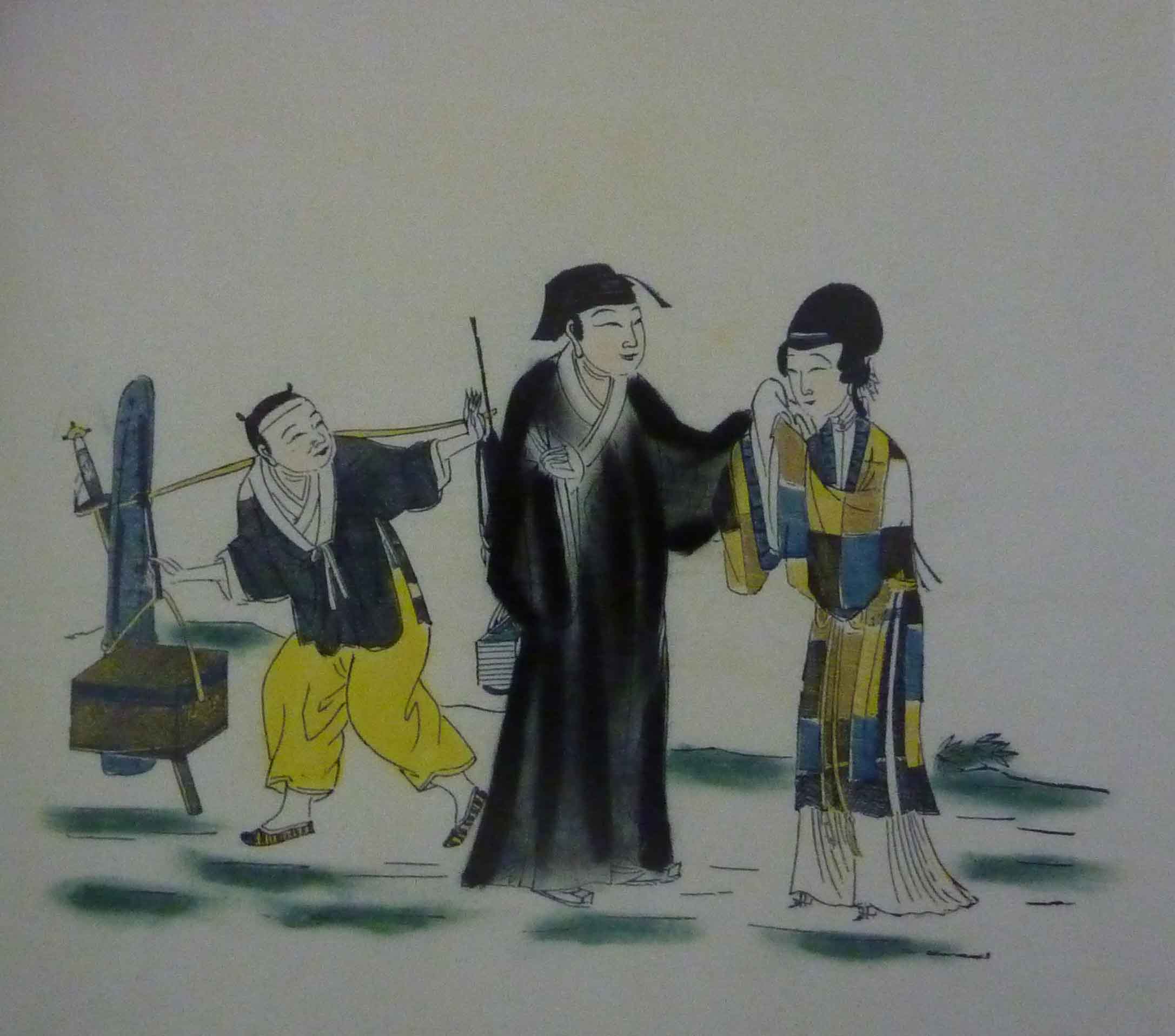
The painting, lady weeping at parting from husband, 17th century, comes from the Qing Dynasty and the book says it is a color woodblock print on paper.

Chinese poetry is frequently personal and often linked to a particular occasion (page 9).

Deeply in love, but tonight
we seem to be passionless;
I just feel, before our last cup of wine
a smile will not come.
The wax candle has sympathy ­­–
weeps at our separation:
Its tears for us keep rolling down
till day breaks.

by Du Mu (803-852 AD)

As you can see, the Chinese are a passionate people—they just don’t dramatize these passions publicly as many in the West do—at least until the West invaded China to force—if possible—a different set of values on China’s collective culture.

The Golden Age of Poetry in China was in the Tang Dynasty (618-906 AD).  This book of Chinese Love Poetry was edited by Jane Portal (© 2004) and published by Barnes & Noble Books (ISBN 0-7607-4833-0).

discover China’s Sexual Revolution or Yu Opera with Mao Wei-tao

_______________

Lloyd Lofthouse is the award-winning author of My Splendid Concubine [3rd edition]. When you love a Chinese woman, you marry her family and culture too. This is the love story Sir Robert Hart did not want the world to discover.

His latest novel is the multiple-award winning Running with the Enemy.

Subscribe to “iLook China”!
Sign up for an E-mail Subscription at the top of this page, or click on the “Following” tab in the WordPress toolbar at the top of the screen.

About iLook China

China’s Holistic Historical Timeline


Accidental Discovery of Gunpowder

July 17, 2010

Sulfur is the main ingredient for gunpowder. It was first developed during the Tang Dynasty (618 – 907 AD). During the Northern Sung Dynasty, in 1044 AD, the book “Essentials of Military Art” published several formulas for gunpowder production. It is ironic that the Sung Dynasty (960 – 1276 AD) used a Tang Dynasty invention to defeat them.

Several ingredients for gunpowder were in wide use for medicinal purposes during the Spring and Autumn Period of China’s history (722 – 481 BC).

According to the famous book “Records of History”, Chang Sangjun, shared secret prescriptions with Pien Ch’iao (around 500 BC), who promised not to give the secret away then became famous as a doctor of Chinese medicine.

Gunpowder was discovered a thousand years ago by accident.  While mixing ingredients to find an elixir for immortality, Chinese scientists stumbled on the formula.  Fireworks and rockets came first to scare away evil spirits. The irony is that gunpowder, which has killed millions used as weapons, came about during the search for eternal life.

One theory says that the knowledge of gunpowder came to Europe along the Silk Road around the beginning of the 13th century, hundreds of years after being discovered in China. It is also ironic, that Britain and France used advanced gunpowder weapons to defeat China during the 19th century in the two Opium Wars.

For other Chinese inventions, see China Points the Way – the invention of the compass

_________________________

Lloyd Lofthouse is the award-winning author of the concubine saga, My Splendid Concubine & Our Hart. When you love a Chinese woman, you marry her family and culture too. 

To subscribe to “iLook China”, look for the “Subscribe” button at the top of the screen in the menu bar, click on it then follow directions.


Invented in China—Printing

July 9, 2010

Six hundred years after paper was invented, the Chinese invented printing and the first printed work was Buddhist scripture during the Tang Dynasty (618 – 906). The most basic printing techniques are older. Engraving came later. The carving, printing technique originated during the Tang Dynasty

When we talk about paper and printing, it is to collect knowledge, preserve and share it.

Once there were paper books being printed to share Buddhist ideas, the religion spread through China into Korea and Japan. Over a thousand years printing techniques continued to improve until there were multi-colored printings.

Then during the Sung Dynasty, the printing board was invented, which used clay characters. One character was carved into a small block of clay. Then the clay was put in a kiln to heat into a solid block. This method was efficient for printing thousands of sheets. These blocks would be placed together to create sentences and paragraphs of Chinese characters.

Later, the characters were carved into wood. Over time, printing was developed into an art.  In fact, Ancient Chinese culture was preserved due to the invention of paper and these printing methods, which wouldn’t reach Europe until after 1300 AD, almost 800 years later.

Without the Chinese invention of printing, Christianity, Islam and Buddhism may not have spread to the extent that they have.

See With or Without Paper

_________________________

Lloyd Lofthouse is the award-winning author of the concubine saga, My Splendid Concubine & Our Hart. When you love a Chinese woman, you marry her family and culture too. 

To subscribe to “iLook China”, look for the “Subscribe” button at the top of the screen in the menu bar, click on it then follow directions.