Growing Cautiously Into a Modern Republic – Part 2/7

October 23, 2010

In Part 1, I talked about how Sun Yat-sen was the father of China’s republic and how Chiang Kai-shek destroyed any chance of having a two-party republic after Sun died.

Even after the Chinese civil war ended in 1949, it would take decades to prepare the people so Sun Yat-sen’s dream becomes a reality.

By reading India Falling Short, you will discover what happens when a democracy or republic moves too fast from a feudal society to a modern one.

For a republic or a democracy to survive, people must be educated and literate.

In fact, literacy in the US is listed at 99 percent. However, studies assert that 46% to 51% of U.S. adults read so poorly that they earn “significantly” below the threshold poverty level for an individual. This means that the chances of the US surviving as a republic or democracy are grim.

In 1949, when the Communists came to power about 32% of the people above the age of 12 could read.

By 1976, literacy was 20% when Mao died. The reason literacy had dropped so much was because of Mao’s Great Leap Forward and The Cultural Revolution, which the nine top leaders of the Communist Party voted against.

Mao had those men eliminated or removed from power one at a time and went ahead with The Cultural Revolution.

Today, literacy in China is more than 90%. See China’s Literacy Policies

During the Tiananmen Square incident, Deng Xiaoping said that the Party wanted democracy for China, but Western style democracy would bring the economic growth to a grinding halt because the country (as India still is) wasn’t ready yet to become a democracy or the kind of republic Sun Yat-sen envisioned.

In 1989, China’s literacy program was in its infancy. Almost a billion people in rural China lived in conditions similar to serfs during Europe’s Dark Ages.  China’s cities had not been rebuilt.

Return to Growing Cautiously Into a Modern Republic – Part 1

______________

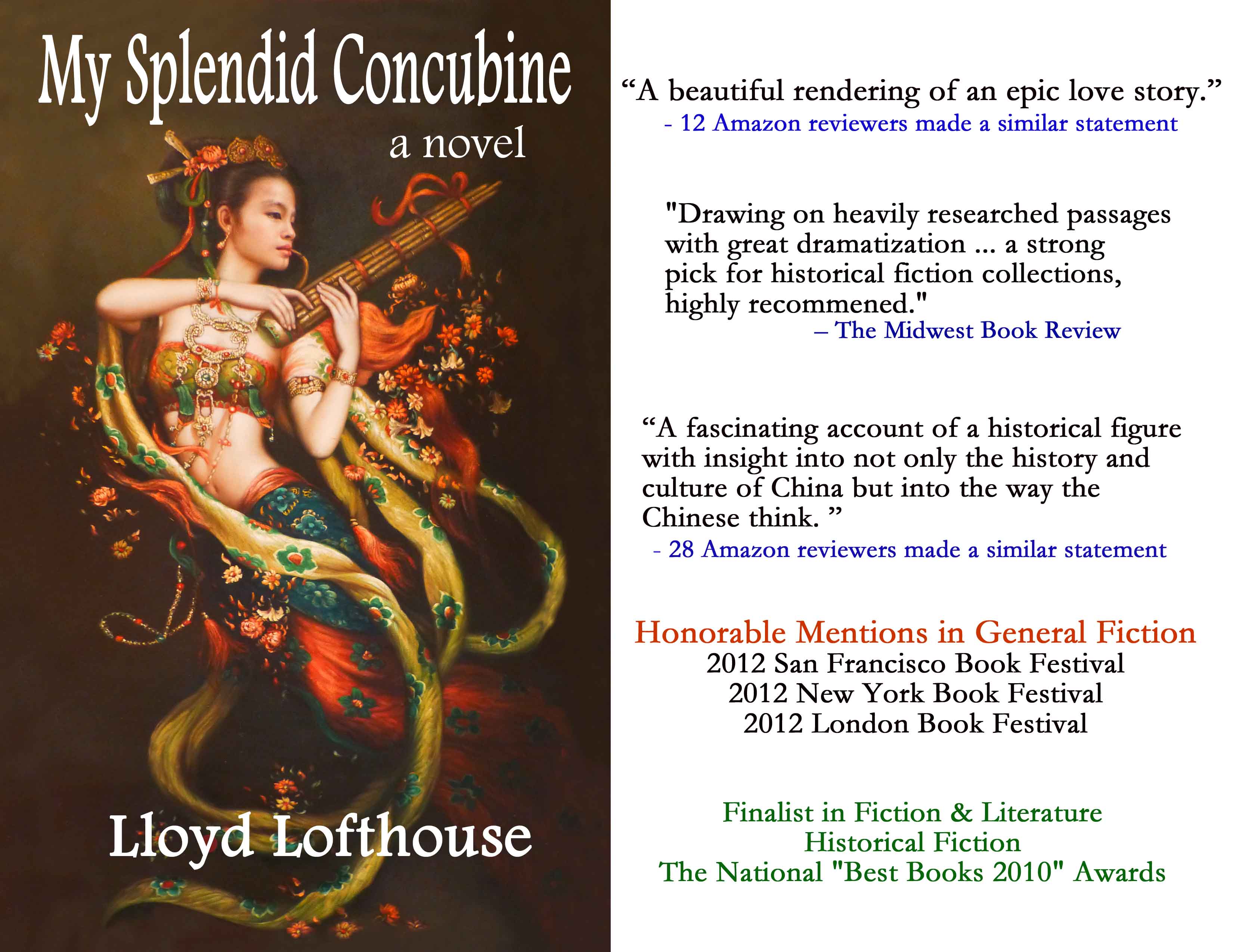
Lloyd Lofthouse is the award-winning author of the concubine saga, My Splendid Concubine & Our Hart. When you love a Chinese woman, you marry her family and culture too. 

If you want to subscribe to iLook China, there is a “Subscribe” button at the top of the screen in the menu bar.


Growing Cautiously Into a Modern Republic – Part 1/7

October 23, 2010

The China Law Blog challenged an opinion I wrote about China becoming a republic with more freedom for the people.

I wrote, “The Economist wants India to win this race, because it is called a democracy as is the U.S., but what isn’t mentioned is that China is becoming a republic with a Chinese twist, which is what Dr. Sun Yat-sen wanted.… Once you read the two pieces in The Economist, you may understand why India’s democracy cannot beat China’s evolving republic.” Source: Comparing India and China’s Economic Engines

The China Law Blog criticized this post saying, “In other words, iLook takes what he sees as China’s aspirations and assumes (without a shred of factual support or even argument) that China will very shortly fully achieve those aspirations.”

I don’t recall writing “very shortly“.

In fact, the freedoms the world’s democracies are urging China’s government to implement ASAP may not materialize for decades and some freedoms found in the West may never appear.

To understand why China may be moving toward more freedom slowly, the best place to start is with Dr. Sun Yat-sen (1866 – 1925)

Sun is known as the father of China’s Republic.

To achieve this dream, Sun started by unifying the Communists and Nationalists into a two-party republic in southern China in the early 20th century. Both parties respected Sun, and he made it work.

Unfortunately, Sun died in 1924 at a time when China was in ruins and torn by anarchy and violence between competing warlords.

Then, Chiang Kai-shek, who was a member of the ruling class and a man who hated the Communists, went on a rampage slaughtering Communists and igniting a civil war that would rage even after Japan invaded during World War II. 

Chiang’s first move against the Communists was in the south. His next was in Shanghai to break the labor unions the Communists had been organizing to improve the lives of sweatshop labor working in foreign owned factories. 

Chiang Kai-shek’s goal was to exterminate the labor unions and the Communists, and he had support from the foreign factory owners.

The Communists that survived had no choice but to defend themselves. Surrender wasn’t an option.

Decades later, in 1949, the Communist Party won the revolution under Mao’s leadership and with the support of China’s peasants.

Chiang Kai-shek would flee to Taiwan and protected by the US, he would rule that island under martial law as a brutal dictator for twenty-six years. Taiwan would not become a democracy until years after Chiang and Mao’s deaths.

______________

Lloyd Lofthouse is the award-winning author of the concubine saga, My Splendid Concubine & Our Hart. When you love a Chinese woman, you marry her family and culture too. 

If you want to subscribe to iLook China, there is a “Subscribe” button at the top of the screen in the menu bar.


Comparing India and China’s Economic Engines

October 13, 2010

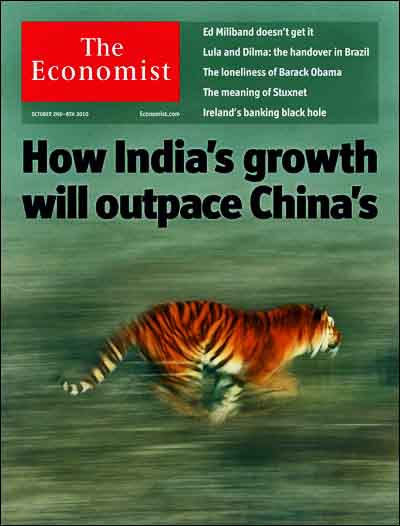
The cover for The Economist of October 2 – 8, 2010, is betting on a race that cannot be won by India.


I opened the magazine and read the two pieces that the cover was about.  One is about India’s surprising economic miracle and the second piece was A bumpier but freer road.

On page 11, I read, “many observers think China has done a better job than India of curbing corruption…”

On page 77, a Western banker was quoted saying, “It’s much easier to deal with the well-understood ‘org chart’ of China Inc than the freewheeling chaos of India.”

After reading both pieces comparing China with India, it was obvious that India would never beat China economically.

The Economist wants India to win this race, because it is called a democracy as is the U.S., but what isn’t mentioned is that China is becoming a republic with a Chinese twist, which is what Dr. Sun Yat-sen wanted.

The reason The Economist is wrong about India is because America’s Founding Fathers hated democracy and they had a good reason.

The Live Journal goes into detail on this topic.  To quote the Live Journal, “It would be an understatement to say that the (U.S.) Founding Fathers hated democracy. They warned against it vehemently and relentlessly. They equated it – properly – with mob rule.

“in a democracy, two wolves and a sheep take a majority vote on what’s for supper, while in a constitutional republic (which China is becoming), the wolves are forbidden on voting on what’s for supper and the sheep are well armed.…

“The Founders, who hated democracy, gave us a free country (a republic). Our (meaning many Americans) ignorance of history, which has lead to a love of democracy, is causing us to surrender our freedoms at an alarming rate.”

Dr. Sun Yat-sen (1866 – 1925), known as the father of modern China, said he wanted to model China’s government after America but by combining Western thought with Chinese tradition.

When he said this, it was 1910, and America, by definition, was still a republic. Once you read the two pieces in The Economist, you may understand why India’s democracy cannot beat China’s evolving republic.

This topic is continued (with more details and facts) at India Falling Short

_______________

Lloyd Lofthouse is the award-winning author of My Splendid Concubine [3rd edition]. When you love a Chinese woman, you marry her family and culture too. This is the love story Sir Robert Hart did not want the world to discover.

Subscribe to “iLook China”!
Sign up for an E-mail Subscription at the top of this page, or click on the “Following” tab in the WordPress toolbar at the top of the screen.

About iLook China


Chiang Kai-shek

July 23, 2010

Chiang Kai-shek (also known as Jiang Jieshi) was born on October 31, 1887. His family was from the upper class and was wine merchants. At 18, he attended a military college in Japan. Chiang had four wives during his life. His first wife died in the Second Sino-Japanese War. His second wife contracted gonorrhea from Chiang (a known womanizer) soon after they married. His most famous wife lived to 106 and died in 2003. Before one marriage, he converted to Christianity as a condition to marry.

After training in Japan, he went to Russia to study the Soviet government and decided he did not care for the Communists. Returning to China, Sun Yat-sin appointed Chiang to command a military academy

Under Sun Yat-sen the Communists and the Nationalists worked together to rule China, and Soviet advisers provided the help needed to increase their power since most of China was ruled by warlords.

However, when Sun died in 1925, Chiang led the Kuomintang army north to defeat the warlords and destroy the Communists.

Meanwhile, in Shanghai, the Communist Party had organized labor unions to improve working conditions in the low paying sweat-shop factories. During Communist organized labor strikes, these factories were shut down.

When Chiang Kai-shek army reached Shanghai, he joined forces with gangsters then went on a killing spree known as the White Terror. Tens of thousands of workers, who belonged to the labor unions organized by the Communists, were hunted down and killed along with their Communist leaders. One of the few to escape was Mao Zedong.

For the next few years, Chiang would rule China unchallenged until 1931, when Japan invaded. During the early months of the war, Chiang ignored Japan and continued hunting for the Communist survivors, who had fled into the countryside.

In 1949, when Mao won the civil war, Chiang Kai-shek took the survivors of his nationalist army to Taiwan where, protected by the US military, he declared brutal martial law and ruled as a dictator until he died on April 5, 1975 at the age of eighty-seven.

______________________________

Lloyd Lofthouse is the award-winning author of My Splendid Concubine [3rd edition]. When you love a Chinese woman, you marry her family and culture too. This is the lusty love story Sir Robert Hart did not want the world to discover.

#1 - Joanna Daneman review posted June 19 2014

Where to Buy

Subscribe to “iLook China”!
Sign up for an E-mail Subscription at the top of this page, or click on the “Following” tab in the WordPress toolbar at the top of the screen.

About iLook China

China’s Holistic Historical Timeline


Dr. Sun Yat-Sen – China’s Democratic Revolutionary

July 23, 2010

“An individual should not have too much freedom. A nation should have absolute freedom.”
– Dr. Sun Yat-Sen (1866 – 1925)

He is referred to as the father of modern China.  If there were no Sun Yat-Sen and his revolution, there would be no modern China as it is becoming today.

While attending a Christian school in Hawaii, he converted to Christianity, which may have shaped his revolutionary future. It was obvious that his writing was influenced by American thought. With the support he received from the Hawaiian Chinese community, he networked with Chinese people all over the world.

He went on to publish revolutionary ideas seeking to overthrow the Manchu Dynasty and create a democratic China. In 1904, he wrote that he wanted to model China’s government after America but by combining Western thought with Chinese tradition.

Yet, he was considered an idealistic dreamer – that his ideas were impractical.

He said, “The whole world is one family.” (1910)

______________________________

Lloyd Lofthouse is the award-winning author of My Splendid Concubine [3rd edition]. When you love a Chinese woman, you marry her family and culture too. This is the lusty love story Sir Robert Hart did not want the world to discover.

2015 Promotion Image for My Splendid Concubine

Subscribe to “iLook China”!
Sign up for an E-mail Subscription at the top of this page, or click on the “Following” tab in the WordPress toolbar at the top of the screen.

About iLook China

China’s Holistic Historical Timeline