Long before Romeo and Juliet there was China’s Butterfly Lovers

August 25, 2015

The legend of The Butterfly Lovers first appeared in 618 AD during the Tang Dynasty, and it’s a tragic Chinese love story similar to Romeo and Juliet.

The basic premise is of a young woman in China wanting to go to school. Since boys were the only ones allowed to attend school, this young woman, like Barbara Streisand in the movie Yentl (1983), disguised herself as a boy.

Yentl was based on Isaac Bashevis Singer’s (1902 – 1991) short story Yentl the Yeshiva Boy.

When I talked to my wife about this, she found her copy of a popular theme song from The Butterfly Lovers played as a violin solo by Yu Lina. As the house filled with the music, which may also be found on the next embedded YouTube video, my wife started to dance.

She said, “This is one of my favorites. I cannot resist dancing when I hear it.”

In fact, Yentl the Yeshiva Boy and Shakespeare’s (1564 – 1616) Romeo and Juliet must be combined to become The Butterfly Lovers. What starts as a charade becomes a love story ending in the suicide of the two young lovers.

The love story of Liang Shanbo and Zhu Yingtai is one of four Chinese folk legends and one of the most influential and best known in China.

China has traded with the West since the Han Dynasty (206 BC – 219 AD). There was an overland route in the north and a sea route in the south, which the Roman Empire used around the time of Christ.

Since China traded with the West for more than two thousand years, it is conceivable that The Butterfly Lovers reached the West and was adapted by Shakespeare and then Singer after being exposed to the plot.

______________________________

Lloyd Lofthouse is the award-winning author of My Splendid Concubine [3rd edition]. When you love a Chinese woman, you marry her family and culture too. This is the lusty love story Sir Robert Hart did not want the world to discover.
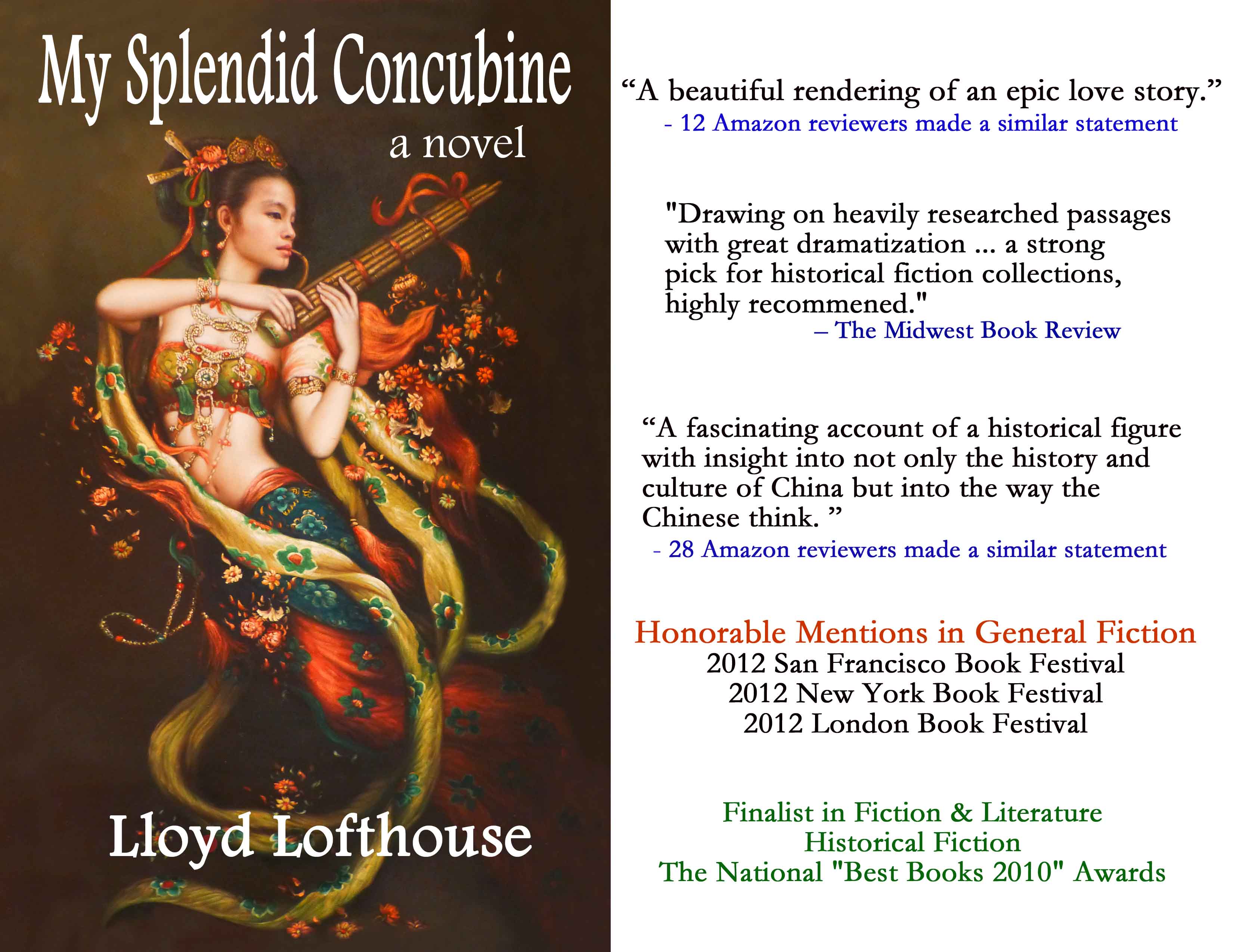
2015 Promotion Image for My Splendid Concubine

Subscribe to “iLook China”!
Sign up for an E-mail Subscription at the top of this page, or click on the “Following” tab in the WordPress toolbar at the top of the screen.

About iLook China

China’s Holistic Historical Timeline


The Butterfly Lovers

March 25, 2011

Recently, I received a comment on my Romeo and Juliet in China post. Y Chan wrote that there were two Chinese tragic love stories similar to Romeo and Juliet.

Chan said, “You probably cannot be regarded as knowing Chinese culture if you do not know these two love stories.”

One of the stories Chan mentioned was The Butterfly Lovers. The other was “the story of Lady White Snake“, which first appeared in 618 AD during the Tang Dynasty.

I’ve heard of The Butterfly Lovers before. The basic premise is of a young woman in China wanting to go to school. Since boys were the only ones allowed to attend school, this young woman, like Barbara Streisand in the movie Yentl (1983), disguised herself as a boy.

Yentl was based on Isaac Bashevis Singer’s (1902 – 1991) short story Yentl the Yeshiva Boy.

When I mentioned what Chan wrote in the comment, my wife found her copy of a popular theme song of The Butterfly Lovers played as a violin solo by Yu Lina. As the house filled with the music, which may also be found on the following embedded YouTube video, my wife started to dance.

She said, “This is one of my favorites. I cannot resist dancing when I hear it.”

In fact, Yentl the Yeshiva Boy and Shakespeare’s (1564 – 1616) Romeo and Juliet must be combined to become The Butterfly Lovers. In The Butterfly Lovers what begins as a charade becomes a love story ending in the suicide of two young lovers.

The legend of The Butterfly Lovers first appeared during the Jin Dynasty 1600 years ago. The love story of Liang Shanbo and Zhu Yingtai is one of four Chinese folk legends and one of the most influential and best known in China.

China has traded with the West since the Han Dynasty (206 BC – 219 AD). There was an overland route in the north and a sea route in the south, which the Roman Empire used around the time of Christ.

Since China has traded with the West for more than two thousand years, it is conceivable The Butterfly Lovers reached the West and was adapted by Shakespeare and Singer after being exposed to the plot.

______________

Lloyd Lofthouse is the award-winning author of the concubine saga, My Splendid Concubine & Our Hart. When you love a Chinese woman, you marry her family and culture too.

If you want to subscribe to iLook China, there is a “Subscribe” button at the top of the screen in the menu bar.


Romeo and Juliet in China

February 12, 2011

Shakespeare’s drama Romeo and Juliet is often taught to ninth graders in US high schools. Other Shakespeare plays are studied at other grade levels and in college.

However, you may be surprised to discover Shakespeare is probably more popular in China since his work is taught in most Chinese universities, both in English and in Chinese and Shakespearean texts are easily available in China in both languages.

When Mao ruled China (1949 to 1976), Shakespeare was banned as was Aristotle and other Western philosophers.  Mao died in 1976. That ban was lifted in 1978.

In fact, according to Zhaoxiang Cheng, the author of  Teaching Shakespeare in China, “It is no exaggeration to say that every educated Chinese knows something about Shakespeare.”

However, when produced in China on stage, the plot may not stay true to the original Shakespeare.

Writing for the The People’s Republic of Shakespeare, Adventures in Chinese Research, Meammi says, “My interest in this topic started when I noticed that many of the Romeo and Juliets performed in China are either parodies or rewrites where one of the lovers survives in the end.

“China has their own pair of star-crossed lovers (The Peony Pavilion – 1598 AD), who tragically die for love and their plight is described in a much more mournful tone than Shakespeare’s version.

“Some Chinese theatre companies state in interviews that their audiences have too much sadness in their lives so Romeo just can’t die in the end of their performance.”

Discover Chinese Yu Opera with Mao Wei-tao

______________

Lloyd Lofthouse is the award-winning author of the concubine saga, My Splendid Concubine & Our Hart. When you love a Chinese woman, you marry her family and culture too.

If you want to subscribe to iLook China, there is a “Subscribe” button at the top of the screen in the menu bar.