Modern Chinese Parents and Children – Part 1/3

May 29, 2011

A Guest post from Hannah in China

Before I start to talking about Chinese parents and children, first let us have a look of the currently pretty hot arguing book, Battle Hymn of the Tiger Mother, which is a Chinese-American Yale law professor mom that wrote about how she was strict with her two daughters by making a lot of can’t doing rules, and she was acting like a wicked witch to push them to study.

I will not comment on which parenting method is better, Chinese or Western.

What I want to say is the book’s author Amy Chua’s way of parenting is typically Chinese though she is 4th-generation American.

Note from Blog host: Evidence of this may be found among reviews and comments on Amazon.UK. Rosie in the UK wrote, “I am Chinese now living in the UK and I admit I was outraged when I first read the WSJ excerpt of her (Amy Chua’s) book. My first thoughts were I can’t believe anyone would do something like that to their children. However, as I thought more about it and I guess living out here in the UK I’ve been so used to the numbing and dummying of our children’s perceived fragile self esteem and always making sure that their feelings and wants are met for fear of damaging them emotionally, I forgot that, hey, I was brought up pretty much the same way.”

Hanna says, “We Chinese have a long history of parents being strict with their children. From old days, the Ke Ju Kaoshi (official examination) was the only chance for people to change their fate and life.

“To achieve this, they must study really hard. We have an old saying about this “Shi Nian Han Chuang Ku Du Ri, Jin Chao Jin Bang Ti Ming Shi”, which means “Ten years of study at a cold window only for the day of passing the examination.”

“To study, students must be pushed even by using the stick.”

Continued on May 30, 2011 with Modern Chinese Parents and Children – Part 2

View as Single Page

Discover Hannah’s review of Red Mansion, a Chinese TV series, or visit her Blogs at Hannah Travel Adventure (Chinese) or Hannah China Backpacker (English)

______________

To subscribe to “iLook China”, look for the “Subscribe” button at the top of the screen in the menu bar, click on it then follow directions.


China’s Future Political Divide Revealed

May 24, 2011

A report by Melissa Chan for Al Jazeera reminded me of America’s political divide between red (Republican) and blue (Democratic) states.

If we look at the four US presidential elections between 1996 – 2008, we discover the political divide in America, and it is mostly between large urban population centers and rural/middle America as if America were two countries — not one.

A similar split may be growing in China, and Melissa Chan’s report, “China’s Youth Divided over Superpower Status” reveals the divide that parallels America’s split between old-world conservative values and new-world, compassionate idealism.

Chan reported from Beijing April 8, 2011 revealing China’s (middle-class urban) youth were living the wild life dancing the nights away as North American and European youth have been doing for decades.

For China’s form of new-world idealism, the music is heavy metal. “Stand up!” the musician sings. “Stand up! You are Chinese! Rise Up! You are the descendents of the dragon!”

“However,” Melissa Chan says, “this euphoria is qualified by a sense of duty missing in the West.”

Hu Song, the lead singer of Yakso, a popular heavy metal group, told Chan, “China most certainly has emerged as a power. But I hope with great power…people’s spirits will also rise up or else it is a problematic power.”

After watching the Al Jazeera news report, it was obvious that many rural youths do not agree with the middle-class urban youths that have the luxury to spend nights dancing to heavy metal, a lifestyle imported from the West along with American fast food, which brought an epidemic of diabetes and heart disease to urban China.

For some (mainly among China’s 700 million rural Chinese) this is expressed in pride and patriotism.

Others (mainly middle-class urban youth) are more skeptical of their leaders, raising their voices through the medium of a dynamic youth counterculture such as heavy metal music with long nights of dancing accompanied by increased drug use as in the West.

There is another difference between rural and urban China. The one-child policy, which focused mainly in urban areas while many peasants on farms in rural China were allowed to have more than one child so there were more hands to work the field. This helped most of rural China avoid raising little emperor/empresses — another explanation for the growing division in thought.

______________

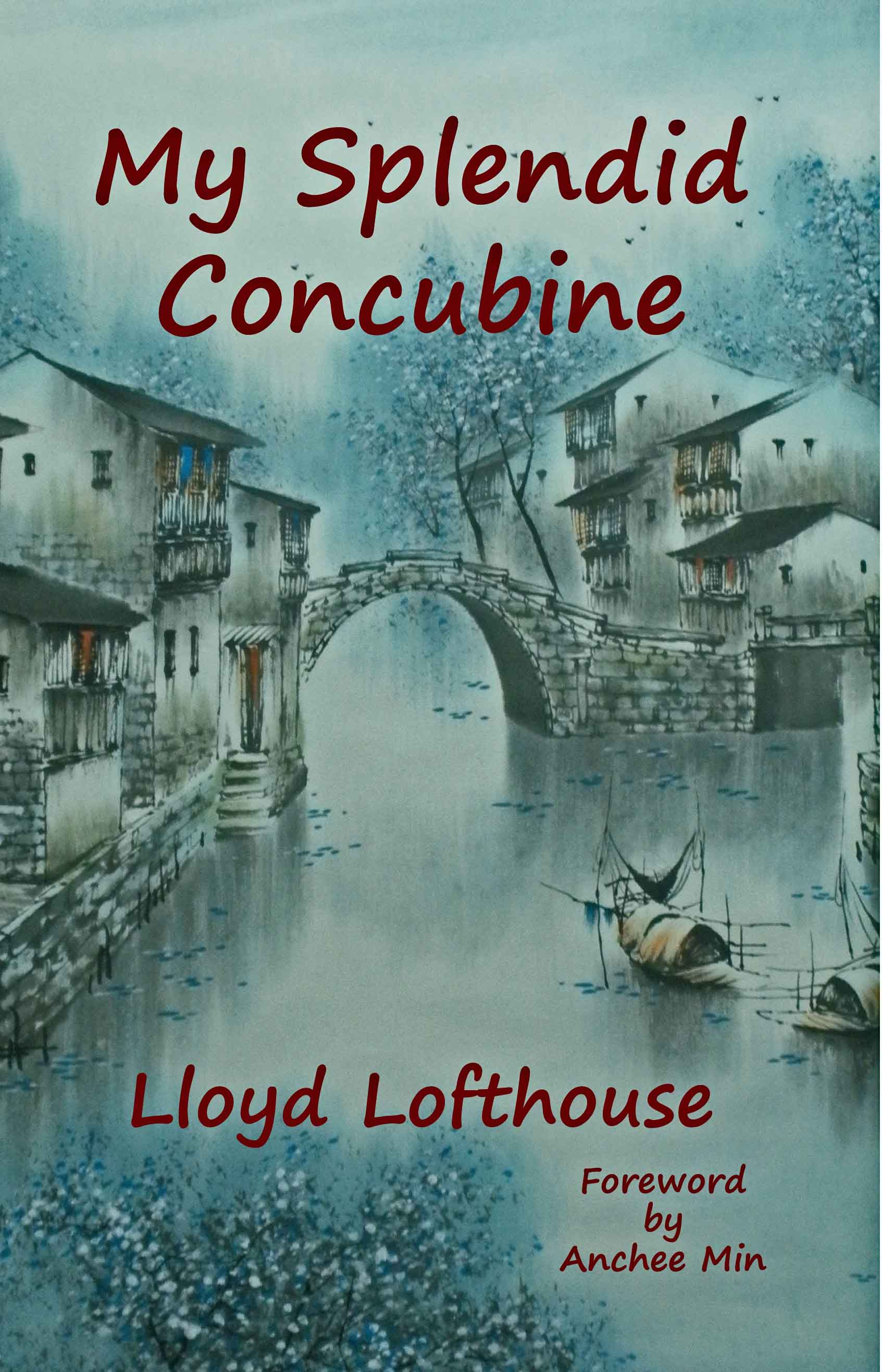
Lloyd Lofthouse is the award-winning author of the concubine saga, My Splendid Concubine & Our Hart. When you love a Chinese woman, you marry her family and culture too.

To subscribe to “iLook China”, look for the “Subscribe” button at the top of the screen in the menu bar, click on it then follow directions.


The Concubine’s Journey

January 17, 2011

In 1999, I was introduced to two dead people. One was a white guy from Ireland that died a hundred years ago and the other was Ayaou, a Chinese woman that was a mystery since Robert Hart tried to erase her from his personal history.

I’m fortunate that Hart failed and traces of Ayaou survived.

Since I was a child of seven or eight, I’ve been writing stories. They were short with lots of bad drawings.

Soon after I was honorably discharged from the US Marine Corps in 1968, I took my first writing workshop at a community college. Then Ray Bradbury came to the campus to speak and although I never read his work, what he said inspired me to never stop writing.

Although I did receive a few encouraging rejections through the decades and was represented by two or three reputable agents before Amazon.com and eBooks were born, nothing I wrote was picked up by a traditional publisher.

Believing I wasn’t good enough, I decided to learn more of the writing craft by earning a BA in journalism. An MFA with a focus in twentieth century American literature came much later.

Between earning the two college degrees, I drove about 150 miles one day each week for seven years to attend a workshop out of UCLA’s writing extension program.

The teacher was a chain smoker with an explosive tempter but she was sharp and several of the writers in her workshop went on to publish their work. When she felt one of her students was ready, she went all out and even found an agent for the author. She found one for me, but that’s another story.

When I published My Splendid Concubine in 2008, I held my breath wondering if anyone would read it and enjoy the lusty, violent story of Robert Hart and Ayaou in the middle of 19th century China immersed in the smoke of the Opium Wars and the oceans of blood of the Taiping Rebellion.

On May 12, 2009, an Amazon reader, an anonymous person in Hong Kong, posted a one-star review of My Splendid Concubine.

The anonymous reader wrote, “As a great fan of Robert Hart’s, I was very eager to get my hands on this book. And what a huge disappointment it proved to be, for many reasons…”

One of those reasons was a “g” missing from one of five “Tang Dynasties” in the novel.

This one-star review was of the first edition. By the time it appeared on Amazon, the second revised edition was out and some of the anonymous reader’s complaints had been corrected.

In three years, My Splendid Concubine earned three honorable mentions in city book festival literary contests then Our Hart earned another four honorable mentions and became a finalist for a national writing award.

About a year ago, the sequel, Our Hart, was submitted to the 18th Annual Writer’s Digest Self-Published Book Awards.

Recently, an envelope arrived from Writer’s Digest.

Jessica Strawser, the editor of Writer’s Digest, wrote that the competition was particularly fierce this year…

Our Hart didn’t win.


This is the book trailer I produced in 2008 of the first edition of
My Splendid Concubine. My wife has been telling me I need a better one and to delete this version.


However, when you enter a book to this Writer’s Digest literary award, a judge writes a commentary of your work and ranks it for plot, grammar, character development, production quality and cover design, which helped dispel the criticism of that one-star review that discovered a missing “g” from one of five “Tang Dynasties” in My Splendid Concubine.

The Writer’s Digest judge, a professional in the publishing industry, awarded grammar a five with five being the highest score.

The judge wrote, “In Our Hart, Elegy for a Concubine, author Lloyd Lofthouse has penned an intriguing story set in an ancient Chinese dynasty. Political intrigue and matters of the heart are both fully explored. The book is meticulously researched and the author’s enthusiasm for his subject is evident.… The author has an ear for natural-sounding dialogue, making Our Hart an engaging read.… That said, readers who enjoy vicariously experiencing other times and cultures will find Our Hart a fascinating journey.”

______________

If you want to subscribe to iLook China, there is a “Subscribe” button at the top of the screen in the menu bar.


The Qing – China’s Last Dynasty – Part 3/3

December 12, 2010

The last travelogue segment takes us on a tour of the Qiao family’s grand courtyard and residence located in Jinzhong, a prefecture in the center of Shanxi Province. Today, this prefecture is home to more than 2.5 million people.

The Qiao family complex shows the blending of the mansion’s practical functions, artistic design and ancient architectural techniques to create complex art in a simple plan.

The details show the glamour of China’s ancient residential house culture in northern China. Each engraving in the mansion is detailed artwork telling a story of life’s philosophy.

The narrator takes us on a tour of a Qiao family courtyard made famous by Zhang Yimou when he directed Raise the Red Lantern. Zhang Yimou won two awards for this 1991 film at the Venice Film Festival.

Raise the Red Lantern also turned the Qiao family’s mansion into a popular tourist attraction. The mansion covers 8,000 square meters (almost 10,000 square yards) of land with 313 rooms.

For security reasons, the roofs are connected.

To build family mansions of this size and scope takes generations of successful businessmen working together as a collective family unit.

However, if a family loses its moral compass, the fortune and land were often lost over time.

These mansions also represent the feudal culture of ancient China.

The last of the three mansions covered in this travelogue was the Chang Mansion, which demonstrates the poetry of a Chinese garden.

Large families such as the Changs built elaborate mansions and gardens. However, the mansions and gardens were built according to rules and guidelines.

Shaanxi province is considered a treasure trove of ancient Chinese architecture.

There are 106 family compounds similar to the four in this travelogue and some date to before the Sung Dynasty (960 to 1276 AD) representing about 70% of China’s surviving ancient wood built architecture.

Return to China’s Last Dynasty – Part 2 or start with Part 1

______________

Lloyd Lofthouse is the award-winning author of “The Concubine Saga”, My Splendid Concubine & Our Hart. When you love a Chinese woman, you marry her family and culture too.

To subscribe to “iLook China”, look for the “Subscribe” button at the top of the screen in the menu bar, click on it then follow directions.


The Qing – China’s Last Dynasty – Part 2/3

December 12, 2010

This segment of the travelogue takes us to the Wong family compound in Lingshi county, Shanxi province. The Wong mansion offers another example of China’s ancient collective culture.

Twenty-seven generations of the Wong family lived in this mansion for 680 years.

To build the mansion and the wall that protects it took more than fifty years.

The narrator points out that the buildings and gardens are well arranged (according to feng shui) and adapted to the geographical conditions.

Three architectural complexes were part of the Wong family compound completed during the Qing Dynasty. This included the Red Gate Fort and an ancestral temple. The area covered 45,000 square meters (almost 54 thousand square yards).

Although the narrator in the video doesn’t mention this, for more than two millennia the Chinese raised their children to follow the Chinese ethical and moral system based on the family and Confucius’s Five Great Relationships.

1. between ruler and subject
2. father and son
3. husband and wife
4. elder and younger brother
5. friend and friend

Instead of being taught from a church pulpit, these values are part of child rearing.

Of the five relationships, in each pair, one role was superior and one inferior; one role led and the other followed. Yet each involved mutual obligations and responsibilities.

When most children married, the newlyweds lived with the groom’s family. Failure to properly fulfill one’s role according to this Chinese ethical and moral system could lead to the end of the relationship.

In fact, when the ruler didn’t fulfill his role, bloody rebellions often gave rise to new dynasties after a period of chaos and violence that in some cases lasted decades or centuries.

China’s history is also littered with failed rebellions often citing the Mandate of Heaven as the right to rebel and challenge the ruling dynasty.

During the Qing Dynasty, there were several failed rebellions. The bloodiest was the Taiping Rebellion, which lasted more than a decade with more than twenty million killed.

Continued in The Qing – China’s Last Dynasty – Part 3 or return to China’s Last Dynasty – Part 1

______________

Lloyd Lofthouse is the award-winning author of “The Concubine Saga”, My Splendid Concubine & Our Hart. When you love a Chinese woman, you marry her family and culture too.

To subscribe to “iLook China”, look for the “Subscribe” button at the top of the screen in the menu bar, click on it then follow directions.