Chinese Crossbow and other Inventions (4/4)

August 1, 2010

The Chinese invented rockets long before anyone in the West did. By the 15th century, the Chinese had mass rocket launchers that fired hundreds of rockets in battle. In one battle during the Ming Dynasty, more than one-hundred rocket launchers were used capable of launching 32,000 rockets in an instant.

The Chinese also invented one of the most dangerous weapons on earth—the landmine. The first landmines were invented in 13th century China.  The triggering mechanism for these weapons was kept a secret until the 16th century. Then this concept was used to create the first musket.

During world war I, armies used colored flares to send messages. The Chinese invented this signal method in the 13th century.

The most important contribution to warfare took place during in the 6th century BC— The Art of War by Sun Tzu. Today, American generals study this Chinese book for fighting wars.

Some might ask, if the Chinese were so advanced in waging war, why not conquer the world?  The answer—they had no desire because they were satisfied with what they had in China.

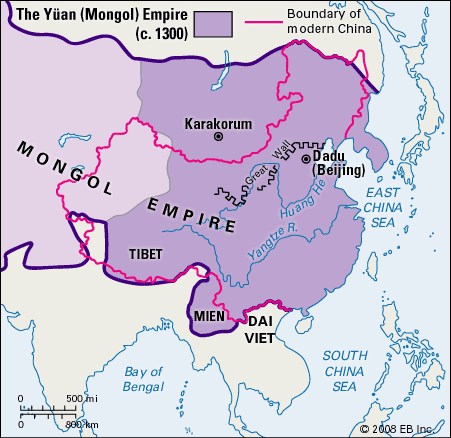
Ironically, the Mongols (Yuan Dynasty 1277 – 1367) conquered China using the weapons that the Chinese had invented.

Return to the Chinese Crossbow and other Inventions Part 3 or start with Part 1

______________

Lloyd Lofthouse is the award-winning author of The Concubine Saga. When you love a Chinese woman, you marry her family and culture too. This is the love story Sir Robert Hart did not want the world to discover.

To subscribe to “iLook China”, look for the “Subscribe” button at the top of the screen in the menu bar, click on it then follow directions.


Chinese Crossbow and other Inventions (3/4)

August 1, 2010

The first firearm was invented in China about one thousand years ago. It was made of bamboo, fired pebbles and had a range of about thirty yards.

Bamboo is strong, flexible and hollow in the center. It was perfect for the first crude gunpowder weapons.  Over time, bamboo was replaced with bronze, and the pebbles became cast-iron chips or pellets. In fact, the first bronze handgun dates to 12th century AD. It was about a foot long and weighed eight pounds.

From these early weapons came cannons.  Long before the rest of the world knew anything about heavy artillery, the Chinese were making strong, mobile cannons from bronze. Since the Chinese already had repeating crossbows, the next step was repeating cannons along with exploding artillery shells.

During the Ming Dynasty, in the 14th century, the Great Wall was equipped with more than 3,000 cannons. In Europe, the first cannons were still being developed. The Chinese also invented the hand grenade about a thousand years ago along with grenade launchers—the bow powered grenade.

A computer analysis demonstrated that China’s largest cannons could fire more than a third of a mile.  It would take centuries before Europeans could match the weaponry of China.

Go to  hinese Crossbow and Other Inventions – Part 4 or return to the Chinese Crossbow and other Inventions Part 2

______________

Lloyd Lofthouse is the award-winning author of The Concubine Saga. When you ove a Chinese woman, you marry her family and culture too. This is the love tory Sir Robert Hart did not want the world to discover.

To subscribe to “iLook China”, look for the “Subscribe” button at the top of the screen in the menu bar, click on it then follow directions.


The White Lotus Mutation

April 24, 2010

Persecution of the White Lotus Society started during the Yuan Dynasty (Mongols 1271 – 1368). Due to this, the White Lotus Society changed from one of peace and tranquility and organized protests against the Mongol rulers, the first non-Han to rule China.

Since Yuan Imperial authorities distrusted the White Lotus Society, the Dynasty banned them, and the White Lotus went underground.  The White Lotus also started to predict that a messianic (Christ like) figure would come and save them from persecution.

White Lotus Rebellion

A White Lotus led revolution started in 1352 around Guangzhou. A Buddhist monk, Zhu Yuanzhang, joined the rebellion. Soon, he became the leader by forbidding his soldiers to pillage, in observance of White Lotus religious beliefs.

By 1355, the rebellion had spread through much of China. In 1356, Zhu Yuanzhang captured Nanjing and made it his capital. Then Confucian scholars issued pronouncements supporting Zhu’s claim of the Mandate of Heaven, the first step toward establishing a new dynasty.

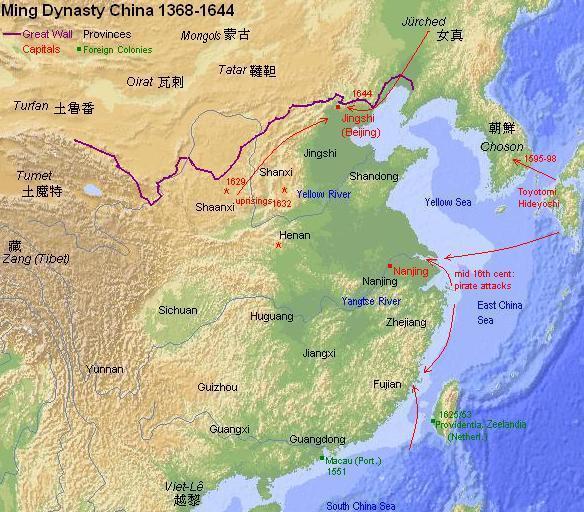
Zhu Yuanzhang liberated China from the Mongols and became the founding Emperor of the Ming Dynasty (1368 – 1643).  

At this point, you may see the danger of allowing a religious cult like the White Lotus to have any power.

Sign up for an RSS Feed for  iLook China


Tibet Inside China – Part 3/5

April 12, 2010

The most damaging evidence against Rinpoche’s claims come from the October 1912 issue of The National Geographic Magazine (I have a copy—it cost me $20 on e-bay). Since the earliest evidence of Communists in China was about 1920, and it wasn’t until 1949 that the Communists came to power under Mao, there is no way the Chinese doctor who wrote that 1912 piece could have lied for the Communists.

Ming Dynasty 1368-1643

On page 979, Dr. Shaoching H. Chuan wrote, “Tibet is governed by the Dalai Lama as politco-religous head and two “Ambans” as the political dictators. The Ambans are appointed by the Chinese Emperor every four years. All governmental affairs have to undergo examination by the two Ambans, and all government policy must be sanctioned by them before it can be put into operation. Literally, the Dalai Lama is under the authority of the two Ambans…” (Page 979)

Go to Tibet Inside China – Part 4

View as Single Page

_______________

Lloyd Lofthouse is the award-winning author of My Splendid Concubine [3rd edition]. When you love a Chinese woman, you marry her family and culture too. This is the love story Sir Robert Hart did not want the world to discover.

Subscribe to “iLook China”!
Sign up for an E-mail Subscription at the top of this page, or click on the “Following” tab in the WordPress toolbar at the top of the screen.

About iLook China


Tibet Inside China – 1/5

April 11, 2010

In 2008, I wrote a post about Tibet on another forum. Someone with a Tibetan sounding name left a comment in crude English calling me a “Communist rabbit”.

Name-calling seems to be popular these days. In America, people like Glenn Beck (FOX network), Rush Limbaugh (600 radio stations) and the Tea Baggers have developed name-calling into an art form—not much substance but colorful and angry.

The Tibetan government in exile’s Prime Minister Samdhong Rinpoche was quoted in “Good” magazine’s May/June 2008 Issue that six-million Tibetan Buddhists still lived in Tibet. He also said that Tibet has never historically been part of China. That isn’t true. Tibet was ruled by three of China’s Imperial Dynasties.

Yuan (Mongol) Dynasty 1277 – 1367

Tibet was first ruled by China during the Yuan Dynasty (1277-1367). Then, when the Ming Dynasty (1368-1643) reclaimed China, a Ming Imperial army was sent to Tibet to drive out the last of the Mongols–holdovers from the Yuan Dynasty. The Ming emperor ordered his army to stay.

When the Ch’ing (Manchu) Dynasty (1644-1911) came to power, the Chinese empire expanded further and Tibet remained in China. Later, I’ll provide evidence from a 1912 National Geographic magazine as proof.

Discover Wearing China’s Shoes or go to Tibet Inside China – Part 2

View as Single Page

_______________

Lloyd Lofthouse is the award-winning author of My Splendid Concubine [3rd edition]. When you love a Chinese woman, you marry her family and culture too. This is the love story Sir Robert Hart did not want the world to discover.

Subscribe to “iLook China”!
Sign up for an E-mail Subscription at the top of this page, or click on the “Following” tab in the WordPress toolbar at the top of the screen.

About iLook China