Beware of Biased Rumors Masquerading as Truth

June 16, 2011

A Music Blog Post written by Caryn Ganz (posted May 13, 2011) reveals how often the Western media plays into the hand of rumors and misinformation. Bias has much to do with that as you may discover.

A 2010 Pew Global Attitudes Project revealed that unfavorable views of China in the West are legion.  The question Pew asked was, “Please tell me if you have a very favorable, somewhat favorable, somewhat unfavorable or very unfavorable opinion of China.”

The response—sixty-one percent (50 million) of those that responded in Germany had an unfavorable opinion of China; France 59% (39 million); Turkey 61% (45 million); Spain 38% (17.5 million); United States 36% (112 million), and Britain 35% (22 million).  More than 285 million minds and mouths may have a negative opinion of China. To see the entire list (for other countries), click the link for the Pew Project.


Mao died in 1976 and the Communist Party guided by Deng Xiaoping repudiated Revolutionary Maoism. When anyone mentions Mao, they are talking of history—not today.

Just to make clear what an “opinion” means, here are a few definitions: judgment or belief not founded on certainty or proof; the prevailing or popular feeling or view (public opinion); an opinion formed by judging something

Just because people believe something that does not mean it is a fact.

With this in mind, consider that many of those people that have unfavorable opinions of China are publishers, editors and reporters working in the Western Media spreading rumors and misinformation in what they write and report.

For example the media rumor mill reported Bob Dylan was refused permission to perform in China.

In fact, Western newspapers and magazines made all kinds of incorrect claims that Bob Dylan played to half-empty audiences, and the Chinese government censored what he would play when he performed in China

Bob Dylan was not pleased. In fact, Bob Dylan wrote on his Website, “Allow me to clarify a couple of things about this so-called China controversy which has been going on for over a year. First of all, we were never denied permission to play in China….”

Dylan said, “According to Mojo magazine, the concerts were attended mostly by ex-pats and there were a lot of empty seats. Not true. If anybody wants to check with any of the concertgoers they will see that it was mostly Chinese young people that came.… Out of 13,000 seats we sold about 12,000 of them, and the rest of the tickets were given away to orphanages.”

“As far as censorship goes, the Chinese government had asked for the names of the songs that I would be playing…. If there were any songs, verses or lines censored, nobody ever told me about it and we played all the songs that we intended to play.”

If you are interested in everything Bob Dylan said, I suggest you visit his Website (the link above).

For those readers with open minds, if we are to learn anything from this,
“It is to take with a grain of salt everything you hear or read in the World about China.”  Most of it will be opinions written as fact based on bias, which shows us that Yellow Journalism  is alive and well in freedom land proving that in the West we have the freedom to lie and pretend it is the truth.

To discover the possible truth about other opinions of China, learn from What is the Truth about Tiananmen Square? and/or 2/28 Massacre in Taiwan

______________

Lloyd Lofthouse is the award-winning author of the concubine saga, My Splendid Concubine & Our Hart. When you love a Chinese woman, you marry her family and culture too.

To subscribe to “iLook China”, look for the “Subscribe” button at the top of the screen in the menu bar, click on it then follow directions.


The Founding of China’s Republic – a Movie Review

May 4, 2011

The Founding of a Republic was produced to coincide with the 60th anniversary (in 2009) of the Chinese Communist Party (CCP) winning the Civil War in October 1949. I first saw this movie March 2011.

The film has the largest number of Chinese movie stars in one movie. Many of the top stars were invited to star as leads, supporting characters, or to appear in cameos, such as internationally well known Jackie Chan and Jet Li, whom appear briefly in the film.

The film covers the period between 1946 and October 1949 — well before the infamous failed Great Leap Forward (1958-1962) and the Cultural Revolution (1966-1976), which are the events most people in the West identify with Mao.

There is seldom any mention in the West of how Mao won the hearts and minds of the hundreds of millions of Chinese that supported the CCP, while distrusting and spurning the Nationalist Kuomintang (KMT). This film (regardless of any propaganda that may exist) provides a glimpse of how Mao accomplished this feat.

The mild dose of propaganda that does appear in the film is nothing compared to the propagandized, anti-bourgeois PRC movies of the early 1950s or 60s.

It was because of how Mao won the Civil War (1926 to 1949 with a pause during a portion of World War II) that despite the deep collective scars left by the catastrophes of the Great Leap Forward and the Cultural Revolution, that he retains a strong measure of popular affection in China to this day.

In fact, many born in China prior to the 1980s still consider Mao to be China’s George Washington.

Directors Huang Jianxin and Han Sanping provide glimpses into the key moments during the final stages of the Chinese Civil War and the film was not just glorified propaganda since the Communists are given only one third of the screen time.

More time was given to people like Zhang Lan and Li Jishen, and key members of the China Democratic League. Until I watched this film, I only knew of the KMT and the CCP. I didn’t know there were other Chinese political parties involved.

In addition, Chiang Kai-shek and his son Chiang Ching-Kuo, who later guided Taiwan’s government to become a multi-party democracy (the first direct presidential election was held in 1996 eight years after Ching-Kuo’s death), are not demonized but are played as characters trapped between their responsibilities towards their country and pleasing political factions in the KMT.

The film suggests that the KMT lost because of the political agendas of these factions within the KMT, and not because of the power of the Communists, which was unexpected in a pro-Communist film.

After all, in war there are few if any saints and politics are more complex than most people ever know.

I urge everyone interested in modern Chinese history to see this film especially students in Chinese history classes and/or those majoring in East Asian studies. People that cannot understand Mandarin will be pleased that the movie has English subtitles.

______________

Lloyd Lofthouse is the award-winning author of the concubine saga, My Splendid Concubine & Our Hart. When you love a Chinese woman, you marry her family and culture too.

If you want to subscribe to iLook China, there is a “Subscribe” button at the top of the screen in the menu bar.


Yuan Shikai — the general who became China’s second president then emperor

December 28, 2010

For thousands of years, the history of China has been defined by wars, rebellion, power struggles and famine, which explains why today’s central government worries about famine and allowing dissidents a voice.

Between 1911 and 1976, three men were responsible for much of the devastation and death that swept over China causing tens of millions of deaths — Yuan Shikai, Chiang Kai-shek and Mao Tse-tung.

In 1911 when the Qing Dynasty fell, Yuan Shikai was a general and commander of the most modern military force in Imperial China. He kept his position by supporting the revolutionaries that brought down the Qing Dynasty.

After the Qing Dynasty fell, rebellion spread through the Yangtze River Valley before revolutionaries from fourteen provinces elected Sun Yat-sen president of a provisional (temporary) government and in January 1912, Sun announced the establishment of the Republic of China.

However, generals controlled China’s provinces and refused to give up power. China’s young republic was essentially the capital city of Nanjing.

On March 20, 1913, Yuan Shikai’s agents assassinated Sung Chiao-jen, who helped Sun Yat-sen become the first president. Sun demanded that those responsible be brought to justice.

Yuan Shikai resisted, sparking a “so-called” second revolution and on September 15, 1913, he ordered Sun Yat-sen’s arrest. To survive, Sun fled to Japan as a political refugee. He wouldn’t return to China until a few months after Yuan Shikai’s death.

Yuan Shikai, supported financially by the British Empire, became China’s second president, but after 1914, World War I caused a reduction in Britain’s financial support.

Weakened, Yuan Shaikai was forced to accept twenty-one demands made by Japan, which included giving up Chinese territory. He agreed on May 7, 1916, which is now considered National Humiliation Day.

Yuan Shaikai was unable to establish control beyond Nanking so he declared himself emperor. His attempt to replace the republic with a monarchy and him as emperor touched off revolts in southwestern China followed by uprisings of Sun Yat-sen’s followers in several other provinces.

This resulted in twelve years of warfare between the warlord generals of China’s provinces and the weak Republic of China.

Yuan Shikai died in 1916, then Sun Yat-sen returned to lead the republic. Sun Yat-sen died in 1925, which caused the Civil War between the Chinese Communist Party and Chiang Kai-shek’s Nationalists.

Discover more from The Roots of Madness

______________

Lloyd Lofthouse is the award-winning author of the concubine saga, My Splendid Concubine & Our Hart. When you love a Chinese woman, you marry her family and culture too.

If you want to subscribe to iLook China, there is a “Subscribe” button at the top of the screen in the menu bar.


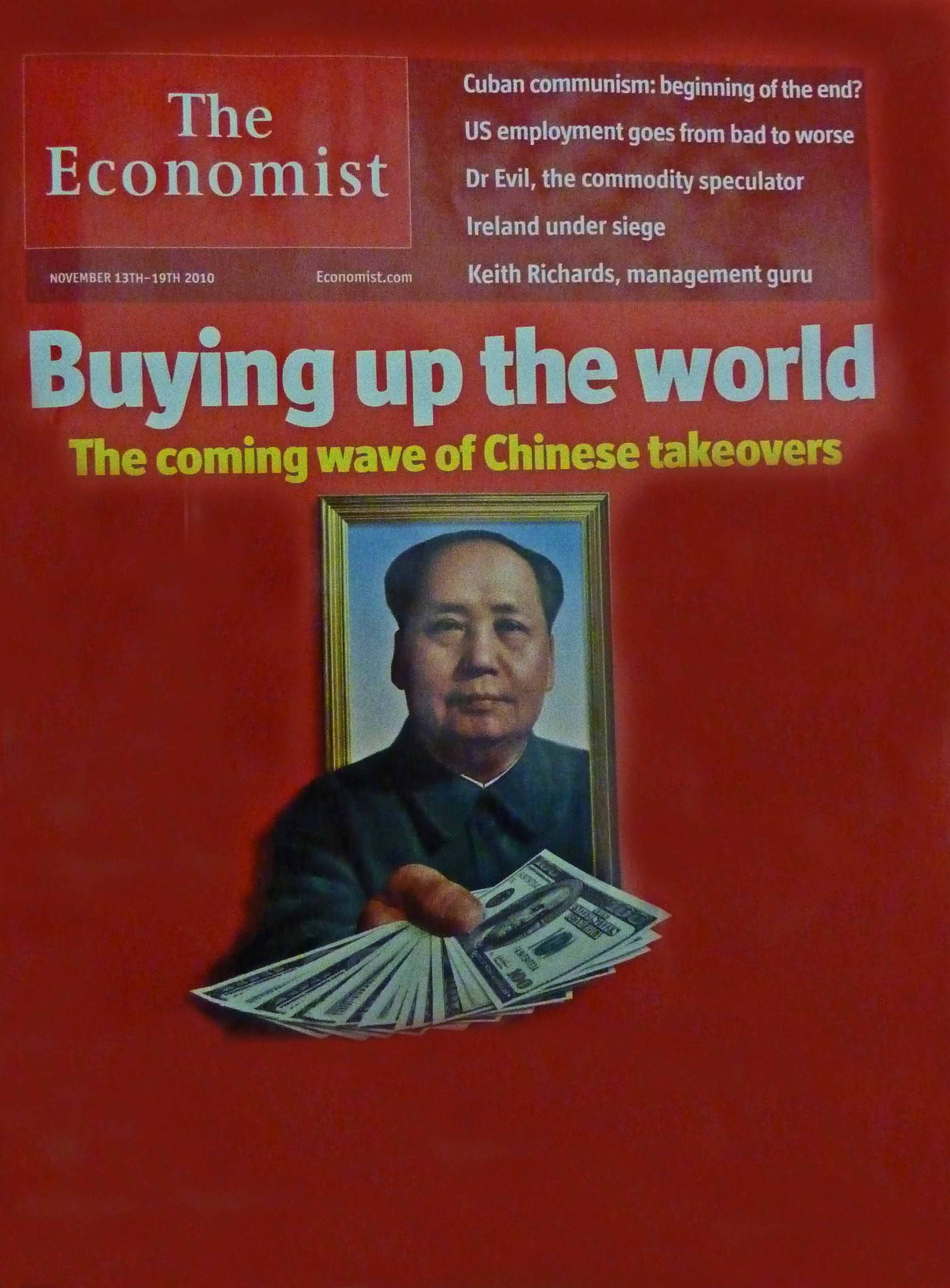
The Fear of Mao Buying the World

November 22, 2010

The cover of The Economist’s November 13 issue plays on fear to sell magazines.

I haven’t read Buying up the world, The coming wave of Chinese takeovers yet, which is the feature piece. I’ll probably write another post about that once I do.

Instead, I’m writing about the magazine’s cover, which is taking advantage of the West’s PTCSD (Post Traumatic Chinese Stress Disorder) that has roots in the “history” of a fear of the word “Communist”, the Korean Conflict and the Cultural Revolution.

I’m sure most Sinophobes that see this cover will have flashbacks of the People’s Liberation Army (PLA) and the rest of China dressed in drab Mao jackets marching across the world to take possession of everything China buys.

However, Mao isn’t the proper man to adorn The Economist’s cover.

Deng Xiaoping or one of China’s recent presidents (there have been four since the 1982 Constitution) would have been more appropriate.

Why? Because after Mao died in 1976, Deng Xiaoping and his allies rejected Maoist Revolutionary thought and embraced CAPITALISM in a very big way.

In fact, surviving Maoists consider the Party that rules China today to be traitors to Mao and the revolution.

Do you remember the 1980s, when wealthy Japanese spent billions buying property in America then a real estate bubble burst, Japan lost a lot of money, and its economy has been limping since?

If anyone should be afraid, it should be the Chinese fearing spending habits in the US, Canada and Europe where debt and plastic rule.

______________

Lloyd Lofthouse is the award-winning author of the concubine saga, My Splendid Concubine & Our Hart. When you love a Chinese woman, you marry her family and culture too.

To subscribe to iLook China, look for the “Subscribe” button at the top of the screen in the menu bar, click on it then follow directions


Different Results for Different Propaganda Campaigns

September 20, 2010

The concept for this post came from an exchange of ideas with A Modern Lei Feng.

On January 20, 1961, President John F. Kennedy said, “And so, my fellow Americans, ask not what your country can do for you; ask what you can do for your country.”

Then in March of that year, President Kennedy signed an executive order that authorized the Peace Corp Act, which resulted in some controversy. (A Peace Corps History)

If history is any sign, many of the laws passed after Kennedy’s premature death did the opposite. Instead of Americans helping the country, the country ended up helping Americans.

LBJ’s Great Society program to aid urban renewal and a wide-scale fight against poverty turned millions into wards of the government and added billions to America’s current deficit. (two views of LBJ’s programs may be found at Free Republic.com and a New York Times Opinion Piece)

Then in 1963, a public relations campaign – similar to what Kennedy called for in his 1961 speech – was launched in China.

It was called the “Learn from Comrade Lei Feng” campaign.

Lei became the symbol of nationwide propaganda; the youth of the country were encouraged to follow his example. Source: Wikipedia.org

In essence, the campaign to learn from Lei Feng was to read Chairman Mao’s books, obey Chairman Mao’s words, and be Chairman Mao’s good soldier.

Maybe Mao borrowed the idea from Kennedy.

See China’s Great Leap Forward

______________

Lloyd Lofthouse is the award-winning author of the concubine saga, My Splendid Concubine & Our Hart. When you love a Chinese woman, you marry her family and culture too. 

If you want to subscribe to iLook China, there is a “Subscribe” button at the top of the screen in the menu bar.