The India, China battle to eliminate poverty and illiteracy

November 2, 2010

Chris Devonshire-Ellis wrote a convincing piece at China Briefing that India‘s economic growth would speed past China in the near future. 

He says, “It (India’s) growth rate could overtake China’s by 2013… Some economists think India will grow faster than any other large country over the next 25 years.”

However, there are flaws in that opinion.

Once again, the foundation of this prediction is based on India being a democracy “where entrepreneurs are all furiously doing their own thing” while China is a culture of secrecy and censorship. Chris mentions a few of China’s other flaws too, which China is struggling to overcome.

What Chris doesn’t mention is the difference in poverty and illiteracy between India and China.

India and China both became independent about the same time—China in 1949 and India in 1947.  Due to Chairman Mao’s policies, China suffered horribly from 1949 to 1976 and little progress was made.

For China, most of the progress has taken place in the last three decades. India, on the other hand, has had more than 60 years to solve its problems.

Let’s see what each has accomplished.

The World Bank says, “that China’s record of poverty reduction and growth is enviable. Between 1981 and 2004 the fraction of the population consuming less than a dollar-a-day fell from 65% to 10% and more than half a billion people were lifted out of poverty.”

For India, the World Bank says, “poverty remains a major challenge. According to the revised official poverty line, 37.2% of the population (about 410 million people remains poor, making India home to one-third of the World’s poor people.” UNICEF shows the poverty in India to be 42%.

World Bank studies also established the direct and functional relationship between literacy and productivity on the one hand and literacy and the overall quality of human life on the other.

India’s literacy rate was about 12% when the British left in 1947. Today, literacy is 68%.

In China, literacy is more than 93% with a goal to reach 99% in the next few years.

This means that India has about 800 million literate people competing with 1.2 billion in China.

As for India succeeding, MeriNews.com says, “At a time when we (India) are poised on the threshold of becoming a superpower, the rampant malnutrition and prevalence of anemic children and women to the extent of 48 per cent of the population is a definitive indicator that we have failed as a democracy in ensuring the fundamental requirements of our citizens.”

It appears that China—with its censorship, secrecy and socialist government—has done a much better job of taking care of its citizens.

See the other posts on this topic at India Falling Short and Comparing India and China’s Economic Engines

______________

Lloyd Lofthouse is the award-winning author of the concubine saga, My Splendid Concubine & Our Hart. When you love a Chinese woman, you marry her family and culture too. 

If you want to subscribe to iLook China, there is a “Subscribe” button at the top of the screen in the menu bar.


Maoism Alive

October 27, 2010

Caution—do not confuse Maoists with the Communist Party that currently rules China.

The Maoists in China want a return to the Cultural Revolution and pure socialism with no capitalism. Chinese Maoists consider the current leaders as traitors.

After the death of Mao Zedong in 1976, the Communist Party under Deng Xiaoping repudiated revolutionary Maoism and embarked on the path toward a socialist-capitalist economic model that has led to the prosperity in China today.

However, Maoism did not vanish. The Revolutionary Internationalist Movement (RIM) was founded in 1984 and included the Communist Party of Peru (also known as the “Shining Path”).

Recently, the Chinese “Maoist” Communist Party thought they had a leader in Bo Xilai because of the crackdown on crime in Chongqing until Bo had thirty members of the Maoist Party arrested and locked up.  Source: Serve the People


China’s last Maoist village

Then there is the Maoist Communist Party of Nepal that formed a coalition government in Nepal in 2009, which collapsed a few months later as different rebel factions fought with each other. The Maoist’s goal was to turn Nepal into a Marxist Republic. Source: Nepal Assessment 2010

In India, there is an ongoing Naxalite-Maoist rebellion against the democratic government.

The Maoist influence in India comes from the lack of progress to end starvation among rural Indians, who have had no improvement in their lifestyles for decades. See: Naxalite-Maoist insurgency

In the US, the Black Panthers (1967) were a militant Maoist organization. In Paris in 1968, the National Liberation Front, another Maoist group, caused street combat.

Maoism, known as Mao Zedong thought, is a variant of Marxism derived from the teachings of the late Chinese leader Mao Zedong. 

Maoism was widely applied as the political and military guiding ideology in the Communist Party between 1949 and 1976, which led to the horrors of the Cultural Revolution.

______________

Lloyd Lofthouse is the award-winning author of the concubine saga, My Splendid Concubine & Our Hart. When you love a Chinese woman, you marry her family and culture too. 

If you want to subscribe to iLook China, there is a “Subscribe” button at the top of the screen in the menu bar.


Two Republics – Part 4/4

September 24, 2010

Mao Zedong ruled China from 1949 to 1976 when he died.  For a brief period between the Great Leap Forward and the Cultural Revolution, Mao was forced to retire.  However, when he launched the Cultural Revolution, the people of China returned Mao to power.

Today, China has a one party system and there is a “small” body of citizens entitled to vote for the top leaders who then rule China. 

China has a Constitution but the language of that Constitution is different from the Constitution of the United States and that Constitution is still being Amended as in the U.S.

China does not have a monarch or a hereditary head of state. The fact that China has both term and  an age limit for holding political positions in the government is proof that China is not a dictatorship, which is a popular opinion held around the world.

Under Mao, who ruled for 27 years and who was known by some as “China’s Modern Emperor”, it would be safe to say a dictator ruled China.

Many may not agree with China’s legal system or laws, but that legal system and those laws were written and adopted by the elected representatives who rule China – not by a dictator or a monarch and they are still subject to change through future amendments as is the United States.

The United States and China are both Republics, and the evidence suggests that China is modeling their Republic after America, but  with a Constitution to fit Chinese culture as the elected leaders of China interpret the document that is China’s law of the land.

Dr. Sun Yat-Sen – China’s Democratic Revolutionary wrote that he wanted to model China’s government after America but by combining Western thought with Chinese tradition.

It appears that is exactly what is happening.

If America had more than two centuries to amend the U.S. Constitution, what will China’s Constitution look like one-hundred-and-seventy-two years from now?

What if China is the real republic transitioning from a socialist state while the US was becoming a socialist democracy.

Return to Two Republics – Part 3

______________

Lloyd Lofthouse is the award-winning author of the concubine saga, My Splendid Concubine & Our Hart. When you love a Chinese woman, you marry her family and culture too.

If you want to subscribe to iLook China, there is a “Subscribe” button at the top of the screen in the menu bar.


China Takes its Future Seriously

August 12, 2010

In China, little is left to chance and the central government takes its job so seriously, many in the West believe the leaders of China are totalitarians and brutal dictators.  In fact, China’s leaders are acting as the collective culture dictates. 

Those in China who speak out against the government are considered aberrations and few have sympathy when they are punished. Confucianism and piety demand that citizens do not publicly challenge the government but, in turn, the government has an obligation to the people to insure a secure and bountiful future. 

Fail in that and the Communists will lose the mandate to rule.

The most critical obligation is water. China has two of the world’s longest rivers—the Yellow and the Yangtze.  However, there is still not enough water in the north.

To solve that challenge, China is building both above and underground pipelines from the south to the north to move water from the Yangtze and the Danjiangkou reservoir in Hubei province.

The most difficult task will be tunneling under earthquake prone mountains as high as five kilometers above sea level.

The South-to-North Water diversion Project in China with an estimated cost of 70 billion dollars is the largest of its kind ever undertaken. Mao Zedong first proposed the project in 1952, and it took 50 years to plan before construction started with completion set for 2050. 

When done, China will divert almost 45 billion cubic meters of water annually to the drier north. Source: Water Technology.net

See the Shanghai Huangpu River Tour

_______________

Lloyd Lofthouse is the award-winning author of the concubine saga, My Splendid Concubine & Our Hart. When you love a Chinese woman, you marry her family and culture too. 

Sign up for an RSS Feed for iLook China


Confucius with Chow Yun Fat

August 6, 2010

When my wife and daughter made their annual summer pilgrimage to China, I asked them to bring back a DVD of the new Confucius with Chow Yun Fat. Unfortunately, the copy they brought would not play on any of the American DVD players we have at home. The world is divided into regions and each region has its own DVDs that won’t play in other regions.

Determined, I resorted to e-bay to find a DVD for the US and Canada.  It cost me about $10 plus postage. The above link will take you to Amazon where you may order one.

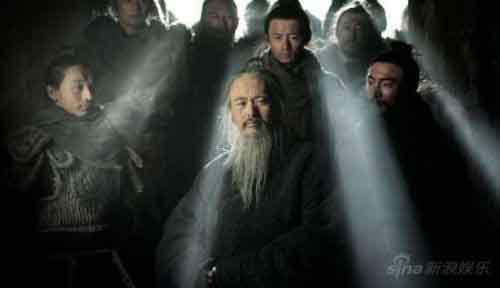
The movie’s visuals are stunning and Chow Yun Fat does an incredibly convincing job of playing Confucius, who, no matter how much he was abused by the rulers of his homeland, he still honored them.

If you don’t speak Mandarin and must rely on the English subtitles, be warned that most of the subtitles are mangled and do not stay on screen long enough.  The challenge is to read the subtitle while keeping an eye on the stunning visuals.

This movie is an epic equal to Cleopatra, Moses and Spartacus.  However, if you expect a potboiler, you won’t get one most of the time. Yet, the battle scenes were amazing no matter how brief they were.

It’s obvious that this movie was filmed for a Chinese/Asian audience and their tastes are not as shallow as what most Americans prefer. I’m sure the Chinese didn’t want to ruin the movie by letting Hollywood get hold of it.

Confucius with his students

The DVD I bought and watched had a photo of Confucius with a beautiful woman on the cover. They must have added her to the cover for that Hollywood sexy touch to appeal to an American audience. In the movie, she plays a minor role and is assassinated for wanting power in a violent world dominated by men busy killing each other.

From what I know of Confucius, the movie showed him close to who he must have been—an honorable man wanting to bring peace to a war-torn land and end the people’s suffering.  He spends more than a decade homeless wondering the land in search of someone who will listen besides the rag-tag band of students who stuck to him like glue.

If anything, we could learn something about dedication and loyalty from this band and their master.

At the bottom of the DVD box, it says, “His teachings were banned under Mao Zedong, who oversaw the destruction of his family home during the Cultural Revolution.”

Ironic, considering that Mao stayed in power his last decade because of what Confucius taught the Chinese about piety.

Discover more about The Life of Confucius

______________

Lloyd Lofthouse is the award-winning author of The Concubine Saga. When you love a Chinese woman, you marry her family and culture too. This is the love story Sir Robert Hart did not want the world to discover.

To subscribe to “iLook China”, look for the “Subscribe” button at the top of the screen in the menu bar, click on it then follow directions.